Effectiveness of Cognitive-Analytical Therapy on Alexithymia and Interpersonal Problems in Patients with Functional Dyspepsia
DOI:
https://doi.org/10.61838/kman.hn.2.1.16Keywords:
Cognitive-Analytical Therapy, Functional Dyspepsia, Interpersonal Problems, AlexithymiaAbstract
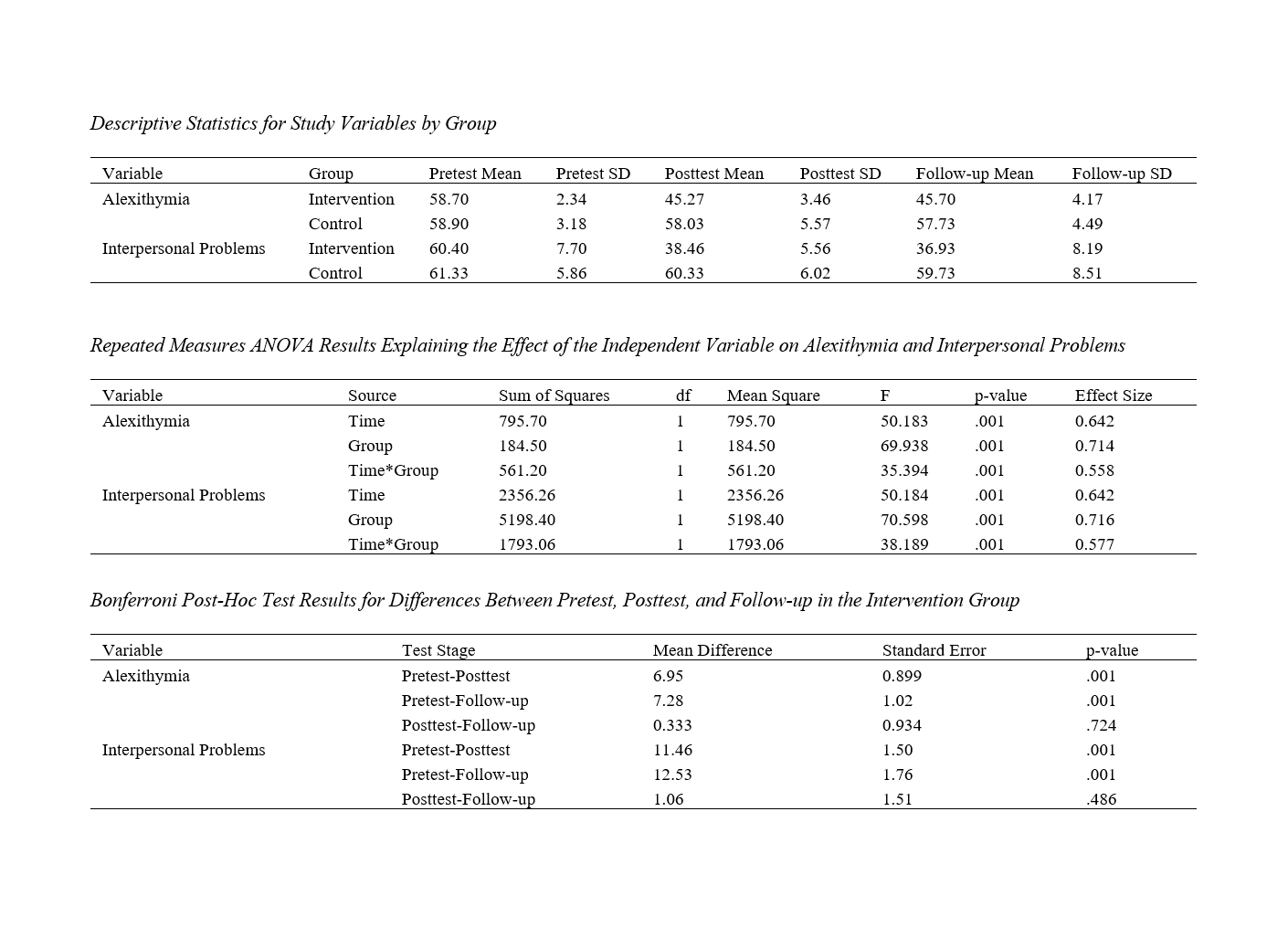
Cognitive-Analytical Therapy (CAT) appears to be a suitable approach for intervening in the improvement of interpersonal problems in individuals with psychosomatic disorders. The present study aimed to determine the effectiveness of Cognitive-Analytical Therapy on alexithymia and interpersonal problems in patients with functional dyspepsia. The present study employed a quasi-experimental method with a pretest, posttest, and follow-up design, along with a control group. The statistical population consisted of patients with functional dyspepsia who visited the gastroenterology clinic of Shariati Hospital in Tehran in 2021, from which 30 eligible volunteers were selected through convenience sampling and randomly assigned to two groups: the "Cognitive-Analytical Therapy" group and a control group. Research tools included a demographic questionnaire, the Toronto Alexithymia Scale and the Inventory of Interpersonal Problems-32. The content validity of the tools was measured qualitatively, and their reliability was assessed using internal consistency by calculating Cronbach’s alpha. After conducting 16 therapeutic sessions for the intervention group, the data were collected and analyzed using SPSS software version 26. In the present study, there was a significant difference between the pretest, posttest, and follow-up scores for both variables (P = .001). There was also a significant difference between the intervention and control groups for both alexithymia (P = .001, F = 69.938) and interpersonal problems (P = .001, F = 70.598). The results indicated that Cognitive-Analytical Therapy is effective in reducing alexithymia and interpersonal problems in patients with functional dyspepsia. It is recommended that, in addition to medical treatments, psychotherapy interventions such as "Cognitive-Analytical Therapy" be provided for patients with functional dyspepsia.
Downloads
References
1. Amiri Seifaddini Kouhbanani F, Saber S. Comparison of life anxiety and the meaning of life between asthmatic and diabetic patients. Health Research Journal. 2019;4(19):120-8. [DOI]
2. Akbarali HI, Murthy KS. 5.01 - Gastrointestinal System – Overview. In: Kenakin T, editor. Comprehensive Pharmacology. Oxford: Elsevier; 2022. p. 1[DOI]
3. Ford AC, Mahadeva S, Carbone MF, Lacy BE, Talley NJ. Functional dyspepsia. Lancet. 2020;396(10263):1689-702. [DOI]
4. Mahmoudi F, Maddahi M, Poursharifi H, Meschi F. Comparison of the effectiveness of acceptance and commitment group therapy and cognitive-behavioral group therapy on quality of life, anxiety and depression in patients with functional indigestion. Journal of Health Promotion Management. 2019;8(4):43-52.
5. Abdollahi A, Vadivel B, Huy DTN, Opulencia MJC, Van Tuan P, Abbood AAA, et al. Psychometric assessment of the Persian translation of the Interpersonal Mindfulness Scale with undergraduate students. Frontiers in Psychiatry. 2022;13(8):1-8. [DOI]
6. Shokrolahi M, Hashemi SE, Mehrabizadeh Honarmand M, Zargar Y, Naaimi A. Comparison of the effectiveness of Emotion Focused Therapy (EFT) and Cognitive Analytic Therapy (CAT) on anxiety sensitivity, pain catastrophizing, experiential avoidance and cognitive emotion regulation in patients with chronic pain and alexithymia. Journal of Research in Behavioural Sciences. 2022;19(4):739-52. [DOI]
7. van der Velde J, Servaas MN, Goerlich KS, Bruggeman R, Horton P, Costafreda SG, et al. Neural correlates of alexithymia: a meta-analysis of emotion processing studies. Neurosci Biobehav Rev. 2013;37(8):1774-85. [DOI]
8. Taylor GJ, Bagby RM, Kushner SC, Benoit D, Atkinson L. Alexithymia and adult attachment representations: associations with the five-factor model of personality and perceived relationship adjustment. Compr Psychiatry. 2014;55(5):1258-68. [DOI]
9. Fang S, Chung MC. The impact of past trauma on psychological distress among Chinese students: The roles of cognitive distortion and alexithymia. Psychiatry Research. 2019;271:136-43. [DOI]
10. Sharifnejad A, Sodagar Sh, Seirafi MR, Afzalaghaie M. Mediating role of stress, anxiety, and depression in relation between alexithymia, and functional dyspepsia. Journal of Research in Behavioural Sciences. 2018;16(2):206-13. [DOI]
11. Hogeveen J, Grafman J. Chapter 3 - Alexithymia. In: Heilman KM, Nadeau SE, editors. Handbook of Clinical Neurology. 183: Elsevier; 2021. p. 47-62[DOI]
12. Darrow SM, Follette WC. A behavior analytic interpretation of alexithymia. Journal of Contextual Behavioral Science. 2014;3(2):98-108. [PMCID: PMC4248666] [DOI]
13. Aftab R. Mediating role of interpersonal problems in the relationship between experiential avoidance with depression and anxiety. Journal of Applied Psychology. 2016;10(40):523-42.
14. Faramarzi M, Kheirkhah F, Shokri-Shirvani J, Mosavi S, Zarini S. Psychological factors in patients with peptic ulcerand functional dyspepsia. Caspian Journal of Internal Medicine. 2014;5(2):71-6. [PMCID: PMC3992231]
15. Ko S-J, Park J-W, Leem J, Kaptchuk TJ, Napadow V, Kuo B, et al. Influence of the patient-practitioner interaction context on acupuncture outcomes in functional dyspepsia: study protocol for a multicenter randomized controlled trial. BMC Complementary and Alternative Medicine. 2017;17(1-10):363. [DOI]
16. Sayuk GS, Gyawali CP. Functional dyspepsia: Diagnostic and therapeutic approaches. Drugs. 2020;80(13):1319-36. [DOI]
17. Hepple J. Cognitive-Analytic Therapy in a group: Reflections on a dialogic approach. British Journal of Psychotherapy. 2012;28(4):474-95. [DOI]
18. Ryle A, Kerr IB. Introducing Cognitive Analytic Therapy: Principles and Practice of a Relational Approach to Mental Health. 2nd ed. New York, United States: Wiley; 2020.
19. McCutcheon LK, Kerr IB, Chanen AM. Chapter 6 - Cognitive Analytic Therapy: A Relational Approach to Young People With Severe Personality Disorder. In: Kramer U, editor. Case Formulation for Personality Disorders: Academic Press; 2019. p. 95-111[DOI]
20. Hadizadeh MH, NavabineZhad S, Nooranipour R-o-a, Farzad V-o-a. The effectiveness of Cognitive Analytic Therapy on the self-efficacy and interpersonal problems of women with dependent personality disorder. Journal of counseling research. 2019;18(69):208-29. [DOI]
21. Gimeno E, Chiclana C. Cognitive Analytic Therapy: A bibliometric review. European Psychiatry. 2016;33(1):S233-S43. [DOI]
22. Wei Z, Xing X, Tantai X, Xiao C, Yang Q, Jiang X, et al. The effects of psychological interventions on symptoms and psychology of Functional Dyspepsia: A systematic review and meta-analysis. Frontiers in Psychology. 2022;13(1):1-10. [DOI]
23. Parker JDA, Taylor GJ, Bagby RM. The 20-Item Toronto Alexithymia Scale: III. Reliability and factorial validity in a community population. Journal of Psychosomatic Research. 2003;55(3):269-75. [DOI]
24. Arenliu A, Krasniqi B, Kelmendi K, Statovci S. Exploring factor validity of 20-item Toronto Alexithymia Scale (tas-20) in Albanian clinical and nonclinical samples. SAGE Journals. 2021;11(1):1-12. [DOI]
25. Besharat MA. Psychometric characteristics of Persian version of the Toronto Alexithymia Scale-20 in clinical and non-clinical samples. Iranian Journal of Medical Sciences. 2008;33(1):1-6.
26. Besharat MA. Assessing reliability and validity of the Farsi version of the Toronto Alexithymia Scale in a sample of substance-using patients. Psychological Reports. 2008;102(1):259-70. [DOI]
27. Barkham M, Hardy GE, Startup M. The IIP-32: a short version of the Inventory of Interpersonal Problems. British Journal of Clinical Psychology. 1996;35(1):21-35. [DOI]
28. Bailey C, Abate A, Sharp C, Venta A. Psychometric evaluation of the Inventory of Interpersonal Problems-32. Bulletin of the Menninger Clinic. 2018;82(2):93-113. [DOI]
29. Fath N, Azad Fallah P, Rasool-zadeh Tabatabaei SK, Rahimi C. Validity and reliability of the Inventory of Interpersonal Problems (IIP-32). Journal of Clinical Psychology. 2013;5(3):69-80. [DOI]
30. Kerr IB. Cognitive Analytic Therapy. Psychiatry. 2005;4(5):28-33. [DOI]
31. Simmonds-Buckley M, Osivwemu E-O, Kellett S, Taylor C. The acceptability of cognitive analytic therapy (CAT): Meta-analysis and benchmarking of treatment refusal and treatment dropout rates. Clinical Psychology Review. 2022;96(1):102187-97. [DOI]
32. Ryle A. Cognitive Analytic Therapy and borderline personality disorder: The model and the method. New York, United States: Wiley; 1997.
Downloads
Additional Files
Publication Timeline
License
Copyright (c) 2024 Maliheh Hashemi (Author); Saied Malihialzackerini (Corresponding Author); Mohammad Kazem Atef Vahid, Addis Kraskian Mujumbari, Alireza Delavari (Author)

This work is licensed under a Creative Commons Attribution-NonCommercial 4.0 International License.