Comparison of Effect of Pilates exercise and Vitex agnus intake on Premenstrual Syndrome in sedentary girls
DOI:
https://doi.org/10.61838/kman.hn.3432Abstract
Context: Premenstrual-syndrome (PMS) is one of the most common problems in women during their childbearing age. It has negative effects on their work performance and the quality of their lives. This study aimed to study Comparison of Effect of Pilates exercise and Vitex agnus intake on Premenstrual Syndrome in sedentary girls.
Materials and Methods: This quasi-experimental study was conducted on 60 sedentary adult girl students aged 18-25 at Isfahan University, with a diagnosis of PMS. The instruments included personal information and a medical questionnaire, a form of premenstrual symptoms DSM‑IV, the GHQ 28 questionnaire, and the Beck Depression and Anxiety questionnaire, and also, daily symptoms were recorded for 4 months. After collecting personal and medical information, the participants were allocated to two experimental groups (Pilates exercise and Vitex agnus) and a control group. Assessments were performed during the first-third menstrual periods (pre-test, mid-test, and post-test, respectively). One way and repeated measures analysis of variance (ANOVA) were used to analyze the data.
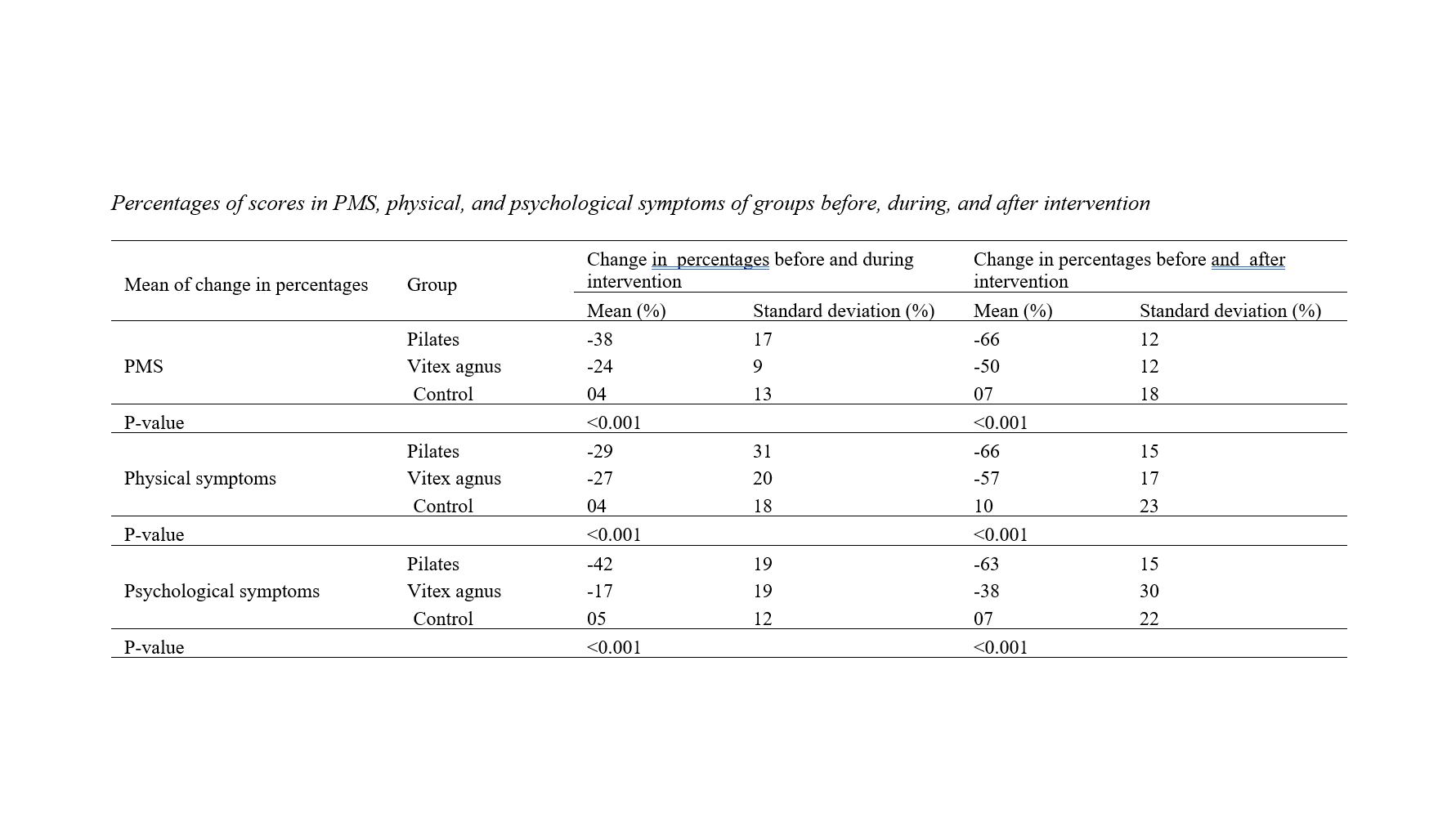
Results: Results showed that the mean scores of PMS and symptoms declined after 2 months of training in the experimental group. In both experimental groups, the mean scores of PMS and physical and psychological symptoms decreased after one and two months (P<0.001). Also, the results indicate that the mean score in decreasing physical, psychological symptoms and total score in Pilates was more than Vitex agnus and control group (P<0.001).
Conclusions: Overall, the findings showed that 2 months of Pilates exercise is effective in preventing the symptoms of PMS and can be used as a treatment.
Downloads
References
1. Dennerstein L, Lehert P, Heinemann K. Epidemiology of premenstrual symptoms and disorders. Menopause International. 2012;18(2):48-51. [PMID: 22611221] [DOI]
2. Ronald G, Karlan B, Hanoy A. Danforth’s obstetrics and gynecology: Lippincott Williams and Wilkins; 2008. 40-50 p.
3. Kyung R, Juyoung H, Margaret H, Hyojnung P. The effect of hand acupuncture therapy hand moxibustion therapy on Premenstrual-syndrome among Korean women. 2009.
4. Lustyk M, Gerrish W. Premenstrual Syndrome and Premenstrual Dysphoric Disorder: Issues of Quality of Life, Stress and Exercise. Handbook of Disease Burdens and Quality of Life Measures2010. p. 1951-75. [DOI]
5. Khajehei M, Abdali K, Tabatabaee H. Effect of treatment with dydrogesterone or calcium plus vitamin D on the severity of Premenstrual syndrome. 2009:473-9. [PMID: 19232611] [DOI]
6. Talaee A, Faiiazi M, Nasiri A. Investigate the epidemiology of premenstrual syndrome in students of Mashhad University of Medical Sciences. Journal of Mashhad Medical School. 2009:22-15.
7. Hekermor. Principles of the Disease of Women and Obstetrics and Gynaecology: Tehran: Symya Publishers; 2008. 85-90 p.
8. Petta C, Duarte Osis M, et al. Premenstrual syndrome as reported by Brazilian women. International Journal of Gynecology & Obstetrics. 2010;108(1):40-3. [PMID: 19892346] [DOI]
9. Fife R, Schrager S. ACP Handbook of Women's Health: ACP American College of Physicians Health; 2009. 441-60 p.
10. Daley A. Exercise and premenstrual symptomatology. Journal of Women's Health. 2009;18(6):895-9. [PMID: 19514832] [DOI]
11. Pinar G, Colak M, Oksuz E. Premenstrual Syndrome in Turkish college students and its effects on life quality. Sexual & Reproductive Healthcare. 2010.
12. Freeman EW. Therapeutic management of premenstrual syndrome. Journal of Expert Opinion on Pharmacotherapy. 2010;11(17):2879-89. [PMID: 20687778] [DOI]
13. O'Donnell E, Kirwan LD, Goodman JM. Aerobic exercise training in healthy postmenopausal women: effects of hormone therapy. The Journal of the North American Menopause Society. 2009;16(4):1-7. [PMID: 19240655] [DOI]
14. Khalatbari J, Salimynezhad S. The Effect of Relaxation on Premenstrual Syndrome in Dormitory Students of Azad Tonekabon University of Iran. Procedia - Social and Behavioral Sciences. 2013:841-1584. [DOI]
15. Lustyk M, Weidman L, Perchance A. Stress, quality of life and physical activity in women with varying degrees of Premenstrual Symptomatology. Women Health. 2004;39(3):35-44. [PMID: 15256354] [DOI]
16. Ramezankhany A, Nazar P, Hedayat AM. Comparing Effects of Aerobics, Pilates Exercises and Low Calorie Diet on Leptin Levels and Lipid Profiles in Sedentary Women. Iranian Journal of Basic Medical Sciences. 2011;14(3):256-63.
17. Ross A, Thomas S. The Health Benefits of Yoga and Exercise: A Review of Comparison Studies. The Journal of Alternative and Complementary Medicine. 2010;16(1):3-12. [PMID: 20105062] [DOI]
18. Salamat S, Ismail K, Brien S. Premenstrual syndrome. Obstetrics, Gynaecology & Reproductive Medicine. 2008;18(2):29-32. [DOI]
19. Aladro-Gonzalvo AnR, Machado-Díaz Mr, et al. The effect of Pilates exercises on body composition: A systematic review. Journal of Bodywork & Movement Therapies. 2012;16:109-14. [PMID: 22196436] [DOI]
20. T I-D, et al. Pilates Principles - Psychological Resources for Efficiency Increase of Fitness Programs for Adults. Procedia - Social and Behavioral Sciences. 2013;84:658-62. [DOI]
21. Cruz-Ferreira A, Fernandes J, et al. Effects of Pilates-Based Exercise on Life Satisfaction, Physical Self-Concept and Health Status in Adult Women. Women & Health. 2011;51:240-55. [PMID: 21547860] [DOI]
22. Eyigor S, Karapolat H, Yesil H, Uslu R. Effects of pilates exercise on functional capacity, flexibility, fatigue, depression and quality of life in female breast cancer patients. European Journal of Physical and Rehabilitation Medicine. 2010:10-21.
23. Na C, et al. Effect of the Pilates exercise on the health physical fitness, immunoglobulin and sex hormone in female college students. 2010. [DOI]
24. Aghajani DM, Nasiri AF, Hossaini SH. The Survey of the effect of Vitex on treatment of premenstrual syndrome. Giahan Daruei J. 2004;2:15-20.
25. American Psychiatric A. Diagnostic and Statistical Manual of Mental Disorders DSM-IV: Tehran: Publications of Sokhan; 2011. 200-8 p.
26. Azkhoosh M. User psychological tests and clinical diagnosis: Tehran: Psychology Press; 2012. 110-5 p.
27. Rashidi Z, et al. Scrutiny Effects of Eight-Weeks Pilates Exercise on women’s Postmenopausal Depressive Symptoms. Journal of Isfahan Medical School. 2013;31(231):408-15.
28. Loch EG, Selle H, Boblitz N. Treatment of premenstrual syndrome with a phytopharmaceutical formulation containing Vitex agnus castus. Journal of Women's Health & Gender-Based Medicine. 2000;9(3):315-20. [DOI]
29. Schellenberg R. Treatment for the premenstrual syndrome with agnus castus fruit extract: prospective, randomised, placebo controlled study. BMJ. 2001;322(7279):134-7. [PMID: 11159568] [PMCID: PMC26589] [DOI]
30. Newall CA, Anderson LA, Phillipson JD. Herbal Medicines: A Guide for Health-Care Professionals: London, UK: Pharmaceutical Press; 1996. 296 p.
31. van Die MD, Burger HG, Teede HJ, Bone KM. Vitex agnus-castus (Chaste-Tree/Berry) in the treatment of Menopause-related complaints. Journal of Alternative and Complementary Medicine. 2009;15(8):853-62. [PMID: 19678775] [DOI]
32. Pick M, Morgan G. The core balance diet: 4 weeks to boost your metabolism and lose weight for good: Publisher India; 2009.
33. Brown D. Herbal prescriptions for health and healing: Roseville, CA: Prima Health; 2000. 47-54 p.
34. Gardiner P. Chasteberry (Vitex agnus castus). 2000.
35. Johnson S. Premenstrual syndrome therapy. Clinical Obstetrics and Gynecology. 2007;41:405-21. [PMID: 9646973] [DOI]
36. Wilmore JH, Costill DL. Physiology of sport and exercise: Tehran: Mobtakeran publication; 2009. 180-96 p.
Downloads
Additional Files
Publication Timeline
- Submitted
- Revised
- Accepted