The Effect of Prior Learning on Table Tennis Instruction in Young Women with Disabilities in Tehran
DOI:
https://doi.org/10.61838/kman.hn.3.2.16Keywords:
Prior learning intervention, table tennis, disabilityAbstract
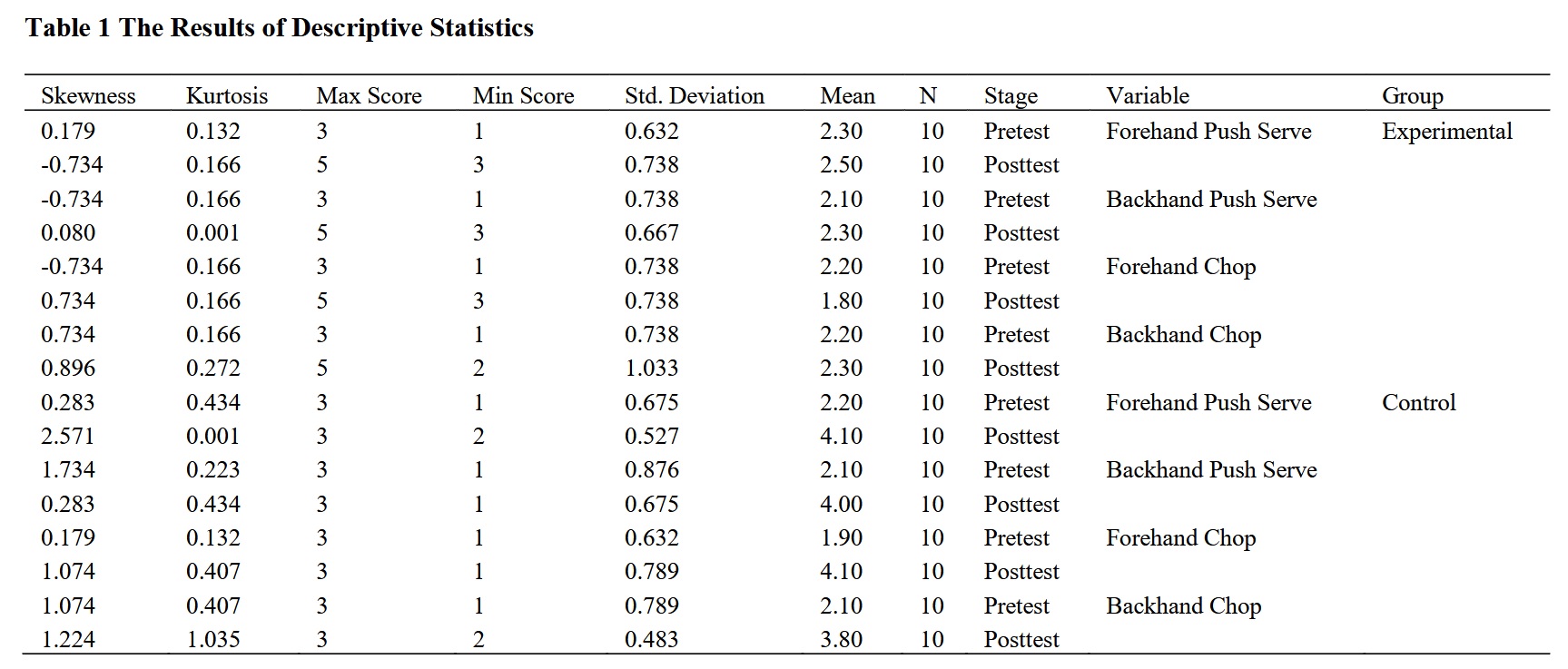
The present study was conducted to examine the effect of prior learning on table tennis instruction in young women with disabilities in the city of Tehran. This research employed a quasi-experimental method with a pretest-posttest design including experimental and control groups. The statistical population consisted of female athletes with physical disabilities from Hazrat Abolfazl Sports Club in District 15 of Tehran in the year 2022. The research sample included 20 participants who were divided into two groups of 10 (experimental and control) using a group homogenization method. The research instrument was a researcher-made checklist on table tennis techniques. Data analysis was conducted using multivariate analysis of covariance (MANCOVA). The findings indicated that there was a statistically significant difference in the scores for forehand push serve, backhand push serve, forehand chop, and backhand chop. A significant difference was observed at the 0.01 error level in the posttest stage between the experimental and control groups. It can be concluded that the prior learning intervention was effective in improving table tennis instruction for young women with disabilities in Tehran.
Downloads
References
1. Caspersen CJ, Powell KE, Christenson GM. Physical activity, exercise, and physical fitness: definitions and distinctions for health-related research. Public health reports (Washington, DC : 2014). 2015;100(2):126-31.
2. Piercy KL, Troiano RP, Ballard RM, Carlson SA, Fulton JE, Galuska DA, et al. The Physical Activity Guidelines for Americans. JAMA. 2018;320(19):2020-8. [PMID: 30418471 ] [PMCID: PMC9582631]
3. Tahmasabzadeh Sheikhler D, Azimi Aghblag AAUSNST, Qadri S. The lived experience of students with physical disabilities from participating in inclusive education. Publications of Allameh Tabatabai University, Psychology of Exceptional People. 2022;12(46):49-87.
4. World Health Organization. Health topics: Disabilities. 2017.
5. Sit C, Li R, McKenzie TL, Cerin E, Wong S, Sum R, et al. Physical Activity of Children with Physical Disabilities: Associations with Environmental and Behavioral Variables at Home and School. International journal of environmental research and public health. 2019;16(8):1394. [PMID: 30999710 ] [PMCID: PMC6518145]
6. Carlon SLAUTNF, Dodd KJ, Shields N. Differences in habitual physical activity levels of young people with cerebral palsy and their typically developing peers: a systematic review. Disability and rehabilitation. 2013;35(8):647-55. [PMID: 23072296]
7. Yamasaki T. Benefits of Table Tennis for Brain Health Maintenance and Prevention of Dementia. Encyclopedia. 2022;2(3):1577-89.
8. Nielsen G, Wikman JM, Jensen CJ, Schmidt JF, Gliemann L, Andersen TR. Health promotion: the impact of beliefs of health benefits, social relations and enjoyment on exercise continuation. Scandinavian journal of medicine & science in sports. 2014;24(Suppl 1):66-75. [PMID: 24944133]
9. Pan CY, Tsai CL, Chu CH, Sung MC, Huang CY, Ma WY. Effects of Physical Exercise Intervention on Motor Skills and Executive Functions in Children With ADHD: A Pilot Study. Journal of attention disorders. 2019;23(4):384-97. [PMID: 25646023]
10. Tsai CL, Pan CY, Chen FC, Tseng YT. Open- and Closed-Skill Exercise Interventions Produce Different Neurocognitive Effects on Executive Functions in the Elderly: A 6-Month Randomized, Controlled Trial. Frontiers in aging neuroscience. 2017;9:294. [PMID: 28959200 ] [PMCID: PMC5604064]
11. Zagatto AM, Kondric M, Knechtle B, Nikolaidis PT, Sperlich B. Energetic demand and physical conditioning of table tennis players. A study review. Journal of sports sciences. 2018;36(7):724-31. [PMID: 28582628]
12. Faber IR, Oosterveld FG, Nijhuis-Van der Sanden MW. Does an eye-hand coordination test have added value as part of talent identification in table tennis? A validity and reproducibility study. PloS one. 2014;9(1):e85657. [PMID: 24465638 ] [PMCID: PMC3895002]
13. Iino Y, Kojima T. Mechanical energy generation and transfer in the racket arm during table tennis topspin backhands. Sports biomechanics. 2016;15(2):180-97.
14. Gu Y, Yu C, Shao S, Baker JS. Effects of table tennis multi-ball training on dynamic posture control. PeerJ. 2019;6:e6262. [PMID: 30671292 ] [PMCID: PMC6339480]
15. Qian J, Zhang Y, Baker JS, Gu Y. Effects of performance level on lower limb kinematics during table tennis forehand loop. Acta of bioengineering and biomechanics. 2016;18(3):149-55.
16. Emery CA, Roy TO, Whittaker JL, Nettel-Aguirre A, van Mechelen W. Neuromuscular training injury prevention strategies in youth sport: a systematic review and meta-analysis. British journal of sports medicine. 2017;49(13):865-70. [PMID: 26084526]
17. Myer GD, Faigenbaum AD, Ford KR, Best TM, Bergeron MF, Hewett TE. When to initiate integrative neuromuscular training to reduce sports-related injuries and enhance health in youth? Current sports medicine reports. 2021;10(3):155-66. [PMID: 21623307 ] [PMCID: PMC3105332]
18. Pasanen K, Parkkari J, Pasanen M, Kannus P. Effect of a neuromuscular warm-up programme on muscle power, balance, speed and agility: a randomised controlled study. British journal of sports medicine. 2019;43(13):1073-8. [PMID: 19622526]
19. McLeod TC, Armstrong T, Miller M, Sauers JL. Balance improvements in female high school basketball players after a 6-week neuromuscular-training program. Journal of sport rehabilitation. 2019;18(4):465-81. [PMID: 20108849]
20. Izen I. The theory of planned behaviour is alive and well, and not ready to retire: A commentary on Sniehotta, Presseau, and Araujo-Soares. Health Psychol Rev. 2016;9:131-7. [PMID: 26209198]
21. Coates J. Paralympic legacy: Exploring the impact of the games on the perceptions of young people with disabilities. Adapt Phys Act Q. 2016;33:338-57. [PMID: 27874305]
22. Olsson K, Franzén E, Johansson A. A Pilot Study of the Feasibility and Effects of Table Tennis Training in Parkinson Disease. Archives of rehabilitation research and clinical translation. 2020;2(3SP - 100064). [PMID: 33543090 ] [PMCID: PMC7853352]
23. Lofgren N, Benka Wallen M, Sorjonen K, Conradsson D, Franzen E. Investigating the Mini-BESTest's construct validity in elderly with Parkinson's disease. Acta neurologica Scandinavica. 2017;135(6):614-21. [PMID: 27417912]
24. Hass CJ, Bishop M, Moscovich M, Stegemöller EL, Skinner J, Malaty IA, et al. Defining the clinically meaningful difference in gait speed in persons with Parkinson disease. Journal of neurologic physical therapy : JNPT. 2014;38(4):233-8. [PMID: 25198866]
Downloads
Additional Files
Publication Timeline
- Submitted
- Revised
- Accepted
License
Copyright (c) 2025 Zeynab Jalilbal (Corresponding Author); Pegah Taghiyar , Mahsa Soltani , Sahar Hasanlou (Author)

This work is licensed under a Creative Commons Attribution-NonCommercial 4.0 International License.