The Effects of Physical Activity on Key Variables That Influence the Characteristics of Children with Attention Deficit Hyperactivity Disorder
DOI:
https://doi.org/10.61838/kman.intjssh.7.4.10Keywords:
Psychological indicators, attention, memory, Attention Deficit Hyperactivity Disorder (ADHD)Abstract
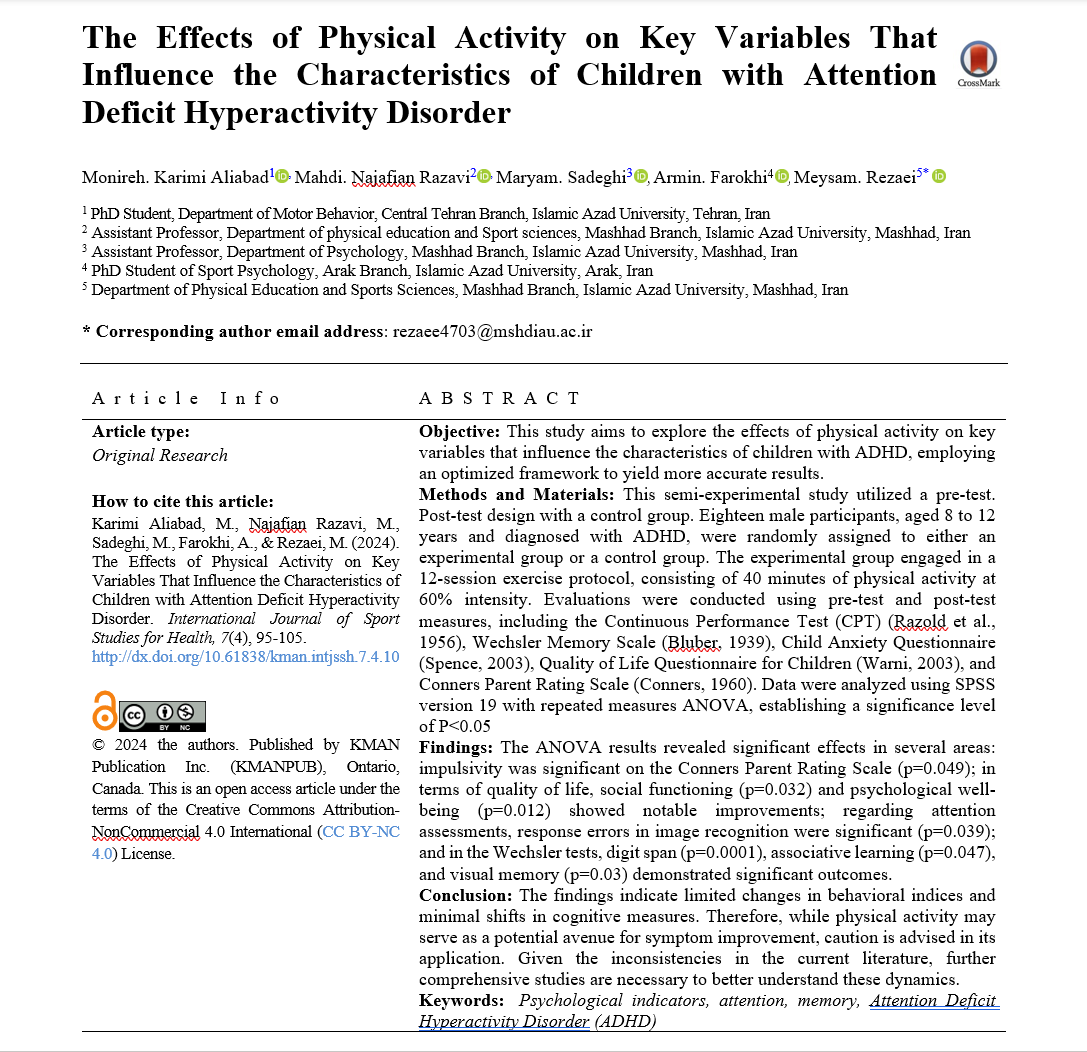
Objective: This study aims to explore the effects of physical activity on key variables that influence the characteristics of children with ADHD, employing an optimized framework to yield more accurate results.
Methods and Materials: This semi-experimental study utilized a pre-test. Post-test design with a control group. Eighteen male participants, aged 8 to 12 years and diagnosed with ADHD, were randomly assigned to either an experimental group or a control group. The experimental group engaged in a 12-session exercise protocol, consisting of 40 minutes of physical activity at 60% intensity. Evaluations were conducted using pre-test and post-test measures, including the Continuous Performance Test (CPT) (Razold et al., 1956), Wechsler Memory Scale (Bluber, 1939), Child Anxiety Questionnaire (Spence, 2003), Quality of Life Questionnaire for Children (Warni, 2003), and Conners Parent Rating Scale (Conners, 1960). Data were analyzed using SPSS version 19 with repeated measures ANOVA, establishing a significance level of P<0.05
Findings: The ANOVA results revealed significant effects in several areas: impulsivity was significant on the Conners Parent Rating Scale (p=0.049); in terms of quality of life, social functioning (p=0.032) and psychological well-being (p=0.012) showed notable improvements; regarding attention assessments, response errors in image recognition were significant (p=0.039); and in the Wechsler tests, digit span (p=0.0001), associative learning (p=0.047), and visual memory (p=0.03) demonstrated significant outcomes.
Conclusion: The findings indicate limited changes in behavioral indices and minimal shifts in cognitive measures. Therefore, while physical activity may serve as a potential avenue for symptom improvement, caution is advised in its application. Given the inconsistencies in the current literature, further comprehensive studies are necessary to better understand these dynamics.
Downloads
References
1. Committee on Quality Improvement. Clinical practice
guideline: diagnosis and evaluation of the child with attentiondeficit/hyperactivity disorder. Pediatrics. 2000;105(5):1158-70.
[PMID: 10836893] [DOI]
2. Gershon J, Gershon J. A meta-analytic review of gender
differences in ADHD. Journal of attention disorders.
2002;5(3):143-54. [PMID: 11911007] [DOI]
3. Van der Oord S, Others. Efficacy of methylphenidate,
psychosocial treatments and their combination in school-aged
children with ADHD: a meta-analysis. Clinical psychology review.
2008;28(5):783-800. [PMID: 18068284] [DOI]
4. Chou CC, Huang CJ. Effects of an 8-week yoga program
on sustained attention and discrimination function in children with
attention deficit hyperactivity disorder. PeerJ. 2017;5:e2883.
[PMID: 28097075] [PMCID: PMC5237364] [DOI]
5. Berwid OG, Halperin JM. Emerging support for a role of
exercise in attention-deficit/hyperactivity disorder intervention
planning. Current psychiatry reports. 2012;14:543-51. [PMID:
22895892] [PMCID: PMC3724411] [DOI]
6. Barkley RA. Comorbid disorders, social and family
adjustment, and subtyping
Attention-deficit hyperactivity disorder: A handbook for diagnosis
and treatment2006.
7. Akhtar P, Yardi S, Akhtar M. Effects of yoga on
functional capacity and well being. International journal of yoga.
2013;6(1):76-9. [PMID: 23439856] [PMCID: PMC3573548]
[DOI]
8. Gevensleben H, Rothenberger A, Moll GH, Heinrich H.
Neurofeedback in children with ADHD: validation and challenges.
Expert review of neurotherapeutics. 2012;12(4):447-60. [PMID:
22449216] [DOI]
9. Chuang LY, Tsai YJ, Chang YK, Huang CJ, Hung TM.
Effects of acute aerobic exercise on response preparation in a
Go/No Go Task in children with ADHD: an ERP study. Journal of
sport and Health science. 2015;4(1):82-8. [DOI]
10. Halperin JM, Berwid OG, O’Neill S. Healthy body,
healthy mind?: the effectiveness of physical activity to treat ADHD
in children. Child and Adolescent Psychiatric Clinics.
2014;23(4):899-936. [PMID: 25220093] [DOI]
11. Fritz KM, O'Connor PJ. Acute exercise improves mood
and motivation in young men with ADHD symptoms. Medicine
and science in sports and exercise. 2016;48(6):1153-60. [PMID:
26741120] [DOI]
12. Rathore A, Lom B. The effects of chronic and acute
physical activity on working memory performance in healthy
participants: a systematic review with meta-analysis of randomized
controlled trials. Systematic reviews. 2017;6:1-16. [PMID:
28666470] [PMCID: PMC5493123] [DOI]
13. Rommel AS, Lichtenstein P, Rydell M, Kuja-Halkola R,
Asherson P, Kuntsi J, et al. Is physical activity causally associated
with symptoms of attention-deficit/hyperactivity disorder? Journal
of the American Academy of Child & Adolescent Psychiatry.
2015;54(7):565-70. [PMID: 26088661] [PMCID: PMC4984951]
[DOI]
14. Rosvold HE, Mirsky AF, Sarason I, Bransome ED, Beck
LH. A continuous performance test of brain damage. Journal of
consulting psychology. 1956;20(5):343. [PMID: 13367264] [DOI]
15. Wechsler D. The measurement of adult intelligence. The
Journal of Nervous and Mental Disease. 1940;91(4):548. [DOI]
16. Spence SH, Barrett PM, Turner CM. Psychometric
properties of the Spence Children’s Anxiety Scale with young
adolescents. Journal of anxiety disorders. 2003;17(6):605-25.
[PMID: 14624814] [DOI]
17. Varni JW, Others. The PedsQL™ 4.0 as a pediatric
population health measure: feasibility, reliability, and validity.
Ambulatory pediatrics. 2003;3(6):329-41. [PMID: 14616041]
[DOI]
18. Conners CK. Conners' rating scales-revised: Technical
manual1997.
19. Hadianfar H, Najarian B, Shekarkan H, Mehrabizadeh
Honarmand M. Preparation Persian form of CPT. Journal of
psychology. 2000;4(4):404-388.
20. Razavieh A, Shahim S. Standardization of Wechsler
intelligence scale revised for children in Iran. Shiraz: Shiraz
University Publication; 2008.
21. Jadidi Mohammadabadi A. Teaching of Non-Verbal
Memory on the Accuracy and Concentration of Primary School
Students. Journal of early childhood health and education.
2024;5(1):0-.
22. Zarghami F, Heidari Nasab L, Shaeiri M, Shahrivar Z. A
Study in the Impact of Coping-Cat-based Cognitive-Behavior
Therapy (CBT) on Reduced Anxiety in the Children Aged 8 to 10
with Anxiety Disorder. Journal of Clinical psychology studies.
2015;14(6):183-202.
23. Mohamadian H, Akbari H, Gilasi H, Gharlipour Z,
Moazami A, Aghajani M, et al. Validation of Pediatric Quality of
Life Questionnaire (PedsQL) in Kashan city. J Ilam Uni Med Sci.
2014;22(3):10-8.
24. Alizadeh H. A Theoretical Explanation on Attention
Deficit/Hyperactivity Disorder: Behavioral Inhibition Model and
Nature of Self-control. Journal of Exceptional Children.
2005;5(3):231-52.
25. Reilly CJ. Attention deficit hyperactivity disorder
(ADHD) in childhood epilepsy. Res Dev Disabil. 2011;32(3):883-
93. [PMID: 21310586] [DOI]
26. Weisani M, Shahni Yailagh M, Alipour S. Effectiveness
of child-parent relation therapy on the symptoms of attention
deficit/hyperactivity disorder (ADHD). Iranian Journal of Family
Psychology. 2021;2(1):29-38.
27. Shahabian A, Shahim S, Bashash L, Yosefi F.
Normization, factor analysis and reliability of short form for
parents of Connors rating scale for children aged 6 to 11 in Shiraz
city. Journal of Psychological studies. 2007;3(3):97-120.
28. Afrasyabi S, Kargarfard M. The effects of 12-weeks
aerobic exercise on catecholamine’s levels and cardiorespiratory
fitness in children with attention deficit hyperactivity disorder.
Journal of Sport Physiology. 2015;7(26):113-26.
29. Sepehri H, Farokhi A, Ebrahimi Sani S. The Comparison
of gross and fine motor skills between attention deficit
hyperactivity disorder and normal students. Journal of Educational
sciences. 2009;1(4):131-45.
30. Hamidian M, Hejazi Dinan P, Shamsipor Dehkordi P.
Effects of Exercise Programs: Working Memory Exercise,
Rhythmic Movements and Combination of Both (working Memory
and Rhythmic) on Selective Attention, and Working Memory in
Children with Attention Deficit and Hyperactivity Disorder
(ADHD). Journal of Armaghane knowledge. 2019;3(24):496-509.
31. Bahrami A, Moradi J, Daei A. The Effect of Physical
Activities on Cognitive Function and Motor Performance of
Children with Attention Deficit Hyperactivity Disorder. Journal of
Sports psychology studies. 2019;8(27):1-18.
32. Chang YK, Etnier JL. Acute exercise and cognitive
function: emerging research issues. Journal of Sport and Health
Science. 2015;4(1):1-3. [DOI]
33. Piepmeier AT, Etnier JL. Brain-derived neurotrophic
factor (BDNF) as a potential mechanism of the effects of acute
exercise on cognitive performance. Journal of Sport and Health
Science. 2015;4(1):14-23. [DOI]
34. Piepmeier AT, Shih C-H, Whedon M, Williams LM,
Davis ME, Henning DA, et al. The effect of acute exercise on
cognitive performance in children with and without ADHD.
Journal of sport and Health science. 2015;4(1):97-104. [DOI]
35. Choi JW, Han DH, Kang KD, Jung HY, Renshaw PF.
Aerobic exercise and attention deficit hyperactivity disorder: brain
research. Medicine and science in sports and exercise.
2015;47(1):33-40. [PMID: 24824770] [PMCID: PMC5504911]
[DOI]
Rezaei et al. International Journal of Sport Studies for Health, 2024, VOL. 7, NO. 4, 95-105
105
36. Hoza B, Smith AL, Shoulberg EK, Linnea KS, Dorsch
TE, Blazo JA, et al. A randomized trial examining the effects of
aerobic physical activity on attention-deficit/hyperactivity disorder
symptoms in young children. Journal of abnormal child
psychology. 2015;43:655-67. [PMID: 25201345] [PMCID:
PMC4826563] [DOI]
37. Pan CY, Tsai CL, Chu CH, Sung MC, Huang CY, Ma
WY. Effects of physical exercise intervention on motor skills and
executive functions in children with ADHD: A pilot study. Journal
of attention disorders. 2019;23(4):384-97. [PMID: 25646023]
[DOI]
38. Ziereis S, Jansen P. Effects of physical activity on
executive function and motor performance in children with ADHD.
Research in developmental disabilities. 2015;38:181-91. [PMID:
25561359] [DOI]
39. Rezaei M, Salarpor Kamarzard T, Najafian Razavi M.
The effects of neurofeedback, yoga interventions on memory and
cognitive activity in children with attention deficit/hyperactivity
disorder: A randomized controlled trial. Annals of applied Sport
science. 2018;6(4):17-27. [DOI]
40. Pontifex MB, Saliba BJ, Raine LB, Picchietti DL,
Hillman CH. Exercise improves behavioral, neurocognitive, and
scholastic performance in children with attentiondeficit/hyperactivity disorder. The Journal of pediatrics.
2013;162(3):543-51. [PMID: 23084704] [PMCID: PMC3556380]
[DOI]
41. Smith AL, Hoza B, Linnea K, McQuade JD, Tomb M,
Vaughn AJ, et al. Pilot physical activity intervention reduces
severity of ADHD symptoms in young children. Journal of
attention disorders. 2013;17(1):70-82. [PMID: 21868587] [DOI]
42. Chang YK, Liu S, Yu HH, Lee YH. Effect of acute
exercise on executive function in children with attention deficit
hyperactivity disorder. Archives of clinical neuropsychology.
2012;27(2):225-37. [PMID: 22306962] [DOI]
43. Medina JA, Netto TL, Muszkat M, Medina AC, Botter
D, Orbetelli R, et al. Exercise impact on sustained attention of
ADHD children, methylphenidate effects. ADHD Attention Deficit
and Hyperactivity Disorders. 2010;2:49-58. [PMID: 21432590]
[DOI]
44. Chen C, Nakagawa S, An Y, Ito, K., Kitaichi Y, Kusumi
I. The exercise-glucocorticoid paradox: How exercise is beneficial
to cognition, mood, and the brain while increasing glucocorticoid
levels. Frontiers in neuroendocrinology. 2017;44:83-102. [PMID:
27956050] [DOI]
45. Madras BK, Miller GM, Fischman AJ. The dopamine
transporter and attention-deficit/hyperactivity disorder. Biological
psychiatry. 2005;57(11):1397-409. [PMID: 15950014] [DOI]
46. Ströhle A, Graetz B, Scheel M, Wittmann A, Feller C,
Heinz A, et al. The acute antipanic and anxiolytic activity of aerobic
exercise in patients with panic disorder and healthy control
subjects. Journal of psychiatric research. 2009;43(12):1013-27.
[PMID: 19289240] [DOI]
47. Winter B, Others. High impact running improves
learning. Neurobiology of learning and memory. 2007;87(4):597-
609. [PMID: 17185007] [DOI]
48. Suárez-Manzano S, Others. Acute and chronic effect of
physical activity on cognition and behaviour in young people with
ADHD: A systematic review. Research in Developmental
Disabilities. 2018;77:12-23. [PMID: 29625261] [DOI]
49. Flohr JA, Saunders MJ, Evans SW, Raggi V. Effects of
physical activity on academic performance and behavior in children
with ADHD. Medicine & Science in Sports & Exercise.
2004;36(5):S145-S6. [DOI]
Downloads
Additional Files
Publication Timeline
Issue
Section
License

This work is licensed under a Creative Commons Attribution-NonCommercial 4.0 International License.