
Machine Learning-Based Identification of Cultural Determinants of Decision-Making: The Role of Risk Perception, Uncertainty Avoidance, and Norm Compliance
Keywords:
Decision-Making, Machine Learning, Risk Perception, Uncertainty Avoidance, Norm Compliance, Cultural DeterminantsAbstract
Objective: The present study aimed to identify and model the cultural determinants of decision-making using machine learning techniques, with a specific focus on the predictive roles of risk perception, uncertainty avoidance, and norm compliance.
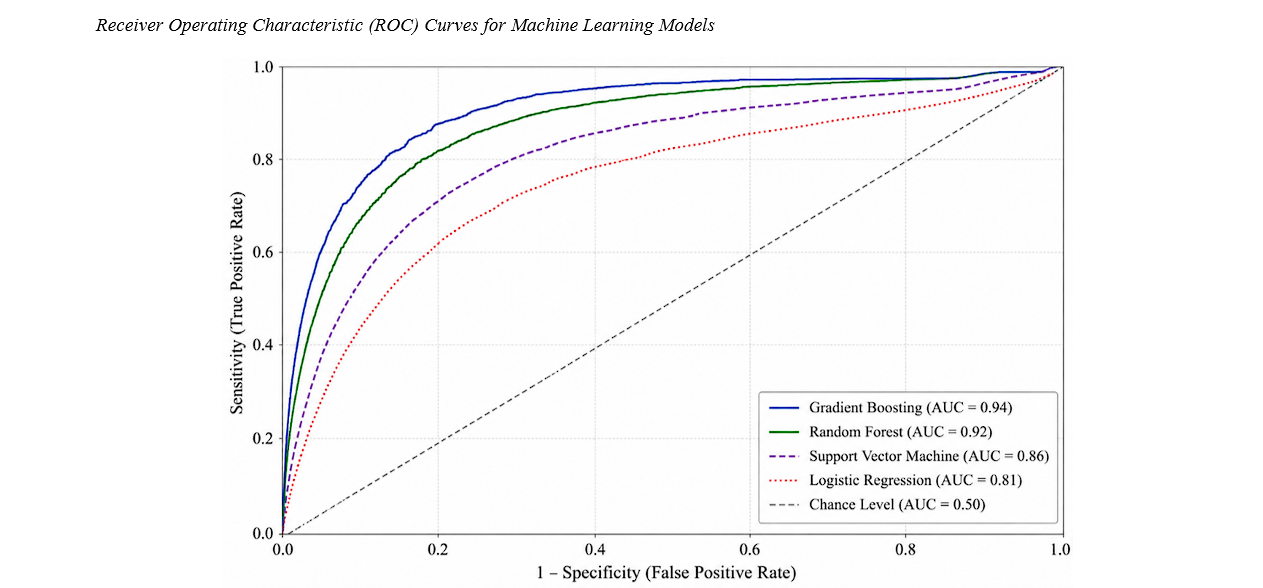
Methods and Materials: This study employed a descriptive–correlational design with a machine learning predictive framework. The sample consisted of 412 adult participants from Portugal selected through stratified random sampling to ensure demographic diversity. Data were collected using standardized instruments measuring risk perception, uncertainty avoidance, norm compliance, and decision-making quality. After preprocessing procedures including normalization and handling of missing values, data were analyzed using both traditional statistical methods and advanced machine learning algorithms. Supervised learning models, including Logistic Regression, Support Vector Machine, Random Forest, and Gradient Boosting, were applied to predict decision-making outcomes. Model performance was evaluated using k-fold cross-validation and metrics such as accuracy, precision, recall, F1-score, and area under the ROC curve. Feature importance analysis was conducted to determine the relative contribution of predictors.
Findings: The results indicated that all three cultural variables significantly predicted decision-making quality, with norm compliance emerging as the strongest predictor, followed by risk perception and uncertainty avoidance. Ensemble models demonstrated superior predictive performance, with Gradient Boosting achieving the highest accuracy and classification efficiency compared to other models. Feature importance analysis confirmed the dominant role of norm compliance in influencing decision-making outcomes. Additionally, significant positive relationships were observed among all study variables, indicating that higher levels of cultural alignment correspond to improved decision-making quality.
Conclusion: The findings highlight the critical role of cultural determinants in shaping decision-making processes and demonstrate the effectiveness of machine learning approaches in modeling complex behavioral patterns. Integrating cultural variables into predictive frameworks enhances both theoretical understanding and practical applications of decision-making research.
Downloads
References
Ahmad, H., & Muslim, M. (2024). Exploring the Nexus Between Internal Control Structures and Good Corporate Governance. Aaar, 2(2). https://doi.org/10.60079/aaar.v2i2.311
Chen, X., Wei, S., Ding, R., & Li, Y. (2023). Managing Users' Uncertainty in Social Commerce: The Moderating Role of Cultural Tightness. Industrial Management & Data Systems, 124(2), 666-697. https://doi.org/10.1108/imds-11-2022-0697
Cooper, M. (2024). The Impact of Cultural Differences on Global Procurement: A Qualitative Study of Multinational Supply Chains. https://doi.org/10.20944/preprints202407.0694.v1
Ferreras, A., Castro, P., & Fernández, M. T. T. (2024). Carbon Performance and Financial Debt: Effect of Formal and Informal Institutions. Corporate Social Responsibility and Environmental Management, 31(4), 2801-2822. https://doi.org/10.1002/csr.2709
Grant, O. (2024). The Influence of Cultural Differences on Supplier Relationship Management in Global E-Commerce. https://doi.org/10.20944/preprints202407.1240.v1
Gupta, M., & Gupta, S. (2025). The Role of National Culture: An Updated Framework for Cross-Cultural Research in Operations Management. Production and Operations Management, 34(5), 877-885. https://doi.org/10.1177/10591478251318103
Harris, M. R., Fein, E. C., & Machin, M. A. (2022). A Systematic Review of Multilevel Influenced Risk-Taking in Helicopter and Small Airplane Normal Operations. Frontiers in Public Health, 10. https://doi.org/10.3389/fpubh.2022.823276
Hinsberg, K. L., Nadesan, M. H., & Lamanna, A. J. (2024). Communicative Framework Development for Construction Risk Governance: An Analysis of Risk and Trust Perception for Organizational Sustainability. Sustainability, 16(13), 5794. https://doi.org/10.3390/su16135794
Holloway, S. (2024). Cultural Influences on Supply Chain Practices and Their Marketing Implications. https://doi.org/10.20944/preprints202406.1290.v1
Ibrahim, M. N., Ribeiro, M. A., & Kimbu, A. N. (2024). Redirecting Slack Resources to Social and Environmental Issues: A Cross-Cultural Analysis of Tourism Firms Post-Crisis. Journal of Travel Research, 64(7), 1639-1661. https://doi.org/10.1177/00472875241260333
Li, X., Hubbard, K., & Hwang, J. (2025). Understanding COVID-19 Booster Information Seeking in a Collectivist Context: The Roles of Social Expectations, Trust in Experts, and Uncertainty. Frontiers in Public Health, 13. https://doi.org/10.3389/fpubh.2025.1611711
Link, E. (2021). Information Avoidance During Health Crises: Predictors of Avoiding Information About the COVID-19 Pandemic Among German News Consumers. Information Processing & Management, 58(6), 102714. https://doi.org/10.1016/j.ipm.2021.102714
Manas, K. (2025). Integrating Legal and Logical Specifications in Perception, Prediction, and Planning for Automated Driving: A Survey of Methods. https://doi.org/10.48550/arxiv.2510.25386
Nair, N., Selvaraj, P., & Nambudiri, R. (2022). Culture and COVID-19: Impact of Cross-Cultural Dimensions on Behavioral Responses. Encyclopedia, 2(3), 1210-1224. https://doi.org/10.3390/encyclopedia2030081
Omrane, A., & Khan, M. A. (2024). A Comparative Analysis of Six National Cultures Under the Umbrella of the Hofstede’s Model. Environment and Social Psychology, 9(3). https://doi.org/10.54517/esp.v9i3.1618
Othman, H. B., Hussainey, K., & Moumen, N. (2023). The Influence of Cultural Tightness–looseness, Religiosity, and the Institutional Environment on Tax Evasion Behaviour: A Cross‐country Study. European Financial Management, 30(1), 346-374. https://doi.org/10.1111/eufm.12420
Peng, A. C., & Kim, D. (2020). A Meta‐analytic Test of the Differential Pathways Linking Ethical Leadership to Normative Conduct. Journal of Organizational Behavior, 41(4), 348-368. https://doi.org/10.1002/job.2427
Rasaei, J. (2025). Conceptual Framework for Offshoring Performance Through Management Control Systems, Trust and Culture. Australian Accounting Review, 35(2), 160-186. https://doi.org/10.1111/auar.70000
Roy, S. (2021). Theory of Social Proof and Legal Compliance: A Socio-Cognitive Explanation for Regulatory (Non) Compliance. German Law Journal, 22(2), 238-255. https://doi.org/10.1017/glj.2021.5
Saleh, M., Amin, H., & Elamer, A. A. (2025). Corporate Social Responsibility, Tax Behavior, and Institutional Context: An Empirical Analysis. Corporate Social Responsibility and Environmental Management, 32(6), 7293-7309. https://doi.org/10.1002/csr.70073
Song, H., & Mbah, P. T. (2024). When Trust Matters: Perceived Characteristics of Behavioral Guidance as Moderators of Trust in Compliance Decisions. Science Communication, 47(5), 702-729. https://doi.org/10.1177/10755470241304389
Sutrisno, T., & Dularif, M. (2020). National Culture as a Moderator Between Social Norms, Religiosity, and Tax Evasion: Meta-Analysis Study. Cogent Business & Management, 7(1), 1772618. https://doi.org/10.1080/23311975.2020.1772618
Teichmann, F., & Wittmann, C. (2022). Psychology and White Collar Crime - Compliance Recommendations Based on the Social and Psychological Reality Dictating Perception. Journal of Financial Crime, 31(2), 408-415. https://doi.org/10.1108/jfc-07-2022-0158
Torgler, B. (2022). Behavioral Taxation: Opportunities and Challenges. Finanzarchiv Public Finance Analysis, 78(1-2), 5-43. https://doi.org/10.1628/fa-2022-0003
Turcanu, C., Sala, R., Perko, T., Abelshausen, B., Oltra, C., Tomkiv, Y., Oughton, D., Liland, A., & Železnik, N. (2020). How Would Citizens React to Official Advice in a Nuclear Emergency? Insights From Research in Three European Countries. Journal of Contingencies and Crisis Management, 29(2), 143-169. https://doi.org/10.1111/1468-5973.12327
Utami, E. R., & Barokah, Z. (2024). The Determinants of Corporate Anti-Corruption Disclosures: Evidence From Construction Companies in the Asia-Pacific. Corporate Governance, 24(6), 1414-1441. https://doi.org/10.1108/cg-04-2023-0152
Wang, J. (2025). Similar Platforms, Different Values: The Presentation of Values in Chinese and American Social Media Privacy Policies and Terms of Service. Sage Open, 15(4). https://doi.org/10.1177/21582440251390630
Yao, Y., Liu, S., Chen, G., Yang, Y., & Yang, J. (2024). Conformity Behavior in Crises: Evidence From the COVID-19 Epidemic in China. Frontiers in psychology, 15. https://doi.org/10.3389/fpsyg.2024.1428075
Yildirim‐Öktem, Ö., Erdogan, I., Calabrò, A., & Kıratlı, O. S. (2023). Effect of Environmental Dynamism on Entrepreneurial Orientation In family Firms: The Moderating Role of Informal Institutions. Journal of Family Business Management, 13(4), 1277-1305. https://doi.org/10.1108/jfbm-11-2022-0128
Zhang, S., Wang, Y., & Wei, Y. (2022). Follow or Not? Descriptive Norms and Public Health Compliance: Mediating Role of Risk Perception and Moderating Effect of Behavioral Visibility. Frontiers in psychology, 13. https://doi.org/10.3389/fpsyg.2022.1040218
Zhuang, J., & Carey, P. (2024). Compliance With Social Norms in the Face of Risks: Delineating the Roles of Uncertainty About Risk Perceptions Versus Risk Perceptions. Risk Analysis, 45(1), 240-252. https://doi.org/10.1111/risa.16112
Downloads
Additional Files
Publication Timeline
- Submitted
- Revised
- Accepted



