
Machine Learning-Based Classification of Cultural Beliefs and Mental Health Attitudes
Keywords:
Machine Learning, Cultural Beliefs, Mental Health Attitudes, Stigma, Help-Seeking Behavior, Gradient Boosting, Cross-Cultural PsychologyAbstract
Objective: The present study aimed to classify cultural beliefs and mental health attitudes using machine learning techniques and to identify the most influential psychosocial predictors within an Armenian population.
Methods and Materials: This cross-sectional, descriptive–analytical study was conducted on a sample of 412 adults from Armenia selected through stratified random sampling. Data were collected using standardized instruments assessing cultural beliefs (including individualism, collectivism, traditionalism, and authority orientation) and mental health attitudes (including stigma, help-seeking attitudes, emotional openness, and beliefs about mental illness), along with a demographic questionnaire. Data preprocessing included normalization, missing data imputation, and categorical encoding. Feature selection was performed using correlation-based filtering and recursive feature elimination. Supervised machine learning models, including Support Vector Machine, Random Forest, and Gradient Boosting, were implemented to classify participants based on their psychosocial profiles. Model evaluation was conducted using 10-fold cross-validation, with performance assessed via accuracy, precision, recall, F1-score, and AUC-ROC metrics.
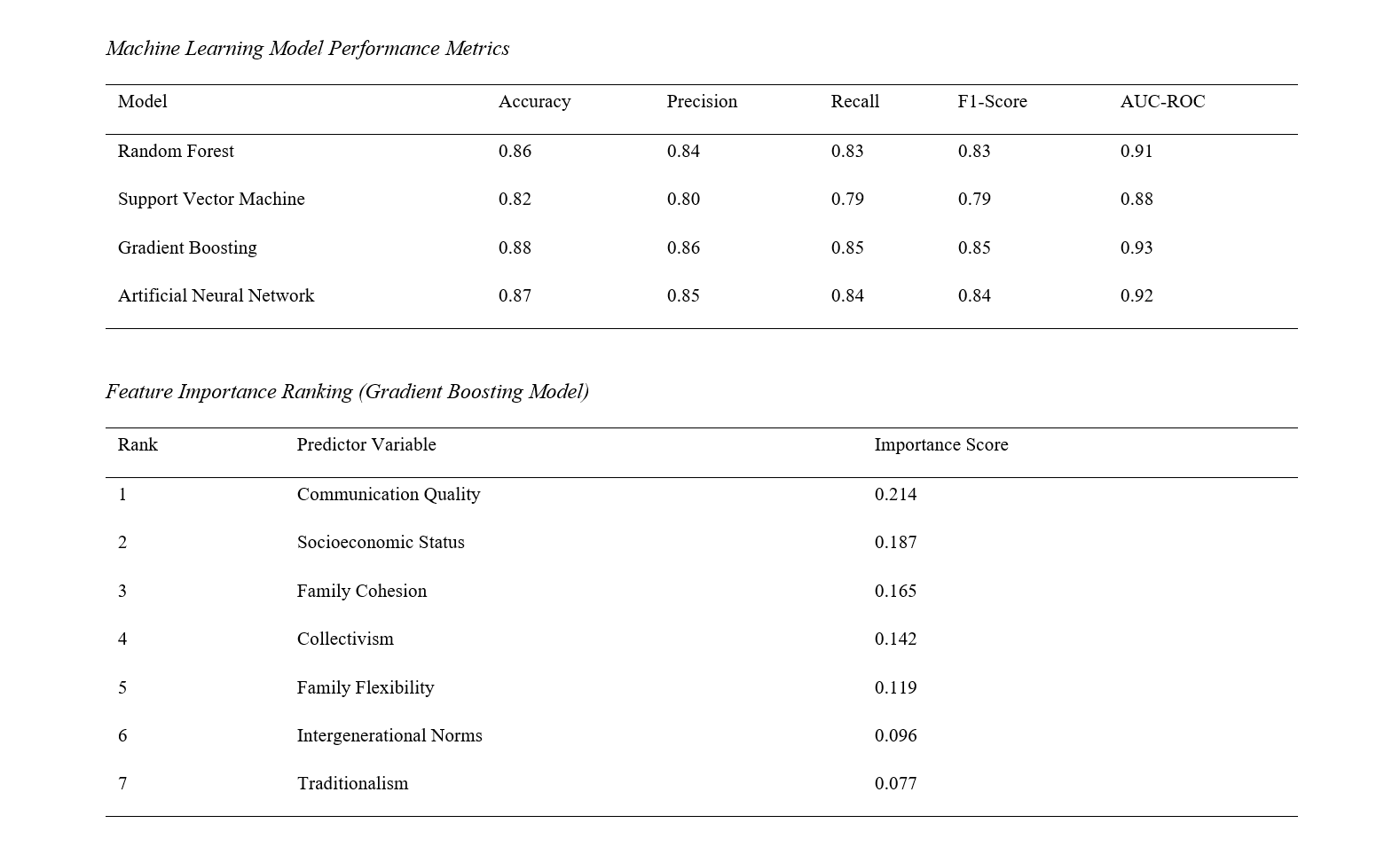
Findings: Inferential results indicated significant associations between cultural belief dimensions and mental health attitudes, with collectivism, traditionalism, and authority orientation positively predicting mental health stigma, while individualism significantly predicted help-seeking attitudes and emotional openness. Machine learning analyses revealed that the Gradient Boosting model demonstrated superior classification performance (accuracy = 0.902, AUC = 0.947) compared to Random Forest and Support Vector Machine models. Feature importance analysis showed that mental health stigma, help-seeking attitudes, and collectivism were the most influential predictors in distinguishing participant profiles. Correlation patterns further confirmed that higher stigma was significantly associated with lower help-seeking and emotional openness, while culturally embedded belief systems significantly shaped mental health perceptions.
Conclusion: The findings demonstrate that cultural beliefs play a critical role in shaping mental health attitudes and that machine learning techniques provide a robust framework for accurately classifying these complex relationships. The prominence of stigma-related constructs highlights the need for culturally sensitive interventions aimed at reducing stigma and promoting adaptive help-seeking behaviors. Integrating computational approaches with cultural psychology offers valuable insights for targeted mental health strategies and policy development.
Downloads
References
Álvarez, E. C., Rifà‐Ros, R., Salinas‐Roca, B., Costa‐Tutusaus, L., Lamas, M. F. M., & Rodríguez‐Monforte, M. (2025). Diet-Related Health Inequalities in High-Income Countries: A Scoping Review of Observational Studies. Advances in Nutrition, 16(6), 100439. https://doi.org/10.1016/j.advnut.2025.100439
Azmitia, M. (2021). Latinx Adolescents' Assets, Risks, and Developmental Pathways: A Decade in Review and Looking Ahead. Journal of Research on Adolescence, 31(4), 989-1005. https://doi.org/10.1111/jora.12686
Chen, S., Wei, W., Witherspoon, D. P., & Kim, S. Y. (2022). Invisibly Oppressed: Individual and Ecological Correlates of Chinese American Adolescents’ Perceived Discrimination. Journal of Research on Adolescence, 32(2), 518-532. https://doi.org/10.1111/jora.12759
Chen, S. H., Zhang, E., Liu, C. H., & Wang, L. K. (2021). Depressive Symptoms in Chinese Immigrant Mothers: Relations With Perceptions of Social Status and Interpersonal Support. Cultural diversity & ethnic minority psychology, 27(1), 72-81. https://doi.org/10.1037/cdp0000343
Chen, X., Haft, S. L., & Zhou, Q. (2025). Associations Between Neighborhood Risk and Protective Factors and Parenting Styles in Chinese American Immigrant Families. Journal of Family Psychology, 39(4), 537-547. https://doi.org/10.1037/fam0001302
Colic‐Peisker, V., Khawaja, N. G., & Hebbani, A. (2020). Parent-Child Engagement and Dissonance in Refugee Families Resettling in Brisbane, Australia. Journal of Intercultural Communication, 20(3), 44-58. https://doi.org/10.36923/jicc.v20i3.311
Cooper, D. K., Bachem, R., Meentken, M. G., Aceves, L., & Barrios, A. G. P. (2020). Cumulative Lifetime Adversity and Depression Among a National Sample of U.S. Latinx Immigrants: Within-Group Differences in Risk and Protective Factors Using Data From the HCHS/SOL Sociocultural Ancillary Study. Journal of Latinx Psychology, 8(3), 202-220. https://doi.org/10.1037/lat0000145
Cordero, C., & Llabre, M. M. (2025). The Health of Hispanic/Latino People in the United States. 211-236. https://doi.org/10.1037/0000396-012
Crawford, J., Kapisavanhu, N., Moore, J., Crawford, C. G., & Lundy, T. (2023). A Critical Review of Social Exclusion and Inclusion Among Immigrant and Refugee Women. Advances in Public Health, 2023, 1-20. https://doi.org/10.1155/2023/8889358
DiBenedetti, C., Zimmerman, G. M., & Fridel, E. E. (2024). Examining the Etiology of Asian American Suicide in the United States. Journal of Racial and Ethnic Health Disparities, 12(4), 2169-2186. https://doi.org/10.1007/s40615-024-02039-4
Fasesan, O. A. (2022). Contextualizing Migration and Mental Health in the Post-Covid Era. Babcock University Medical Journal, 5(2), 120-130. https://doi.org/10.38029/babcockunivmedj.v5i2.157
Gennetian, L. A., Cabrera, N., Crosby, D. A., Guzman, L., Mendez, J. L., & Wildsmith, E. (2021). A Strength-Based Framework for Realizing Latino Young Children’s Potential. Policy Insights from the Behavioral and Brain Sciences, 8(2), 152-159. https://doi.org/10.1177/23727322211033618
Guerrero, E. G. (2022). Effective Elimination of Structural Racism. https://doi.org/10.5772/intechopen.95223
Hossain, B. (2025). Mapping the Evidence on the Intersection of Gender and Social Determinants of Health in Health Inequality: A Scoping Review. BMC public health, 25(1). https://doi.org/10.1186/s12889-025-25525-8
Huynh, A., Yeh, C. J., & Tang, P. (2024). Intergenerational Trauma and Resilience Among Second-Generation Southeast Asian Americans. Asian American Journal of Psychology, 15(2), 158-172. https://doi.org/10.1037/aap0000343
Kamanzi, P. C. (2023). Pathways of Black Immigrant Youth in Québec From Secondary School to University: Cumulative Racial Disadvantage and Compensatory Advantage of Resilience. Canadian Review of Sociology/Revue Canadienne De Sociologie, 60(3), 409-437. https://doi.org/10.1111/cars.12446
Kim, Y., Lee, H., Lee, H., Lee, M., Kim, S., & Konlan, K. D. (2023). Social Determinants of Health of Racial and Ethnic Minority Adolescents: An Integrative Literature Review. Heliyon, 9(10), e20738. https://doi.org/10.1016/j.heliyon.2023.e20738
Lee, K. (2024). Racial Disparity in Parenting Practice Among Parents With Young Children. Journal of Family Issues, 46(5), 733-766. https://doi.org/10.1177/0192513x241299424
Li, Y. (2021). Entrenched Inequalities? Class, Gender and Ethnic Differences in Educational and Occupational Attainment in England. Frontiers in Sociology, 5. https://doi.org/10.3389/fsoc.2020.601035
Mori, K., & Onyango, E. O. (2023). Intersections of Race, COVID-19 Pandemic, and Food Security in Black Identifying Canadian Households: A Scoping Review. Canadian Food Studies / La Revue Canadienne Des Études Sur L Alimentation, 10(3), 3-34. https://doi.org/10.15353/cfs-rcea.v10i3.630
Nava, M. (2023). Conceptual Framing of Immigrant Social Capital as a Component of Socioeconomic Status for Comparative Health Research. https://doi.org/10.20944/preprints202310.0344.v1
Raghav, S. V., & Sm, P. (2024). The Role of Socioeconomic Factors in Shaping Health Outcomes Among Vulnerable Populations. South Eastern European Journal of Public Health, 1422-1432. https://doi.org/10.70135/seejph.vi.2086
Raphael, S., & Schneider, D. (2023). Introduction: The Socioeconomic Impacts of COVID-19. RSF the Russell Sage Foundation Journal of the Social Sciences, 9(3), 1-30. https://doi.org/10.7758/rsf.2023.9.3.01
Semé, J. L., Bivins, B. L., Sternberg, C. A., Barnett, J., Junis-Florian, T., Nicolas, G., Etienne, M. O., & Jean, P. (2021). The Educational, Health, and Economic Impacts of COVID-19 Among Haitians in the USA: Time for Systemic Change. Journal of Racial and Ethnic Health Disparities, 9(6), 2171-2179. https://doi.org/10.1007/s40615-021-01156-8
Sullivan, K., & Thakur, N. (2020). Structural and Social Determinants of Health in Asthma in Developed Economies: A Scoping Review of Literature Published Between 2014 and 2019. Current Allergy and Asthma Reports, 20(2). https://doi.org/10.1007/s11882-020-0899-6
Sun, S., Huang, J., Hudson, D., & Sherraden, M. (2021). Cash Transfers and Health. Annual Review of Public Health, 42(1), 363-380. https://doi.org/10.1146/annurev-publhealth-090419-102442
Torche, F., Fletcher, J. M., & Brand, J. E. (2024). Disparate Effects of Disruptive Events on Children. RSF the Russell Sage Foundation Journal of the Social Sciences, 10(1), 1-30. https://doi.org/10.7758/rsf.2024.10.1.01
Varela, E., McVay, M. A., Shelnutt, K. P., & Mobley, A. R. (2023). The Determinants of Food Insecurity Among Hispanic/Latinx Households With Young Children: A Narrative Review. Advances in Nutrition, 14(1), 190-210. https://doi.org/10.1016/j.advnut.2022.12.001
Wheeler, L. A., Updegraff, K. A., Umaña‐Taylor, A. J., & Crouter, A. C. (2021). Mexican-Origin Parents’ Workplace Discrimination and Well-Being: The Roles of Familism Values, Family Conflict, and Gender. Cultural diversity & ethnic minority psychology, 27(4), 717-727. https://doi.org/10.1037/cdp0000483
Zan, H., Fan, J. X., & Lozada, B. (2023). The Economic Disparity Between Hispanic and non‐Hispanic White Households: An Analysis of middle‐class Achievement. American Journal of Economics and Sociology, 83(1), 93-107. https://doi.org/10.1111/ajes.12521
Zinn, M. B., & Wells, B. L. (2022). The Racialization of Latino Families. Journal of Family Issues, 44(10), 2547-2566. https://doi.org/10.1177/0192513x221105246
Downloads
Additional Files
Publication Timeline
- Submitted
- Revised
- Accepted



