
Preliminary Evidence on Moral Underpinnings of Rape Victim Blaming in Iran: Replication and Extensions of Milesi et al. (2020)
Underpinnings of Rape Victim Blaming in Iran
Keywords:
Rape Victim Blaming, Acceptance of Modern Myths About Sexual Aggression, Moral Foundations, IranAbstract
Objective: According to Moral Foundation Theory, people rely on five intuitive-based foundations in their moral decisions. These foundations are divided into Individualizing foundations (Care and Fairness) and Binding foundations (Loyalty, Authority, and Sanctity).
Methods and Materials: In an attempt to replicate Milesi at al’s (2020) findings in a non-WEIRD and honored context, across three studies, we explored the relationship between Moral Foundation and Acceptance of Modern Myths About Sexual Aggression (AMMSA) with rape victim-blaming.
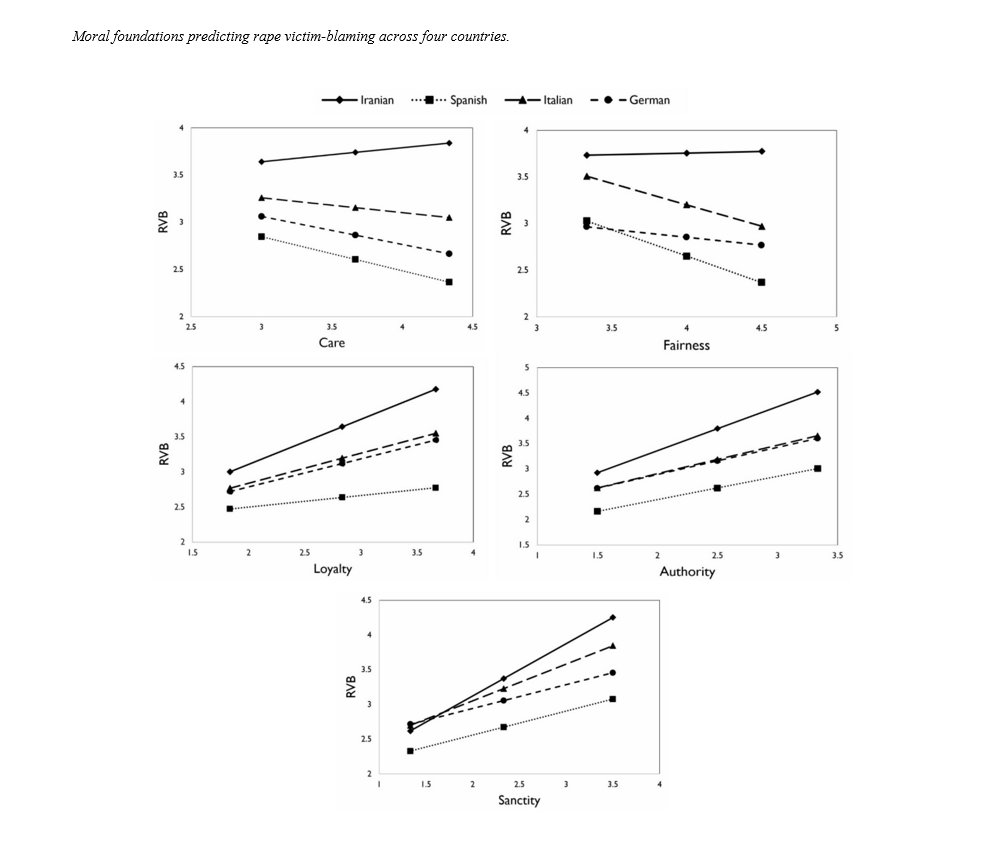
Findings: Study 1 showed that Fairness, Authority, and Sanctity foundations were predictive of rape victim-blaming. Study 2 showed that binding foundations predict rape victim-blaming in a preregistered analysis. Our cross-country analyses (Iran, Germany, Spain, and Italy) showed that the effects of binding moral foundations were stronger among Iranian participants than those with less-honored cultures (i.e., Italy, Spain, and Germany). Exploratory analyses revealed no differences in rape victim-blaming among men and women. However, men had higher levels of endorsement of AMMSA than women. Religious individuals had higher levels of rape victim-blaming and AMMSA. Findings are discussed concerning the honored context of Iran’s society.
Conclusion: The findings indicate that rape victim-blaming in Iran is strongly associated with acceptance of modern myths about sexual aggression and binding moral foundations, particularly Authority and Sanctity. These relationships appear especially salient within honor-based cultural contexts, highlighting the importance of culturally sensitive approaches to understanding and reducing victim-blaming attitudes.
Downloads
References
Aghtaie, N. (2017). Rape within heterosexual intimate relationships in Iran: Legal frameworks, cultural and structural violence. Families, Relationships and Societies, 6(2), 167-183. https://doi.org/10.1332/204674317X14861126776962
Alicke, M. D., Mandel, D. R., Hilton, D. J., Gerstenberg, T., & Lagnado, D. A. (2015). Causal Conceptions in Social Explanation and Moral Evaluation: A Historical Tour. Perspectives on Psychological Science, 10(6), 790-812. https://doi.org/10.1177/1745691615601888
Bagherian, M., Sayyad, P., Sheibani, H., & Rios, K. (2025). Fallout of faith in Iran: How religious leaders' hypocrisy undermines beliefs while parents' devotion sustains it. Psychology of Religion and Spirituality. https://doi.org/10.1037/rel0000567
Barnett, M. D., & Hilz, E. N. (2018). The Psychology of the Politics of Rape: Political Ideology, Moral Foundations, and Attitudes Toward Rape. Violence Against Women, 24(5), 545-564. https://doi.org/10.1177/1077801217708887
Bohner, G., Eyssel, F., Pina, A., Siebler, F., & Viki, T. (2009). Rape myth acceptance: Cognitive, affective, and behavioural effects of beliefs that blame the victim and exonerate the perpetrator. In Rape: Challenging Contemporary Thinking (pp. 17-45). https://doi.org/10.4324/9781843927129
Bohner, G., Reinhard, M. A., Rutz, S., Sturm, S., Kerschbaum, B., & Effler, D. (1998). Rape myths as neutralizing cognitions: Evidence for a causal impact of anti-victim attitudes on men's self-reported likelihood of raping. European Journal of Social Psychology, 28(2), 257-268. https://doi.org/10.1002/(SICI)1099-0992(199803/04)28:2<257::AID-EJSP871>3.0.CO;2-1
Bohner, G., Siebler, F., & Schmelcher, J. (2006). Social Norms and the Likelihood of Raping: Perceived Rape Myth Acceptance of Others Affects Men's Rape Proclivity. Personality and Social Psychology Bulletin, 32(3), 286-297. https://doi.org/10.1177/0146167205280912
Burt, M. R. (1980). Cultural myths and supports for rape. Journal of Personality and Social Psychology, 38, 217-230. https://doi.org/10.1037/0022-3514.38.2.217
Campbell, R. (2008). The psychological impact of rape victims. American Psychologist, 63, 702-717. https://doi.org/10.1037/0003-066X.63.8.702
Faul, F., Erdfelder, E., Lang, A. G., & Buchner, A. (2007). G* Power 3: A flexible statistical power analysis program for the social, behavioral, and biomedical sciences. Behavior Research Methods, 39(2), 175-191. https://doi.org/10.3758/BF03193146
Frese, B., Moya, M., & Megías, J. L. (2004). Social perception of rape: How rape myth acceptance modulates the influence of situational factors. Journal of Interpersonal Violence, 19(2), 143-161. https://doi.org/10.1177/0886260503260245
Gerger, H., Kley, H., Bohner, G., & Siebler, F. (2007). The acceptance of modern myths about sexual aggression scale: Development and validation in German and English. Aggressive Behavior, 33(5), 422-440. https://doi.org/10.1002/ab.20195
Ghoreishi, S. A., & Nalekiashari, K. B. (2024). Obstacles in the Field of Sexual Assault Research in Iran. Journal of the American Academy of Psychiatry and the Law Online, 52(1), 2-5. https://doi.org/10.29158/JAAPL.240003-24
Graham, J., Haidt, J., Koleva, S., Motyl, M., Iyer, R., Wojcik, S. P., & Ditto, P. H. (2013). Chapter Two - Moral Foundations Theory: The Pragmatic Validity of Moral Pluralism. In Advances in Experimental Social Psychology (Vol. 47, pp. 55-130). Academic Press. https://doi.org/10.1016/B978-0-12-407236-7.00002-4
Gray, K., Young, L., & Waytz, A. (2012). Mind perception is the essence of morality. Psychological Inquiry, 23(2), 101-124. https://doi.org/10.1080/1047840X.2012.651387
Grubb, A., & Turner, E. (2012). Attribution of blame in rape cases: A review of the impact of rape myth acceptance, gender role conformity and substance use on victim blaming. Aggression and Violent Behavior, 17, 443-452. https://doi.org/10.1016/j.avb.2012.06.002
Haidt, J. (2012). The righteous mind: Why good people are divided by politics and religion. New York, NY: Random House. https://books.google.com/books?hl=en&lr=&id=ItuzJhbcpMIC&oi=fnd&pg=PR11&dq=Haidt,+J.+(2012).+The+righteous+mind:+Why+good+people+are+divided+by+politics+and+religion,+New+York,+NY:+Random+House.+%09&ots=H5a6HMcy1z&sig=rD9U46ID7Y8slqObvK2n2X0-1RQ
Harper, C. A., & Harris, A. J. (2017). Applying moral foundations theory to understanding public views of sexual offending. Journal of Sexual Aggression, 23(2), 111-123. https://doi.org/10.1080/13552600.2016.1217086
Hayes, A. F. (2017). Introduction to Mediation, Moderation, and Conditional Process Analysis, Second Edition: A Regression-Based Approach. Guilford Publications. https://www.researchgate.net/profile/Adasa-Nkrumah-Kofi-Frimpong/post/Can-anyone-tell-me-that-which-one-is-better-for-running-mediation-and-moderation-Process-macro-by-Hayes-or-AMOS/attachment/5e74fcd23843b0047b366238/AS%3A871214797045762%401584725202506/download/templates.pdf
Henrich, J. (2009). The evolution of costly displays, cooperation and religion: Credibility enhancing displays and their implications for cultural evolution. Evolution and Human Behavior, 30(4), 244-260. https://doi.org/10.1016/j.evolhumbehav.2009.03.005
Karimi-Malekabadi, F., & Falahatpishe Baboli, M. (2023). Qeirat Values and Victim Blaming in Iran: The Mediating Effect of Culture-Specific Gender Roles. Journal of Interpersonal Violence, 38(3-4), 2485-2509. https://doi.org/10.1177/08862605221101184
Laing, L. (2017). Secondary Victimization: Domestic Violence Survivors Navigating the Family Law System. Violence Against Women, 23(11), 1314-1335. https://doi.org/10.1177/1077801216659942
Malayeri, S., Nater, C., Krahé, B., & Sczesny, S. (2025). Married or on a date: Cultural norms and gender differences in rape perception in an Iranian sample. Journal of Sexual Aggression, 31(2), 156-171. https://doi.org/10.1080/13552600.2024.2418102
Malayeri, S., Nater, C., Krahé, B., Vandello, J., & Sczesny, S. (2025). Is She a Good Muslima? The Impact of Hijab (Head Covering) on Muslims' Evaluations of a Rape Incident. Journal of Interpersonal Violence. https://doi.org/10.1177/08862605251384944
Megías, J. L., Romero-Sánchez, M., Durán, M., Moya, M., & Bohner, G. (2011). Spanish validation of the Acceptance of Modern Myths about Sexual Aggression scale (AMMSA). The Spanish Journal of Psychology, 14(2), 912-925. https://doi.org/10.5209/rev_sjop.2011.v14.n2.37
Milesi, P., Süssenbach, P., Bohner, G., & Megías, J. L. (2020). The interplay of modern myths about sexual aggression and moral foundations in the blaming of rape victims. European Journal of Social Psychology, 50(1), 111-123. https://doi.org/10.1002/ejsp.2622
Moghadam, V. M. (2003). Modernizing Women: Gender and Social Change in the Middle East. Lynne Rienner Publishers. https://doi.org/10.1515/9781685858995
Nejat, P., & Hatami, J. (2019). Psychometric Properties of the Persian Version of Moral Foundations Questionnaire in Three Iranian Samples. Social Cognition, 8(1), 107-124. https://doi.org/10.30473/sc.2019.40617.2204
Niemi, L., & Young, L. (2016). When and why we see victims as responsible: The impact of ideology on attitudes toward victims. Personality and Social Psychology Bulletin, 42(9), 1227-1242. https://doi.org/10.1177/0146167216653933
Nisbett, R. E., & Cohen, D. (1996). Culture of honor: The psychology of violence in the South. Westview Press. https://books.google.com/books?hl=en&lr=&id=LQHFDwAAQBAJ&oi=fnd&pg=PP1&dq=Nisbett,+R.+E.+and+D.+Cohen+(1996).+Culture+of+honor:+The+psychology+of+violence+in+the+South,+Westview+Press.+%09&ots=5iLIcwtPUw&sig=G3jlm6gTjVPLFexTHRtvFfdAib4
Razavi, P., Shaban-Azad, H., & Srivastava, S. (2023). Gheirat as a complex emotional reaction to relational boundary violations: A mixed-methods investigation. Journal of Personality and Social Psychology, 124(1), 179-214. https://doi.org/10.1037/pspp0000424
Schein, C., Goranson, A., & Gray, K. (2015). The uncensored truth about morality. The Psychologist, 28(12), 982-985. https://www.researchgate.net/profile/Kurt-Gray/publication/313077052_The_uncensored_truth_about_morality/links/58a1c23945851598babac78e/The-uncensored-truth-about-morality.pdf
Shanti, T. I., Isa, T. M., Sumampouw, N., & Agustian, M. (2026). Morality and rape culture: Rape myths as a mediator between moral theory, institutional betrayal, and sexual violence claims. Social Sciences & Humanities Open, 13, 102653. https://doi.org/10.1016/j.ssaho.2026.102653
Vandello, J. A., & Cohen, D. (2003). Male honor and female fidelity: Implicit cultural scripts that perpetuate domestic violence. Journal of Personality and Social Psychology, 84(5), 997-1010. https://doi.org/10.1037/0022-3514.84.5.997
Vecina, M. L., & Piñuela, R. (2017). Relationships between Ambivalent Sexism and the Five Moral Foundations in Domestic Violence: Is it a Matter of Fairness and Authority? The Journal of Psychology, 151(3), 334-344. https://doi.org/10.1080/00223980.2017.1289145
Watts, A. L., Bowes, S. M., Latzman, R. D., & Lilienfeld, S. O. (2017). Psychopathic traits predict harsh attitudes toward rape victims among undergraduates. Personality and Individual Differences, 106, 1-5. https://doi.org/10.1016/j.paid.2016.10.022
World Health, O. (2021). Violence against women prevalence estimates, 2018 - Executive summary. https://www.who.int/publications-detail-redirect/9789240026681
Downloads
Additional Files
Publication Timeline
- Submitted
- Revised
- Accepted



