
Family Expressiveness and Adolescent Empathy: The Mediating Role of Emotional Awareness
DOI:
https://doi.org/10.61838/kman.jprfc.3.3.4Keywords:
Family Expressiveness, Emotional Awareness, Adolescent EmpathyAbstract
Objective: This study aimed to examine the mediating role of emotional awareness in the relationship between family expressiveness and adolescent empathy.
Methods and Materials: A descriptive correlational research design was used, involving 400 Mexican adolescents selected based on the Morgan and Krejcie sampling table. Data were collected using three standardized self-report instruments: the Family Expressiveness Questionnaire (FEQ), the Emotional Awareness Questionnaire (EAQ), and the Interpersonal Reactivity Index (IRI) for empathy. Pearson correlation analysis was conducted using SPSS-27 to explore bivariate associations, and structural equation modeling (SEM) was performed using AMOS-21 to assess direct, indirect, and total effects among the variables and test the hypothesized mediation model.
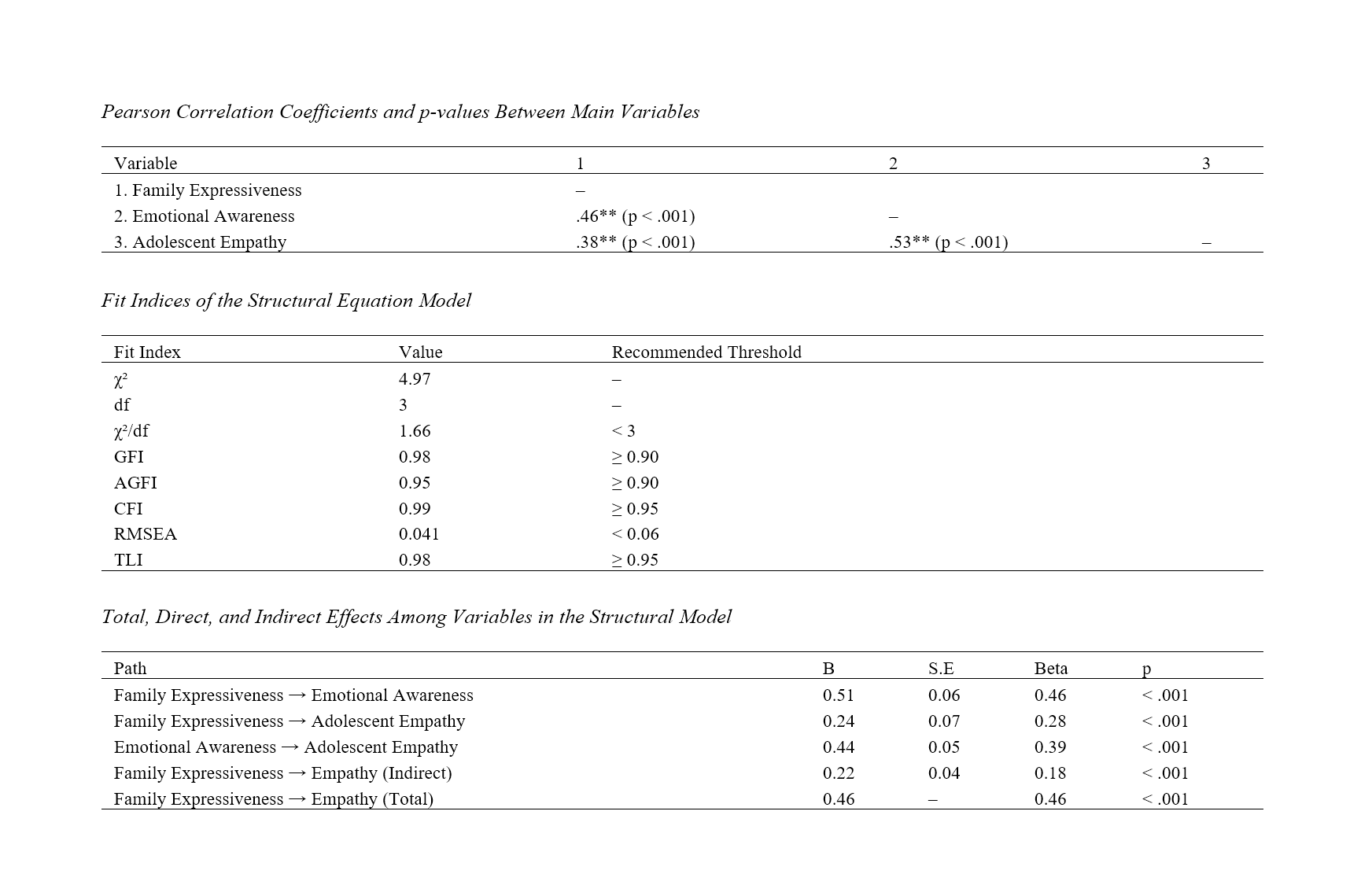
Findings: The results showed significant positive correlations between family expressiveness and emotional awareness (r = .46, p < .001), family expressiveness and adolescent empathy (r = .38, p < .001), and emotional awareness and adolescent empathy (r = .53, p < .001). The structural model demonstrated a good fit to the data (χ²/df = 1.66, RMSEA = 0.041, CFI = 0.99). Direct effects from family expressiveness to emotional awareness (B = 0.51, β = 0.46, p < .001), from family expressiveness to empathy (B = 0.24, β = 0.28, p < .001), and from emotional awareness to empathy (B = 0.44, β = 0.39, p < .001) were statistically significant. The indirect effect of family expressiveness on empathy via emotional awareness was also significant (B = 0.22, β = 0.18, p < .001), supporting partial mediation.
Conclusion: These findings suggest that emotionally expressive family environments foster adolescents' empathy partly by enhancing their emotional awareness. Emotional awareness serves as a key developmental mechanism through which family dynamics shape prosocial emotional outcomes in adolescence.
Downloads
References
Antikaningsih, Y. E., & Sarajar, D. K. (2025). Adolescents From Broken Homes: The Role of Emotional Regulation in Reducing Aggressive Tendencies. Jurnal Bimbingan dan Konseling Terapan, 9(1), 86-100. https://doi.org/10.30598/bkt.v9i1.17112
Cheng, W. Y., Cheung, R. Y. M., & Chung, K. K. H. (2024). The Role of Family Conflict and Cohesion in Adolescents’ Social Responsibility: Emotion Regulation Ability as a Mediator. PLoS One, 19(9), e0311265. https://doi.org/10.1371/journal.pone.0311265
Chernikova, A. A., & Oblasova, O. V. (2024). The Impact of Subjective Perception of Family on the Emotions in Adolescents. Vestnik Altaiskogo Gosudarstvennogo Pedagogiceskogo Universiteta(58), 70-76. https://doi.org/10.37386/2413-4481-2024-1-70-76
DemİRcİ, Z. A. (2024). The Relationship Between Family Interaction Quality and Adolescent Mental Health With a Focus on Parental Roles in Reconstituted Families. Studies in Social Science & Humanities, 3(11), 34-38. https://doi.org/10.56397/sssh.2024.11.07
Hadley, W., McWhirter, A. C., Franz, D., Bogner, J., Barker, D., Rizzo, C. J., & Houck, C. (2024). The Moderating Role of Poverty on Parenting, Family Climate, and Early Adolescent Emotion Regulation. The Journal of Early Adolescence, 45(3), 341-365. https://doi.org/10.1177/02724316241249486
Huang, Y. (2023). Family Factors to Predict Adolescents’ Emotional Health by Decision Tree Model: A Comparison Between Normally Developed Group and Chronic-Condition Group. Frontiers in Public Health, 11. https://doi.org/10.3389/fpubh.2023.1087547
Jeon, H., & Lee, Y. (2024). Exploring the Relationship and Influencing Factors of the Emotional Awareness Competences of Adolescents, Guardians, and Siblings. Chyngang Acad Soc Welf, 6(2), 131-157. https://doi.org/10.15300/jcw.2024.6.30.131
Khofifah, R. (2024). Melatih Keterampilan Regulasi Emosi Pada Remaja Di Pusat Pembelajaran Keluarga (Puspaga) Sleman. Hudan Lin Naas Jurnal Ilmu Sosial Dan Humaniora, 5(2), 217. https://doi.org/10.28944/hudanlinnaas.v5i2.1654
Koay, G. L., & Abdullah, S. M. S. (2024). Understanding Adolescent Gaming Addiction: Predictors, Influences, and Consequences. International Journal of Education Psychology and Counseling, 9(55), 445-463. https://doi.org/10.35631/ijepc.955030
Leung, J. T. Y., Shek, D. T. L., To, S. m., & Ngai, S. (2023). Maternal Distress and Adolescent Mental Health in Poor Chinese Single-Mother Families: Filial Responsibilities—Risks or Buffers? International journal of environmental research and public health, 20(7), 5363. https://doi.org/10.3390/ijerph20075363
Li, E. (2025). The Impact of Emotion Regulation Strategies on Adolescent Mental Health: Interactions of Family and Society. International Journal of Education and Humanities, 18(1), 180-184. https://doi.org/10.54097/w689dm55
Lin, S. C., Kehoe, C. E., Pozzi, E., Liontos, D., & Whittle, S. (2023). Research Review: Child Emotion Regulation Mediates the Association Between Family Factors And internalizing Symptoms in Children and Adolescents – A Meta‐analysis. Journal of Child Psychology and Psychiatry, 65(3), 260-274. https://doi.org/10.1111/jcpp.13894
Maulina, Y., Fitriani, W., Yeni, P., & Maharjan, K. (2024). Analysis Dynamics of Adolescents' Lack of Openness to Parents: A Qualitative Study. Agenda Jurnal Analisis Gender Dan Agama, 6(2), 103. https://doi.org/10.31958/agenda.v6i2.12823
Muktar, M. (2024). Penurunan Intensitas Pendidikan Islam Terhadap Fluktuasi Emosional Pada Remaja Usia Pertengahan. Ipjie, 2(2), 34-46. https://doi.org/10.52029/ipjie.v2i2.255
Munthe, L. M., Lumbantoruan, R., & Naibaho, D. (2024). Pengaruh Peran Keluarga Terhadap Kesejahteraan Emosional Remaja Di Dusun Kutambaru. Jimu, 2(02), 257-264. https://doi.org/10.70294/jimu.v2i02.360
Nasir, S. S. M., & Johari, K. S. K. (2024). Exploring the Effects of Family Communication on Adolescent Emotional Development. International Journal of Academic Research in Business and Social Sciences, 14(8). https://doi.org/10.6007/ijarbss/v14-i8/22475
Natavia, D. S., Haryaka, U., & Sillakhudin, S. (2025). Keterkaitan Judi Online Dengan Lingkungan Keluarga Di Kalangan Remaja Balikpapan. Al Amiyah, 2(01), 115-128. https://doi.org/10.71382/aa.v2i01.232
Nguyen, M. T., Nguyen, N. N. T., & Nguyen, P. (2024). Family and Friends: Key Influences on Teenage Traits and Behaviors. Social Science and Humanities Journal, 8(10), 5711-5723. https://doi.org/10.18535/sshj.v8i10.1430
Nikolić, N., Srećković, M., & Malbaša, J. D. (2025). Risk Factors for Suicidal Tendencies Among Adolescents: The Role of Family System, Emotional Regulation, Cyberbullying,and Sleep Issues. 322-337. https://doi.org/10.46793/girr25.322n
Nurhidayati, I., Amin, L. H., & Hıdayah, N. (2024). The Role of Family Education in the Formation of Adolescent Personality. Iseth, 2852-2856. https://doi.org/10.23917/iseth.5440
Peláez-Fernández, M. Á., Mérida‐López, S., Yudes, C., & Extremera, N. (2024). How Can the Social Family Climate Contribute to Emotional Intelligence in Preventing Suicidal Ideation and Promoting Life Satisfaction Among Adolescents? Applied Research in Quality of Life, 19(5), 2915-2932. https://doi.org/10.1007/s11482-024-10354-5
Raposo, B., & Francisco, R. (2022). Emotional (Dys)Regulation and Family Environment in (Non)Clinical Adolescents’ Internalizing Problems: The Mediating Role of Well-Being. Frontiers in psychology, 13. https://doi.org/10.3389/fpsyg.2022.703762
Rodríguez-Rubio, P., Martín-Ávila, J., Rodríguez-Jiménez, E., Valero‐Moreno, S., Montoya‐Castilla, I., & Pérez‐Marín, M. (2025). Emotional Contagion Among Adolescents With Type 1 Diabetes Mellitus (T1DM) and Their Primary Caregivers: Benefits of Psychological Support for Family Systems in Pilot Study. Children, 12(2), 151. https://doi.org/10.3390/children12020151
Sabah, A., & Alduais, A. (2024). Intersections of Family Expressiveness and Adolescent Mental Health: Exploring Parent–adolescent Relationships as a Mediator. Mental Health and Social Inclusion, 29(3), 246-258. https://doi.org/10.1108/mhsi-06-2024-0104
Zhang, L., & Bi, X.-X. (2024). The Impact of Family Physical Education and Physical Activity on Adolescents' Social Emotional Competence: The Moderating Role of Positive Youth Development. https://doi.org/10.21203/rs.3.rs-5245217/v1
Downloads
Additional Files
Publication Timeline
- Submitted
- Revised
- Accepted
Issue
Section
License

This work is licensed under a Creative Commons Attribution-NonCommercial 4.0 International License.



