
Ranking Family Role Models Shaping Adolescent Decision-Making
Keywords:
Adolescent decision-making, parental modeling, family role models, communication style, family valuesAbstract
Objective: This study aimed to identify and rank the most influential family role models that shape adolescents’ decision-making processes through an integrated qualitative–quantitative research approach.
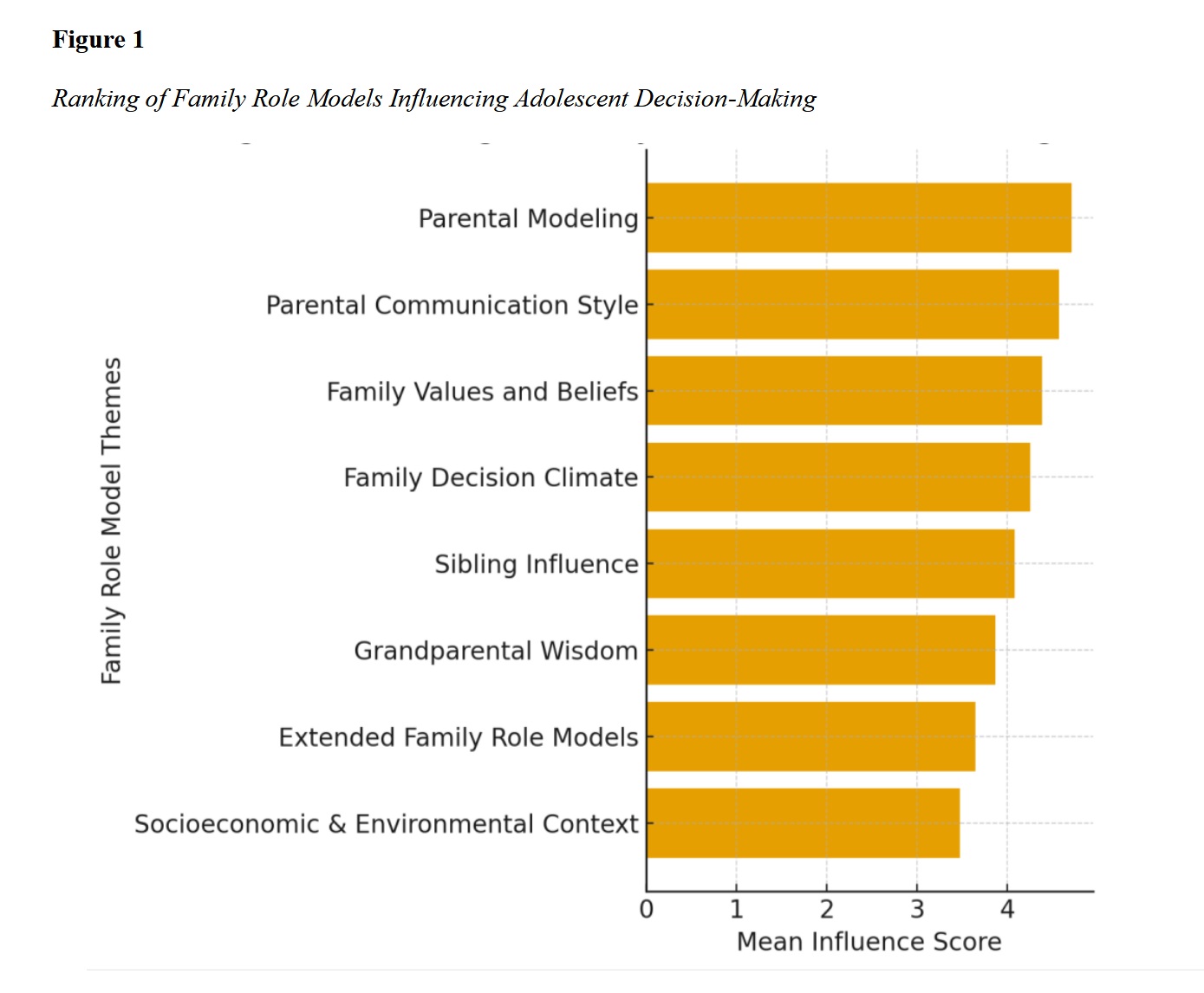
Methods and Materials: The research employed a sequential mixed-method design. In the first phase, a qualitative literature-based analysis was conducted until theoretical saturation was achieved. Using NVivo 14, eight major themes were identified, representing the primary family role models influencing adolescents’ decision-making: parental modeling, sibling influence, grandparental wisdom, extended family role models, parental communication style, family values and beliefs, family decision climate, and socioeconomic context. In the second phase, a quantitative ranking survey was administered to 200 adolescents in Italy, who evaluated the importance of each theme using a 5-point Likert scale. Data were analyzed with SPSS 26 using descriptive statistics, Friedman’s test, and Kendall’s W to assess agreement among participants.
Findings: The analysis revealed significant differences among the ranked family role model themes (p < 0.001). Parental modeling received the highest mean score (M = 4.72, SD = 0.41), followed by parental communication style (M = 4.58) and family values and beliefs (M = 4.39). Socioeconomic and environmental context ranked lowest (M = 3.48). Kendall’s W coefficient of 0.84 indicated a high level of consensus among participants regarding the hierarchy of family influences.
Conclusion: The study concludes that family influence on adolescent decision-making is primarily shaped by direct behavioral and emotional modeling within supportive, communicative, and value-oriented households. Strengthening family dynamics through targeted mentoring and communication-focused interventions may enhance adolescents’ decision-making competence and moral reasoning.
Downloads
References
Atif, H., Peck, L., Connolly, M., Endres, K., Musser, L., Shalaby, M., Lehman, M., & Olympia, R. P. (2022). The Impact of Role Models, Mentors, and Heroes on Academic and Social Outcomes in Adolescents. Cureus. https://doi.org/10.7759/cureus.27349
Azh, N., Zeighami, R., Ataei, T., & Mafi, M. (2020). The Study of the Relationship Between Parenting Styles and Risk-Taking in Adolescents in Only-Child Families in Qazvin City. International Journal of Adolescent Medicine and Health, 33(3), 235-243. https://doi.org/10.1515/ijamh-2019-0074
Bahar, O. S., Sssewamala, F. M., Namuwonge, F., Abdella, M., Kizito, S., Namuli, F., & Nabunya, P. (2024). A Mixed Methods Study of Multilevel Factors Influencing Sexual Risk-Taking Behaviors Among Adolescent Girls in Uganda. Journal of Adolescent Research. https://doi.org/10.1177/07435584241268476
Billingsley, J. T., Rivens, A. J., Charity‐Parker, B. M., Chang, S. H., Garrett, S. L., Li, T., & Hurd, N. M. (2021). Familial Mentor Support and Black Youths’ Connectedness to Parents Across Adolescence. Youth & Society, 54(4), 547-572. https://doi.org/10.1177/0044118x211058215
Bishop, C. (2022). “She Is Always Doing the Work". Advances in Social Work, 21(4), 1161-1177. https://doi.org/10.18060/24620
Carolo, D., Carvalho, R. M., Batalha, C., Gouveia, S., & Lebre, P. (2023). Integrating Middle East and North Africa Unaccompanied Minors Refugees and Asylum Seekers Through Mentoring: Exploring Eu-Based Research to Inform Future Applications in Portugal. https://doi.org/10.20944/preprints202208.0363.v2
Charity‐Parker, B. M., Negrete, A., Deutsch, N. L., & Hurd, N. M. (2023). A Mixed Method Investigation of Associations Between Caregiver Attachment and Natural Mentoring Relationships Among Black Adolescents. Journal of Adolescent Research, 40(4), 948-981. https://doi.org/10.1177/07435584231189213
Dam, L. v., Rhodes, J. E., & Spencer, R. (2021). Youth-Initiated Mentoring as a Scalable Approach to Addressing Mental Health Problems During the COVID-19 Crisis. JAMA Psychiatry, 78(8), 817. https://doi.org/10.1001/jamapsychiatry.2021.0490
Dam, L. v., & Schwartz, S. E. O. (2020). Cultivation of Natural Mentors to Strengthen Resiliency in Youth: A Program Theory of Youth Initiated Mentoring (YIM). Journal of Social Intervention Theory and Practice, 29(1), 3. https://doi.org/10.18352/jsi.623
Dou, K., Wang, L., Cheng, D. L., Li, Y., & Zhang, M. C. (2022). Longitudinal Association Between Poor Parental Supervision and Risk‐taking Behavior: The Role of Self‐control and School Climate. Journal of adolescence, 94(4), 525-537. https://doi.org/10.1002/jad.12043
Dove, L. M. (2022). Black Youths’ Perspectives: Importance of Family and Caregiver Involvement in the Mentor–Mentee Relationship. Healthcare, 10(11), 2181. https://doi.org/10.3390/healthcare10112181
Fransiska Anita Ekawati Rahayu, S. p., Regar, J. C., & Tandiayu, V. R. (2023). The Relationship Between Family Roles and Prevention and Risk of Non-Communicable Diseases in Adolescents. Jurnal Mutiara Ners, 6(2), 143-150. https://doi.org/10.51544/jmn.v6i2.3524
Fryt, J., Szczygieł, M., & Duell, N. (2021). Positive and Negative Risk Taking in Adolescence: Age Patterns and Relations to Social Environment. New directions for child and adolescent development, 2021(179), 127-146. https://doi.org/10.1002/cad.20431
Gorina, A. L., Lunkov, D. R., Sergreeva, E. S., & Trusovich, N. V. (2022). Experience in Implementing the Author’s Concept of the Direction «Mentoring: Individual Personal and Professional Support for Adolescents at Risk», Carried Out Within the Framework of the Project «Ecosystem of Childhood». Bulletin of Psychological Practice in Education, 18(4), 78-87. https://doi.org/10.17759/bppe.2021180408
Gunlicks‐Stoessel, M., Weiler, L. M., Rydberg, K., He, Y., & Reigstad, K. (2025). Rural Adolescents’ and Parents’ Attitudes Toward Types of Mental Health Services and Supports. Rural Mental Health, 49(3), 311-318. https://doi.org/10.1037/rmh0000292
Harder, A., Eenshuistra, A., & Knorth, E. J. (2021). Feeling Better: Experiences and Needs of Adolescents and Professionals Regarding Their Mentoring Relationship in Residential Youth Care. Child & Youth Care Forum, 51(3), 613-631. https://doi.org/10.1007/s10566-021-09645-x
Jia, X., Zhu, H., Sun, G., Meng, H., & Zhao, Y. (2021). Socioeconomic Status and Risk-Taking Behavior Among Chinese Adolescents: The Mediating Role of Psychological Capital and Self-Control. Frontiers in psychology, 12. https://doi.org/10.3389/fpsyg.2021.760968
Junaid, S., Batool, S. S., Nazir, R., & Nayyar, A. (2025). Relationship Between Peer Pressure and Risk Taking Behavior Among Adolescents: Moderating Role of Family Functioning. Res. J. Social Affairs, 3(1), 121-128. https://doi.org/10.71317/rjsa.003.01.0056
Kholifah, S. N., Minarti, M., Sulistijino, H., & Kumala, F. (2022). Family Empowerment as an Effort to Prevent Hypertension in the Adolescent Group in the Working Area of the Kebonsari Health Center Surabaya. Journal of Community Service and Empowerment, 3(1), 26-31. https://doi.org/10.22219/jcse.v3i1.18359
Maepa, M. P., & Ntshalintshali, T. (2020). Family Structure and History of Childhood Trauma: Associations With Risk-Taking Behavior Among Adolescents in Swaziland. Frontiers in Public Health, 8. https://doi.org/10.3389/fpubh.2020.563325
Park, Y., Wood, B. M., Crutchfield, J., & Park, K. (2024). Built Environment and Anxiety Among Adolescents: To What Extent Can Resilient Family Protect Youth? Families in Society the Journal of Contemporary Social Services. https://doi.org/10.1177/10443894241265530
Rice, T., & Sher, L. (2021). The Men’s Mental Health Perspective on Adolescent Suicide in the COVID-19 Era. Acta Neuropsychiatrica, 33(4), 178-181. https://doi.org/10.1017/neu.2021.10
Sari, D. P. (2024). Role SOS Children Village Through Family Strengthening Programs in the Development of Children and Adolescents. Ijis, 110-120. https://doi.org/10.71039/istifham.v2i2.45
Schnettler, S., & Steinbach, A. (2022). Is Adolescent Risk Behavior Associated With Cross-Household Family Complexity? An Analysis of Post-Separation Families in 42 Countries. Frontiers in Sociology, 7. https://doi.org/10.3389/fsoc.2022.802590
Sulimani‐Aidan, Y., Schwartz-Tayri, T. M., & Melkman, E. (2020). Future Expectations of Adolescents: The Role of Mentoring, Family Engagement, and Sense of Belonging. Youth & Society, 53(6), 1001-1020. https://doi.org/10.1177/0044118x20920081
Tian, Y. (2024). Risk Taking in Adolescents and Relevant Factors. Journal of Education Humanities and Social Sciences, 40, 54-59. https://doi.org/10.54097/3kh7q066
Tschorn, M., Lorenz, R. C., O’Reilly, P. F., Reichenberg, A., Garavan, H., Robbins, T. W., Dalley, J. W., Subramaniam, N., Theobald, D., Mann, K., Bach, C., Struve, M., Banaschewski, T., Flor, H., Rietschel, M., Spanagel, R., Nees, F., Fauth‐Bühler, M., Millenet, S., . . . Tahmasebi, A. (2021). Differential Predictors for Alcohol Use in Adolescents as a Function of Familial Risk. Translational psychiatry, 11(1). https://doi.org/10.1038/s41398-021-01260-7
Vengurlekar, I. N., Steggerda, J. C., Brown, M., Kiefer, J. L., & Cavell, T. A. (2022). Informal Mentoring Support as a Potential Moderator of the Relation Between Adolescent Dating Violence Victimization and Substance Use. Journal of Community Psychology, 51(3), 1335-1344. https://doi.org/10.1002/jcop.22968
Wati, N. K. (2025). Upaya Pendampingan Untuk Mengurangi Pengaruh Minuman Keras Di Kalangan Remaja Desa Janapria. J. Comm. Dev. Empower., 1(3), 55-59. https://doi.org/10.70716/jocdem.v1i3.179
Wilhelm, A. K., Pratt, R., & Allen, M. (2021). Key Informant Perspectives on Somali Adolescent Tobacco Use: Contextualizing Influences and Prevention Opportunities. Health Education & Behavior, 49(2), 304-312. https://doi.org/10.1177/10901981211052892
Young, W. B. (2020). It Takes a Village: Mentors, Colleagues, Family, and Friends. ACS Medicinal Chemistry Letters, 11(3), 214-216. https://doi.org/10.1021/acsmedchemlett.9b00449
Downloads
Additional Files
Publication Timeline
- Submitted
- Revised
- Accepted



