
Predicting Adolescent Risk Behavior via Family Monitoring, Sensation Seeking, and Peer Deviance with Machine Learning Analysis
DOI:
https://doi.org/10.61838/kman.jprfc.5335Keywords:
Adolescent Risk Behavior, Family Monitoring, Sensation Seeking, Peer Deviance, Machine Learning, Predictive ModelingAbstract
Objective: The present study aimed to predict adolescent risk behavior by examining the combined effects of family monitoring, sensation seeking, and peer deviance using machine learning analytical approaches.
Methods and Materials: This cross-sectional predictive study was conducted among 512 adolescents aged 14 to 18 years recruited from secondary schools in Tunisia using multistage cluster random sampling. Data were collected using standardized self-report instruments, including the Youth Risk Behavior Surveillance Questionnaire, the Parental Monitoring Scale, the Brief Sensation Seeking Scale, and the Peer Delinquency Scale, all of which demonstrated acceptable reliability and validity. Statistical analyses were performed using SPSS-27 to compute descriptive indices and Pearson correlations. Machine learning models, including random forest, support vector machine, gradient boosting, and multilayer perceptron neural networks, were implemented in Python. Data preprocessing included normalization and feature scaling, and model performance was evaluated using k-fold cross-validation and metrics such as accuracy, precision, recall, F1-score, and area under the ROC curve.
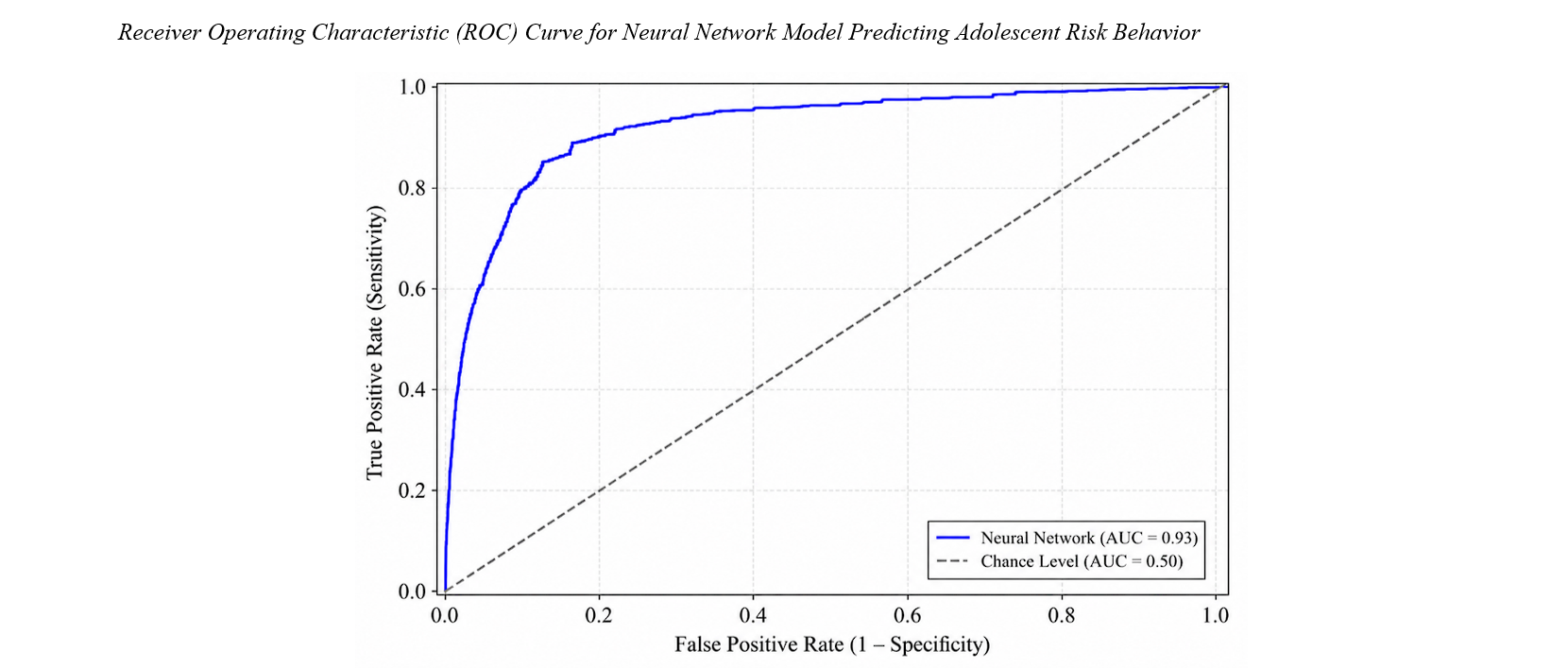
Findings: The results revealed that adolescent risk behavior was significantly negatively associated with family monitoring and positively associated with sensation seeking and peer deviance. Among the predictive models, the neural network demonstrated the highest performance, achieving the greatest accuracy and discriminative power. Feature importance analyses consistently identified peer deviance as the strongest predictor of risk behavior, followed by sensation seeking, while family monitoring showed a weaker but still significant contribution. The models indicated that nonlinear interactions among predictors significantly improved prediction accuracy compared to linear approaches.
Conclusion: The findings highlight the critical role of peer deviance and sensation seeking in shaping adolescent risk behavior, while confirming the protective function of family monitoring. The superior performance of machine learning models underscores their utility in capturing complex behavioral patterns and enhancing predictive precision.
Downloads
References
Cavanagh, C. (2022). Healthy Adolescent Development and the Juvenile Justice System: Challenges and Solutions. Child Development Perspectives, 16(3), 141-147. https://doi.org/10.1111/cdep.12461
Cioban, S., Lazăr, A., Bacter, C., & Hatos, A. (2021). Adolescent Deviance and Cyber-Deviance. A Systematic Literature Review. Frontiers in psychology, 12. https://doi.org/10.3389/fpsyg.2021.748006
Couture, S., Hébert, S. T., Laurier, C., Monette, S., Hélie, S., & Lafortune, D. (2021). Profile of Runaway Youths From Residential Care Centers: Variation in Risk‐Taking Propensity. Journal of Research on Adolescence, 32(1), 355-371. https://doi.org/10.1111/jora.12612
Datchi, C. C. (2022). The Ecology of Delinquency and Crime. 43-65. https://doi.org/10.1037/0000285-004
Deitzer, J. R., Frankenhuis, W. E., Jacobsen, W. C., Ribeaud, D., Eisner, M., Feinberg, M. E., & Gelder, J. L. v. (2024). Why Do Harsh and Unpredictable Environments Lead to Delinquency? The Case for Unpredictability Schemas and Short-Term Mindsets. Journal of Research in Crime and Delinquency, 62(1), 136-193. https://doi.org/10.1177/00224278241275573
Deitzer, J. R., Frankenhuis, W. E., Ribeaud, D., Eisner, M., & Gelder, J. L. v. (2024). Effect of Early Interactions With the Police on Intertemporal Choice: A Longitudinal Study of Zurich Public School Students. Crime & Delinquency, 71(9), 3094-3127. https://doi.org/10.1177/00111287241264224
Farrington, D. P., & Bergstrøm, H. (2021). High Resting Heart Rate Protects Against Childhood Risk Factors in Predicting Adult Psychopathy. Journal of Criminal Psychology, 11(2), 141-156. https://doi.org/10.1108/jcp-01-2021-0003
Fine, A., Fix, R. L., Toro, J. D., & Jackson, D. B. (2023). Great Expectations: The Importance of Procedural Justice and Parenting for Perceptions of Success Among Youth on Probation. Criminal Justice and Behavior, 51(1), 127-147. https://doi.org/10.1177/00938548231206837
Friedman, A. L., Taraban, L., Sitnick, S. L., & Shaw, D. S. (2021). Early Adolescent Predictors of Violent Behavior: Child and Contextual Risk, and Moderation by Rejecting Parenting. The Journal of Early Adolescence, 41(8), 1228-1254. https://doi.org/10.1177/02724316211002268
Gottfredson, N. C., Reyes, H. L. M., & Wu, J. C. (2021). Predictive Associations Between Adolescent Profiles of Violent and Nonviolent Deviant Behavior With Convictions in Adulthood. Journal of interpersonal violence, 37(13-14), NP12207-NP12237. https://doi.org/10.1177/0886260521997453
Jensen, M., Weinstein, M., Brown, M. T., & Navarro, J. (2022). Digital Media in Adolescent Health Risk and Externalizing Behaviors. 264-299. https://doi.org/10.1017/9781108976237.015
Jose, R., Hipp, J. R., Butts, C. T., Wang, C., & Lakon, C. M. (2021). A Multi-Contextual Examination of Non-School Friendships and Their Impact on Adolescent Deviance and Alcohol Use. PLoS One, 16(2), e0245837. https://doi.org/10.1371/journal.pone.0245837
Kübel, S. L., Deitzer, J. R., Frankenhuis, W. E., Ribeaud, D., Eisner, M., & Gelder, J. L. v. (2024). Beyond the Situation: Hanging Out With Peers Now Is Associated With Short-Term Mindsets Later. Journal of Developmental and Life-Course Criminology, 10(1), 51-72. https://doi.org/10.1007/s40865-024-00249-2
Liu, D., & Vazsonyi, A. T. (2023). Longitudinal Links of Parental Solicitation, Knowledge, and Peer Approval With Deviance During Early Adolescence. Journal of Research on Adolescence, 33(4), 1098-1114. https://doi.org/10.1111/jora.12859
Mahbub, F., & Rahman, Z. U. (2023). The Rationale for Initiation and Continuation of Drug Abuse Among Female Users: A Study of the Youth in Dhaka City. Social Science Review, 40(1), 21-39. https://doi.org/10.3329/ssr.v40i1.69071
Mazza, M., Lisci, F. M., Marzo, E. M., Masi, V. D., Abate, F., & Marano, G. (2025). Why Do They Do It? The Psychology Behind Antisocial Behavior in Children and Adolescents. Pediatric Reports, 17(2), 26. https://doi.org/10.3390/pediatric17020026
Moore, J. A., Tam, L. Y. C., & Allen, J. L. (2024). When Being Bad Feels Good: A Systematic Review of the Relationship Between Positive Emotion and Antisocial Behavior in Children and Adolescents. Clinical Child and Family Psychology Review, 27(3), 832-862. https://doi.org/10.1007/s10567-024-00493-4
Oliveira, N. A. (2025). Gender Differences in Self-Control and Offending in Brazilian Adolescents. Journal of Contemporary Criminal Justice. https://doi.org/10.1177/10439862251385375
Osgood, D. L. (2023). Delinquency, Unstructured Socializing, and Social Change: The Rise and Fall of a Teen Culture of Independence. Criminology, 61(4), 681-704. https://doi.org/10.1111/1745-9125.12358
Ouellet, M., Daigle, L. E., & Gallupe, O. (2022). Deviant Peers: Does Friendship Stability Condition the Peer-Delinquency Link? European Journal of Criminology, 20(3), 1123-1145. https://doi.org/10.1177/14773708221128293
Qamar, F., & Qurat-ul-ain, A. (2023). Impulsivity, Sensation-Seeking, Emotional Neglect, and Delinquent Behavior Among Pakistani E-Cigarette Users. Journal of Professional & Applied Psychology, 4(3), 400-417. https://doi.org/10.52053/jpap.v4i3.213
Qu, J., Wu, Y., & Chen, X. (2021). Self-Control, Risky Lifestyles, and Victimization Among Chinese Adolescents. International journal of offender therapy and comparative criminology, 66(16), 1837-1861. https://doi.org/10.1177/0306624x211027487
Sasson, H., Tur‐Sinai, A., Dvir, K., & Harel‐Fisch, Y. (2022). The Role of Parents and Peers in Cyberbullying Perpetration: Comparison Among Arab and Jewish and Youth in Israel. Child Indicators Research, 16(2), 717-737. https://doi.org/10.1007/s12187-022-09986-6
Vaughan, E. P., Speck, J. S., Frick, P. J., Robertson, E., Ray, J. V., Thornton, L. C., Myers, T. D. W., Steinberg, L., & Cauffman, E. (2022). Longitudinal Associations of Parental Monitoring and Delinquent Peer Affiliation: The Potential Influence of Parental Solicitation and Monitoring Rules. Journal of adolescence, 94(4), 656-666. https://doi.org/10.1002/jad.12054
Wallner, S., Stemmler, M., & Reinecke, J. (2020). The Contributions of Propensity, Delinquent Peers, Low Parental Supervision, and Empathy to the Emergence of Antisocial Behavior in Childhood and Adolescence: Testing Developmental Path Models Combining Psychological- And Sociological-Criminological Approaches. International Journal of Developmental Science, 14(3-4), 99-112. https://doi.org/10.3233/dev-200285
Wilhoit, S. A., & Goodnight, J. A. (2022). Deviant Peer Affiliation Mediates the Prospective Association From Impulsivity to Alcohol Use in Late Adolescence. Journal of adolescence, 95(3), 454-467. https://doi.org/10.1002/jad.12127
Wojciechowski, T. (2021). The Relevance of the Dual Systems Model for Predicting Offending Among College Students: The Moderating Role of Deviant Peer Influence. Criminal Justice Review, 47(3), 318-333. https://doi.org/10.1177/07340168211036934
Yim, H.-N. (2020). The Differential Relationship Between Self-Control and Peer Influences Over Time: Toward an Integrative Model of Offending Using a Dual-Systems Approach. Crime & Delinquency, 67(12), 1903-1934. https://doi.org/10.1177/0011128720977448
Zedaker, S. B., Fansher, A. K., & Goodson, A. (2024). Sex Differences in the Influence of Relationships on Adolescent Offending. Social Sciences, 13(5), 270. https://doi.org/10.3390/socsci13050270
Downloads
Additional Files
Publication Timeline
- Submitted
- Revised
- Accepted



