
Machine Learning Identification of Cultural Value Systems Using Collectivism, Power Distance, and Uncertainty Avoidance
DOI:
https://doi.org/10.61838/kman.jprfc.5346Keywords:
Cultural Value Systems, Collectivism, Power Distance, Uncertainty Avoidance, Cultural PsychologyAbstract
Objective: The present study aimed to identify and model latent cultural value system profiles using machine learning techniques based on collectivism, power distance, and uncertainty avoidance.
Methods and Materials: This study employed a cross-sectional, descriptive–analytical design with a predictive modeling approach. The sample consisted of 512 adult participants from Canada selected through stratified random sampling to ensure demographic and cultural diversity. Data were collected using standardized instruments measuring collectivism, power distance, and uncertainty avoidance, all of which demonstrated established validity and reliability in prior research. After data preprocessing, including normalization and handling of missing values, both supervised and unsupervised machine learning techniques were applied. Classification models included support vector machines, random forest, gradient boosting, and logistic regression, while k-means clustering was used to identify latent cultural profiles. Model evaluation was conducted using stratified k-fold cross-validation, with performance metrics including accuracy, precision, recall, F1-score, and AUC-ROC. Feature importance and interpretability were assessed using SHAP analysis.
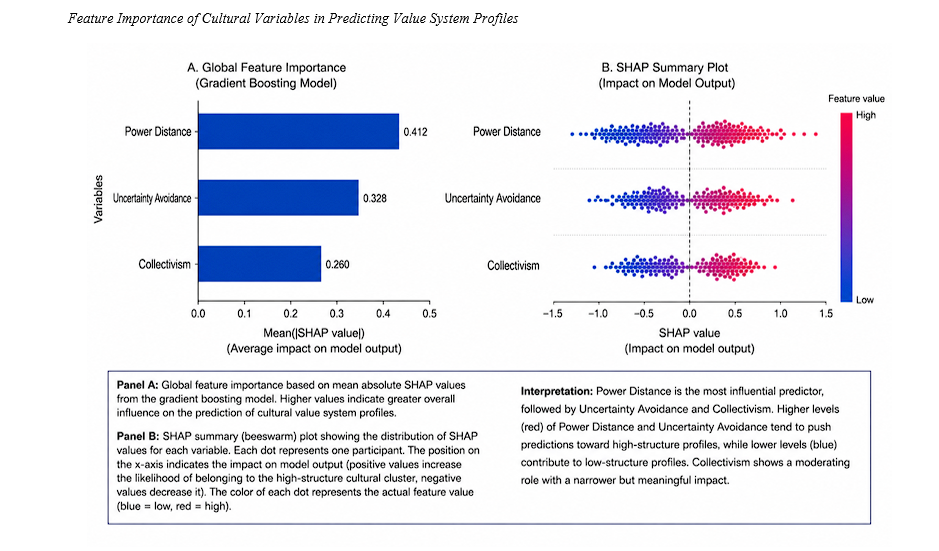
Findings: The results indicated significant positive associations among collectivism, power distance, and uncertainty avoidance (p < 0.01). Among classification models, gradient boosting demonstrated the highest predictive performance (AUC-ROC = 0.927), followed by random forest (AUC-ROC = 0.912), indicating strong model discrimination. Logistic regression showed comparatively lower performance, suggesting the presence of nonlinear relationships among variables. Clustering analysis identified three distinct cultural profiles characterized by low, moderate, and high levels of the examined dimensions. Feature importance analysis revealed that power distance was the strongest predictor of cultural profile classification, followed by uncertainty avoidance and collectivism.
Conclusion: The study underscores the importance of power distance and uncertainty avoidance in shaping cultural profiles and supports the utility of advanced computational methods in cultural research.
Downloads
References
Asiedu, E. A., Ohemeng, F., Obuobisa‐Darko, T., & Parku, K. (2023). The Persistence of Organizational Performance Problems the Public Services in Ghana: The Perspective of Societal Culture. International Journal of Cross Cultural Management, 23(2), 443-466. https://doi.org/10.1177/14705958231190825
Bonjeer, T., & Voňková, H. (2023). Relationships Between Response Styles and the Hofstede and GLOBE Dimensions of Culture in a Sample of Adolescents From 33 Countries. Cross-Cultural Research, 58(2-3), 180-207. https://doi.org/10.1177/10693971231203759
Casais, B., & Cardoso, C. (2023). Cosmopolitan Tourists in P2P Accommodation: An Exploratory Study of Online Reviews on Airbnb. Tourism and Hospitality Research, 25(3), 375-386. https://doi.org/10.1177/14673584231218105
Chen, Y., & Biswas, M. I. (2022). Impact of National Culture on the Severity of the COVID-19 Pandemic. Current Psychology, 42(18), 15813-15826. https://doi.org/10.1007/s12144-022-02906-5
Dhingra, D., Srivastava, S., & Srivastava, N. (2024). Psychometric Validation of the Scale of Individual Cultural Values (CVSCALE) in Indian Context (Private and Public Leaders in Indian Organizations). Journal of Ecohumanism, 3(4), 2238-2251. https://doi.org/10.62754/joe.v3i4.3749
Geng, P., & Tan, Q. (2021). Cultural Values, Economic Growth, and International Ipo Underpricing: Evidence From Chinese Companies. Journal of Business Economics and Management, 22(2), 537-556. https://doi.org/10.3846/jbem.2021.13914
Lee, H.-S., Chernikov, S. U., Nagy, S., & Degtereva, E. A. (2022). The Impact of National Culture on Innovation: A Comparative Analysis Between Developed and Developing Nations During the Pre- And Post-Crisis Period 2007–2021. Social Sciences, 11(11), 522. https://doi.org/10.3390/socsci11110522
Li, W., & Liu, L. (2024). Study on the Impact of Cultural Differences on Sino-Us Business Negotiations Under the Guidance of Cultural Dimensions Theory. Journal of Education and Educational Research, 11(1), 70-73. https://doi.org/10.54097/rt3f5f85
Ma, J., Gong, Y., & Xu, W. (2024). Predicting User Preference for Innovative Features in Intelligent Connected Vehicles From a Cultural Perspective. World Electric Vehicle Journal, 15(4), 130. https://doi.org/10.3390/wevj15040130
Mandela, K. (2024). Influence of Cultural Differences on Global PR Campaigns. Journal of Public Relations, 3(1), 52-63. https://doi.org/10.47941/jpr.1775
Mohamed, Z. A. (2024). The Impact of Individualism/Collectivism and Masculinity/Femininity on Brand Loyalty: A Mediation Role of Perceived Ease of Use. Icrbme, 1(1), 1-13. https://doi.org/10.33422/icrbme.v1i1.191
Moradi, E. (2024). Examining Hofstede’s Cultural Dimensions in Iranian and Chinese Context: A Mixed Methods Approach. Innovare Journal of Education, 6-14. https://doi.org/10.22159/ijoe.2024v12i2.50259
Muchsini, B., & Siswandari, S. (2020). Class Culture and the Academic Stress of Digital Natives Generations. Jurnal Cakrawala Pendidikan, 39(1), 102-110. https://doi.org/10.21831/cp.v39i1.26910
Offiah, G., Schofield, S., & Rees, C. E. (2025). Using Hofstede's Framework to Explore Surgical Cultures and Their Impact on Female Surgeons. Academic Medicine, 59(10), 1067-1078. https://doi.org/10.1111/medu.15726
Paul, A., Ahmed, S., & Zaluski, K. (2021). Does Online Dating Promotion Vary Across Cultures? A Cross-Cultural Analysis of Homepage Advertisements of Online Dating Services in 51 Countries. Journal of Creative Communications, 17(2), 179-198. https://doi.org/10.1177/09732586211060010
Pérez‐Cornejo, C., Puente, E. d. Q., & García, J. B. D. (2021). The Role of National Culture as a Lens for Stakeholder Evaluation of Corporate Social Performance and Its Effect on Corporate Reputation. BRQ Business Research Quarterly, 26(4), 282-296. https://doi.org/10.1177/23409444211007487
Polatcan, M., Bellibaş, M. Ş., & Apaydın, Ç. (2025). Cultural and Psychological Dynamics in School Leadership: The Moderating Role of Trust in the Relationship Between Teachers' Cultural Values and Their Expectations for Paternalistic Leadership. European Journal of Education, 60(1). https://doi.org/10.1111/ejed.70002
Rajkumar, R. P. (2023). The Influence of Cultural and Religious Factors on Cross-National Variations in the Prevalence of Chronic Back and Neck Pain: An Analysis of Data From the Global Burden of Disease 2019 Study. Frontiers in Pain Research, 4. https://doi.org/10.3389/fpain.2023.1189432
Riaz, W., Gul, S., & Lee, Y. (2023). The Influence of Individual Cultural Value Differences on Pro-Environmental Behavior Among International Students at Korean Universities. Sustainability, 15(5), 4490. https://doi.org/10.3390/su15054490
Santi, D. E. (2020). Cross-Cultural Conflict in a Multinational Company (Case of Japanese Company in Indonesia). https://doi.org/10.2991/assehr.k.200818.017
Shamsabadi, E. A., Savabi-Esfahani, M., & Hashemianfar, A. (2020). Relationships of Cultural Dimensions and Lactation Patterns. https://doi.org/10.21203/rs.2.20030/v1
Shen, X., Zhao, Y., Yu, J., & Yu, M. (2024). Chinese Young Consumers’ Response to Negative Brand Information of Electric Vehicles – Do Personal Cultural Values Matter? Young Consumers Insight and Ideas for Responsible Marketers, 25(4), 483-506. https://doi.org/10.1108/yc-07-2023-1796
Tandra, T. A., & Rofil, L. E. F. (2023). Cultural Dimensions and Intercultural User Interface Design (IUID) in a Learning Management System: Indonesian and International Student Perspectives. E3s Web of Conferences, 426, 01100. https://doi.org/10.1051/e3sconf/202342601100
Tong, F. (2024). Which Dimensions of Culture Matter for Central Bank Independence? International Evidence. International Review of Finance, 24(2), 291-333. https://doi.org/10.1111/irfi.12451
Venkatesh, V., Davis, F. D., & Zhu, Y. (2022). A Cultural Contingency Model of Knowledge Sharing and Job Performance. Journal of Business Research, 140, 202-219. https://doi.org/10.1016/j.jbusres.2021.07.042
Wan Abdul Rahim Wan Mohd, I., Suhaimi, A. I. H., Noordin, N., & Safiq, M. S. M. (2020). The Influence of Islamic Culture on Information Privacy: Case of Malaysia’s Computer Professionals. Indonesian Journal of Electrical Engineering and Computer Science, 20(2), 910. https://doi.org/10.11591/ijeecs.v20.i2.pp910-916
Wang, J. (2025). Similar Platforms, Different Values: The Presentation of Values in Chinese and American Social Media Privacy Policies and Terms of Service. Sage Open, 15(4). https://doi.org/10.1177/21582440251390630
Wang, Q., Chau, M., Peng, C.-H., & Ngai, E. W. (2021). Using the Anchoring Effect and the Cultural Dimensions Theory to Study Customers’ Online Rating Behaviors. Information Systems Frontiers, 24(5), 1451-1463. https://doi.org/10.1007/s10796-021-10148-2
Xu, J., & Duan, R. (2023). How Do US Corporations Communicate Interculturally With Their Chinese Stakeholders: Analysis of GM Company’s Social Media Posts From the Cultural Value Perspective. PLoS One, 18(10), e0292552. https://doi.org/10.1371/journal.pone.0292552
Yeganeh, H. (2023). Culture and Innovation: A Human Emancipation Perspective. International Journal of Sociology and Social Policy, 43(11/12), 980-1007. https://doi.org/10.1108/ijssp-07-2022-0185
Zapata, D. I. C., Raineri, A., & Rojas, R. (2022). Cultural Dimensions in Colombia and Chile According to the Spanish Version of the Dorfman and Howell Questionnaire. Sustainability, 14(3), 1623. https://doi.org/10.3390/su14031623
Downloads
Additional Files
Publication Timeline
- Submitted
- Revised
- Accepted



