
Predicting Parenting Inconsistency Using Machine Learning: Executive Dysfunction, Stress Reactivity, and Role Overload
DOI:
https://doi.org/10.61838/kman.jprfc.5348Keywords:
Parenting Inconsistency, Executive Dysfunction, Stress Reactivity, Role OverloadAbstract
Objective: The present study aimed to predict parenting inconsistency using machine learning models based on executive dysfunction, stress reactivity, and role overload among parents.
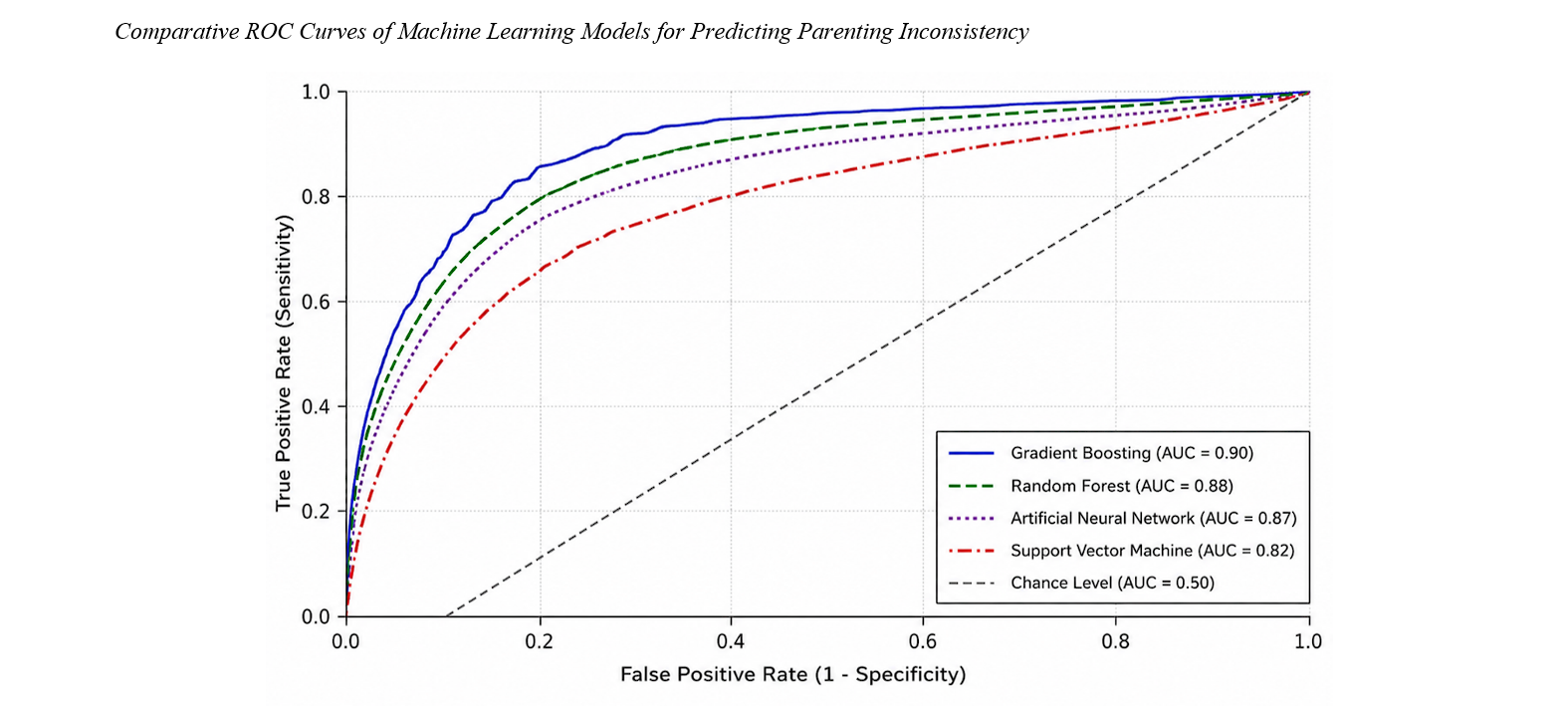
Methods and Materials: This study employed a descriptive–correlational design with a machine learning predictive approach. The statistical population consisted of parents residing in Canada with at least one child aged 6 to 16 years, from which 412 participants were selected using stratified random sampling. Data were collected through standardized self-report instruments, including the Parenting Consistency Scale, the Behavior Rating Inventory of Executive Function–Adult Version (BRIEF-A), the Perceived Stress Reactivity Scale (PSRS), and the Role Overload Scale. Data preprocessing involved normalization, outlier detection, and handling missing values using multiple imputation. Statistical analyses were initially conducted using SPSS-27 to compute descriptive statistics and correlations. Subsequently, machine learning models including Random Forest, Support Vector Machine, Gradient Boosting, and Artificial Neural Networks were implemented using Python-based libraries. Model performance was evaluated using accuracy, mean squared error (MSE), coefficient of determination (R²), and area under the receiver operating characteristic curve (AUC-ROC), with a 70/30 train–test split and cross-validation procedures applied.
Findings: The results indicated that executive dysfunction, stress reactivity, and role overload were all significant positive predictors of parenting inconsistency. Among these variables, executive dysfunction demonstrated the strongest predictive contribution across all models. Machine learning analyses revealed that the Gradient Boosting model achieved the highest performance (Accuracy = 0.86, R² = 0.66, AUC = 0.90), followed by Random Forest (Accuracy = 0.84, R² = 0.62). Artificial Neural Networks showed moderate predictive performance, while Support Vector Machine exhibited comparatively lower explanatory power. Feature importance analyses confirmed that executive dysfunction was the most influential predictor, followed by role overload and stress reactivity.
Conclusion: Integrating executive functioning, stress regulation, and environmental demands within predictive frameworks offers a comprehensive understanding of parenting variability and provides a foundation for developing targeted interventions to promote consistent parenting practices.
Downloads
References
Aluğan, Z. (2024). The Impact of Early Childhood Adversity on Neurodevelopment: A Comprehensive Review. Üha, 11(2), 45-59. https://doi.org/10.32739/uha.jnbs.11.1539116
Blair, C., & Ku, S. (2022). A Hierarchical Integrated Model of Self-Regulation. Frontiers in psychology, 13. https://doi.org/10.3389/fpsyg.2022.725828
Chaudhuri, A., & Gupta, D. K. (2025). Stress, Stress Management, and Dementia: A Narrative Review. Cureus. https://doi.org/10.7759/cureus.94401
Ewing‐Cobbs, L., Danna, C. V., Tolar, T. D., Granger, D. A., Cox, C. S., & Prasad, M. R. (2023). Stress Reactivity After Pediatric Traumatic Brain Injury: Relation With Behavioral Adjustment. Journal of neurotrauma, 40(13-14), 1436-1450. https://doi.org/10.1089/neu.2022.0227
George, M. Y., Mageed, S. S. A., Mansour, D. E., & Fawzi, S. F. (2025). The Cortisol Axis and Psychiatric Disorders: An Updated Review. Pharmacological Reports, 77(6), 1573-1599. https://doi.org/10.1007/s43440-025-00782-x
Ghadimi, T., & McCormack, C. (2025). Executive Functioning in Matrescence and Implications for Perinatal Depression. Frontiers in Psychiatry, 16. https://doi.org/10.3389/fpsyt.2025.1663017
Golden, A. B., Choe, D. E., Hibel, L. C., & Olwert, M. R. (2025). Child Effortful Control Moderates the Link Between Parenting Stress and Child Parasympathetic Regulation: Interactions Across Contexts and Measures. Developmental Psychobiology, 67(4). https://doi.org/10.1002/dev.70059
Goozen, S. H. v., Langley, K., & Hobson, C. (2022). Childhood Antisocial Behavior: A Neurodevelopmental Problem. Annual review of psychology, 73(1), 353-377. https://doi.org/10.1146/annurev-psych-052621-045243
Kelly, M. M., & Sullivan, M. C. (2022). Differential Susceptibility. Advances in nursing science, 46(3), E98-E113. https://doi.org/10.1097/ans.0000000000000433
Kimonis, E. R. (2023). The Emotionally Sensitive Child-Adverse Parenting Experiences-Allostatic (Over)Load (ESCAPE-AL) Model for the Development of Secondary Psychopathic Traits. Clinical Child and Family Psychology Review, 26(4), 1097-1114. https://doi.org/10.1007/s10567-023-00455-2
Kok, R., Luijk, M., Lucassen, N., Prinzie, P., Jongerling, J., Ijzendoorn, M. H. v., Tiemeier, H., & Bakermans‐Kranenburg, M. J. (2022). The Role of Supportive Parenting and Stress Reactivity in the Development of Self-Regulation in Early Childhood. Journal of Child and Family Studies, 31(9), 2424-2435. https://doi.org/10.1007/s10826-022-02360-8
Logue, E., & Nemeroff, C. B. (2025). Sex Differences in the Associations Among Early Life Adversity, Inflammation, and Cognition. Biomolecules, 15(2), 161. https://doi.org/10.3390/biom15020161
Lopez, M., Ruiz, M. O., Rovnaghi, C. R., Tam, G. K., Hiscox, J., Gotlib, I. H., Barr, D. A., Carrión, V. G., & Anand, K. J. S. (2021). The Social Ecology of Childhood and Early Life Adversity. Pediatric research, 89(2), 353-367. https://doi.org/10.1038/s41390-020-01264-x
Marceau, K. (2025). Does Including Multiple Hormones and Family Context Together Clarify Hormone-Behavior Associations? A Systematic Review. Comprehensive Psychoneuroendocrinology, 24, 100326. https://doi.org/10.1016/j.cpnec.2025.100326
Ostrov, J. M., Murray‐Close, D., Perry, K. J., Perhamus, G. R., Memba, G. V., Rice, D. R., & Nowalis, S. (2022). Parenting and Adjustment Problems Among Preschoolers During COVID-19. Journal of Child and Family Studies, 32(1), 93-109. https://doi.org/10.1007/s10826-022-02439-2
Papke, V., Hodges, H. R., Reigstad, K., Gunlicks‐Stoessel, M., & Klimes‐Dougan, B. (2023). A Scoping Review of Potential Biological Mechanisms and Predictors of Interpersonal Psychotherapy. Endocrines, 4(4), 742-756. https://doi.org/10.3390/endocrines4040054
Scott, M. G., Smiley, P. A., Ahn, A., Lazarus, M. F., Borelli, J. L., & Doan, S. N. (2022). A Mother's Touch: Preschool‐aged Children Are Regulated by Positive Maternal Touch. Developmental Psychobiology, 64(2). https://doi.org/10.1002/dev.22243
Shah, S., Laplante, D. P., Atkinson, L., & Wazana, A. (2022). From Temperament and Parenting to Attachment: A Review of the Interplay of Gene and Environment Factors in the Developmental Pathway to Attachment. Current Opinion in Psychiatry, 35(6), 401-408. https://doi.org/10.1097/yco.0000000000000817
Shakiba, N., Gao, M., Conradt, E., Terrell, S., & Lester, B. M. (2022). Parent–child Relationship Quality and Adolescent Health: Testing the Differential Susceptibility and Diathesis-Stress Hypotheses in African American Youths. Child development, 93(1), 269-287. https://doi.org/10.1111/cdev.13667
Squillaci, M., & Benoit, V. (2021). Role of Callous and Unemotional (CU) Traits on the Development of Youth With Behavioral Disorders: A Systematic Review. International journal of environmental research and public health, 18(9), 4712. https://doi.org/10.3390/ijerph18094712
Vaughn, R., & Weisz, J. R. (2021). Leveraging the Developmental Science of Psychosocial Risk to Strengthen Youth Psychotherapy. Development and Psychopathology, 33(2), 670-683. https://doi.org/10.1017/s0954579420002035
Wang, L., Dong, S., Zhao, C., Gao, Z., Jiang, L., Zhang, R., Shen, T., Guo, Y., Zhou, H., & Xu, S. (2023). Association of Stressful Life Events With Cognitive Impairment in Patients With Type 2 Diabetes Mellitus. Journal of Diabetes Investigation, 14(6), 792-800. https://doi.org/10.1111/jdi.14010
Watanabe, K., Imamura, K., Eguchi, H., Hidaka, Y., Komase, Y., Sakuraya, A., Inoue, A., Kobayashi, Y., Sasaki, N., Tsuno, K., Ando, E., Arima, H., Asaoka, H., Hino, A., Iida, M., Iwanaga, M., Inoue, R., Otsuka, Y., Shimazu, A., . . . Tsutsumi, A. (2023). Usage of the Brief Job Stress Questionnaire: A Systematic Review of a Comprehensive Job Stress Questionnaire in Japan From 2003 to 2021. International journal of environmental research and public health, 20(3), 1814. https://doi.org/10.3390/ijerph20031814
Downloads
Additional Files
Publication Timeline
- Submitted
- Revised
- Accepted



