
Predicting Fertility Intentions Using Cultural Norms, Economic Security, and Relationship Satisfaction via a Machine Learning Approach
Keywords:
Fertility intentions, cultural norms, economic security, relationship satisfaction, machine learning, predictive modelingAbstract
Objective: The present study aimed to predict fertility intentions based on cultural norms, economic security, and relationship satisfaction using advanced machine learning techniques.
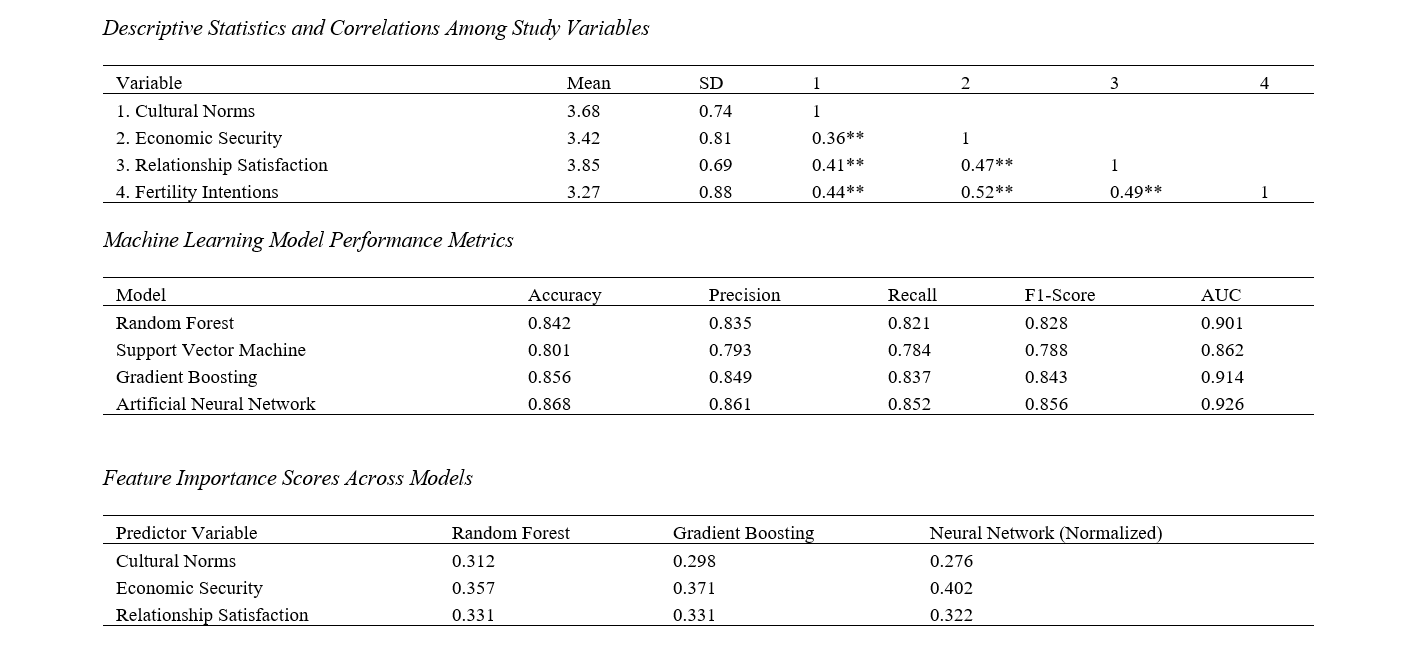
Methods and Materials: This study employed a cross-sectional, predictive-correlational design conducted on 512 adults of reproductive age in South Africa selected through stratified random sampling. Data were collected using standardized instruments including the Cultural Values Scale, Economic Stability Index, Dyadic Adjustment Scale, and a Fertility Intention Scale, all of which demonstrated acceptable validity and reliability in previous studies. Data were analyzed using IBM SPSS-27 for descriptive and correlational analyses, followed by machine learning modeling in Python using Random Forest, Support Vector Machine, Gradient Boosting, and Artificial Neural Network algorithms. Data preprocessing included normalization, missing data imputation, and categorical encoding. Model performance was evaluated using 10-fold cross-validation and metrics including accuracy, precision, recall, F1-score, and area under the ROC curve.
Findings: The results indicated significant positive relationships between cultural norms, economic security, relationship satisfaction, and fertility intentions (p < .01). Among predictors, economic security demonstrated the strongest predictive power, followed by relationship satisfaction and cultural norms. Machine learning results showed that the Artificial Neural Network achieved the highest performance (accuracy = 0.868, AUC = 0.926), followed by Gradient Boosting (accuracy = 0.856, AUC = 0.914) and Random Forest (accuracy = 0.842, AUC = 0.901), while Support Vector Machine showed comparatively lower performance (accuracy = 0.801, AUC = 0.862). Feature importance analysis confirmed the dominant role of economic security across all models.
Conclusion: The superior performance of machine learning models demonstrates their effectiveness in capturing complex, nonlinear relationships among predictors, offering a powerful approach for understanding and predicting reproductive decision-making.
Downloads
References
Bi, M. (2024). Influencing Factors and Coping Strategies of Women's Fertility Intention Under the Guidance of China's Development Policy. Journal of Education Humanities and Social Sciences, 32, 29-34. https://doi.org/10.54097/8qeyne69
Chang, P. Y., Oh, J., & Kim, Y. (2023). Opting Out or Left Out? The Gendered Determinants of Marriage in South Korea. Journal of marriage and family, 86(1), 132-153. https://doi.org/10.1111/jomf.12935
Fakari, F. R., Ghahremani, F., Mahmoodi, Z., & Doulabi, M. A. (2025). The Role of Social Determinants of Health in Woman’s Intention to Pregnancy: A Model With the Mediation of Social Support. BMC public health, 25(1). https://doi.org/10.1186/s12889-025-22223-3
Han, S. W., & Oh, E. (2024). Aligned, Competing, and Blurred: Gender and Family Attitudes in East Asia. Journal of marriage and family, 87(2), 676-700. https://doi.org/10.1111/jomf.13059
K., S., & S., I. (2024). Social and Cultural Implications of Live-in Relationships in India. International Journal for Multidisciplinary Research, 6(3). https://doi.org/10.36948/ijfmr.2024.v06i03.20396
Kapelle, N., Nutz, T., Tisch, D., Schechtl, M., Lersch, P. M., & Struffolino, E. (2022). My Wealth, (Y)Our Life Satisfaction? Sole and Joint Wealth Ownership and Life Satisfaction in Marriage. European Journal of Population / Revue Européenne De Démographie, 38(4), 811-834. https://doi.org/10.1007/s10680-022-09630-7
Karney, B. R. (2021). Socioeconomic Status and Intimate Relationships. Annual review of psychology, 72(1), 391-414. https://doi.org/10.1146/annurev-psych-051920-013658
Kaur, M., & Singh, M. (2025). Money in Couples: A Systematic Literature Review on Intrahousehold Financial Management. International Journal of Consumer Studies, 49(4). https://doi.org/10.1111/ijcs.70100
Kim, D., & Kim, E. H. (2023). Event History Analysis on Cessation of Leisure Activities Among Married South Korean Women From 2007 to 2018. Asia-pacific Journal of Convergent Research Interchange, 9(3), 213-226. https://doi.org/10.47116/apjcri.2023.03.18
Li, C. Y., & He, S. (2024). Too Privileged to Move? Neighbourhood Perception and Relocation Intention in China's Gated Communities. Tijdschrift Voor Economische en Sociale Geografie, 115(5), 691-705. https://doi.org/10.1111/tesg.12616
liao, y. (2025). How Does Digital Life Affect Family Fertility Behavior? — An Analysis Based on CFPS Data of Chinese Families With a Second Child. https://doi.org/10.21203/rs.3.rs-7261191/v1
Lo-oh, J. L. (2023). Conceptions of Marriage Readiness and Marital Quality Indicators for Future Wellbeing Among Emerging Adult Students in the University of Buea, Cameroon. American Journal of Social Sciences and Humanities, 8(1), 16-34. https://doi.org/10.55284/ajssh.v8i1.822
Lo-oh, J. L. (2024). Demographic Criteria for Marriage Readiness and Implications for Future Marital Satisfaction Among Some University-Level Emerging Adults in Cameroon. RHSS. https://doi.org/10.7176/rhss/14-1-08
Mashayekh‐Amiri, S., Molaie, B., Aliasghari, F., Rashidi, F., Hemati, E., & Mirghafourvand, M. (2025). Fertility Knowledge, Desire, and Associated Factors Among Iranian Couples: A Cross-Sectional Study in Northwest Iran. BMC public health, 25(1). https://doi.org/10.1186/s12889-025-22347-6
Mesbah, M., Ghahramani, S., Amani, R., Rahmanipour, E., Ghorbani, M., Sadati, A. K., Sadeghieh, S., & Lankarani, K. B. (2025). Desire for Childbearing in the View of Iranian Parents: A Qualitative Study. PLoS One, 20(8), e0330658. https://doi.org/10.1371/journal.pone.0330658
Mussino, E. (2025). Migrants’ and Natives’ Childbearing Intentions in Sweden During the COVID-19 Pandemic. Sage Open, 15(4). https://doi.org/10.1177/21582440251389549
Park, H. (2021). Introduction to the Special Collection on Family Changes and Inequality in East Asia. Demographic Research, 44, 979-992. https://doi.org/10.4054/demres.2021.44.40
Pathak, B. G., Mburu, G., Habib, N., Kabra, R., Kiarie, J., Chowdhury, R., Dhabhai, N., & Mazumder, S. (2025). Quality of Life and Its Determinants in Women With Delayed Conception in Low-Mid Socioeconomic Neighbourhoods of Northern India: A Cross-Sectional Study. BMJ Public Health, 3(1), e001740. https://doi.org/10.1136/bmjph-2024-001740
Ranjbar, F., Farahani, F. K., Montazeri, S., Taheri, M., Mirghafourvand, M., Sadeghi, T., Darabi, P., & Gharacheh, M. (2025). Factors Affecting the Decision to Become a Parent: A Content Analysis. Health Science Reports, 8(7). https://doi.org/10.1002/hsr2.70972
Ranjbar, M., Zarchi, M. K. R., Heidari, E., Bahariniya, S., Alimondegari, M., Lotfi, M. H., & Shafaghat, T. (2024). What Factors Influence Couples’ Decisions to Have Children? Evidence From a Systematic Scoping Review. BMC Pregnancy and Childbirth, 24(1). https://doi.org/10.1186/s12884-024-06385-3
Umoh, N. R. (2022). Socioeconomic Status and Women’s Mental Health and Wellbeing in Male-Factor Infertility Marital Circumstances: A Scoping Review. https://doi.org/10.1101/2022.10.11.22280950
Wang, Y., & Sun, J. (2025). Age Discrimination, Personal Wellbeing, and Fertility Intentions: Evidence From the 2021 Chinese Social Survey. https://doi.org/10.21203/rs.3.rs-6672477/v1
Wang, Z., & Fan, Z. (2025). Freedom and Cradle: The Impact of Flexible Work on Chinese Women's Fertility Intention. Population Space and Place, 31(7). https://doi.org/10.1002/psp.70111
Yu, J. (2024). Gender Dynamics and Marital Bargaining in the Global South. Sociology Compass, 18(7). https://doi.org/10.1111/soc4.13244
Zhang, G. H., & Cheng, L. (2024). Level of Urbanization, Social Security Satisfaction and Fertility Intentions. Academic Journal of Management and Social Sciences, 7(2), 49-55. https://doi.org/10.54097/hwbcsp51
Downloads
Additional Files
Publication Timeline
- Submitted
- Revised
- Accepted



