
Modeling Substance Use Risk via Family Monitoring, Sensation Seeking, and Peer Deviance
Keywords:
Substance Use Risk, Family Monitoring, Sensation Seeking, Peer Deviance, Adolescents, Structural Equation ModelingAbstract
Objective: The present study aimed to model substance use risk among adolescents by examining the predictive roles of family monitoring, sensation seeking, and peer deviance within an integrated analytical framework.
Methods and Materials: This study employed a quantitative, cross-sectional, correlational design among 472 high school students from urban regions of Ontario, Canada, selected through multistage cluster sampling. Data were collected using standardized self-report instruments, including the Substance Use Risk Profile Scale, the Parental Monitoring Scale, the Brief Sensation Seeking Scale, and a modified Peer Deviance Scale. All instruments demonstrated acceptable validity and reliability in previous research and within the current sample. Data analysis was conducted using IBM SPSS version 27 and AMOS version 24. Descriptive statistics and Pearson correlation coefficients were calculated, followed by multiple regression analysis to examine predictive relationships. Structural equation modeling was used to test the hypothesized model and evaluate direct and indirect effects. Model fit was assessed using standard indices including χ²/df, CFI, TLI, GFI, and RMSEA.
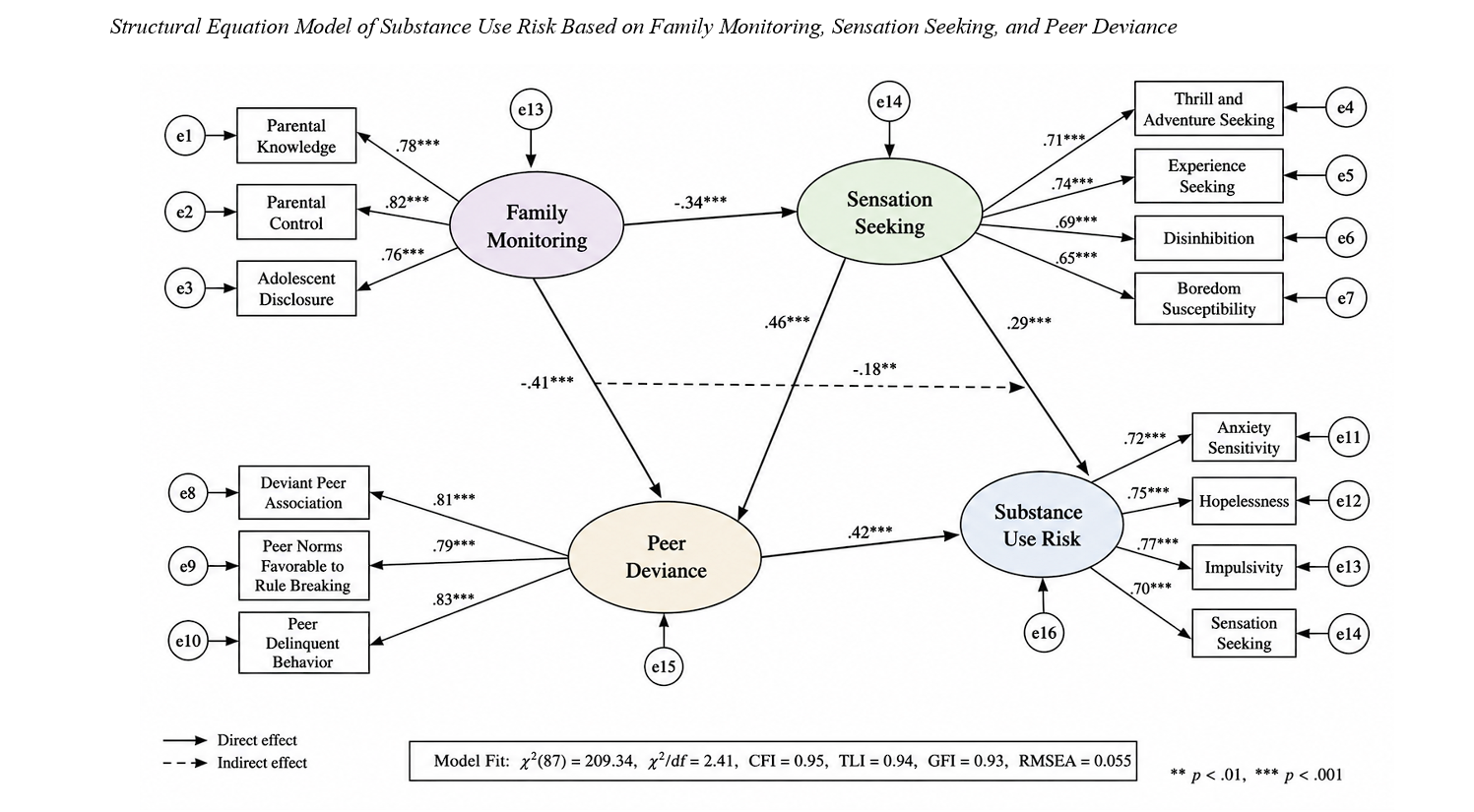
Findings: The results indicated significant relationships among all study variables. Family monitoring was negatively associated with substance use risk (β = -0.31, p < 0.001), while sensation seeking (β = 0.36, p < 0.001) and peer deviance (β = 0.43, p < 0.001) showed positive and significant predictive effects, with peer deviance emerging as the strongest predictor. The overall regression model was significant (F(3, 468) = 132.74, p < 0.001), explaining 46% of the variance in substance use risk. Structural equation modeling demonstrated good model fit (χ²/df = 2.41, CFI = 0.95, TLI = 0.94, GFI = 0.93, RMSEA = 0.055). Indirect effects revealed that family monitoring reduced substance use risk through peer deviance, and sensation seeking partially mediated the relationship between peer deviance and substance use risk.
Conclusion: The findings highlight the multidimensional nature of adolescent substance use risk, emphasizing the combined influence of familial, personality, and peer-related factors. Family monitoring serves as a protective factor, whereas sensation seeking and peer deviance function as significant risk enhancers. Integrative models that consider both individual dispositions and social contexts provide a more comprehensive understanding of substance use risk. These results underscore the importance of developing prevention and intervention strategies that simultaneously target family dynamics, personality traits, and peer environments to effectively reduce substance use risk among adolescents.
Downloads
References
Boccio, C. M. (2023). Low Self-Control, Peer Risk Factors, and Adolescent Vaping Activity. Crime & Delinquency, 70(9), 2514-2531. https://doi.org/10.1177/00111287231160739
Brislin, S. J., Choi, M., & Hicks, B. M. (2024). Characterizing Delinquent Behavior in Early Adolescence: Results From the Adolescent Brain Cognitive Development- Social Development Study. https://doi.org/10.31234/osf.io/5k9aw
Datchi, C. C. (2022). The Ecology of Delinquency and Crime. 43-65. https://doi.org/10.1037/0000285-004
Davis, I., Aks, I. R., Patel, H., Leitz, L., & Pelham, W. E. (2023). How Much Should We Trust Non-Experimental Studies of Parental Monitoring? https://doi.org/10.31234/osf.io/v8947
Deitzer, J. R., Frankenhuis, W. E., Jacobsen, W. C., Ribeaud, D., Eisner, M., Feinberg, M. E., & Gelder, J. L. v. (2024). Why Do Harsh and Unpredictable Environments Lead to Delinquency? The Case for Unpredictability Schemas and Short-Term Mindsets. Journal of Research in Crime and Delinquency, 62(1), 136-193. https://doi.org/10.1177/00224278241275573
Deitzer, J. R., Frankenhuis, W. E., Ribeaud, D., Eisner, M., & Gelder, J. L. v. (2024). Effect of Early Interactions With the Police on Intertemporal Choice: A Longitudinal Study of Zurich Public School Students. Crime & Delinquency, 71(9), 3094-3127. https://doi.org/10.1177/00111287241264224
Grummitt, L., Visontay, R., Clare, P., Slade, T., & Birrell, L. (2025). Multivariable Machine Learning Prediction of Risky Alcohol Use in Contemporary Youth. Addiction. https://doi.org/10.1111/add.70145
Icenogle, G., & Cauffman, E. (2021). Adolescent Decision Making: A Decade in Review. Journal of Research on Adolescence, 31(4), 1006-1022. https://doi.org/10.1111/jora.12608
Jensen, M., Weinstein, M., Brown, M. T., & Navarro, J. (2022). Digital Media in Adolescent Health Risk and Externalizing Behaviors. 264-299. https://doi.org/10.1017/9781108976237.015
Kabiri, S., Sharepour, M., Howell, C. J., Wellen, H., Smith, H. P., Cochran, J. K., Shadmanfaat, S. M., & Andersen, T. S. (2022). Violations of Emergent Norms Regarding COVID-19 Mitigation and Social Hygiene: An Application of Agnew’s General Theory of Crime. Crime & Delinquency, 71(2), 575-610. https://doi.org/10.1177/00111287221130961
Kübel, S. L., Deitzer, J. R., Frankenhuis, W. E., Ribeaud, D., Eisner, M., & Gelder, J. L. v. (2024). Beyond the Situation: Hanging Out With Peers Now Is Associated With Short-Term Mindsets Later. Journal of Developmental and Life-Course Criminology, 10(1), 51-72. https://doi.org/10.1007/s40865-024-00249-2
LaFreniere, L. S., Newman, M. G., & Graham, J. W. (2021). Parental Support and Monitoring Influences on Adolescent Alcohol Use: A Peer Selection Mediation Model. Mental Health and Addiction Research, 6(2). https://doi.org/10.15761/mhar.1000202
Liu, M., Tang, X., Xia, Q., Wu, X., Yang, Y., Hong, X., & Hu, J. (2025). Patterns of Health-Risk Behaviors Among Chinese Adolescents During the COVID-19 Pandemic: A Latent Class Analysis. BMC public health, 25(1). https://doi.org/10.1186/s12889-025-22089-5
Lu, Y. (2024). Examining the Decline in Gender-Specific Youth Offending Since the 1990s: A Decomposition Analysis of Two Cohorts. Crime & Delinquency, 71(13-14), 3940-3966. https://doi.org/10.1177/00111287241290512
Mahbub, F., & Rahman, Z. U. (2023). The Rationale for Initiation and Continuation of Drug Abuse Among Female Users: A Study of the Youth in Dhaka City. Social Science Review, 40(1), 21-39. https://doi.org/10.3329/ssr.v40i1.69071
Michielsen, P. J. S., Spaan, P., Ravensbergen, S. J., Nita, G. M. d. N.-E., Hoogendijk, W. J., Mil, N. H. G., & Roza, S. J. (2024). Puberty Timing and Adolescent Antisocial Behavior: The Role of Callous-Unemotional Traits, Sensation Seeking, and Parental Hostility. International journal of offender therapy and comparative criminology, 69(16), 2338-2358. https://doi.org/10.1177/0306624x241306896
Molina, B. S. G., Joseph, H. M., Kipp, H., Lindstrom, R. A., Pedersen, S. L., Kolko, D. J., Bauer, D. J., & Subramaniam, G. (2021). Adolescents Treated for Attention-Deficit/Hyperactivity Disorder in Pediatric Primary Care: Characterizing Risk for Stimulant Diversion. Journal of Developmental & Behavioral Pediatrics, 42(7), 540-552. https://doi.org/10.1097/dbp.0000000000000923
Murray, A. L., Mirman, J. H., Carter, L., & Eisner, M. (2021). Individual and Developmental Differences in Delinquency: Can They Be Explained by Adolescent Risk-Taking Models? Developmental Review, 62, 100985. https://doi.org/10.1016/j.dr.2021.100985
Negriff, S., Dilkina, B., Matai, L., & Rice, E. (2022). Using Machine Learning to Determine the Shared and Unique Risk Factors for Marijuana Use Among Child-Welfare Versus Community Adolescents. PLoS One, 17(9), e0274998. https://doi.org/10.1371/journal.pone.0274998
Oliveira, N. A. (2025). Gender Differences in Self-Control and Offending in Brazilian Adolescents. Journal of Contemporary Criminal Justice. https://doi.org/10.1177/10439862251385375
Osadolor, O. O., & Onyejaka, N. K. (2022). Substance Abuse and Oral Health of Adolescence. Journal of Nepalese Association of Pediatric Dentistry, 3(1), 44-46. https://doi.org/10.3126/jnapd.v3i1.50065
Osgood, D. L. (2023). Delinquency, Unstructured Socializing, and Social Change: The Rise and Fall of a Teen Culture of Independence. Criminology, 61(4), 681-704. https://doi.org/10.1111/1745-9125.12358
Qamar, F., & Qurat-ul-ain, A. (2023). Impulsivity, Sensation-Seeking, Emotional Neglect, and Delinquent Behavior Among Pakistani E-Cigarette Users. Journal of Professional & Applied Psychology, 4(3), 400-417. https://doi.org/10.52053/jpap.v4i3.213
Riley, B. J., Oster, C., Rahamathulla, M., & Lawn, S. (2021). Attitudes, Risk Factors, and Behaviours of Gambling Among Adolescents and Young People: A Literature Review and Gap Analysis. International journal of environmental research and public health, 18(3), 984. https://doi.org/10.3390/ijerph18030984
Sârbu, E. A., Nadolu, B., Runcan, R., Tomiţă, M., & Lazăr, F. (2022). Social Predictors of the Transition From Anomie to Deviance in Adolescence. PLoS One, 17(6), e0269236. https://doi.org/10.1371/journal.pone.0269236
Sasson, H., Tur‐Sinai, A., Dvir, K., & Harel‐Fisch, Y. (2022). The Role of Parents and Peers in Cyberbullying Perpetration: Comparison Among Arab and Jewish and Youth in Israel. Child Indicators Research, 16(2), 717-737. https://doi.org/10.1007/s12187-022-09986-6
Watts, A. L., Megahan, J. F., Conlin, W., Doss, M. I., & Sher, K. J. (2022). Sociodemographic Differences in Youth Alcohol Sipping's Nomological Network. Alcoholism Clinical and Experimental Research, 46(4), 589-599. https://doi.org/10.1111/acer.14790
Wei, F., & Stere, M. J. (2021). Protective and Risk Factors of Alcohol Use Among Southeastern Pennsylvania Youth. Social Development Issues, 42(3). https://doi.org/10.3998/sdi.17872073.0042.307
Wilhoit, S. A., & Goodnight, J. A. (2022). Deviant Peer Affiliation Mediates the Prospective Association From Impulsivity to Alcohol Use in Late Adolescence. Journal of adolescence, 95(3), 454-467. https://doi.org/10.1002/jad.12127
Zhang, S., Marsiglia, F. F., & Zhang, Y. (2023). Adolescents’ Substance Use Initiation and Transitions Across Alcohol, Tobacco, and Illicit Drugs: A Survival Analysis Approach. Families in Society the Journal of Contemporary Social Services, 105(4), 539-550. https://doi.org/10.1177/10443894231190251
Downloads
Additional Files
Publication Timeline
- Submitted
- Revised
- Accepted



