
Cross-Cultural Prediction of Norm Internalization Using Conformity Pressure, Moral Disengagement, and Social Learning
Keywords:
Norm Internalization, Conformity Pressure, Moral Disengagement, Social Learning, Cross-Cultural Psychology, Machine Learning, Predictive ModelingAbstract
Objective: The present study aimed to predict norm internalization across culturally diverse individuals based on conformity pressure, moral disengagement, and social learning using an integrated statistical and machine learning approach.
Methods and Materials: This study employed a descriptive–correlational design with a predictive modeling framework. The sample consisted of 512 participants from Canada, selected through stratified random sampling to ensure cultural diversity. Data were collected using standardized instruments measuring norm internalization, conformity pressure, moral disengagement, and social learning. Demographic variables were also assessed to control for potential confounding effects. Data analysis was conducted using both classical statistical techniques, including Pearson correlation and multiple regression analysis, and advanced machine learning models such as Random Forest, Support Vector Machine, and Gradient Boosting. Model performance was evaluated using cross-validation procedures and metrics including R², RMSE, and MAE.
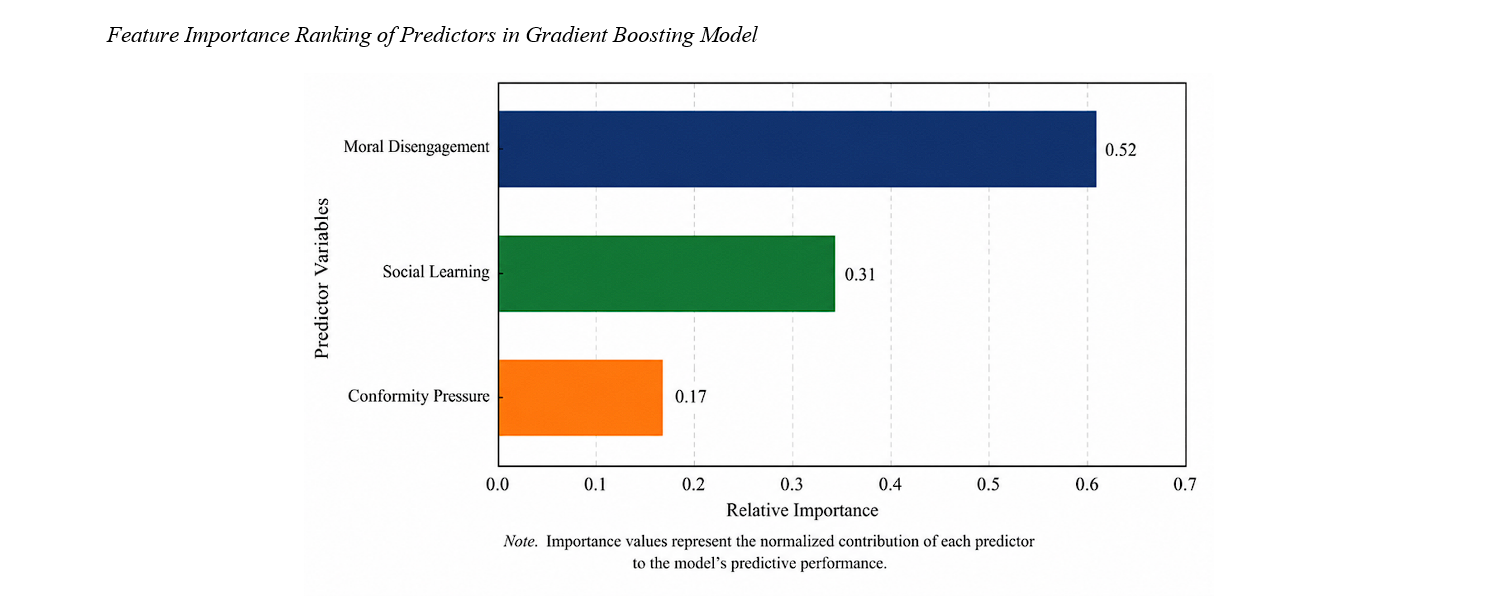
Findings: The results indicated that conformity pressure (β = 0.24, p < 0.001) and social learning (β = 0.31, p < 0.001) significantly and positively predicted norm internalization, while moral disengagement (β = -0.38, p < 0.001) was a significant negative predictor. The regression model explained a substantial proportion of variance in norm internalization (R² = 0.41). Machine learning analyses revealed that the Gradient Boosting model achieved the highest predictive performance (R² = 0.47), outperforming Random Forest and Support Vector Machine models. Feature importance analysis consistently identified moral disengagement as the most influential predictor, followed by social learning and conformity pressure.
Conclusion: The findings demonstrate that norm internalization is a multifaceted process influenced by the interaction of social influence and cognitive moral mechanisms. Social learning and conformity pressure facilitate the internalization of norms, whereas moral disengagement undermines it. The integration of machine learning methods enhances predictive accuracy and reveals complex non-linear relationships among variables. These results highlight the importance of addressing both social and cognitive dimensions in interventions aimed at promoting ethical behavior and strengthening social cohesion in culturally diverse contexts.
Downloads
References
Abboud-Armaly, O. (2024). “Within Five Seconds, I Can Already See the Contradictions and the Conflict With Society”: Applying the Normative Conflict Model to a Collectivist Society. Conflict Resolution Quarterly, 41(4), 437-452. https://doi.org/10.1002/crq.21418
Ahtisham, M. M. A., Haq, M. A. u., Ahmed, M. A., & Khalid, S. (2023). Effect of Despotic Leadership on Organizational Cynicism: Role of Moral Disengagement and Organizational Identification. Verslas Teorija Ir Praktika, 24(1), 194-205. https://doi.org/10.3846/btp.2023.13483
Bjärehed, M. (2022). The Association Between Moral Disengagement and Bullying in Early Adolescence. https://doi.org/10.3384/9789179291280
Bosaia, L., Garbi, G., Berlin, E., Lasagna, C., Macrì, L., Paradiso, M. N., & Piccoli, N. D. (2025). Do Boys and Girls Evaluate Sexual Harassment Differently? The Role of Negative Emotions and Moral Disengagement. Behavioral Sciences, 15(10), 1306. https://doi.org/10.3390/bs15101306
Bowles, T., Scull, J., & Jimerson, S. R. (2022). School Connection Through Engagement Associated With Grade Scores and Emotions of Adolescents: Four Factors to Build Engagement in Schools. Social Psychology of Education, 25(2-3), 675-696. https://doi.org/10.1007/s11218-022-09697-4
Dempsey, R. P., Eskander, E., & Dubljević, V. (2023). Ethical Decision-Making in Law Enforcement: A Scoping Review. Psych, 5(2), 576-601. https://doi.org/10.3390/psych5020037
Dong, S., Dong, Q., & Chen, M. (2024). The Relationship Between Grandparents’ Violent Discipline and School Bullying Behavior Among Left-Behind Children. Journal of interpersonal violence, 40(1-2), 177-203. https://doi.org/10.1177/08862605241246001
Grady, S. P. (2025). From Pecking Orders to Forest Networks: Reimagining Inclusion Through Biodiversity. Support for Learning, 40(4), 302-309. https://doi.org/10.1111/1467-9604.70010
He, J., Wang, Z., & Xu, S. (2025). How Legal Motivation Buffers the Effects of Moral Disengagement on School Bullying Among Chinese College Students. Frontiers in psychology, 16. https://doi.org/10.3389/fpsyg.2025.1583706
Janhonen, J. (2023). Socialisation Approach to AI Value Acquisition: Enabling Flexible Ethical Navigation With Built-in Receptiveness to Social Influence. Ai and Ethics, 5(1), 527-553. https://doi.org/10.1007/s43681-023-00372-8
Jiang, W., & Xie, Y. (2024). How Unethical Pro-Organizational Behavior Links to Actors’ and Observers’ Behaviors: A Meta-Analysis. Sage Open, 14(3). https://doi.org/10.1177/21582440241271278
Khan, A. G., Li, Y., Akram, Z., & Akram, U. (2021). Does Bad Gossiping Trigger for Targets to Hide Knowledge in Morally Disengaged? New Multi-Level Insights of Team Relational Conflict. Journal of Knowledge Management, 26(9), 2370-2394. https://doi.org/10.1108/jkm-08-2021-0609
Koay, K. Y., & Lim, P. K. (2021). Ethical Leadership and Knowledge Hiding: Testing the Mediating and Moderating Mechanisms. Journal of Knowledge Management, 26(3), 574-591. https://doi.org/10.1108/jkm-02-2021-0091
Košir, K. (2021). Preventing Bullying: Peer Culture as the Crucial Developmental Context in Adolescence. 107-126. https://doi.org/10.32320/978-961-270-341-7.107-126
Li, J., Wang, H., Cai, Y., & Chen, Z. (2022). How Leaders Restrict Employees’ Deviance: An Integrative Framework of Interactional Justice and Ethical Leadership. Frontiers in psychology, 13. https://doi.org/10.3389/fpsyg.2022.942472
Ljubica, J., Shaffer, M. A., & Baker, C. (2023). Breaking Bad: A Model of Expatriate Managerial Misbehavior. Applied Psychology, 73(3), 1261-1286. https://doi.org/10.1111/apps.12512
Malaret, S., Allan, E. J., Graham, G., Esquenazi, C., Bacon, D., & Whalen, P. J. (2021). Teaching Student Leadership, Ethics, and Group Responsibility for Hazing Prevention: An Exploratory Study. Jcaps, 3(1), 17-33. https://doi.org/10.52499/2021012
Mo, S., Lupoli, M. J., Newman, A., & Umphress, E. E. (2022). Good Intentions, Bad Behavior: A Review and Synthesis of the Literature on Unethical Prosocial Behavior (UPB) at Work. Journal of Organizational Behavior, 44(2), 335-354. https://doi.org/10.1002/job.2617
Mokano, M. F., & Letuma, M. C. (2025). Disciplinary Issues in Special Education: Teachers’ Experiences and Attribution. African Journal of Disability, 14. https://doi.org/10.4102/ajod.v14i0.1655
Naureen, S., Rashid, S., & Tariq, F. T. (2024). Parental Expectations and Student’s Morality Mediating Role of Frustration Intolerance. Academy of Education and Social Sciences Review, 4(2), 236-248. https://doi.org/10.48112/aessr.v4i2.768
Okan, N. (2025). The Moderating Role of Willpower as a Personality Trait in the Relationship Between Social Influence and Moral Disengagement Contradiction. Brain and Behavior, 15(5). https://doi.org/10.1002/brb3.70506
Rico, D. A., Panesso, C., Arbeláez, J. S., Gutiérrez, G. C., Isaac, V., Escobar, M. J., & Herrera, E. (2024). Moral Disengagement in Adolescent Offenders: Its Relationship With Antisocial Behavior and Its Presence in Offenders of the Law and School Norms. Children, 11(1), 70. https://doi.org/10.3390/children11010070
Sharma, A., & C., K. (2024). Peer Pressure: A Comprehensive Literature Review of the Last Two Decades. International Journal for Multidisciplinary Research, 6(2). https://doi.org/10.36948/ijfmr.2024.v06i02.14916
Shi, L., Wu, Y., & Zhou, Y. (2025). The Role of Moral Disengagement and Classroom Collective Efficacy in Social Support and Bystander Behavior of Elementary School Students: A Multilevel Moderated Mediation Analysis. School Psychology, 40(4), 462-471. https://doi.org/10.1037/spq0000639
Thiel, C. E., Bonner, J., Bush, J., Welsh, D., & Pati, R. K. (2020). Rationalize or Reappraise? How Envy and Cognitive Reappraisal Shape Unethical Contagion. Personnel psychology, 74(2), 237-263. https://doi.org/10.1111/peps.12387
Walters, G. D. (2021). Social Influence and Delinquency: The Role of Criminal Thinking. Criminal Behaviour and Mental Health, 31(6), 368-371. https://doi.org/10.1002/cbm.2219
Yan, W., Chen, H., He, Y., & Zhang, C. (2023). Abusive Supervision and Employee Unethical Pro-Organizational Behavior: A Moderated Mediation Model of Moral Disengagement and Traditionality. Chinese Management Studies, 18(2), 324-341. https://doi.org/10.1108/cms-07-2022-0264
Zhan, J., Yang, Y., & Lian, R. (2022). The Relationship Between Cyberbullying Victimization and Cyberbullying Perpetration: The Role of Social Responsibility. Frontiers in Psychiatry, 13. https://doi.org/10.3389/fpsyt.2022.995937
Zhang, L., Hui, B. P. H., Kong, F., Lu, H., & Chen, S. X. (2025). Why People “Lie Flat”? An Integrative Framework of Social-Psychological Pathways in China. Personality and Social Psychology Review, 29(4), 371-382. https://doi.org/10.1177/10888683251358516
Zhu, J. N., Lam, L. W., Li, N., & Shao, M. (2024). Making Our Groups Better? The Roles of Moral Disengagement and Group Identification in the Learning of Pro‐group Unethical Behaviour. Journal of Occupational and Organizational Psychology, 97(4), 1550-1571. https://doi.org/10.1111/joop.12528
Downloads
Additional Files
Publication Timeline
- Submitted
- Revised
- Accepted



