
A Predictive Study of Family Adaptability Based on Cultural and Economic Indicators
Keywords:
Family Adaptability, Cultural Orientation, Acculturation, Economic Indicators, Financial Stability, Machine Learning, Predictive ModelingAbstract
Objective: The present study aimed to predict family adaptability based on cultural orientation and economic indicators using both statistical and machine learning approaches in a Canadian population.
Methods and Materials: This study employed a quantitative, cross-sectional, descriptive–correlational design. The statistical population consisted of married adults residing in Canada in 2025, from which 486 participants were selected using a stratified random sampling method based on the Krejcie and Morgan table. Data were collected using standardized instruments, including the Family Adaptability subscale of the Family Adaptability and Cohesion Evaluation Scales IV (FACES IV), a Cultural Orientation Scale assessing individualism, collectivism, traditionalism, and acculturation, and a socioeconomic questionnaire measuring income index, financial stability, and economic pressure. The reliability and validity of all instruments were confirmed in prior research and re-evaluated in the present study. Data analysis was conducted using IBM SPSS Statistics (version 27) for descriptive statistics, Pearson correlations, and multiple regression analysis. Additionally, machine learning models including Random Forest, Support Vector Machine, and Gradient Boosting were implemented in Python using Scikit-learn to enhance predictive accuracy.
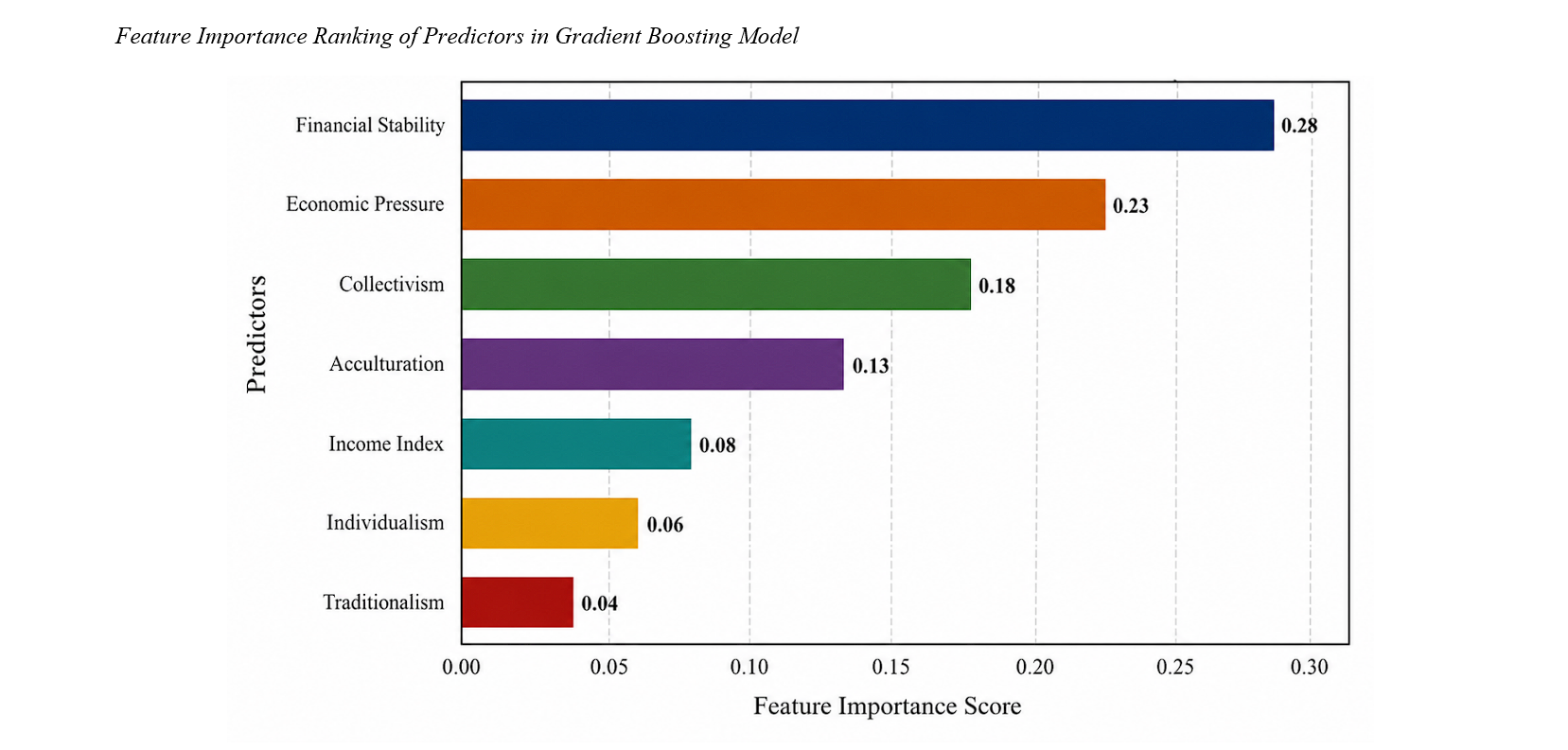
Findings: The results revealed that collectivism (β = 0.31, p < 0.001), financial stability (β = 0.36, p < 0.001), acculturation (β = 0.18, p < 0.001), and individualism (β = 0.12, p = 0.007) were significant positive predictors of family adaptability, whereas economic pressure (β = -0.29, p < 0.001) was a significant negative predictor. The regression model explained 46% of the variance in family adaptability (R² = 0.46, p < 0.001). Machine learning results indicated that the Gradient Boosting model achieved the highest predictive performance (R² = 0.74), followed by Random Forest (R² = 0.71) and Support Vector Machine (R² = 0.66). Feature importance analysis identified financial stability and economic pressure as the most influential predictors.
Conclusion: The findings demonstrate that both cultural and economic factors play a critical and complementary role in shaping family adaptability, with economic conditions exerting particularly strong effects. The integration of machine learning approaches provided enhanced predictive accuracy and revealed complex relationships among variables, highlighting the importance of multidimensional and data-driven approaches in family research. These results underscore the need for interventions and policies that simultaneously address financial stability and cultural integration to promote adaptive family functioning.
Downloads
References
Álvarez, E. C., Rifà‐Ros, R., Salinas‐Roca, B., Costa‐Tutusaus, L., Lamas, M. F. M., & Rodríguez‐Monforte, M. (2025). Diet-Related Health Inequalities in High-Income Countries: A Scoping Review of Observational Studies. Advances in Nutrition, 16(6), 100439. https://doi.org/10.1016/j.advnut.2025.100439
Barb, J. J., Yang, L., Steele, E. M., Ahmed, A., Medina, P., Valencia, E. M., Roberts, A., Farmer, N., & Wallen, G. R. (2025). Consumption of Ultra-Processed Foods by Foreign-Born Adults Rise With Increased Levels of Acculturation in the United States. Frontiers in Public Health, 13. https://doi.org/10.3389/fpubh.2025.1570832
Cabrera, N., Alonso, A. C., He, M., & Ramos‐Olazagasti, M. (2024). Understanding Latino Children and Families’ Well-Being Requires Data Disaggregated by Birth Within or Outside the United States. https://doi.org/10.59377/790l2978q
Chen, S., Wei, W., Witherspoon, D. P., & Kim, S. Y. (2022). Invisibly Oppressed: Individual and Ecological Correlates of Chinese American Adolescents’ Perceived Discrimination. Journal of Research on Adolescence, 32(2), 518-532. https://doi.org/10.1111/jora.12759
Cordero, C., & Llabre, M. M. (2025). The Health of Hispanic/Latino People in the United States. 211-236. https://doi.org/10.1037/0000396-012
Duan, C. (2024). Immigrant Consumption Behaviors: A Systematic Integrative Review and Future Research Agenda. World, 5(2), 365-393. https://doi.org/10.3390/world5020020
Gagné, M. H., Guhn, M., Janus, M., Georgiades, K., Emerson, S. D., Milbrath, C., Duku, E., Magee, C., Schonert‐Reichl, K. A., & Gadermann, A. (2021). Thriving, Catching Up, Falling Behind: Immigrant and Refugee Children’s Kindergarten Competencies and Later Academic Achievement. Journal of Educational Psychology, 113(7), 1387-1404. https://doi.org/10.1037/edu0000634
George, U., Thomson, M. S., Chaze, F., & Guruge, S. (2024). Immigrant Mental Health, a Public Health Issue: Looking Back and Moving Forward. https://doi.org/10.32920/14639682
Gölcük, M., Ertekin, Z., & Berument, S. K. (2025). The Role of Temperamental Characteristics in Growth Rates of Theory of Mind: A Turkish Care Types Study. Child & Youth Care Forum. https://doi.org/10.1007/s10566-025-09857-5
Guan, A., Talingdan, A. S., Tanjasiri, S. P., Kanaya, A. M., & Gomez, S. L. (2024). Lessons Learned From Immigrant Health Cohorts: A Review of the Evidence and Implications for Policy and Practice in Addressing Health Inequities Among Asian Americans, Native Hawaiians, and Pacific Islanders. Annual Review of Public Health, 45(1), 401-424. https://doi.org/10.1146/annurev-publhealth-060922-040413
Kim, H., Kim, O., Kim, K.-A., Chu, S. H., & Chung, M. L. (2022). Acculturation Stress and Post-Traumatic Growth Among Female North Korean Defectors: A Moderated Mediation Effect of Loneliness and Neighborhood Social Cohesion. https://doi.org/10.21203/rs.3.rs-2311746/v1
Kim, Y., Lee, H., Lee, H., Lee, M., Kim, S., & Konlan, K. D. (2023). Social Determinants of Health of Racial and Ethnic Minority Adolescents: An Integrative Literature Review. Heliyon, 9(10), e20738. https://doi.org/10.1016/j.heliyon.2023.e20738
Kitchens, K., Kirsch, J., & Naseh, M. (2025). Socioeconomic Status Among Older Resettled Refugees in the United States: Older Bhutanese Refugees’ Diminished Returns on Cognitive Health. Sage Open Aging, 11. https://doi.org/10.1177/30495334251356739
Mac-Niven, A. C., Comer, J. S., & Bagner, D. M. (2025). Predictors of Homework Engagement in Internet-Delivered Parent-Child Interaction Therapy for Children With Developmental Delay: What About Acculturation and Enculturation? Frontiers in Child and Adolescent Psychiatry, 4. https://doi.org/10.3389/frcha.2025.1500742
Mullins, J. L., Cheung, C., & Michalska, K. J. (2024). Caregiver Experienced Racism, Acculturative Stress, and Political Hostility Predict Anxiety in Latinx Families Residing in the United States. Cultural diversity & ethnic minority psychology, 30(4), 792-804. https://doi.org/10.1037/cdp0000667
Okunseri, C., Zheng, C., Zhang, Y., Okunseri, E., García, R. I., & Szabó, A. (2023). Acculturation and Children's Dental Service Utilization in the United States. Community Dentistry and Oral Epidemiology, 51(3), 380-387. https://doi.org/10.1111/cdoe.12860
Osei-Kwasi, H., Boateng, D., Asamane, E. A., Akparibo, R., & Holdsworth, M. (2022). Transitioning Food Environments and Diets of African Migrants: Implications for Non-Communicable Diseases. Proceedings of the Nutrition Society, 82(1), 69-79. https://doi.org/10.1017/s0029665122002828
Purcino, L. S., & Bedrikow, R. (2024). Findings on Dietary Characteristics Among Haitian Immigrants and the Threat of Food Insecurity: A Scoping Review. Public Health in Practice, 8, 100520. https://doi.org/10.1016/j.puhip.2024.100520
Ramírez, A. S., Wilson, M., & Miller, L. M. S. (2022). Segmented Assimilation as a Mechanism to Explain the Dietary Acculturation Paradox. Appetite, 169, 105820. https://doi.org/10.1016/j.appet.2021.105820
Roby, E., Piccolo, L. d. R., Gutiérrez, J., Kesoglides, N. M., Raak, C. D., Mendelsohn, A. L., & Canfield, C. F. (2021). Father Involvement in Infancy Predicts Behavior and Response to Chronic Stress in Middle Childhood in a Low‐income Latinx Sample. Developmental Psychobiology, 63(5), 1449-1465. https://doi.org/10.1002/dev.22081
Silva, K., Amarneh, D., & Viana, A. G. (2024). Acculturative Stress Among Latino Youth. Advances in Psychiatry and Behavioral Health, 4(1), 199-210. https://doi.org/10.1016/j.ypsc.2024.05.014
Stamou, A., & Flórez, K. R. (2025). Cross-Sectional Analysis of Sugar-Sweetened Beverage Consumption, Food Security, and Nativity Among Adults: Associations From National Health and Nutrition Examination Survey 2007–2020. Nutrients, 17(3), 520. https://doi.org/10.3390/nu17030520
Thor, P., Yang, S., & Park, Y. (2022). Child Maltreatment in Asian American and Pacific Islander Families: The Roles of Economic Hardship and Parental Aggravation. International Journal on Child Maltreatment Research Policy and Practice, 5(2), 295-310. https://doi.org/10.1007/s42448-021-00111-8
Treviño, M. S., & Gerstein, E. D. (2022). Latinx Dual Language Learners in the U.S.: Examining Family Context During Early Social Emotional Development. Journal of Family Psychology, 36(8), 1275-1284. https://doi.org/10.1037/fam0001005
Varela, E., McVay, M. A., Shelnutt, K. P., & Mobley, A. R. (2023). The Determinants of Food Insecurity Among Hispanic/Latinx Households With Young Children: A Narrative Review. Advances in Nutrition, 14(1), 190-210. https://doi.org/10.1016/j.advnut.2022.12.001
Downloads
Additional Files
Publication Timeline
- Submitted
- Revised
- Accepted



