
Identifying Cultural Patterns in Parenting Beliefs Through Clustering Algorithms
Keywords:
Parenting beliefs, cultural patterns, clustering algorithms, machine learning, autonomy support, collectivism, cross-cultural psychologyAbstract
Objective: The present study aimed to identify latent cultural patterns in parenting beliefs by applying clustering algorithms to multidimensional data on parental attitudes and cultural orientations.
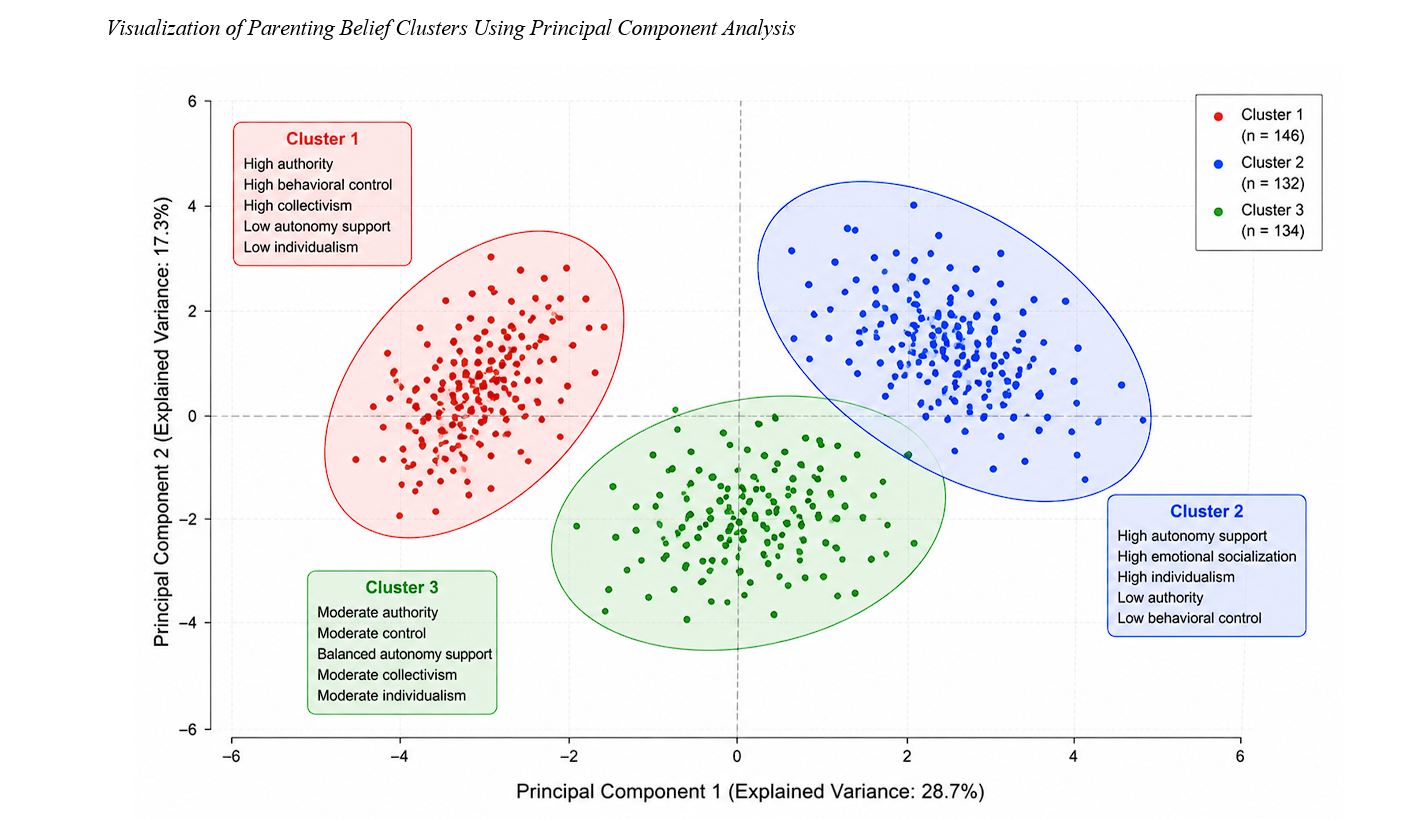
Methods and Materials: This study employed a quantitative, cross-sectional design with a data-driven analytical approach. The sample consisted of 412 parents from Georgia, selected through stratified random sampling to ensure representation across demographic strata. Data were collected using standardized instruments assessing parenting beliefs, including dimensions such as parental authority, autonomy support, emotional socialization, and behavioral control, alongside cultural orientation constructs such as collectivism, individualism, power distance, and uncertainty avoidance. After data preprocessing, clustering analyses were conducted using K-means and hierarchical methods. The optimal number of clusters was determined using the Elbow method, Silhouette coefficient, and Davies–Bouldin index. Principal component analysis (PCA) was also employed to enhance interpretability and visualize cluster separation. Statistical preprocessing and descriptive analyses were performed using IBM SPSS, while machine learning analyses were implemented in Python.
Findings: Clustering results revealed a statistically meaningful three-cluster solution with acceptable validity indices (Silhouette = 0.53; Davies–Bouldin = 0.81), indicating moderate-to-strong separation between clusters. The first cluster demonstrated significantly higher levels of parental authority, behavioral control, and collectivist orientation, reflecting a traditional-authoritarian profile. The second cluster exhibited significantly higher autonomy support, emotional socialization, and individualism, representing an autonomy-supportive profile. The third cluster showed moderate levels across all variables, indicating a hybrid or integrative parenting belief pattern. Principal component analysis confirmed clear spatial differentiation among clusters, supporting the robustness and interpretability of the classification model.
Conclusion: The findings demonstrate that parenting beliefs are structured into distinct cultural profiles that reflect varying combinations of authority, autonomy, and cultural orientation. The identification of traditional, autonomy-supportive, and hybrid parenting patterns highlights the complexity and heterogeneity of parenting beliefs within a single cultural context. These results underscore the value of machine learning approaches in uncovering latent cultural structures and provide a foundation for culturally informed research and intervention in family and developmental studies.
Downloads
References
Baumert, J., Jansen, M., Becker, M., Neumann, M., Köller, O., & Maaz, K. (2023). Individually Endorsed and Socially Shared Normative Beliefs on Acculturation: Resources and Risk Factors for Academic and Psychosocial Adjustment in Mid-Adolescence. Journal of Educational Psychology, 115(4), 589-608. https://doi.org/10.1037/edu0000779
Berry, J. W. (2023). The Search for Some General Psychological Principles for Improving Intercultural Living in Plural Societies. Psychology and Developing Societies, 35(2), 278-301. https://doi.org/10.1177/09713336231178368
Chalik, A. A., Arrianie, L., & Sarofah, R. (2023). The Wisdom of Sundanese Intercultural Communication in Social Interaction With Javanese Ethnic Communities. Nyimak Journal of Communication, 7(1), 71. https://doi.org/10.31000/nyimak.v7i1.7019
Daniel, S. (2023). Negotiating the Challenges of an Interracial Marriage: An Interpretive Phenomenological Analysis of the Perception of Diaspora Indian Partners. Family Relations, 73(1), 282-297. https://doi.org/10.1111/fare.12888
Ferrante, L. (2024). The Phenomena of “Doing Family” in a Migrant’s Experience. https://doi.org/10.5772/intechopen.1004708
Goldstein, O. C., Witherspoon, D. P., & Bámaca‐Colbert, M. Y. (2025). Neighborhood Conditions in a New Destination Context and Latine Youth’s Ethnic–Racial Identity: What’s Gender Got to Do With It? Behavioral Sciences, 15(9), 1148. https://doi.org/10.3390/bs15091148
Han, Q. (2022). New in Town, Already Settled In: Assessing the Behavioural and Experiential Indicators That Lead to Acculturative Advantages. International Journal of Cross Cultural Management, 22(1), 105-135. https://doi.org/10.1177/14705958221081631
He, H., Usami, S., Rikimaru, Y., & Jiang, L. (2021). Cultural Roots of Parenting: Mothers’ Parental Social Cognitions and Practices From Western US and Shanghai/China. Frontiers in psychology, 12. https://doi.org/10.3389/fpsyg.2021.565040
Kim, S. E., Fanta, A., Tsai, W., & Huang, C. (2024). Cultural Orientation, Racial-Ethnic Socialization, and Youth Adjustment Outcomes: Test of a Path Model With Asian American Parents. Journal of Family Issues, 45(12), 3084-3107. https://doi.org/10.1177/0192513x241236542
Kim, S. E., Huang, C. J., Tsai, W., & Huang, C. (2025). The Interplay of Cultural Orientation and Discrimination in Asian American Parents’ Racial-Ethnic Socialization. Journal of Cross-Cultural Psychology, 56(7), 829-852. https://doi.org/10.1177/00220221251333446
Kusuma, A. (2023). Identification of Ethnogenesis in the Communication and Adaptation Process of the Alor Community in the Sunda Culture Area. International Journal of Environmental Sustainability and Social Science, 4(2), 442-451. https://doi.org/10.38142/ijesss.v4i2.412
Levy, S., Gvili, Y., & Hino, H. (2021). Engagement of Ethnic-Minority Consumers With Electronic Word of Mouth (eWOM) on Social Media: The Pivotal Role of Intercultural Factors. Journal of Theoretical and Applied Electronic Commerce Research, 16(7), 2608-2632. https://doi.org/10.3390/jtaer16070144
Li, L.-W., & McWayne, C. M. (2025). Exploring Shared Caregiving Among Low-Income, Chinese Immigrants Raising Preschool Children During the “Dual Pandemic”. Asian American Journal of Psychology. https://doi.org/10.1037/aap0000394
Lo, A. Y. H., Kim, S. Y., & Grotevant, H. D. (2023). Parents’ Adaptation From Conflict: Bicultural Socialization Beliefs and Acculturative Family Conflict in Chinese American Families. Journal of Family Psychology, 37(4), 443-452. https://doi.org/10.1037/fam0001094
McIntosh, D., & Wang, G. (2024). Assessments for Multi‐heritage Couple Therapy: A Review of Existing Tools. Journal of marital and family therapy, 50(3), 611-629. https://doi.org/10.1111/jmft.12708
Mesman, J., & Emmen, R. A. G. (2021). Cultural Perspectives on Parenting. 97-114. https://doi.org/10.1093/oxfordhb/9780190674687.013.4
Muniz, C. N., & Curry, T. R. (2024). Immigration and Physical Discipline of Children: The Influence of Generational Status and Culture. Child & Family Social Work, 30(4), 578-590. https://doi.org/10.1111/cfs.13196
Olsson, I. (2023). Assimilation, Acculturation, and Social Integration the Psychological Effect on Mixed Marriage in Sweden: Qualitative Study of Immigrants and Native Swedes. Journal of Social Science Studies, 10(1), 81. https://doi.org/10.5296/jsss.v10i1.20821
Pérez, I. E., Wu, R., Murray, C. B., & Bravo, D. Y. (2021). An Interdisciplinary Framework Examining Culture and Adaptation in Migrant Children and Adolescents. New directions for child and adolescent development, 2021(176), 13-39. https://doi.org/10.1002/cad.20405
Quek, K. M., Hsieh, N. W., & Eppler, C. (2021). Collectivist Discourses in Relational Intersectionality: Insights From Chinese American Christian Couples. Journal of Family Issues, 42(11), 2487-2508. https://doi.org/10.1177/0192513x20983387
Schachner, M. K., Hölscher, S., Moscardino, U., Ceccon, C., Juang, L. P., & Pastore, M. (2024). Adolescent Cultural Identity Development in Context: The Dynamic Interplay of the Identity Project With Classroom Cultural Diversity Climate in Italy and Germany. Journal of youth and adolescence, 53(11), 2480-2498. https://doi.org/10.1007/s10964-024-02031-5
Su, T. (2023). Challenges and Stressors in Intimate Intercultural Relationships: A Systematic Research Synthesis. Personal Relationships, 30(2), 379-398. https://doi.org/10.1111/pere.12489
Suleiman, J., Haight, W., Park, S., & Flanagan, S. (2023). Somali Parenting in Western Contexts: Acculturative Stressors and Family Strengths. Qualitative Social Work, 23(6), 1058-1076. https://doi.org/10.1177/14733250231175506
Sun, K., & Mulvaney, M. K. (2021). Parental Involvement in Chinese Immigrant Mothers: The Influences of Cultural and Parenting Cognitions. Journal of Child and Family Studies, 31(1), 169-184. https://doi.org/10.1007/s10826-021-02158-0
Wang, D., Tu, X., Guzman, M. R. d., & Xia, Y. (2023). Parenting Beliefs and Practices of Immigrant Chinese in the Midwestern United States: A Qualitative Study. Journal of Family Issues, 45(10), 2550-2574. https://doi.org/10.1177/0192513x231209045
Downloads
Additional Files
Publication Timeline
- Submitted
- Revised
- Accepted



