Exploring the Role of Teacher Scaffolding in Fostering Independent Learning
DOI:
https://doi.org/10.61838/kman.ec.psynexus.3.14Keywords:
Scaffolding, Independent Learning, Zone of Proximal Development, Teacher Support, Learner Autonomy, Qualitative Research, MalaysiaAbstract
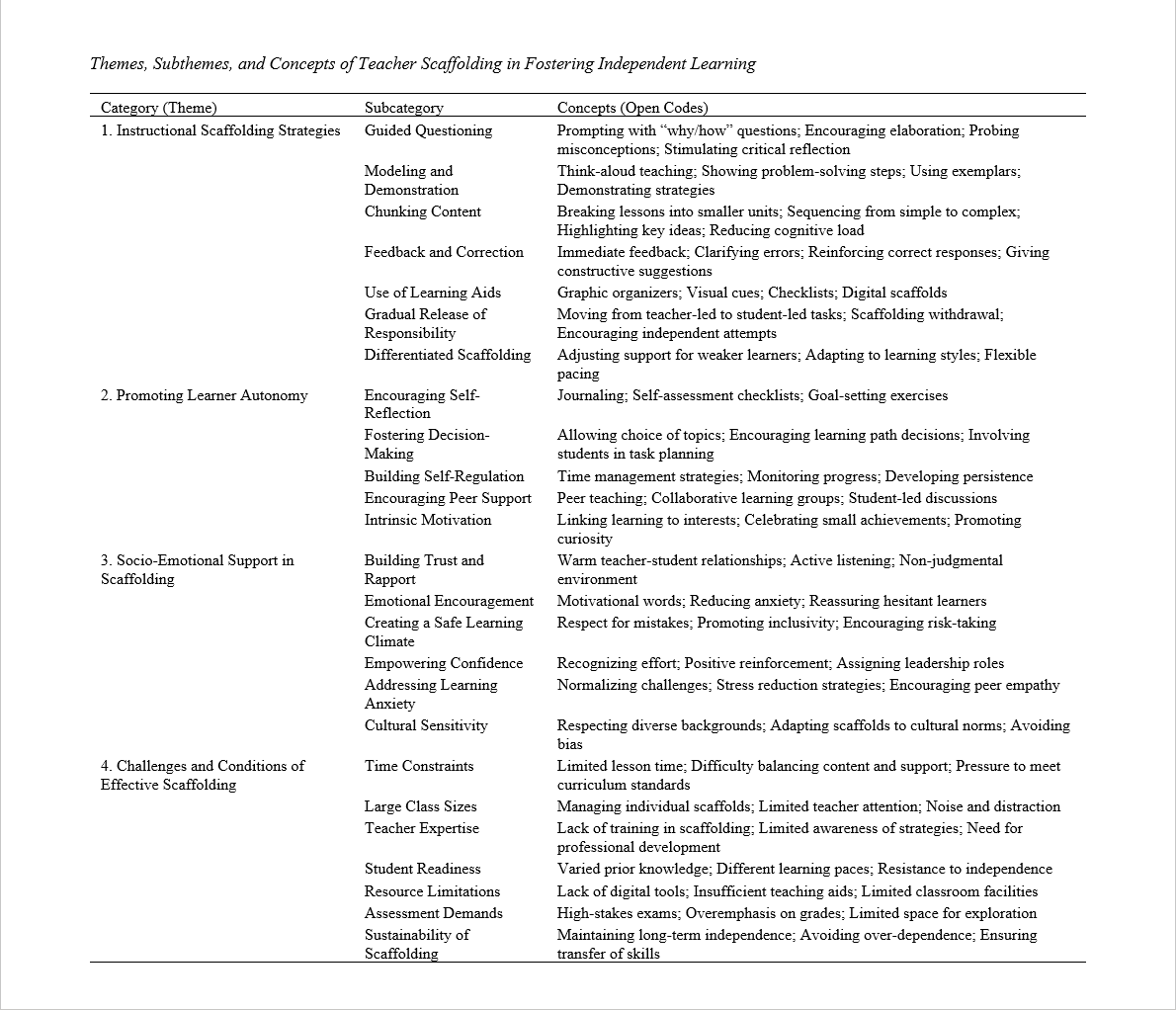
This study aimed to explore how teacher scaffolding practices contribute to the development of independent learning among students in Malaysia. A qualitative research design was employed using semi-structured interviews with 25 teachers from secondary schools and higher education institutions across Malaysia. Participants were selected through purposive sampling, ensuring diversity in subject areas and teaching experience. Data collection continued until theoretical saturation was achieved. Interviews, lasting 45–60 minutes, were audio-recorded, transcribed verbatim, and analyzed using thematic analysis with NVivo 14 software. Coding followed an iterative process to identify open codes, subthemes, and overarching themes. Trustworthiness was enhanced through peer debriefing and reflective memoing. Four major themes emerged from the analysis. First, teachers reported diverse instructional scaffolding strategies, including guided questioning, modeling, chunking, feedback, gradual release of responsibility, and differentiated support. Second, scaffolding was found to promote learner autonomy by fostering reflection, decision-making, self-regulation, peer collaboration, and intrinsic motivation. Third, teachers emphasized socio-emotional support such as building trust, encouragement, creating safe learning climates, empowering confidence, addressing anxiety, and cultural sensitivity as integral to fostering independence. Finally, participants identified challenges and conditions of scaffolding, including time constraints, large class sizes, variability in student readiness, limited resources, exam pressures, and sustainability of independence. Collectively, these findings illustrate scaffolding as a multidimensional process combining cognitive, motivational, and socio-emotional dimensions. The study demonstrates that teacher scaffolding plays a pivotal role in facilitating independent learning by integrating instructional, motivational, and relational strategies. However, systemic and contextual barriers, such as curriculum pressures and limited resources, can constrain its effectiveness. The findings underscore the need for professional development, institutional support, and policy initiatives to strengthen scaffolding practices and ensure their sustainability in fostering lifelong independent learners.
Downloads
References
Anwar, M. N., Mushtaq, N., Mubeen, A., & Iqbal, M. (2024). The Power of ZPD: Enhancing Teaching and Learning. Journal of Education and Social Studies, 5(2), 396-405. https://doi.org/10.52223/jess.2024.5220
Ashar, L. C. (2024). Use of Scaffolding to Promote Engagement and Learning in Asynchronous Online Discussions. 313-340. https://doi.org/10.4018/979-8-3693-4407-1.ch011
Auliyani, Z. F., Rery, R. U., & Noer, A. M. (2023). The Effect of E-Scaffolding in Guided Inquiry Learning on Concept Understanding in Reaction Rate Material. Jurnal Penelitian Pendidikan Ipa, 9(6), 4417-4422. https://doi.org/10.29303/jppipa.v9i6.3646
Homayouni, M. (2022). Peer Assessment in Group-Oriented Classroom Contexts: On the Effectiveness of Peer Assessment Coupled With Scaffolding and Group Work on Speaking Skills and Vocabulary Learning. Language testing in Asia, 12(1). https://doi.org/10.1186/s40468-022-00211-3
Huang, T. (2022). An Empirical Study on the Data Analytics-Based Self-Regulated Learning Scaffolding Model for Primary Students. Best Evidence of Chinese Education, 11(2), 1529-1533. https://doi.org/10.15354/bece.22.ab006
Kim, M.-H., & Han, S. (2022). A Study on the Development of Learners in Hairdressing Using Vygotsky's Zone of Proximal Development. Journal of the Korean Society of Cosmetology, 28(4), 855-871. https://doi.org/10.52660/jksc.2022.28.4.855
Kolly-Shamne, A. (2022). The Concept of Zone of Proximal Development and Its Derivatives: Problems and Prospects of Modern Interpretations. Scientific Bulletin of Mukachevo State University Series “Pedagogy and Psychology”, 8(4). https://doi.org/10.52534/msu-pp.8(3).2022.81-95
Margolis, A. A. (2020). Zone of Proximal Development, Scaffolding and Teaching Practice. Cultural-Historical Psychology, 16(3), 15-26. https://doi.org/10.17759/chp.2020160303
Marlina, L., & Rahayu, Y. S. (2025). Penerapan Metode Scaffolding Pada Zone of Proximal Development (ZPD) Dalam Meningkatkan Hasil Belajar Siswa Kelas X-1 SMAN 6 Kota Tangerang Selatan. Pro Patria Jurnal Pendidikan Kewarganegaraan Hukum Sosial Dan Politik, 8(1), 42-55. https://doi.org/10.47080/propatria.v8i1.3786
Matsuo, M. (2024). A Revised Model of Cognitive Apprenticeship: A Qualitative Study. International Journal of Training and Development, 28(4), 454-472. https://doi.org/10.1111/ijtd.12336
Nasir, N. A. M., & Aziz, A. A. (2020). Implementing Student-Centered Collaborative Learning When Teaching Productive Skills in an ESL Primary Classroom. International Journal of Publication and Social Studies, 5(1), 44-54. https://doi.org/10.18488/journal.135.2020.51.44.54
Nurfadila, R. A., Utami, D. D. F., Im, F. A. J., & Rahmawati, P. (2024). Enhancing Algebraic Problem Solving Through Scaffolding: A Case Study of Indonesian Junior High School Students. Ices, 1, 700-707. https://doi.org/10.62097/ices.v124.108
Radev, M. T., & Pešikan, A. (2023). Effective Teaching in the Zone of Proximal Development of Students: The Role of Emotions. Nastava I Vaspitanje, 72(1), 43-57. https://doi.org/10.5937/nasvas2301043r
Raslan, G. (2024). The Impact of the Zone of Proximal Development Concept (Scaffolding) on the Students Problem Solving Skills and Learning Outcomes. 59-66. https://doi.org/10.1007/978-3-031-56121-4_6
Risaaldi, H. M., & Widyawati, I. W. (2024). Strategi Scaffholding Pada Prinsip Zone of Proximal Development Dalam Materi Seni Patung Pada Kelas IX. JITPro, 2(1), 110-116. https://doi.org/10.17977/um084v2i12024p110-116
Sitini, Y. (2025). Application of Scaffolding Method to Improve Learning Outcomes of the Material on Praiseable Morals at MTS Masyarqul Anwar Mekar Jaya Tanjung Raja. Jcii, 1(1), 486-500. https://doi.org/10.62945/jcii.v1i1.152
Thiện, N. V. (2024). Phương Pháp Dạy Học “Bắc Giàn Giáo” Và Việc Ứng Dụng Vào Giảng Dạy Môn Khẩu Ngữ Tiếng Trung Quốc Ở Trường Đại Học Sư Phạm Hà Nội. Journal of Science Educational Science, 44-51. https://doi.org/10.18173/2354-1075.2024-0022
Xi, J., & Lantolf, J. P. (2020). Scaffolding and the Zone of Proximal Development: A Problematic Relationship. Journal for the Theory of Social Behaviour, 51(1), 25-48. https://doi.org/10.1111/jtsb.12260
Xu, S. (2024). An in-Depth Examination of the Sociocultural Framework-Informed Practical Model of Scaffolded Feedback in Enhancing Senior High School English Writing Instruction. Ijsspa, 3(3), 110-119. https://doi.org/10.62051/ijsspa.v3n3.13
Downloads
Additional Files
Publication Timeline
- Submitted
- Revised
- Accepted