The Effectiveness of Meanin-Centered Therapy on the Dimensions of Quality of Life in Women with Grief Syndrome Following Cancer-Related Amputation
DOI:
https://doi.org/10.61838/Keywords:
Meanin-Centered Therapy, Quality of Life, Grief Syndrome, Cancer, Amputation, Death Anxiety, Meaning in LifeAbstract
Objective: The aim of this study was to investigate the effectiveness of Meanin-Centered Therapy on the dimensions of quality of life in women experiencing grief syndrome following cancer-related amputation.
Methods and Materials: This study employed a quasi-experimental design with a pretest–posttest control group and a follow-up phase. The statistical population consisted of women with breast cancer experiencing death anxiety and grief symptoms following amputation, who were recruited from specialized oncology centers in Isfahan. A total of 36 participants were selected using purposive sampling and randomly assigned to an experimental group (n = 18) and a control group (n = 18). The experimental group received an eight-session group-based Meanin-Centered Therapy intervention, while the control group did not receive any psychological intervention during the study period. Data were collected using the WHOQOL-BREF, the Grief Experience Questionnaire, and the Death Anxiety Scale. Data analysis was conducted using repeated measures ANOVA and Bonferroni post-hoc tests in SPSS-27, with a significance level set at p < 0.05.
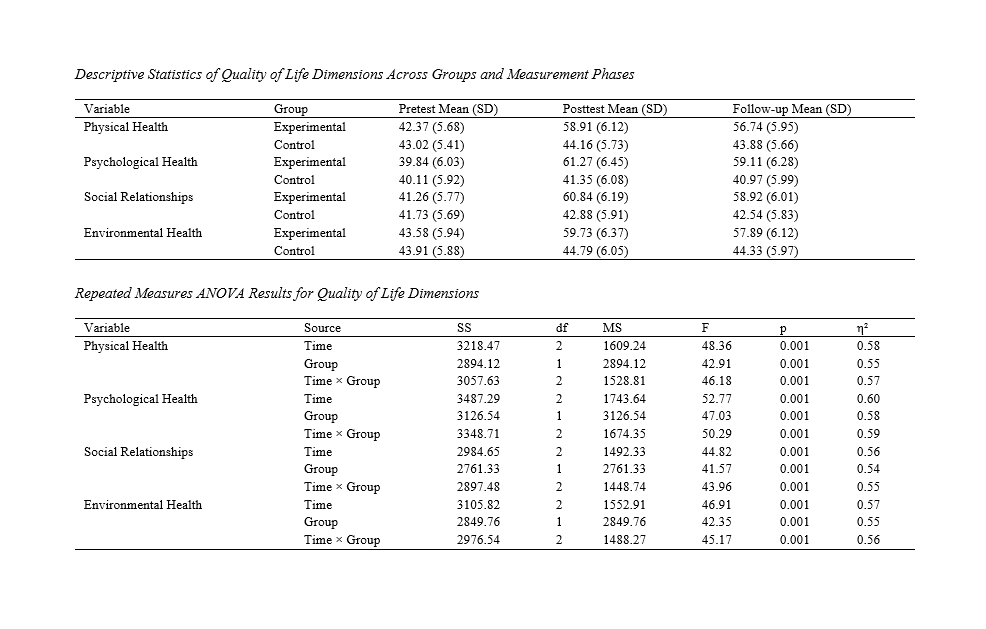
Findings: The results indicated significant effects of time, group, and the interaction between time and group on all dimensions of quality of life (p < 0.001). Participants in the experimental group showed significant improvements in physical health, psychological health, social relationships, and environmental health at posttest compared to pretest, while no significant changes were observed in the control group. Bonferroni post-hoc analyses revealed that the differences between pretest and posttest, as well as between pretest and follow-up, were statistically significant (p < 0.001), whereas no significant differences were found between posttest and follow-up (p > 0.05), indicating stability of the intervention effects over time. Effect size indices demonstrated large practical significance across all variables.
Conclusion: Meanin-Centered Therapy is an effective intervention for improving multiple dimensions of quality of life in women experiencing grief syndrome following cancer-related amputation, and its effects are sustained over time, suggesting its utility as a meaning-centered therapeutic approach in psychosocial oncology care.
Downloads
References
Aguado, M. G., Wilde, L., & Hanna, E. (2024). “You Don’t Realize What a Big Change It Is”: A Reflexive Thematic Analysis of Patients’ Experiences of Amputation Preparation, Information Provision, and Support. Qualitative Health Research, 35(10-11), 1146-1158. https://doi.org/10.1177/10497323241293039
Baghaei, B., & Aghaei, A. (2025). Effectiveness of Positive Psychotherapy on Quality of Life, Happiness, and Meaningfulness in Firefighters. Bi-Monthly Journal of Health Dawn in Yazd, 1(2), 1-16. https://doi.org/10.18502/tbj.v21i2.10337
Bahrani Tanha, S., Torkan, H., & Kalahdozian, S. A. (2024). The effectiveness of Acceptance and Commitment Therapy on anhedonia, meaning in life, emotional empathy, parent-child relationship, and the quality of life of children and mothers of children with cancer. Journal of Applied Research in Counseling. https://www.jarci.ir/article_721087.html?lang=en
Carreiro, J. P., Cardoso, S., Teques, P., Teques, A. P., & Ribeiro, J. L. P. (2025). Satisfaction With Social Support and Quality of Life Among Portuguese Patients With Breast Cancer: Mediating Effects of Coping Styles—Cross-Sectional Study. Healthcare, 13(3), 297. https://doi.org/10.3390/healthcare13030297
Geravand, A., Jalilzadeghan, H., Khezri, H., Ahmadishool, P., & Mehraban, S. H. (2025). Effectiveness of Spiritual-religious Interventions in Mental Health and Quality of Life of Cancer Patients: A Meta-analysis of Studies Conducted in IranSummary. Pizhuhish dar din va salamat, 10(4), 128-142. https://journals.sbmu.ac.ir/jrrh/article/download/43780/34142/247943
Ghoseiri, K., Allami, M., Soroush, M. R., & Rastkhadiv, M. Y. (2018). Assistive Technologies for Pain Management in People With Amputation: A Literature Review. Military Medical Research, 5(1). https://doi.org/10.1186/s40779-018-0151-z
Karimi Dastaki, A., & Mahmudi, M. (2024). The Effectiveness of Life Meaning Workshops on Resilience, Negative Affect, and Perceived Social Support in Students. Journal of Psychological Dynamics in Mood Disorders (PDMD), 3(1), 187-197. https://doi.org/10.22034/pdmd.2024.448984.1063
Kyriazos, T., & Poga, M. (2024). Planfulness in Psychological Well-being: Mediating Roles of Self-Efficacy and Presence of Meaning in Life. Applied Research in Quality of Life, 19(4), 1927-1950.
Maffoni, M., Casati, A., Tambussi, C., Torlaschi, V., Baldini, M., Dragoni, R., Fundarò, C., Bagnara, L., Ferretti, C., & Pierobon, A. (2025). Psychological and Behavioral Adjustment in Patients With Non-Traumatic Lower Limb Amputation and Prosthesis: A Mixed-Method Triangulation Study. Journal of clinical medicine, 14(19), 6973. https://doi.org/10.3390/jcm14196973
Miragha Pour Tarrah, A., Asadian, K., & Esmkhani Akbari Nejad, H. (2024). Comparison of the Effectiveness of Mindfulness-Based Cognitive Therapy and Meaning Therapy on Pain Self-Efficacy and Quality of Life in Men with Chronic Headache. Anesthesia and Pain, 15(1), 1-12. https://www.sid.ir/paper/1604129/fa
Modderkolk, L., van Meurs, J., de Klein, V., Engels, Y., & Wichmann, A. B. (2025). Effectiveness of Meaning-Centered Coaching on the Job of Oncology Nurses on Spiritual Care Competences: A Participatory Action Research Approach. Cancer Nursing, 48(1), 55-63. https://doi.org/10.1097/ncc.0000000000001255
Najafi, E., Mousavi Pour, S., & Sajadi Nejad, M. A.-S. (2024). Comparing the Effectiveness of Meaning Therapy and Acceptance and Commitment Therapy on Resilience and Quality of Life in Patients with Multiple Sclerosis. Journal of Rehabilitation Research in Nursing, 10(3), 103-114. http://ijrn.ir/article-1-764-fa.html
Shahbazi Bandani, S., & Atashpour, S. (2024). Prediction the quality of life based on the perception of suffering, the meaning of life, social support and psychological flexibility in irritable bowel syndrome patient. Journal of Research in Behavioral Science, 22(3), 515-528. http://rbs.mui.ac.ir/article-1-1719-en.html
Štánerová, E., Zelenayová, V., & Rajčáni, J. (2025). Mindfulness-based interventions for cancer patients in standard treatment: A meta-analysis of effects on depression, anxiety, and quality of life. Journal of psychosomatic research, 196, 112312. https://doi.org/10.1016/j.jpsychores.2025.112312
Talebi, G., Bagherian-Sararoudi, R., Rezaei Jamaloui, H., Oreyzi, H., & Bagherian-Sararoudi, P. (2025). The Effectiveness Of Emotional Schema Therapy On Hope And Illness Perception In Women With Breast Cancer: A Randomized Clinical Trial. Journal of Research in Behavioural Sciences, 23(2), 371-381.
Talebi, G., Bagherian-Sararoudi, R., Rezaei_ Jamaloei, H., Oreyzi, H., & Pegah Bagherian-Sararoudi, P. (2025). The effectiveness of mindfulness-based cognitive therapy Intervention on attitudes toward death and hope in women with breast cancer: A randomized clinical trial. Daneshvar Medicine, 33(1), 1-10.
Talebi, G., Rezaei, J. H., Bagherian, S. R., & Oreyzi, H. (2023). Effectiveness of emotional schema therapy on death attitude and distress tolerance of breast cancer patients.
Talebi, G., Rezayi Jamaloui, H., Bagherian Sararodi, R., Oreyzi, H., & Bagherian-Sararoudi, P. (2024). Effectiveness of Meaning-Centered Group Therapy on Death Attitude and Distress Tolerance in Women with Breast Cancer with Death Anxiety. Health Psychology, 13(51), 83-98. https://doi.org/10.30473/hpj.2024.68761.5874
Valizadeh, S., Hadi, H., Eissa, M., Molavi, Z., Dadkhah, B., & Kheiri, R. (2023). Influential Factors in Accepting Amputation by Trauma Patients: A Qualitative Study. https://doi.org/10.21203/rs.3.rs-3201390/v1
Downloads
Additional Files
Publication Timeline
- Submitted
- Revised
- Accepted