Comparing the Effectiveness of Solution-Focused Brief Therapy and Compassion-Focused Therapy on Death Anxiety and Negative Meta-Emotion in Women with Multiple Sclerosis
DOI:
https://doi.org/10.61838/Keywords:
multiple sclerosis, death anxiety, negative meta-emotion, solution-focused brief therapy, compassion-focused therapyAbstract
Objective: The present study aimed to compare the effectiveness of Solution-Focused Brief Therapy (SFBT) and Compassion-Focused Therapy (CFT) on death anxiety and negative meta-emotion in women with multiple sclerosis.
Methods and Materials: This applied quasi-experimental study used a pretest–posttest design with a control group and follow-up phase. The statistical population consisted of women with multiple sclerosis in Tehran, Iran, during 2024–2025. A total of 45 participants were selected through convenience sampling and randomly assigned into three groups: SFBT, CFT, and control group, with 15 participants in each group. The experimental groups participated in eight 90-minute weekly group therapy sessions, while the control group received no psychological intervention during the study period. Data were collected using Templer’s Death Anxiety Scale and the Negative Meta-Emotion Scale developed by Mitmansgruber et al. Data were analyzed using repeated-measures analysis of variance, multivariate analysis, and Bonferroni post hoc comparisons in SPSS at a significance level of p < .05.
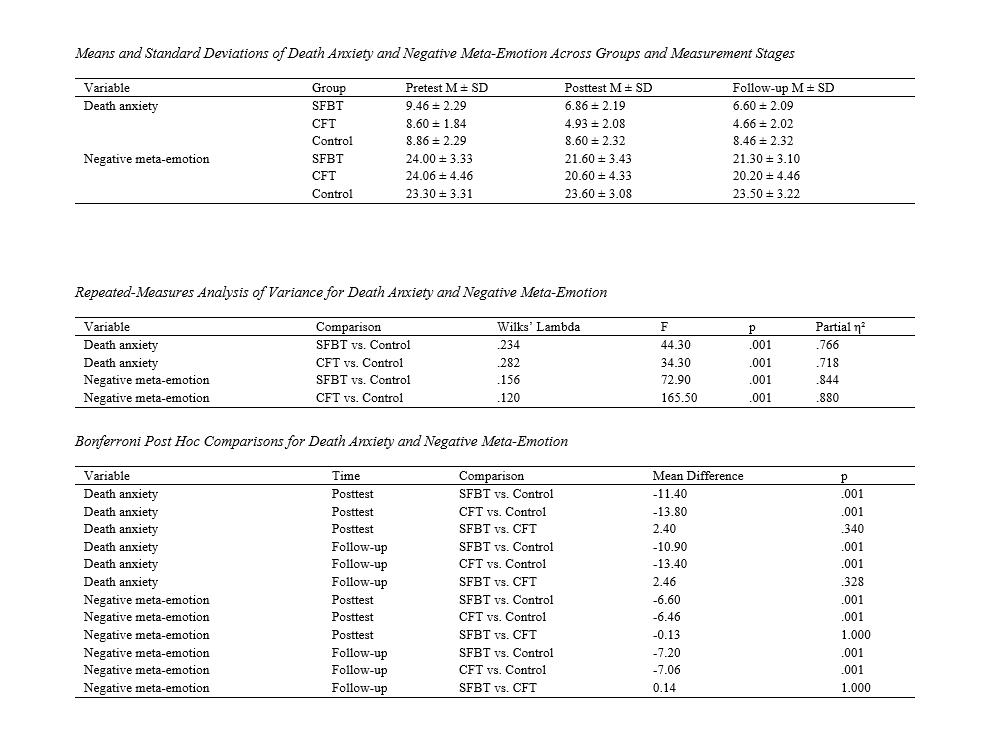
Findings: The findings demonstrated significant time-by-group interaction effects for both death anxiety and negative meta-emotion. In the comparison between the SFBT and control groups, significant reductions were observed in death anxiety (Wilks’ Lambda = .234, F = 44.30, p = .001, partial η² = .766) and negative meta-emotion (Wilks’ Lambda = .156, F = 72.90, p = .001, partial η² = .844). Similarly, the comparison between the CFT and control groups revealed significant reductions in death anxiety (Wilks’ Lambda = .282, F = 34.30, p = .001, partial η² = .718) and negative meta-emotion (Wilks’ Lambda = .120, F = 165.50, p = .001, partial η² = .880). Bonferroni post hoc comparisons showed that both intervention groups differed significantly from the control group at posttest and follow-up stages. Although the CFT group showed descriptively greater reductions in death anxiety and negative meta-emotion, the direct differences between SFBT and CFT were not statistically significant.
Conclusion: The results indicated that both Solution-Focused Brief Therapy and Compassion-Focused Therapy were effective in reducing death anxiety and negative meta-emotion in women with multiple sclerosis, and the treatment effects remained stable at follow-up. These findings suggest that brief solution-oriented and compassion-based psychological interventions can serve as effective supportive treatments alongside medical care for women with chronic neurological illness. Both approaches may help patients improve emotional adjustment, reduce existential distress, and develop more adaptive emotional coping strategies.
Downloads
References
Aboutalebi, H., Yazdchi, N., & Smkhani Akbarinejhad, H. (2022). Effectiveness of compassion-focused therapy on death anxiety and quality of life among women with multiple sclerosis. Medical Science Journal of Islamic Azad University, Tehran Medical Branch, 32(1), 92-101. https://doi.org/10.52547/iau.32.1.92
Azizpour, A., Azmoudeh, M., Ayromlou, H., & Hoseini Nasab, S. D. (2025). The effectiveness of acceptance and commitment therapy and compassion-focused therapy on death anxiety and fear of falling in patients with multiple sclerosis: A quasi-experimental study [Research]. Journal of Rafsanjan University of Medical Sciences, 23(8), 677-690. https://doi.org/10.61186/jrums.23.8.677
Boeschoten, R. E., Braamse, A. M. J., Beekman, A. T. F., Cuijpers, P., van Oppen, P., Dekker, J., & Uitdehaag, B. M. J. (2017). Prevalence of depression and anxiety in multiple sclerosis: A systematic review and meta-analysis. Journal of the Neurological Sciences, 372, 331-341. https://doi.org/10.1016/j.jns.2016.11.067
de Shazer, S., Dolan, Y., Korman, H., Trepper, T., McCollum, E., & Berg, I. K. (2007). More than Miracles: The State of the Art of Solution-Focused Brief Therapy. Haworth Press.
Dennison, L., Moss-Morris, R., & Chalder, T. (2009). A review of psychological correlates of adjustment in women with multiple sclerosis. Clinical psychology review, 29(2), 141-153. https://doi.org/10.1016/j.cpr.2008.12.001
Desborough, J., Brunoro, C., Parkinson, A., Chisholm, K., & Eljiz, K. (2020). It struck at the heart of who I thought I was: A meta-synthesis of the qualitative literature examining the experiences of people with multiple sclerosis. Health Expectations, 23(5), 1007-1027. https://doi.org/10.1111/hex.13093
Dobson, R., & Giovannoni, G. (2019). Multiple sclerosis: A review. European Journal of Neurology, 26(1), 27-40. https://doi.org/10.1111/ene.13819
Fereydoni, F., & Sabet, M. (2021). The effect of solution-focused brief psychotherapy on distress tolerance, decision-making styles and social adjustment in MS patients of Sari City. Journal of Consulting Excellence and Psychotherapy, 10, 36-47.
Filippi, M., Bar-Or, A., Piehl, F., Preziosa, P., Solari, A., Vukusic, S., Rocca, M. A., & Ciccarelli, O. (2018). Multiple sclerosis. Nature Reviews Disease Primers, 4, 43. https://doi.org/10.1038/s41572-018-0041-4
Ford, B. Q., Lam, P., John, O. P., & Mauss, I. B. (2018). The psychological health benefits of accepting negative emotions and thoughts: Laboratory, diary, and longitudinal evidence. Journal of personality and social psychology, 115(6), 1075-1092. https://doi.org/10.1037/pspp0000157
Francalancia, J., Chiambretto, P., & Garegnani, M. (2021). Death anxiety and attitudes towards death in women with multiple sclerosis: An exploratory study. Brain Sciences, 11(8), 964. https://doi.org/10.3390/brainsci11080964
Franklin, C., Zhang, A., Froerer, A., & Johnson, S. (2017). Solution focused brief therapy: A systematic review and meta-summary of process research. Journal of marital and family therapy, 43(1), 16-30. https://doi.org/10.1111/jmft.12193
Gan, C. (2020). Solution-focused brief therapy with individuals with brain injury and their families. NeuroRehabilitation, 46(2), 143-155. https://doi.org/10.3233/NRE-192967
Gilbert, P. (2009). Introducing compassion-focused therapy. Advances in psychiatric treatment, 15(3), 199-208. https://doi.org/10.1192/apt.bp.107.005264
Gilbert, P. (2010). Compassion Focused Therapy: Distinctive Features. Routledge. https://doi.org/10.4324/9780203851197
Gilbert, P. (2014). The origins and nature of compassion focused therapy. British Journal of Clinical Psychology, 53(1), 6-41. https://doi.org/10.1111/bjc.12043
Gross, J. J. (2015). Emotion regulation: Current status and future prospects. Psychological Inquiry, 26(1), 1-26. https://doi.org/10.1080/1047840X.2014.940781
Hakimabadi, M. G., & Tajikesmaeili, A. (2021). Effectiveness of compassion-based therapy on reducing rumination, distress tolerance and sense of coherence in women with multiple sclerosis. Journal of Research in Psychological Health, 15(2).
Hassami, F., Timouri, Z., Ghafourian, G., Razaei Zadeh, M., Kashfi, M., Abedi Noghandar, M., & Pourmohammad Ghouchani, K. (2025). Comparison of mindfulness-based cognitive therapy and acceptance and commitment therapy on self-efficacy and quality of life in patients with multiple sclerosis. Journal of Experimental and Cognitive Psychology, 2(1), 243-256. https://doi.org/https://www.quarterlyecp.com/index.php/ecp/article/view/184
Jellinger, K. A. (2024). Depression and anxiety in multiple sclerosis: Review of a fatal combination. Journal of Neural Transmission, 131, 847-869. https://doi.org/10.1007/s00702-024-02792-0
Kim, J. S., & Franklin, C. (2015). Understanding emotional change in solution-focused brief therapy: Facilitating positive emotions. Best Practices in Mental Health, 11(1), 25-41. https://doi.org/10.70256/167814cunsta
Kirby, J. N., Tellegen, C. L., & Steindl, S. R. (2017). A meta-analysis of compassion-based interventions: Current state of knowledge and future directions. Behavior therapy, 48(6), 778-792. https://doi.org/10.1016/j.beth.2017.06.003
Mansouri Koryani, R. (2022). Effectiveness of compassion-focused acceptance and commitment therapy on psychological flexibility and psychological distress in women with multiple sclerosis. Iranian Journal of Psychiatry and Clinical Psychology, 28(2), 222-235. https://doi.org/10.32598/ijpcp.28.2.3747.1
Marrie, R. A., Reingold, S., Cohen, J., Stuve, O., Trojano, M., Sorensen, P. S., Cutter, G., & Reider, N. (2015). The incidence and prevalence of psychiatric disorders in multiple sclerosis: A systematic review. Multiple Sclerosis Journal, 21(3), 305-317. https://doi.org/10.1177/1352458514564487
Millard, L. (2023). The effectiveness of compassion focused therapy with clinical populations: A systematic review and meta-analysis. Journal of affective disorders, 326, 168-192. https://doi.org/10.1016/j.jad.2023.01.010
Mitmansgruber, H., Beck, T. N., Hofer, S., & Schussler, G. (2009). When you don't like what you feel: Experiential avoidance, mindfulness and meta-emotion in emotion regulation. Personality and individual differences, 46(4), 448-453. https://doi.org/10.1016/j.paid.2008.11.013
Mousavipour, S. P., & Bavi, S. (2024). Effectiveness of self-compassion therapy for distress tolerance and rumination in women with multiple sclerosis. Journal of Health Reports and Technology, 10(3). https://doi.org/10.5812/jhrt-146666
Multiple Sclerosis International, F. (2023). Atlas of MS: Number of people with MS.
Naderipour, A. (2023). The effectiveness of short-term solution-oriented psychotherapy on pain perception and distress tolerance in female women with multiple sclerosis. Rooyesh-e-Ravanshenasi Journal, 12(5), 75-84.
Najafi, E., Mousavi Pour, S., & Sajadi Nejad, M. A.-S. (2024). Comparing the Effectiveness of Meaning Therapy and Acceptance and Commitment Therapy on Resilience and Quality of Life in Patients with Multiple Sclerosis. Journal of Rehabilitation Research in Nursing, 10(3), 103-114. http://ijrn.ir/article-1-764-fa.html
Neff, K. D. (2023). Self-compassion: Theory, method, research, and intervention. Annual review of psychology, 74(1), 193-218. https://doi.org/10.1146/annurev-psych-032420-031047
Nery-Hurwit, M., Yun, J., & Ebbeck, V. (2018). Examining the roles of self-compassion and resilience on health-related quality of life for individuals with multiple sclerosis. Disability and Health Journal, 11(2), 256-261. https://doi.org/10.1016/j.dhjo.2017.10.010
Pakenham, K. I., & Giovannetti, A. M. (2024). ACT resilience training in multiple sclerosis. In R. Coates (Ed.), Innovations in Acceptance and Commitment Therapy (ACT) for Acquired Brain Injury (pp. 6-22). Taylor & Francis Group. https://doi.org/10.4324/9781003193722-2
Shandiz, H. A., Boogar, I. R., & Talepasand, S. (2022). The effectiveness of solution-focused brief therapy on improving the quality of life in women with multiple sclerosis. International Journal of Applied Behavioral Sciences, 9(3), 33-41.
Vermeulen-Oskam, E., Franklin, C., van't Hof, L. P. M., Stams, G. J. J. M., van Vugt, E. S., Assink, M., Veltman, E. J., Froerer, A. S., Staaks, J. P. C., & Zhang, A. (2024). The current evidence of solution-focused brief therapy: A meta-analysis of psychosocial outcomes and moderating factors. Clinical psychology review, 113, 102512. https://doi.org/10.1016/j.cpr.2024.102512
Vidal, J., & Soldevilla, J. M. (2023). Effect of compassion-focused therapy on self-criticism and self-soothing: A meta-analysis. British Journal of Clinical Psychology, 62(1), 70-81. https://doi.org/10.1111/bjc.12394
Walton, C., King, R., Rechtman, L., Kaye, W., Leray, E., Marrie, R. A., Robertson, N., La Rocca, N., Uitdehaag, B., van der Mei, I., Wallin, M., Helme, A., Angood Napier, C., Rijke, N., & Baneke, P. (2020). Rising prevalence of multiple sclerosis worldwide: Insights from the Atlas of MS, third edition. Multiple Sclerosis Journal, 26(14), 1816-1821. https://doi.org/10.1177/1352458520970841
Downloads
Additional Files
Publication Timeline
- Submitted
- Revised
- Accepted