Modeling Women's Psychological Flourishing Based on Self-Compassion, Emotional Intelligence, Perceived Social Support, and Body Appreciation: The Mediating Role of Psychological Flexibility
DOI:
https://doi.org/10.61838/kman.pwj.5413Keywords:
Psychological Flourishing, Self-Compassion, Emotional Intelligence, Perceived Social Support, Body Appreciation, Psychological FlexibilityAbstract
Objective: The present study aimed to develop and test a structural model of women's psychological flourishing based on self-compassion, emotional intelligence, perceived social support, and body appreciation, with psychological flexibility serving as a mediating variable.
Methods and Materials: This descriptive-correlational study employed a cross-sectional design and structural equation modeling (SEM). The study population consisted of adult women residing in Canada in 2026. A total of 620 women were selected through online convenience sampling and completed a battery of standardized questionnaires, including the Flourishing Scale, Self-Compassion Scale, Wong and Law Emotional Intelligence Scale, Multidimensional Scale of Perceived Social Support, Body Appreciation Scale-2, and Acceptance and Action Questionnaire-II. Data were analyzed using SPSS version 29 and AMOS version 29. Descriptive statistics, Pearson correlation analyses, confirmatory factor analyses, and structural equation modeling were performed. The significance of indirect effects was examined using a bootstrap procedure with 5,000 resamples and 95% confidence intervals.
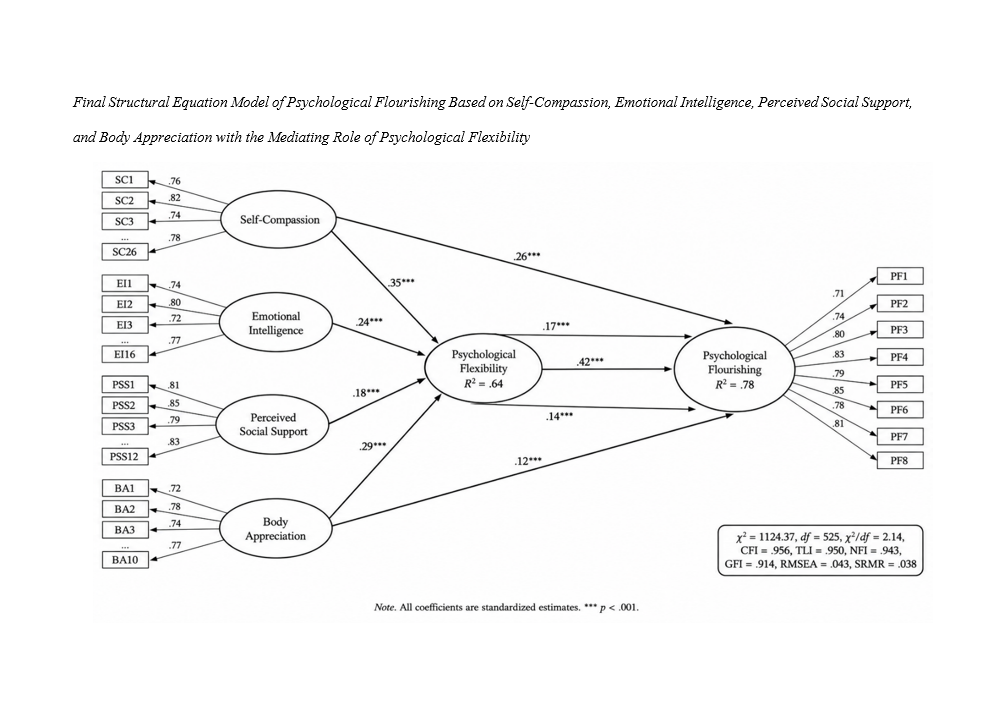
Findings: The measurement model demonstrated excellent fit to the data (χ²/df = 2.12, CFI = .957, TLI = .951, RMSEA = .042, SRMR = .038). Significant positive correlations were observed among all study variables (p < .001). Structural equation modeling revealed that self-compassion (β = .26, p < .001), emotional intelligence (β = .17, p < .001), perceived social support (β = .14, p < .001), body appreciation (β = .12, p < .001), and psychological flexibility (β = .42, p < .001) significantly predicted psychological flourishing. Furthermore, self-compassion (β = .35, p < .001), emotional intelligence (β = .24, p < .001), perceived social support (β = .18, p < .001), and body appreciation (β = .29, p < .001) significantly predicted psychological flexibility. Bootstrap analyses confirmed significant indirect effects of all predictor variables on flourishing through psychological flexibility. The model explained 64% of the variance in psychological flexibility and 78% of the variance in psychological flourishing.
Conclusion: The findings indicate that self-compassion, emotional intelligence, perceived social support, and body appreciation contribute significantly to women's psychological flourishing both directly and indirectly through psychological flexibility. Psychological flexibility emerged as a central mechanism linking personal strengths and social resources to optimal psychological functioning. These results highlight the importance of multidimensional strengths-based interventions aimed at enhancing flexibility, self-compassion, emotional competencies, social connectedness, and positive body image to promote flourishing and well-being among women.
Downloads
References
Armaou, M., Araviaki, E., Dutta, S., Konstantinidis, S., & Blake, H. (2022). Effectiveness of Digital Interventions for Deficit-Oriented and Asset-Oriented Psychological Outcomes in the Workplace: A Systematic Review and Narrative Synthesis. European Journal of Investigation in Health Psychology and Education, 12(10), 1471-1497. https://doi.org/10.3390/ejihpe12100102
Corrigan, V. K., Richmond, P. W., Strand, E. B., & Vaisman, J. M. (2025). The Future of Flourishing in Veterinary Medicine: A Systems-Informed Positive Psychology Approach in Veterinary Education. Frontiers in veterinary science, 11. https://doi.org/10.3389/fvets.2024.1484412
Cuchet, I., Maneval, A., & Dambrun, M. (2025). Stress, Mental Health, and Resources of Palliative Care Professionals. Palliative & Supportive Care, 23. https://doi.org/10.1017/s1478951524002050
El-Jor, C., Hallez, Q., Filippone, L., Flaudias, V., & Shankland, R. (2025). Disordered Eating in Emerging Adults: A Narrative Review and Recommendations for Prevention. Emerging Adulthood, 13(3), 721-747. https://doi.org/10.1177/21676968251318056
Gannamraju, S. K. (2025). Lived Experiences of Spiritual Emotional Intelligence: A Bhagavad Gitā-Based Indigenous Model of Psychological Wellbeing. Frontiers in psychology, 16. https://doi.org/10.3389/fpsyg.2025.1730103
Irmischer, K., Cans, M. I., Burke, J., & Sweeney, A. (2024). Self-Compassion Enhances Intuitive Eating Patterns in Middle-Aged Adults. Journal of Happiness and Health(FirstView Articles), 63-70. https://doi.org/10.47602/johah.v4i2.72
Isaee, H. (2026). Beyond the Self in AI-Enhanced EFL Classrooms: Cultivating Self-Transcendent Emotions, Well-Being, and Speaking Fluency Through Intelligent Simulations. https://doi.org/10.21203/rs.3.rs-8514715/v1
Kauser, S., Keyte, R., Mantzios, M., & Egan, H. (2022). A Qualitative Exploration Into Experiences and Attitudes Regarding Psychosocial Challenges, Self-Compassion, and Mindfulness in a Population of Adults With Cystic Fibrosis. Journal of Clinical Psychology in Medical Settings, 29(4), 898-910. https://doi.org/10.1007/s10880-022-09859-8
Kazanjian, C. J. (2022). Mindfulness Diligence: Supporting the Culturally Relative Self-Actualization Processes of Diverse Groups of Youth. The Humanistic Psychologist, 50(2), 234-255. https://doi.org/10.1037/hum0000192
Kemp, A. H. (2025). Promoting Holistic Wellbeing During the Polycrisis: An Essay on Inner Development Through the Martial Art of Wing Chun. PLOS Mental Health, 2(9), e0000433. https://doi.org/10.1371/journal.pmen.0000433
Konte, A. G. (2023). Mindfulness in Organizations: The Concept of Mindful Leadership. https://doi.org/10.5772/intechopen.108322
Liu, H., & Boyatzis, R. E. (2021). Focusing on Resilience and Renewal From Stress: The Role of Emotional and Social Intelligence Competencies. Frontiers in psychology, 12. https://doi.org/10.3389/fpsyg.2021.685829
Loncar, L., & Fiskum, C. (2025). Detached Self-Observation as a Developmental Catalyst: Theoretical Insights From Dynamical Systems Thinking, Cultural Mediation, and Contemplative Practice. Frontiers in psychology, 16. https://doi.org/10.3389/fpsyg.2025.1659774
Longhurst, P. (2021). Incorporating Positive Body Image in Therapeutic Practice: An Overview of Construct Definitions, Concepts and Theoretical Foundations. Counselling and Psychotherapy Research, 22(2), 257-266. https://doi.org/10.1002/capr.12494
Lu, T., Liu, M., Zhang, X., & Li, O. (2024). Assessing the Emotional Intelligence Level of School Heads Towards Crafting an Executive Development Program. Journal of World Englishes and Educational Practices, 6(1), 117-136. https://doi.org/10.32996/jweep.2024.6.1.5
Maillet, S., & Richard, E. (2021). Work Environment Characteristics and Emotional Intelligence as Correlates of Nurses’ Compassion Satisfaction and Compassion Fatigue: A Cross-Sectional Survey Study. Nursing Reports, 11(4), 847-858. https://doi.org/10.3390/nursrep11040079
Mitsea, E., Drigas, A., & Skianis, C. (2024). Well-Being Technologies and Positive Psychology Strategies for Training Metacognition, Emotional Intelligence and Motivation Meta-Skills in Clinical Populations: A Systematic Review. Psych, 6(1), 305-344. https://doi.org/10.3390/psych6010019
Munroe, M. (2022). Positive Embodiment for Wellbeing Researchers and Practitioners: A Narrative Review of Emerging Constructs, Measurement Tools, Implications, and Future Directions. International Journal of Wellbeing, 12(2), 134-162. https://doi.org/10.5502/ijw.v12i2.1917
Panditharathne Nishantha Kumara Wijesekara, P., & Chen, Z. (2021). An Integrative Review on the Research Progress of Mindfulness and Its Implications at the Workplace. Sustainability, 13(24), 13852. https://doi.org/10.3390/su132413852
Papazoglou, K., Kamkar, K., & Thompson, J. (2021). Law Enforcement Wellness: Promoting the “Good” During the “Bad” and “Ugly”. Journal of Community Safety and Well-Being, 6(4), 168-173. https://doi.org/10.35502/jcswb.209
Ravanbakhsh, L., Ebrahimi, M. I., Haddadi, A., & Yazdi‐Ravandi, S. (2023). Effects of the Acceptance and Commitment Therapy on Resiliency, Self-Compassion, and Corona Disease Anxiety on Medical Staff Involved in COVID-19 Pandemic. Iranian journal of psychiatry and behavioral sciences, 17(4). https://doi.org/10.5812/ijpbs-136845
Razza, R. A., Zhang, Y., & Edelstein, A. (2025). Mindfulness-Based Cognitive and Emotional Wellness Supports for Adolescents: Adaptations and Lessons Learned During the COVID-19 Pandemic. School Psychology International, 46(4), 421-454. https://doi.org/10.1177/01430343251361133
Rofiqah, R. (2023). The Effect of Self-Compassion and Support Systems on Flourishing in Students. 68-76. https://doi.org/10.2991/978-2-38476-032-9_8
Sansone, A. (2024). The Central Role of Mindful Parenting in Child’s Emotional Regulation and Human Flourishing: A Blueprint Perspective. Frontiers in psychology, 15. https://doi.org/10.3389/fpsyg.2024.1420588
Segall, S. Z., & Kristeller, J. L. (2022). Positive Psychology and Buddhism. 211-225. https://doi.org/10.1007/978-3-031-10274-5_14
Shrestha, A. K. (2024). Positive Psychology at Work: A Review of Concepts, Conceptual and Methodological Challenges and Future Research Directions. Nep. J. Mgt. Tech., 2(2), 22-36. https://doi.org/10.3126/njmt.v2i2.68717
Tendhar, T., Marcotte, M. A., Mesquita, P. B. d., & Saikia, M. J. (2024). Online Video-Mediated Compassion Training Program for Mental Health and Well-Being of University Students. Healthcare, 12(10), 1033. https://doi.org/10.3390/healthcare12101033
Trinko, V., Sarewitz, J., & Athan, A. (2025). Improving Maternal Well-Being: A Matrescence Education Pilot Study for New Mothers. Maternal Health Neonatology and Perinatology, 11(1). https://doi.org/10.1186/s40748-025-00203-0
Yoshinaga, N., & Cooper, S. (2025). The Four Pathways of Assertiveness: A Multidimensional Framework for Enhancing Individual Well-Being. Frontiers in psychology, 16. https://doi.org/10.3389/fpsyg.2025.1610807
Zhang, S., Liu, Q., Jia, M., Zhang, Q., & Zhang, L. (2025). The Predictive Roles of Self-Compassion, Perceived Social Support, and Psychological Flexibility in Early Maladaptive Schemas Among College Students: An Exploration Based on Latent Profile Analysis. Frontiers in psychology, 16. https://doi.org/10.3389/fpsyg.2025.1619308
Downloads
Additional Files
Publication Timeline
- Submitted
- Revised
- Accepted