The Effectiveness of Schema Therapy on Obsessive-Compulsive Disorder in Individuals with Borderline Personality Disorder
DOI:
https://doi.org/10.61838/kman.hn.3.2.8Keywords:
Schema Therapy, Obsessive-Compulsive Disorder, Borderline Personality DisorderAbstract
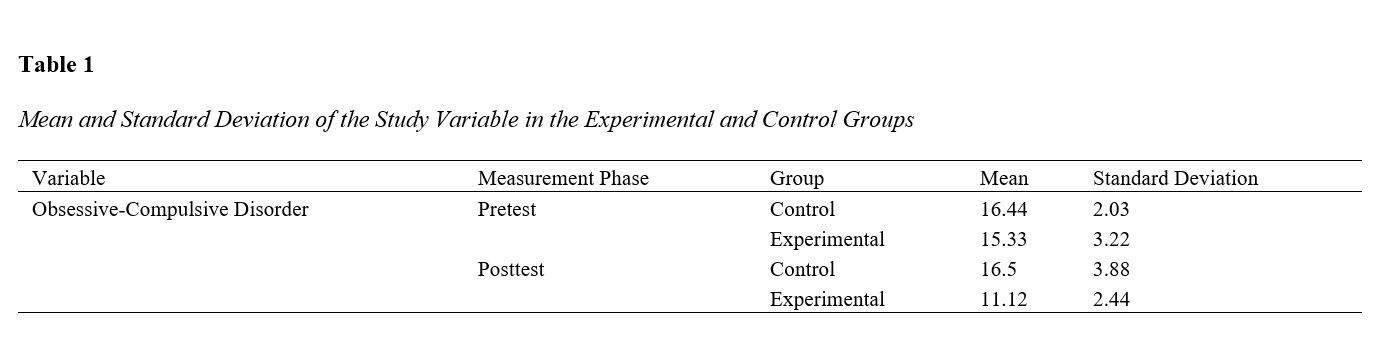
Borderline personality disorder, a severe and pervasive mental health condition, has attracted the interest of many researchers. Therefore, the present study aimed to examine the effectiveness of schema therapy on obsessive-compulsive disorder in individuals with borderline personality disorder. This study employed a quasi-experimental design with a pretest-posttest control group structure. The statistical population included all married women diagnosed with borderline personality disorder who visited the Family Green Psychological Services Center in Semnan in 2024. From this population, 30 individuals were selected using purposive sampling based on inclusion and exclusion criteria and were randomly assigned to either the experimental or control group (15 participants per group). The research instrument was the Maudsley Obsessive-Compulsive Inventory (MOCL). The schema therapy sessions were conducted based on the schema therapy protocol developed by Young et al. (2003; translated by Hamidpour, 2007). Data analysis was performed using SPSS-24 software and multivariate analysis of covariance (MANCOVA) while ensuring statistical assumptions were met. The results indicated that after controlling for the pretest effect, the difference in pretest-posttest scores in the experimental group for obsessive-compulsive disorder was statistically significant. Additionally, the posttest mean scores for obsessive-compulsive disorder in the experimental group were significantly lower than those in the control group (p < .001). Based on the study findings, schema therapy has a significant impact on the research variables. To enhance the external validity of the findings, further studies in this area are recommended.
Downloads
References
1. American Psychiatric Association. Diagnostic and Statistical Manual of Mental Disorders: DSM-5: American Psychiatric Publishing, Inc.; 2013.
2. Krause-Utz A, Winter D, Niedtfeld I, Schmahl C. The latest neuroimaging findings in borderline personality disorder. Current Psychiatry Reports. 2014;16(3).
3. Zutphen Lv, Siep N, Jacob GA, Goebel R, Arntz A. Emotional sensitivity, emotion regulation and impulsivity in borderline personality disorder: a critical review of fMRI studies. Neuroscience & Biobehavioral Reviews. 2015;51:64-76.
4. Amad A, Ramoz N, Thomas P, Jardri R, Gorwood P. Genetics of borderline personality disorder: systematic review and proposal of an integrative model. Neuroscience & Biobehavioral Reviews. 2014;40:6-19.
5. Crowell SE, Beauchaine TP, Linehan MM. A biosocial developmental model of borderline personality: Elaborating and extending Linehan's theory. Psychological Bulletin. 2009;135(3):495-510.
6. Kessler RC, Berglund P, Demler O, Jin R, Merikangas KR, Walters EE. Lifetime prevalence and age-of-onset distributions of DSM-IV disorders in the national comorbidity survey replication. Archives of General Psychiatry. 2005;62(6):593-602.
7. Stein DJ, Costa DL, Lochner C, Miguel EC, Reddy YJ, Shavitt RG, et al. Obsessive-compulsive disorder. Nature Reviews Disease Primers. 2019;5(1):52.
8. Young JE, Klosko JS, Weishaar ME. Schema Therapy: A Practitioner's Guide: Guilford Press; 2006.
9. Martin R, Young J. Schema Therapy. In: Dobson KS, editor. Handbook of Cognitive-Behavioral Therapies: The Guilford Press; 2010. p. 317-46.
10. Arntz A, Rijkeboer M, Chan E, Fassbinder E, Karaosmanoglu A, Lee CW, et al. Towards a reformulated theory underlying schema therapy: position paper of an international workgroup. Cognitive Therapy Research. 2021;45(6):1007-20.
11. Bamelis LLM, Evers SMAA, Spinhoven P, Arntz A. Results of a multicenter randomized controlled trial of the clinical effectiveness of schema therapy for personality disorders. American Journal of Psychiatry. 2014;171(3):305-22.
12. Cain NM, Ansell EB, Pinto A. Cluster C personality disorders and anxiety disorders. Handbook of Treating Variants and Complications in Anxiety Disorders: Springer, New York; 2013. p. 349-61.
13. Cockram DM, Drummond PD, Lee CW. Role and treatment of early maladaptive schemas in Vietnam veterans with PTSD. Clinical Psychology & Psychotherapy. 2010;17(3):165-82.
14. Gude T, Monsen JT, Hoffart A. Schemas, affect consciousness, and cluster C personality pathology: a prospective one-year follow-up study of patients in a schema-focused short-term treatment program. Psychotherapy Research. 2001;11(1):85-98.
15. Hoffart A, Sexton H. The role of optimism in the process of schema-focused cognitive therapy of personality problems. Behavioral Research and Therapy. 2002;40(6):611-23.
16. Thiel N, Jacob GA, Tuschen-Caffier B, Herbst N, Kulz AK, Hertenstein E, et al. Schema therapy augmented exposure and response prevention in patients with obsessive-compulsive disorder: Feasibility and efficacy of a pilot study. Journal of Behavior Therapy and Experimental Psychiatry. 2016;52:59-67.
17. Veenstra-Spruit MS, Bouman R, van Dijk SD, van Asselt AD, van Alphen SP, Veenstra DH, et al. Group schema therapy combined with psychomotor therapy for older adults with a personality disorder: an open-label, multicentre, randomised controlled trial. The Lancet Healthy Longevity. 2024;5(4):e245-e54.
18. Khosravani V, Sharifi Bastan F, Mohammadzadeh A, Amirinezhad A, Samimi Ardestani SM. Early maladaptive schemas in patients with obsessive-compulsive disorder, bipolar disorder, and schizophrenia: A comparative study. Current Psychology. 2021;40(5):2442-52.
19. Assmann N, Schaich A, Arntz A, Wagner T, Herzog P, Alvarez-Fischer D, et al. The effectiveness of dialectical behavior therapy compared to schema therapy for borderline personality disorder: A randomized clinical trial. Psychotherapy and Psychosomatics. 2024;93(4):249-63.
20. Hodgson RJ, Rachman S. Obsessional-compulsive complaints. Behaviour Research and Therapy. 1977;15(5):389-95.
21. Asli Azad M, Manshaee GR, Ghamarani A. Effectiveness of acceptance and commitment therapy on cognitive emotion regulation and intolerance of uncertainty of the students with obsessive-compulsive disorder. Psychology of Exceptional Individuals. 2020;9(36):33-53.
22. Bakhshipour A, Mahmoud Aliloo M. Schema therapy for patients with Symptoms Obsessive-compulsive personality disorder (OCPD): A single case series study. Journal of Psychological Science. 2022;21(112):677-92.
23. Hopwood CJ, Thomas KM. Schema therapy is an effective treatment for avoidant, dependent and obsessive-compulsive personality disorders. BMJ Mental Health. 2014;17(3):90-1.
24. Semp'ertegui GA, Karreman A, Arntz A, Bekker MHJ. Schema therapy for borderline personality disorder: A comprehensive review of its empirical foundations, effectiveness and implementation possibilities. Clinical Psychology Review. 2013;33(3):426-47.
25. Jacob GA, Arntz A. Schema therapy for personality disorders-A review. International Journal of Cognitive Therapy. 2013;6(2):171-85.
26. Moritz S, Fink J, Miegel F, Nitsche K, Kraft V, Tonn P, et al. Obsessive-compulsive disorder is characterized by a lack of adaptive coping rather than an excess of maladaptive coping. Cognitive Therapy and Research. 2018;42:650-60.
27. Rosa-Alcázar Á, García-Hernández MD, Parada-Navas JL, Olivares-Olivares PJ, Martínez-Murillo S, Rosa-Alcázar AI. Coping strategies in obsessive-compulsive patients during Covid-19 lockdown. International Journal of Clinical and Health Psychology. 2021;21(2):100223.
28. Leichsenring F, Heim N, Leweke F, Spitzer C, Steinert C, Kernberg OF. Borderline personality disorder: a review. JAMA. 2023;329(8):670-9.
29. Basile B, Tenore K, Luppino OI, Mancini F. Schema Therapy mode model applied to OCD. Clinical Neuropsychiatry. 2017;14(6).
30. Dostal AL, Pilkington PD. Early maladaptive schemas and obsessive-compulsive disorder: A systematic review and meta-analysis. Journal of Affective Disorders. 2023;336:42-51.
31. Haeyen S. Strengthening the healthy adult self in art therapy: using schema therapy as a positive psychological intervention for people diagnosed with personality disorders. Frontiers in Psychology. 2019;10:644.
32. Fassbinder E, Schweiger U, Martius D, Brand-de Wilde O, Arntz A. Emotion regulation in schema therapy and dialectical behavior therapy. Frontiers in Psychology. 2016;7:1373.
Downloads
Additional Files
Publication Timeline
- Submitted
- Revised
- Accepted
License
Copyright (c) 2025 Elham Eftekhari (Corresponding Author)

This work is licensed under a Creative Commons Attribution-NonCommercial 4.0 International License.