Evaluation of the Effect of Continuous and Interval Aerobic Training on Survivin Gene Expression and Cytochrome C in Myocardial Tissue of Rats Modeled with Myocardial Infarction
DOI:
https://doi.org/10.61838/kman.hn.4765Keywords:
Myocardial infarction, aerobic training, Survivin, Cytochrome C, oxidative stressAbstract
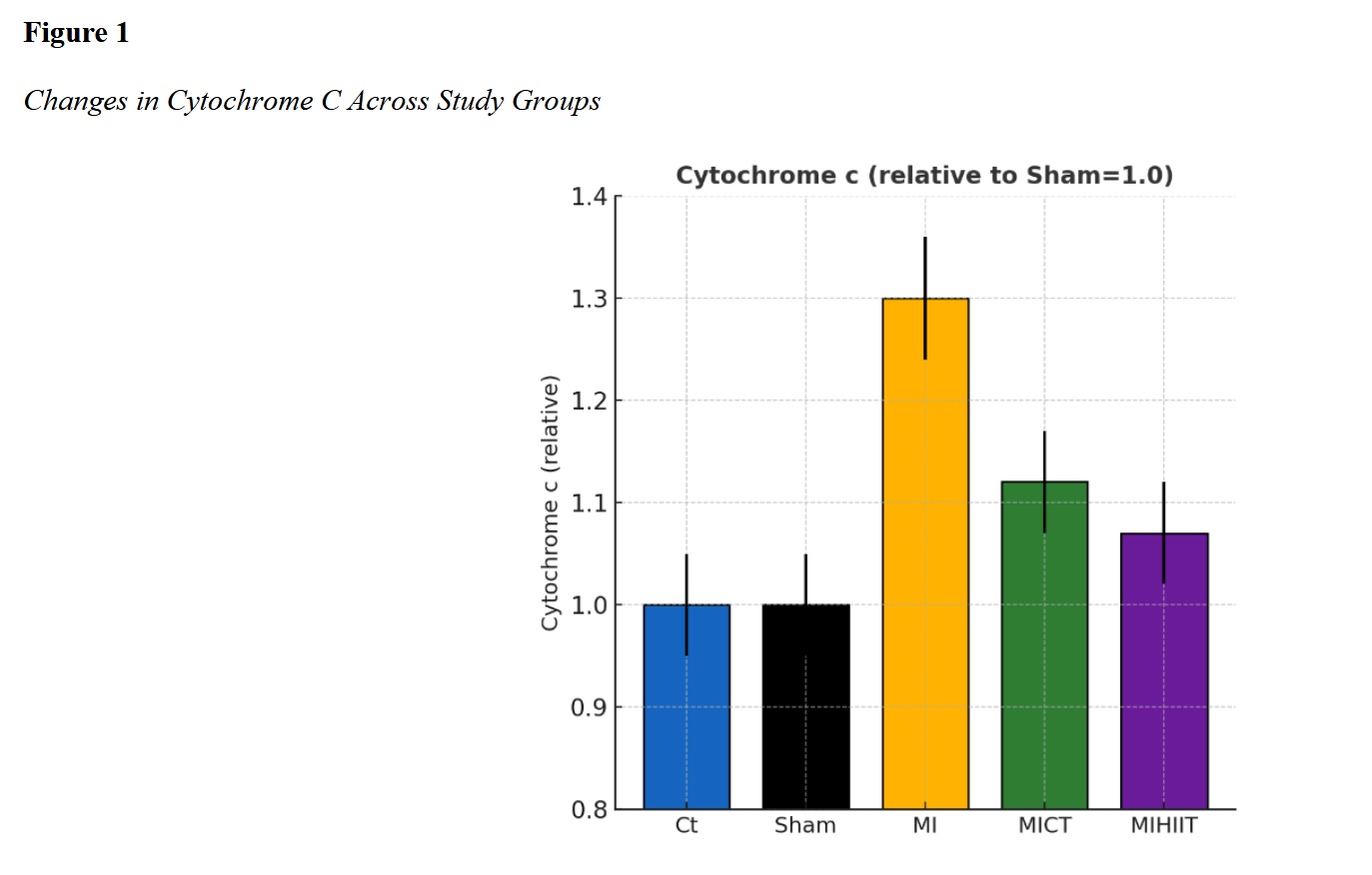
This study aimed to investigate the effects of moderate-intensity continuous training (MICT) and high-intensity interval training (MIHIIT) on Survivin gene expression and Cytochrome C levels in myocardial tissue of rats modeled with myocardial infarction. In this experimental study, 30 adult male Wistar rats (10–12 weeks, 275 ± 25 g) were assigned to five groups: healthy control, sham, myocardial infarction (MI), MICT, and MIHIIT. The MI model was induced through left anterior descending coronary artery occlusion and confirmed by echocardiography. Training protocols were performed for 8 weeks, five sessions per week. The MICT group performed continuous running at moderate intensity (15–23 m/min, 50 minutes), while the MIHIIT group completed interval running consisting of 7 sets of high-intensity bouts (20–28 m/min, 4 minutes) with active recovery periods (11–17 m/min, 3 minutes). Survivin gene expression was measured using RT-qPCR, and Cytochrome C levels were quantified using ELISA. Data were analyzed using MANOVA, ANOVA, and Tukey post-hoc tests. Myocardial infarction caused a significant increase in Cytochrome C levels and a reduction in Survivin expression compared to the healthy and sham groups (p < .001). Both types of aerobic training significantly reversed the infarction-induced alterations; Cytochrome C levels were reduced, and Survivin expression returned to levels comparable to the control group. When comparing the two protocols, interval training (MIHIIT) produced a greater increase in Survivin expression (p ≈ .046), while both exercise types demonstrated similar effects on reducing Cytochrome C. Both continuous and interval aerobic training restore the survival/death balance in myocardial tissue following infarction by reducing oxidative stress and enhancing Survivin expression. These findings reinforce the role of aerobic exercise as an effective non-pharmacological intervention in cardiac rehabilitation.
Downloads
References
1. Valenzuela PL, Ruilope LM, Santos-Lozano A, Wilhelm M, Kränkel N, Fiuza-Luces C, et al. Exercise benefits in cardiovascular diseases: from mechanisms to clinical implementation. European Heart Journal. 2023;44(21):1874-89. [PMID: 37005351] [DOI]
2. Shahidi F, Kashef M, Dalfani Z. A Review of Exercise-Based Cardiac Rehabilitation Strategies in Patients with Myocardial Infarction: Focusing on High-Intensity Interval Training. Arak University of Medical Sciences Journal. 2021;24(6):778-91. [DOI]
3. Martens MD, Karch J, Gordon JW. The molecular mosaic of regulated cell death in the cardiovascular system. Biochimica et Biophysica Acta (BBA)-Molecular Basis of Disease. 2022;1868(1):166297. [PMID: 34718119] [DOI]
4. Mongirdienė A, Skrodenis L, Varoneckaitė L, Mierkytė G, Gerulis J. Reactive oxygen species induced pathways in heart failure pathogenesis and potential therapeutic strategies. Biomedicines. 2022;10(3):602. [PMID: 35327404] [PMCID: PMC8945343] [DOI]
5. Jin W, Liu M, Zhang X, Zhang X. Comparison of aerobic exercise effects on oxidative stress and apoptosis in rats with myocardial infarction. Molecular Medicine Reports. 2015;12(4):4949-55.
6. Ebrahimi M, Asgharpour H, Farzanehgi P, Rezaei Shirazi R. The Effect of Two Types of Exercise (Continuous and Interval) and Atorvastatin on the Gene Expression of $PP2Ac$ and $GSK-3beta$ in the Heart Tissue of Diabetic Model Rats. Journal of Plasma and Biomarkers. 2023;16(3):86-98.
7. Dor-Haim H, Horowitz M, Yaakobi E, Katzburg S, Barak S. Intermittent aerobic-resistance interval training versus continues aerobic training: Improvement in cardiac electrophysiologic and anthropometric measures in male patients post myocadiac infarction, a randomized control trial. Plos one. 2022;17(5):e0267888. [PMID: 35503787] [PMCID: PMC9064084] [DOI]
8. Kavano H, Takamoto S, Matsumura N, Hara S. The effects of intermittent and continuous exercise on oxidative stress in patients with heart failure. Clinical Medicine MDPI Journal. 2020;10(9):2250.
9. Kramer AM, Martins JB, de Oliveira PC, Lehnen AM, Waclawovsky G. High-intensity interval training is not superior to continuous aerobic training in reducing body fat: A systematic review and meta-analysis of randomized clinical trials. Journal of Exercise Science & Fitness. 2023;21(4):385-94. [PMID: 37927356] [PMCID: PMC10624584] [DOI]
10. Jung JY, Kim JH, Lee HY, Park HS. The effects of intermittent and continuous exercise on apoptosis and oxidative stress in rats with heart failure. Journal of Sports Rehabilitation. 2020;16(2):135-42.
11. Rostami N, Afrondeh R, Seyfi Asg Shahri F, Pourrahim Ghourghchi A. The Effect of Moderate-Intensity Interval Training on the Expression of Necroptosis-Related Genes in the Heart Tissue of Male Mice with Myocardial Infarction. Scientific-Research Journal of Shahid Sadoughi University of Medical Sciences Yazd. 2024;32(8):8173-86. [DOI]
12. Mendes RF, Sousa MS, Sampaio R, Silva MT. Comparative effects of continuous and interval aerobic training on cardiac function in chronic heart failure rats. Physiological Research. 2017;66(2):203-12. [DOI]
13. Ahmadi R, Fathi M, Rahmati M. The Effect of High-Intensity Interval Training and Crocin Consumption on Serum Markers of Cardiac Tissue Toxicity Induced by Doxorubicin Injection in Male Wistar Rats. Quarterly Journal of Complementary Medicine. 2022;12(2):136-47. [DOI]
14. Bennett E, Devan H, Hale L, Gray E. Evaluation of the quality and self-management-related content of websites promoting physical activity engagement after myocardial infarction or cardiac surgery: A scoping review. Heart & Lung. 2025;69:94-110. [PMID: 39378531] [DOI]
15. Gonçalves C, Bravo J, Pais J, Abreu A, Raimundo A. Improving Health Outcomes in Coronary Artery Disease Patients with Short‐Term Protocols of High‐Intensity Interval Training and Moderate‐Intensity Continuous Training: A Community‐Based Randomized Controlled Trial. Cardiovascular Therapeutics. 2023;2023(1):6297302. [PMID: 38146531] [PMCID: PMC10749735] [DOI]
16. Charan J, Biswas T. How to calculate sample size for different study designs in medical research? Indian journal of psychological medicine. 2013;35(2):121-6. [PMID: 24049221] [PMCID: PMC3775042] [DOI]
17. Nori P, Haghshenas R, Aftabi Y, Akbari H. Comparison of moderate-intensity continuous training and high-intensity interval training effects on the Ido1-KYN-Ahr axis in the heart tissue of rats with occlusion of the left anterior descending artery. Scientific Reports. 2023;13(1):3721. [PMID: 36879035] [PMCID: PMC9988842] [DOI]
18. Høydal MA, Wisløff U, Kemi OJ, Ellingsen Ø. Running speed and maximal oxygen uptake in rats and mice: practical implications for exercise training. European Journal of Preventive Cardiology. 2007;14(6):753-60. [PMID: 18043295] [DOI]
19. Khalafi M, Mohebbi H, Symonds ME, Karimi P, Akbari A, Tabari E, et al. The impact of moderate-intensity continuous or high-intensity interval training on adipogenesis and browning of subcutaneous adipose tissue in obese male rats. Nutrients. 2020;12(4):925. [PMID: 32230849] [PMCID: PMC7231004] [DOI]
20. Hannan AL, Hing W, Simas V, Climstein M, Coombes JS, Jayasinghe R, et al. High-intensity interval training versus moderate-intensity continuous training within cardiac rehabilitation: a systematic review and meta-analysis. Open access journal of sports medicine. 2018:1-17. [PMID: 29416382] [PMCID: PMC5790162] [DOI]
21. Xiang Q, Yi X, Zhu XH, Wei X, Jiang DS. Regulated cell death in myocardial ischemia-reperfusion injury. Trends in Endocrinology & Metabolism. 2024;35(3):219-34. [DOI]
22. Wang L, Tu W, Li X, Li C, Lu J, Dai P, et al. Exercise improves cardiac function and attenuates myocardial inflammation and apoptosis by regulating APJ/STAT3 in mice with stroke. Life Sciences. 2023;332:122041. [PMID: 37657526] [DOI]
23. Rasouli Foushazadeh A, Abedi B, Matin Homaee H, Farzanehgi P. The Effect of Aerobic Exercise and Tribulus Terrestris Extract on Some Indices of Oxidative Stress and Apoptosis in the Lungs of Male Rats Poisoned with Hydrogen Peroxide. Quarterly Journal of Complementary Medicine. 2022;12(1):84-99. [DOI]
Downloads
Additional Files
Publication Timeline
- Submitted
- Revised
- Accepted