The Mediating Role of Generalized Anxiety Disorder Symptoms in the Relationship of Stressful Life Events and Childhood Maltreatment with Gastrointestinal Symptoms
DOI:
https://doi.org/10.61838/kman.hn.5136Keywords:
childhood maltreatment, stressful life events, generalized anxiety disorder symptoms, gastrointestinal symptomsAbstract
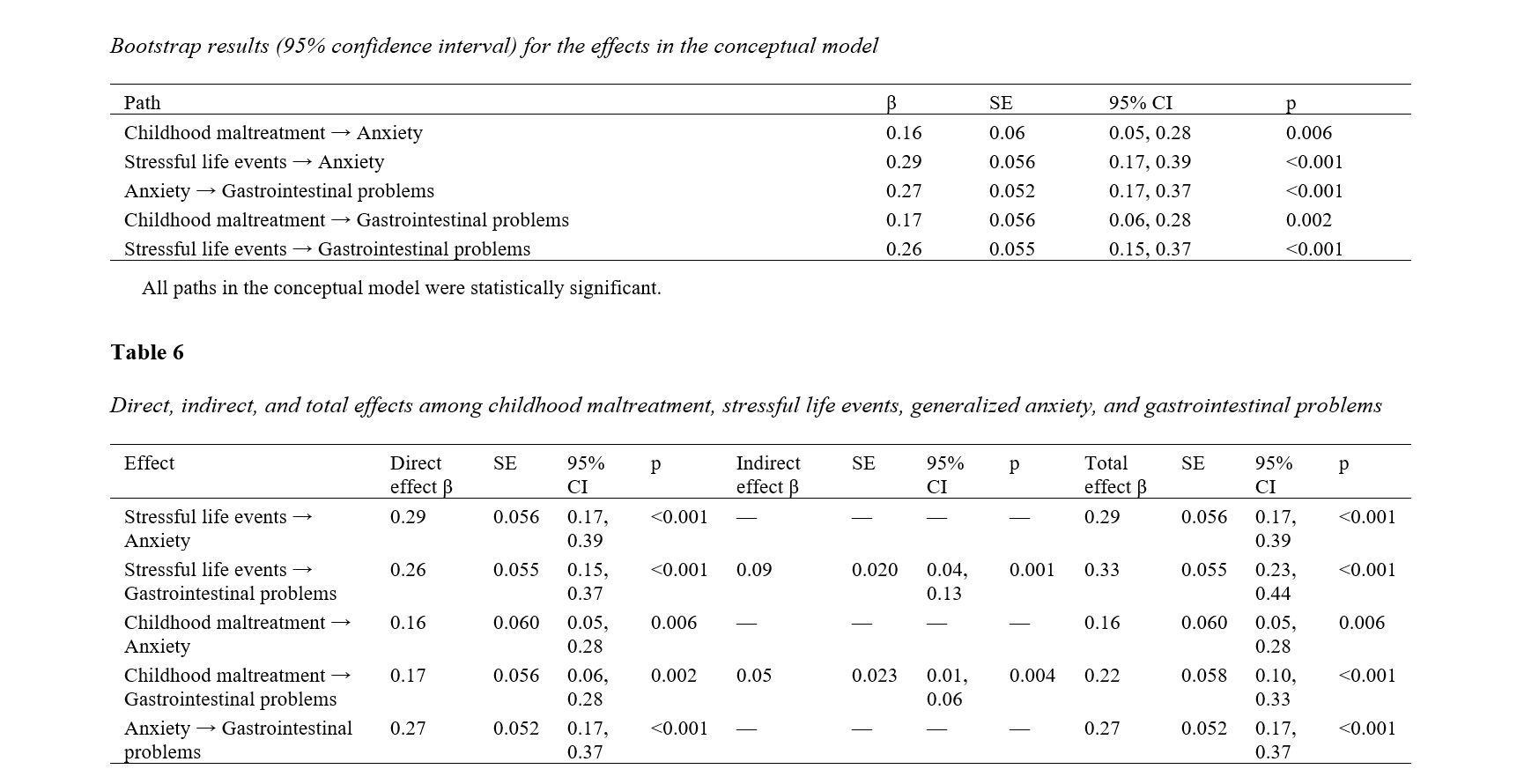
Psychosomatic disorders, particularly gastrointestinal complaints, are a major health concern among university students, as they can impair physical health, academic performance, psychological well-being, and social functioning. This study examined the mediating role of generalized anxiety disorder (GAD) symptoms in the relationship between stressful life events, childhood maltreatment, and gastrointestinal symptoms. This descriptive correlational study was conducted among undergraduate and graduate students of Islamic Azad University, Neyshabur Branch, during the 2024–2025 academic year. A total of 300 students were selected through convenience sampling. Data were collected using the Child Abuse Self-Report Scale, the GAD-7, the Stressful Life Events Screening Questionnaire, and the Gastrointestinal Symptom Rating Scale. Data were analyzed in SPSS 26 and AMOS using descriptive statistics, Pearson correlations, and structural equation modeling. The results showed significant associations among GAD symptoms, stressful life events, childhood maltreatment, and gastrointestinal symptoms. The structural model showed acceptable fit. Stressful life events positively predicted GAD symptoms (β = 0.28, p < 0.001) and gastrointestinal symptoms (β = 0.24, p < 0.01). Childhood maltreatment also positively predicted GAD symptoms (β = 0.36, p < 0.001) and gastrointestinal symptoms (β = 0.37, p < 0.01). GAD symptoms partially mediated these relationships.
Downloads
References
1. Jethloja HB, Unadkat PB, Raichura RK, Rana JN, Ved NS. Correlation between occurrence of psychosomatic disorders and age during COVID-19 lockdown. Journal of Clinical and Diagnostic Research. 2021;15(7):YC10-YC2.
2. Ochnik D, Rogowska AM, Kuśnierz C, Jakubiak M, Schütz A, Held MJ, et al. Mental health prevalence and predictors among university students in nine countries during the COVID-19 pandemic: a cross-national study. Sci Rep. 2021;11(1):18644.
3. Satsangi AK, Brugnoli MP. Anxiety and psychosomatic symptoms in palliative care: From neuro-psychobiological response to stress, to symptoms’ management with clinical hypnosis and meditative states. Annals of Palliative Medicine. 2018;7(1):75-111.
4. Koloski N, Holtmann G, Talley NJ. Is there a causal link between psychological disorders and functional gastrointestinal disorders? Expert Review of Gastroenterology & Hepatology. 2020;14(11):1047-59.
5. Revicki DA, Wood M, Wiklund I, Crawley J. Reliability and validity of the Gastrointestinal Symptom Rating Scale in patients with gastroesophageal reflux disease. Qual Life Res. 1998;7(1):75-83.
6. Cantarero-Prieto D, Moreno-Mencia P. The effects of gastrointestinal disturbances on the onset of depression and anxiety. PLoS One. 2022;17(1):e0262712.
7. Heim C, Nemeroff CB. The role of childhood trauma in the neurobiology of mood and anxiety disorders: preclinical and clinical studies. Biol Psychiatry. 2001;49(12):1023-39.
8. Rzeszutek M, Kowalkowska J, Drabarek K, Van Hoy A, Schier K, Lis-Turlejska M, et al. Adverse childhood experiences and diet quality in the national sample of Poles: The mediating role of emotion regulation. Appetite. 2025;204:107749.
9. Santos MA, Jardim GB, Ranjbar S, Gholam M, Schuster JP, Gomes I, et al. Childhood maltreatment and late-life generalized anxiety disorder: Are personality and attachment characteristics mediators? Journal of Affective Disorders Reports. 2023;12:100514.
10. Carlson D. Stressful Life Events. Encyclopedia of Quality of Life and Well-Being Research: Springer, Cham; 2023.
11. Dong Y, Baumeister D, Berens S, Eich W, Tesarz J. Stressful Life Events Moderate the Relationship Between Changes in Symptom Severity and Health-related Quality of Life in Patients With Irritable Bowel Syndrome. J Clin Gastroenterol. 2020;54(5):445-51.
12. Spitzer RL, Kroenke K, Williams JB, Löwe B. A brief measure for assessing generalized anxiety disorder: the GAD-7. Arch Intern Med. 2006;166(10):1092-7.
13. Li Q, Duan H, Wang Q, Dong P, Zhou X, Sun K, et al. Analyzing the correlation between gastroesophageal reflux disease and anxiety and depression based on ordered logistic regression. Sci Rep. 2024;14(1):6594.
14. Zamani M, Alizadeh-Tabari S, Zamani V. Systematic review with meta-analysis: the prevalence of anxiety and depression in patients with irritable bowel syndrome. Aliment Pharmacol Ther. 2019;50(2):132-43.
15. Goodman LA, Corcoran C, Turner K, Yuan N, Green BL. Assessing traumatic event exposure: general issues and preliminary findings for the Stressful Life Events Screening Questionnaire. J Trauma Stress. 1998;11(3):521-42.
16. Green BL, Chung JY, Daroowalla A, Kaltman S, Debenedictis C. Evaluating the cultural validity of the stressful life events screening questionnaire. Violence Against Women. 2006;12(12):1191-213.
17. Fond G, Loundou A, Hamdani N, Boukouaci W, Dargel A, Oliveira J, et al. Anxiety and depression comorbidities in irritable bowel syndrome (IBS): A systematic review and meta-analysis. European Archives of Psychiatry and Clinical Neuroscience. 2014;264:651-60.
18. Kennedy PJ, Cryan JF, Quigley EM, Dinan TG, Clarke G. A sustained hypothalamic-pituitary-adrenal axis response to acute psychosocial stress in irritable bowel syndrome. Psychol Med. 2014;44(14):3123-34.
19. Tanaka Y, Kanazawa M, Fukudo S, Drossman DA. Biopsychosocial model of irritable bowel syndrome. J Neurogastroenterol Motil. 2011;17(2):131-9.