
Comparison of the Effectiveness of Problem-Solving Skills Training and Cognitive-Behavioral Group Play Therapy on Cognitive Emotion Regulation in Children with Generalized Anxiety Disorder
Keywords:
problem-solving skills training, cognitive-behavioral group play therapy, cognitive emotion regulation, children, generalized anxiety disorderAbstract
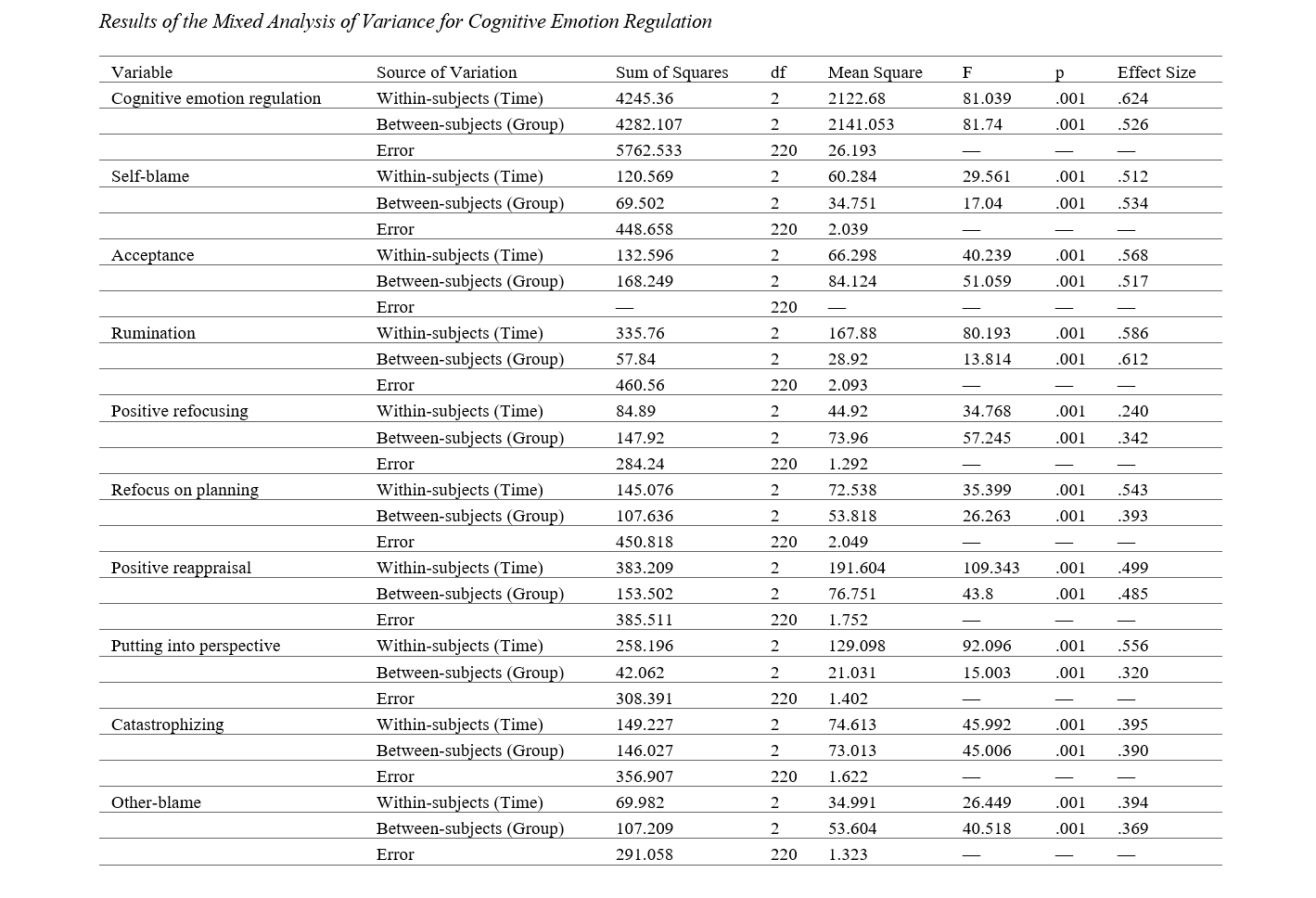
The aim of this study was to compare the effectiveness of problem-solving skills training and cognitive-behavioral group play therapy on cognitive emotion regulation in children with generalized anxiety disorder. The present study employed a quasi-experimental pretest-posttest design with a one-month follow-up and a control group. The statistical population consisted of children with generalized anxiety disorder who were referred to counseling and welfare centers in Kermanshah. A total of 75 eligible participants were selected through purposive sampling and randomly assigned to three groups of 25 participants each: problem-solving skills training, cognitive-behavioral group play therapy, and control. The Cognitive Emotion Regulation Questionnaire developed by Garnefski (2001) was used in this study. The intervention for the first experimental group (problem-solving skills training) was conducted in 10 sessions of 120 minutes each, whereas the intervention for the second experimental group (cognitive-behavioral group play therapy) consisted of eight 90-minute sessions. The collected data were analyzed using SPSS version 24 and repeated-measures analysis of variance, following examination of the relevant statistical assumptions. The results indicated significant differences across the pretest, posttest, and follow-up stages in cognitive emotion regulation and its components (p < .05 to p < .001), and these significant differences were maintained at the follow-up stage (p < .05). Moreover, a significant difference was observed between problem-solving skills training and cognitive-behavioral group play therapy among children with generalized anxiety disorder. Problem-solving skills training produced greater changes in cognitive emotion regulation among children with generalized anxiety disorder than cognitive-behavioral group play therapy. Problem-solving skills training enhances cognitive emotion regulation strategies in children with generalized anxiety disorder. Through problem-solving skills training, children can develop the belief that they are genuinely capable of influencing the events and situations they encounter.
Downloads
References
1. Shafdelpour A, Alimohammadi M. Generalized Anxiety Disorder (GAD): Causes, Symptoms And The Role Of Counseling In Treatment. 7th International Conference on Educational Sciences, Counseling, Psychology and Social Sciences; Hamadan2025.
2. Whisman MA, Collazos T. A Longitudinal Investigation Of Marital Dissolution, Marital Quality, And Generalized Anxiety Disorder In A National Probability Sample. Journal of Anxiety Disorders. 2023;96:102713. [PMID: 37075491]
3. Liu L, Wu J, Geng H, Liu C, Luo Y, Luo J. Long-Term Stress And Trait Anxiety Affect Brain Network Balance In Dynamic Cognitive Computations. Cerebral Cortex. 2022;32(14):2957-71. [PMID: 34875030]
4. Anderson PA. Policy Framework For The Promotion Of Mental Health And The Prevention Of Mental Disorders. Mental Health Policy and Practice Across Europe2016. p. 188.
5. Nuscheler R, Roeder K. Financing And Funding Healthcare: Optimal Policy And Political Implementability. Journal of Health Economics. 2015;42:197-208. [PMID: 26037207]
6. Gross JJ. Emotion Regulation In Adulthood: Timing Is Everything. Current Directions in Psychological Science. 2001;10(6):214-9.
7. Hu Y, Fan X, Wu Z, Locasala-Crouch J, Yang A, Zhang J. Teacher-Child Interactions And Children'S Cognitive And Social Skills In Chinese Preschool Classrooms. Children and Youth Services Review. 2018;79:78-86.
8. Deplancke C, Somerville MP, Harrison A, Vuillier L. It’S All About Beliefs: Believing Emotions Are Uncontrollable Is Linked To Symptoms Of Anxiety And Depression Through Cognitive Reappraisal And Expressive Suppression. Current Psychology. 2023;42(25):22004-12.
9. Garnefski N, Kraaij V. Cognitive Emotion Regulation Strategies And Depressive Symptoms: A Comparative Study Of Five Specific Samples. Personality and Individual Differences. 2006;40:1659-69.
10. Hasani J. Investigating The Validity And Reliability Of The Short Form Of The Cognitive Regulation Of Emotion Questionnaire. JRBS. 2012;9:229-40.
11. Alipour F, Nejati V, Dehrouyeh SH, Moradalian F, Bodaghi E. Cognitive Emotion Regulation And Behavioral Problems In 7-12 Years Old Children With Specific Learning Disorders (Reading, Writing And Mathematics Deficits). JOEC. 2020;20(1):87-98.
12. Bruggink A, Huisman S, Vuijk R, Kraaij V, Garnefski N. Cognitive Emotion Regulation, Anxiety And Depression In Adults With Autism Spectrum Disorder. Research in Autism Spectrum Disorders. 2016;22:34-44.
13. Anderberg JL, Baker LD, Kalantar EA, Berghoff CR. Cognitive Fusion Accounts For The Relation Of Anxiety Sensitivity Cognitive Concerns And Rumination. Current Psychology. 2024;43(5):4475-81.
14. Torbati AG, Feizabadi AS, Askari MR, Zandi A, Sarmadi M. Thought Believability And Anxious Feelings About COVID-19: A Case-Control Study In Northeastern Iran. Medical Journal of the Islamic Republic of Iran. 2023;37(1).
15. Fisher PL. Metacognitive Therapy. In: Wenzel A, editor. Handbook of Cognitive Behavioral Therapy: Overview and Approaches: American Psychological Association; 2021. p. 617-36. [PMID: 33390087]
16. Fusaro M, Smith M. Preschool Inquisitiveness And Science-Relevant Problem Solving. Early Childhood Research Quarterly. 2017;42:119-27.
17. Morin E. How To Teach Kids Problem-Solving Skills: Give Them Skills To Make Good Decisions. 2017.
18. Shokoohi Yekta M, Davaei M, Zamani N, Poorkarimi J, Sharifi Researcher A. The Efficacy Of “I Can Problem Solve” Program In Improving Problem Solving And Social Skills Among Preschoolers And First Grade Students. Advances in Cognitive Sciences. 2013;15(3):73-82.
19. Khalili SH, Lavasani M, Azad Farsane Y. The Study Of The Effectiveness Of Group Training Problem-Solving Skills On Anger Control In High School Students. Applied Psychological Research Quarterly. 2015;6(1):1-10.
20. Bakhshi A, Mirloo S. The Effect Of Problem-Solving Skills Training On Aggression And Anger In Hyperactive Children. Journal of Studies and Research in Behavioral Sciences. 2017;3(6):189-210.
21. Taher M, Norouzi A, Taghizadeh Romi F. Efficacy Of Problem-Solving Skill Training In The Treatment Of Test Anxiety Of Students. Journal of Child Mental Health. 2015;1(1):9-17.
22. Kakabraee K, Moradi AR. Family-Oriented Problem-Solving Training To Parents And The Impact On The Child'S Perception Of Parents. Journal of Counseling and Psychotherapy. 2017;8(29):165-85.
23. Kakabraee K. The Effect Of Family/School-Based Problem-Solving Training On The Problem-Solving Styles Of Elementary School Students. Journal of Child Mental Health. 2019;6(1):14-27.
24. Farid Marandi B, Kakabaraee K, Hosseini SA. The Effect Of Problem-Solving Training On Social Skills Of Preschool Children. Quarterly Journal of Child Mental Health. 2020;6(4):131-43.
25. Vahedi S, Yakanizad A, Aalizadeh S, Arjomandi N. The Effectiveness Of Problem-Solving Skills Training On Cognitive Emotion Regulation Strategies And Students' Well-Being. Quarterly Journal of Health Psychology and Social Behavior. 2024;4(3/12):21-38.
26. Yekanizad A, Soleiman Nejad A. The Effectiveness Of Problem-Solving Skills Training On Cognitive Emotion Regulation Strategies And Self-Regulation Of Students. Quarterly Journal of Educational Psychology Skills. 2023;14(1):70-84.
27. Landert G. Play Therapy And The Dynamics Of Counseling With Children. Tehran: Etelaat Publications; 2010.
28. Nell S. Cognitive Behavioral Play Therapy: Parandeh; 2018.
29. Mahmoodi A, Mashayekh M, Zam F, Shahnazari M, Peymani J. The Effectiveness Of Group Play Therapy With A Cognitive-Behavioral Approach On Anxiety And Social Skills Of Deaf Students. Alborz University Medical Journal. 2023;12(1):23-34.
30. Vahedi S, Armun S. The Effectiveness Of Adlerian Play Therapy On Aggression And Emotion Regulation Of Children With Oppositional Defiant Disorder. Journal of Culture of Counseling and Psychotherapy. 2025;16(63):207-54.
31. Sharafi M, Jafari D, Bahrami M. The Effects Of Cognitive Behavioral Therapy And Unified Transdiagnostic Therapy On The Emotional Regulation Of Adolescents With Generalized Anxiety Disorder. Rooyesh. 2023;11(12):183-94.
32. Ghobadi S, Kakabraee K, Goudarzi M. The Effectiveness Of Cognitive-Behavioral Coping Training Package With Infertility Stress On Distress Tolerance And Cognitive Regulation Of Emotion In Infertile Women. Journal of Ilam University of Medical Sciences. 2024;32(5):106-23.
Downloads
Publication Timeline
- Submitted
- Revised
- Accepted