Developing a Culturally Grounded Ethical Behavior Framework for Olympic Athletes on Social Media: Insights from Islamic Ethics and Delphi Consensus
Keywords:
Olympic athletes; social media; ethical behavior; Islamic ethics; Delphi method; digital citizenship; professional ethics; athlete conductAbstract
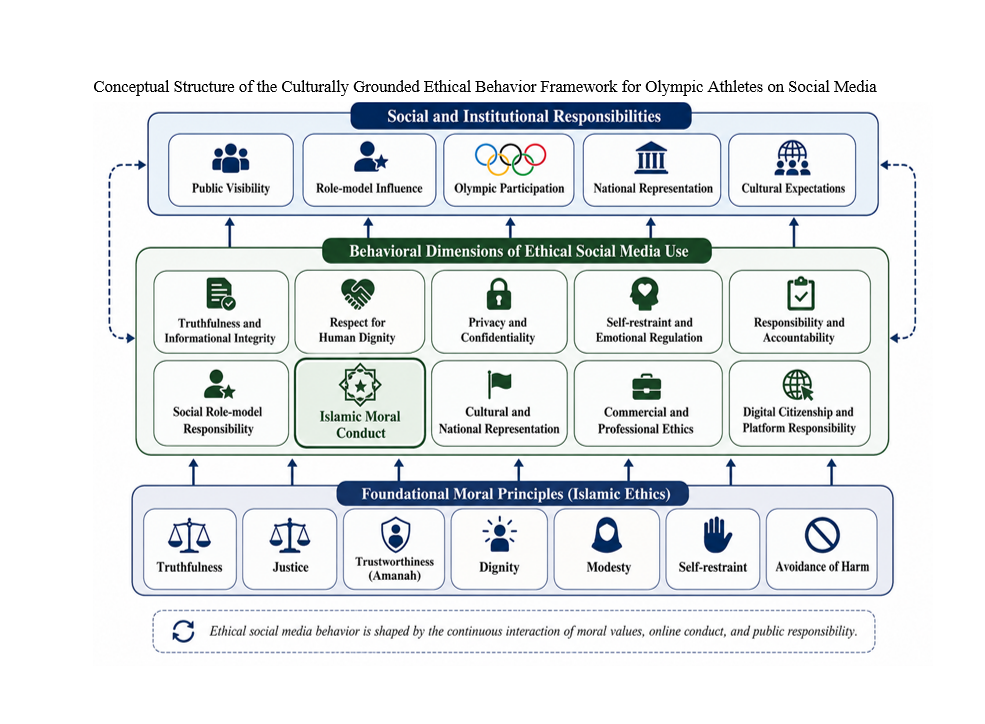
This study aimed to develop and achieve expert consensus on a culturally grounded ethical behavior framework for Olympic athletes on social media by integrating contemporary sport and digital ethics with principles derived from Islamic ethics. This exploratory qualitative study was conducted in Tehran, Iran, using a sequential qualitative–Delphi design. Twenty-eight experts in sport ethics, Olympic sport, sport management, Islamic ethics, communication, media studies, athlete education, and related fields were selected through purposive sampling. Data were initially collected using semi-structured interviews focused on ethical responsibilities, digital conduct, cultural expectations, and Islamic moral principles relevant to Olympic athletes’ social media use. Interview data were analyzed through conventional qualitative content analysis using an inductive coding process. The resulting categories and behavioral indicators were subsequently converted into Delphi questionnaires and evaluated across two rounds in terms of relevance, cultural appropriateness, clarity, and practical applicability. Consensus was assessed using measures of central tendency, dispersion, percentage agreement, and stability across rounds. The final framework comprised ten dimensions: truthfulness and informational integrity, respect for human dignity, privacy and confidentiality, self-restraint and emotional regulation, responsibility and accountability, social role-model responsibility, Islamic moral conduct, cultural and national representation, commercial and professional ethics, and digital citizenship and platform responsibility. In the second Delphi round, respect for human dignity, self-restraint and emotional regulation, and Islamic moral conduct achieved 100.00% expert agreement. Truthfulness and informational integrity, responsibility and accountability, and digital citizenship and platform responsibility each reached 96.43% agreement. Privacy and confidentiality, social role-model responsibility, and cultural and national representation each reached 92.86%, while commercial and professional ethics reached 89.29%. Median ratings were 5.00 for all dimensions except commercial and professional ethics, which obtained a median of 4.00. The findings support a multidimensional ethical framework in which Islamic moral principles, digital responsibilities, professional conduct, and social role-model obligations jointly shape appropriate social media behavior among Olympic athletes.
Downloads
References
1. Kian EM, Zimmerman MH. Social Media Scholarship In Sport Studies And College Athletes’ Name, Image, And Likeness Opportunities. International Journal of Sport Communication. 2023;16(3):321-7. [DOI]
2. Kavanagh E, Litchfield C, Osborne J. Social Media And Athlete Welfare. International Journal of Sport Communication. 2023;16(3):274-81. [DOI]
3. Poursoltani Zarandi H, Damavandi Jegal E. Designing A Model For Managing Ethical Behavior Of Prominent Athletes In Cyberspace. Journal of Sport Media. 2025;12(1):45-62.
4. Yin H. An Analysis Of The Influence Of Brand Sponsorship And Social Media On The Reconfiguration Of Athlete Value. Advances in Economics Management and Political Sciences. 2025;158(1):132-6. [DOI]
5. Dunn SS, Nisbett GS. College Nil Athletes As Social Media Influencers: Examining Sports Vs Lifestyle Posts On Consumer Perceptions. International Journal of Sports Marketing and Sponsorship. 2025. [DOI]
6. Nichols E, Shapiro SL. The Impact Of Authenticity On Celebrity Athlete Social Media Endorsement Messaging. Sport Marketing Quarterly. 2023;32(3):175-88. [DOI]
7. Karimi A, Bastami H. Designing A Professional Ethics Model For Athletes. Olympic Studies. 2024;1(1):75-87.
8. Jeon M, Lim H, Yun HJ, Oh H. Correlation Between Ethical Sensitivity As Well As Doping Attitude And Dispositions In Taekwondo Kyorugi Athletes: Athlete Career And National Team Moderation Effect. 2023;52(4):789. [DOI]
9. Saki̇ Ü, Öztaş M. The Effect Of Prosocial Behaviour Manageability On Conscious Awareness In University Athletes: The Mediating Role Of Athlete Identity. Rol Spor Bilimleri Dergisi. 2024;5(4):750-63. [DOI]
10. Ahmadi MA, Molana Y. A Tale Of Iranian Women Athletes: Elite Female Athletes Share Their Perspectives Of Barriers And Consequences Of Media Coverage. Journal of Social Media Marketing. 2024;3(1):35-47. [DOI]
11. Liu Z. Relationship Between Perceived Social Support And Mental Health Among Chinese College Football Athletes: A Moderated Mediation Model. BMC Psychology. 2023;11(1). [PMID: 37822005] [PMCID: PMC10568796] [DOI]
12. Karimi Dastaki A, Mahmudi M. The Effectiveness Of Life Meaning Workshops On Resilience, Negative Affect, And Perceived Social Support In Students. Journal of Psychological Dynamics in Mood Disorders (PDMD). 2024;3(1):187-97. [DOI]
Downloads
Publication Timeline
- Submitted
- Revised
- Accepted