Comparison of High- and Moderate-Intensity Aerobic Training on Cerebellar Autophagy in Aged Rats With Induced Diabetes
Keywords:
autophagy, LC3, Beclin-1, SA-β-gal, moderate-intensity continuous training, high-intensity interval training, diabetes, aging, cerebellum.Abstract
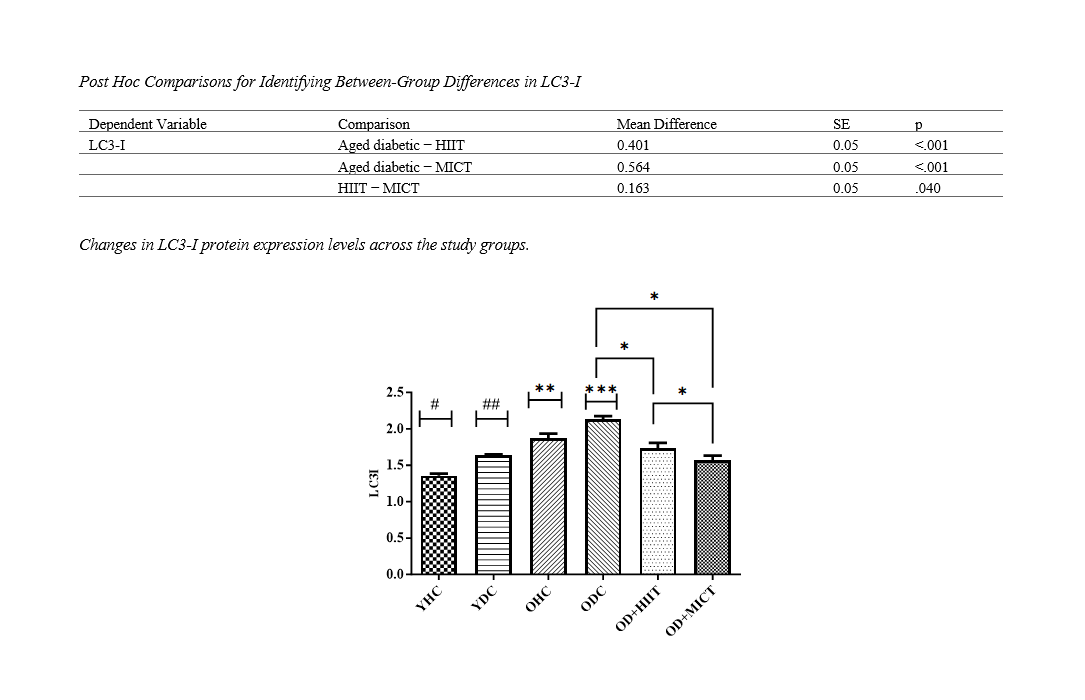
Aging and diabetes are associated with impaired autophagic function, which can lead to the accumulation of cellular damage, accelerated cellular senescence, and increased vulnerability of neural tissues, particularly the cerebellum. Aerobic exercise has been proposed as a non-pharmacological strategy for improving autophagy and attenuating the adverse consequences of aging and diabetes; however, the comparative effects of moderate-intensity continuous training (MICT) and high-intensity interval training (HIIT) on autophagy-related markers in the cerebellum of aged diabetic rats have not been fully elucidated. The aim of this study was to compare the effects of MICT and HIIT on markers of autophagy and cellular senescence in the cerebellum of aged rats with diabetes. In this experimental study, rats were initially maintained on either a standard diet or a high-fat, high-fructose diet. At 6 months of age, the young control groups were sampled. After the animals reached 18 months of age, they were assigned to four groups: aged healthy control, aged diabetic control, aged diabetic + MICT, and aged diabetic + HIIT. The exercise programs were conducted for 3 months. Diabetes induction was confirmed by assessment of blood glucose and insulin resistance. Forty-eight hours after the final exercise session, cerebellar tissue was collected, and the expression levels of LC3-I, LC3-II, and Beclin-1 were measured using Western blotting. The LC3-II/LC3-I ratio was also calculated as an index of autophagic flux, and senescence-associated β-galactosidase (SA-β-gal) activity was assessed using ELISA. The results showed that aging combined with diabetes increased LC3-I expression, decreased the LC3-II/LC3-I ratio, and reduced Beclin-1 expression in the cerebellum, indicating impaired autophagy. SA-β-gal activity was also significantly increased in the aged diabetic group. Both exercise protocols partially reversed these alterations; however, MICT was more effective than HIIT in increasing the LC3-II/LC3-I ratio, improving Beclin-1 expression, and reducing SA-β-gal activity. Overall, aging and diabetes impair autophagy and increase cellular senescence in the cerebellum, and both forms of aerobic exercise exert protective effects; nevertheless, MICT appears to be more effective than HIIT.
Downloads
References
1. Esiri MM. Ageing And The Brain. The Journal of Pathology: A Journal of the Pathological Society of Great Britain and Ireland. 2007;211(2):181-7. [PMID: 17200950] [DOI]
2. Li P, Ma Y, Yu C, Wu S, Wang K, Yi H, et al. Autophagy And Aging: Roles In Skeletal Muscle, Eye, Brain And Hepatic Tissue. Frontiers in Cell and Developmental Biology. 2021;9:752962. [PMID: 34778264] [PMCID: PMC8581214] [DOI]
3. Iskusnykh IY, Zakharova AA, Kryl'Skii ED, Popova TN. Aging, Neurodegenerative Disorders, And Cerebellum. International Journal of Molecular Sciences. 2024;25(2):1018. [PMID: 38256091] [PMCID: PMC10815822] [DOI]
4. Caponio D, Veverová K, Zhang SQ, Shi L, Wong G, Vyhnalek M, et al. Compromised Autophagy And Mitophagy In Brain Ageing And Alzheimer'S Diseases. Aging Brain. 2022;2:100056. [PMID: 36908880] [PMCID: PMC9997167] [DOI]
5. Hansen M, Rubinsztein DC, Walker DW. Autophagy As A Promoter Of Longevity: Insights From Model Organisms. Nature Reviews Molecular Cell Biology. 2018;19(9):579-93. [PMID: 30006559] [PMCID: PMC6424591] [DOI]
6. Kumar R, Looi JC, Raphael B. Type 2 Diabetes Mellitus, Cognition And Brain In Aging: A Brief Review. Indian Journal of Psychiatry. 2009;51(Suppl 1):S35-S8.
7. Jha MK, Fatt CRC, Minhajuddin A, Mayes TL, Berry JD, Trivedi MH. Accelerated Brain Aging In Individuals With Diabetes: Association With Poor Glycemic Control And Increased All-Cause Mortality. Psychoneuroendocrinology. 2022;145:105921. [PMID: 36126385] [PMCID: PMC10177664] [DOI]
8. Axelsen LN, Lademann JB, Petersen JS, Holstein-Rathlou NH, Ploug T, Prats C. Cardiac And Metabolic Changes In Long-Term High Fructose-Fat Fed Rats With Severe Obesity And Extensive Intramyocardial Lipid Accumulation. American Journal of Physiology-Regulatory, Integrative and Comparative Physiology. 2010;298(6):R1560-R70. [PMID: 20357025] [DOI]
9. Lozano I, Van Der Werf R, Bietiger W, Seyfritz E, Peronet C, Pinget M. High-Fructose And High-Fat Diet-Induced Disorders In Rats: Impact On Diabetes Risk, Hepatic And Vascular Complications. Nutrition & Metabolism. 2016;13:1-13. [PMID: 26918024] [PMCID: PMC4766713] [DOI]
10. Doroodian F. Comparison Of The Effects Of Rapid, Moderate, And Slow Weight Loss Combined With A Low-Calorie Diet And Physical Activity On Inflammatory Factors In Obese Women. International Journal of Sport Studies for Health. 2025:1-12. [DOI]
11. Azadi R, Irandoust K, Taheri M. Effect Of An Aerobic Exercise Program And Gymnema Supplementation On Plasma Ghrelin Levels And Sweet Taste Preference In Obese Women. Health Nexus. 2025:1-11. [DOI]
12. Huang J, Wang X, Zhu Y, Li Z, Zhu YT, Wu JC. Exercise Activates Lysosomal Function In The Brain Through Ampk-Sirt1-Tfeb Pathway. CNS Neuroscience & Therapeutics. 2019;25(6):796-807. [PMID: 30864262] [PMCID: PMC6515701] [DOI]
13. Haram PM, Kemi OJ, Lee SJ, Bendheim MØ, Al-Share QY, Waldum HL. Aerobic Interval Training Vs. Continuous Moderate Exercise In The Metabolic Syndrome Of Rats Artificially Selected For Low Aerobic Capacity. Cardiovascular Research. 2009;81(4):723-32. [PMID: 19047339] [PMCID: PMC2642601] [DOI]
14. Qin F, Dong Y, Wang S, Xu M, Wang Z, Qu C. Maximum Oxygen Consumption And Quantification Of Exercise Intensity In Untrained Male Wistar Rats. Scientific Reports. 2020;10(1):11520. [PMID: 32661254] [PMCID: PMC7359321] [DOI]
15. Zhang Y, Liao B, Hu S, Pan SY, Wang GP, Wang YL. High Intensity Interval Training Induces Dysregulation Of Mitochondrial Respiratory Complex And Mitophagy In The Hippocampus Of Middle-Aged Mice. Behavioural Brain Research. 2021;412:113384. [PMID: 34147565] [DOI]
16. Khosravi P, Shahidi F, Eskandari A, Khoramipour K. High-Intensity Interval Training Reduces Tau And Beta-Amyloid Accumulation By Improving Lactate-Dependent Mitophagy In Rats With Type 2 Diabetes. Iranian Journal of Basic Medical Sciences. 2024;27(11):1430.
Downloads
Publication Timeline
- Submitted
- Revised
- Accepted