
A Review of the Role of eHealth Literacy in the Prevention and Management of Non-Communicable Diseases
Keywords:
eHealth literacy, digital health, chronic noncommunicable diseases, disease prevention, disease managementAbstract
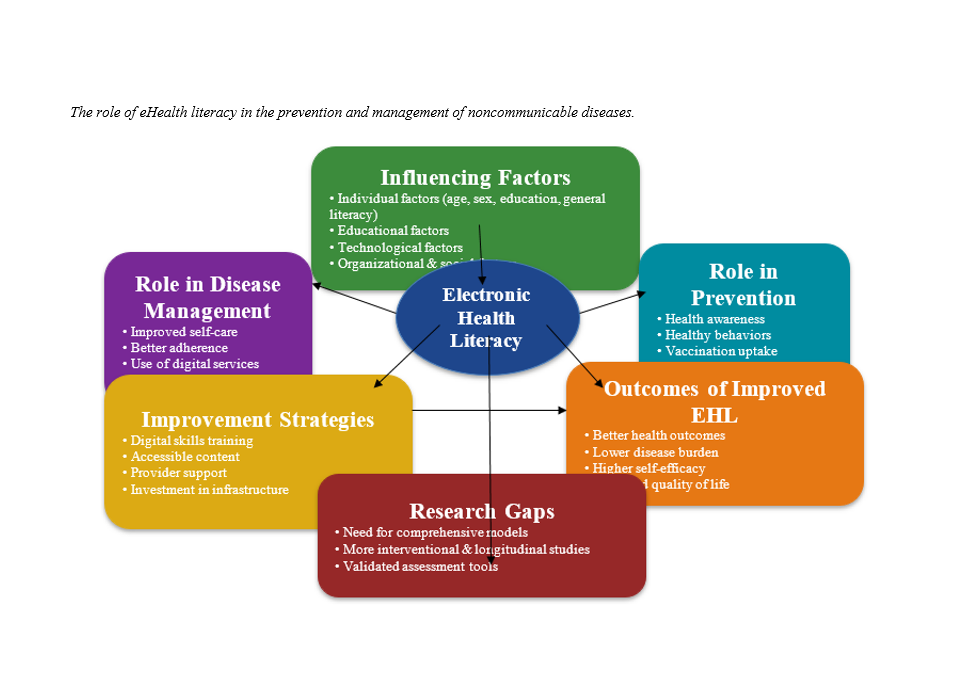
Chronic noncommunicable diseases (NCDs) are the leading causes of mortality and disability worldwide, posing substantial challenges to healthcare systems. Their effective prevention and management increasingly depend on innovative digital health approaches. In this context, eHealth literacy defined as the ability to seek, understand, critically evaluate, and apply health information obtained from digital sources has emerged as a key determinant of disease prevention, self-care, and chronic disease management. This study aimed to examine the role of eHealth literacy in the prevention and management of chronic noncommunicable diseases and to summarize the factors influencing eHealth literacy, its outcomes, and strategies for its promotion. A narrative review was conducted by searching national and international scientific databases for studies published between 2020 and 2026. Articles addressing eHealth literacy, digital health, and the prevention and management of chronic noncommunicable diseases were identified, screened for relevance, and included in the review. The findings were synthesized using a descriptive-analytical approach. The reviewed evidence indicates that higher levels of eHealth literacy are associated with improved health behaviors, greater self-care, more informed decision-making, better treatment adherence, and more effective use of digital health services. eHealth literacy is influenced by multiple individual, educational, technological, and organizational factors. The findings further suggest that improving eHealth literacy requires continuous education, strengthened digital infrastructure, access to reliable health information, efforts to reduce the digital divide, and sustained policy support. Despite the growing body of evidence, important gaps remain, including the limited availability of context-specific models, evidence-based educational interventions, and comprehensive strategies for promoting eHealth literacy among individuals with chronic non-communicable diseases. eHealth literacy represents a fundamental component of digital health and an essential prerequisite for the effective prevention and management of chronic noncommunicable diseases. Strengthening eHealth literacy can enhance individuals' engagement in managing their own health, improve the effectiveness of digital health services, reduce the burden of chronic diseases, and increase the efficiency of healthcare systems. Accordingly, the development of educational policies, empowerment programs, and evidence-based interventions should be prioritized.
Downloads
References
1. Piovani D. Non-Communicable Diseases: The Invisible Epidemic. Frontiers in Public Health. 2022. [PMID: 36233805] [PMCID: PMC9572583] [DOI]
2. Osborne RH, Elmer S, Hawkins M, Cheng CC, Batterham RW, Dias S, et al. Health Literacy Development Is Central To The Prevention And Control Of Non-Communicable Diseases. BMJ Global Health. 2022;7(12):e010362. [PMID: 36460323] [PMCID: PMC9723891] [DOI]
3. Javanbakht M. Sex Disparity In Non-Communicable Disease Burden In Iran From 1990 To 2021 Based On The Global Burden Of Disease Study. Scientific Reports. 2025.
4. Wittich L, Rödiger H, Rombey T, Brecher AL, Kraft L. Navigating The Complexities Of Digital Health Technology Implementation: A Scoping Review Of Barriers And Facilitators. Implementation Science Communications. 2026;7(69). [PMID: 41782054] [PMCID: PMC13064259] [DOI]
5. Scheibner J, Ienca M, Sleigh J, Vayena E. Benefits, Challenges And Contributors To Success For National Ehealth Systems Implementation: A Scoping Review. Journal of the American Medical Informatics Association. 2021. [PMID: 34151990] [PMCID: PMC8363797] [DOI]
6. Norman CD, Skinner HA. Ehealth Literacy: Essential Skills For Consumer Health In A Networked World. Journal of Medical Internet Research. 2006;8(2):e9. [PMID: 16867972] [DOI]
7. Kim K, Shin S, Kim S, Lee E. The Relation Between Ehealth Literacy And Health-Related Behaviors: Systematic Review And Meta-Analysis. Journal of Medical Internet Research. 2023;25:e40778. [PMID: 36716080] [PMCID: PMC9926349] [DOI]
8. Seidel E, Cortes T, Chong C. Digital Health Literacy. Agency for Healthcare Research and Quality (AHRQ); 2023.
9. Global Digital Health P. Digital Health Literacy Overview 2025 [Available from: https://gdhp.health/resource/digital-health-literacy/
10. Kim S, Xie B. Health Literacy In The Ehealth Era: A Systematic Review Of The Concepts, Definitions, And Measurement Approaches. Frontiers in Public Health. 2023;11:1152345. [DOI]
11. Mitsutake S, Shibata A, Ishii K, Oka K. Health Literacy And Physical Activity Among Japanese Adults. BMC Public Health. 2023;23:1123.
12. Zaghloul H, Fanous K, Ahmed L, Arabi M, Varghese S, Omar S, et al. Digital Health Literacy In Patients With Common Chronic Diseases: Systematic Review And Meta-Analysis. Journal of Medical Internet Research. 2025. [DOI]
13. Milanti A, Chan DNS, Parut AA, So WKW. Determinants And Outcomes Of Ehealth Literacy In Healthy Adults: A Systematic Review. PLOS ONE. 2023;18(10):e0291229. [PMID: 37792773] [PMCID: PMC10550189] [DOI]
14. Geukes C, Stark AL, Dockweiler C. Ehealth Literacy As A Basis For Developing Digital Technologies In Health Promotion And Prevention: A Systematic Literature Overview. Prävention und Gesundheitsförderung. 2022;17:163-9. [DOI]
15. Estrela M, Semedo GM, Roque F, Ferreira PL, Herdeiro MT. Sociodemographic Determinants Of Digital Health Literacy: A Systematic Review And Meta-Analysis. International Journal of Medical Informatics. 2023;177:105124. [PMID: 37329766] [DOI]
16. Hua Z, Song Y, Liu Q, Chen H. Factors Influencing Ehealth Literacy Worldwide: Systematic Review And Meta-Analysis. Journal of Medical Internet Research. 2025;27:e50313. [PMID: 40063939] [DOI]
17. Brørs G, Larsen MH, Hølvold LB, Wahl AK. Ehealth Literacy Among Hospital Health Care Providers: A Systematic Review. BMC Health Services Research. 2023;23:1144. [PMID: 37875882] [PMCID: PMC10599073] [DOI]
18. Özatkan Y, Tekin PŞ. Determinants Of Digital Health Literacy Of Healthcare Professionals: A Systematic Review. Journal of Telemedicine and Telecare. 2026. [PMID: 41810765] [DOI]
19. Andersson SW. Digital Health Literacy—A Key Factor In Realizing The Value Of Digital Health Technologies For Healthcare Professionals. Frontiers in Digital Health. 2025.
20. Gu Y, Guan Y, Meng Z. Health Providers' Perceptions And Experiences Of Using Mhealth For Chronic Noncommunicable Diseases: Qualitative Systematic Review And Meta-Synthesis. Journal of Medical Internet Research. 2023;25:e45437. [PMID: 37698902] [PMCID: PMC10523226] [DOI]
21. Aljedaani B, Babar MA. Challenges In Developing Secure Mobile Health Applications: A Systematic Review. Journal of Medical Systems. 2020;44(12):1-20. [PMID: 30132711] [DOI]
22. Wang Y, Niu Y, Xu R, Zhang Q, Jia S, Wang A. Ehealth Literacy Interventions: Scoping Review. Interactive Journal of Medical Research. 2025;14:e69640. [PMID: 40845756] [PMCID: PMC12373412] [DOI]
23. Mehdi Khankalabi M, Ahmadzadeh M, Shahrabadi R, Saadati H, Tavakoli Ghochani H. Investigating The Effect Of Educational Intervention Based On Freer'S Educational Model On Ehealth Literacy Of Health Care Providers In Bojnourd City. Journal of North Khorasan University of Medical Sciences. 2025;17(1).
24. Borzoei T, Kordestani F, Ashktorab T, Delgoshaei Y, Shirzadkobria B. Identifying The Dimensions And Components Affecting Health Literacy Education For Patients With Diabetes In Hospitals Of Tehran Islamic Azad University Of Medical Sciences. Medical Sciences of Tehran Islamic Azad University. 2024;34(1):84-96. [DOI]
25. Rasouli HR, Abbasi Farajzadeh M, Tadayin AH, editors. Investigating Ehealth Literacy And Its Predictive Factors Among Patients Referring To A Military Hospital In Tehran During 2017. National Conference on Health and e-Health; 2018.
26. Dastani M, Mokhtarzadeh M, Eidi M, Delshad A. Investigating The Level Of Internet-Based Ehealth Literacy Of Students At Gonabad University Of Medical Sciences. Journal of the Yazd Medical Education Studies and Development Center. 2019;14(1):36-45. [DOI]
27. Ganji M, Heydarian A, editors. A Review Of Ehealth Literacy Studies In Iran. First International Conference on Health, Hygiene and Education; 2024; Sari, Iran.
28. Ayneh M, Hosseinpour M, editors. Investigating The Impact Of Factors Affecting The Use Of Social Media On Improving Citizens' Ehealth Literacy In Crises. International Conference on Management, Accounting and Educational Sciences in Iran; 2021.
29. Rahmani M, editor Investigating The Relationship Between Health Literacy And Behaviors And Policies Promoting Health Literacy Among The People And Evaluating These Policies: A Case Study Of Mashhad City. Fourth International Conference on Health, Treatment and Health Promotion; 2019.
30. Bagheri-Lankarani K. Improving Digital Health Literacy: A Comprehensive Review. Culture and Health Promotion. 2023;7(2):152-6.
31. Sajedi R, Khorshid A, Hamidifar F, Moghaddisi H, Mahmoudi A. Providing An E-Learning Model For Medical Universities With An Approach Based On Data-Based Theory. Koomesh. 2019;23(1):39-48. [DOI]
Downloads
Publication Timeline
- Submitted
- Revised
- Accepted