Comparing the Effectiveness of Intensive Short-Term Dynamic Psychotherapy and Acceptance and Commitment Therapy on Difficulties in Emotion Regulation in Adolescents with Self-Injurious Behavior
Keywords:
Intensive Short-Term Dynamic Psychotherapy, Acceptance and Commitment Therapy, Emotion Regulation, Self-Injurious Behavior, AdolescentsAbstract
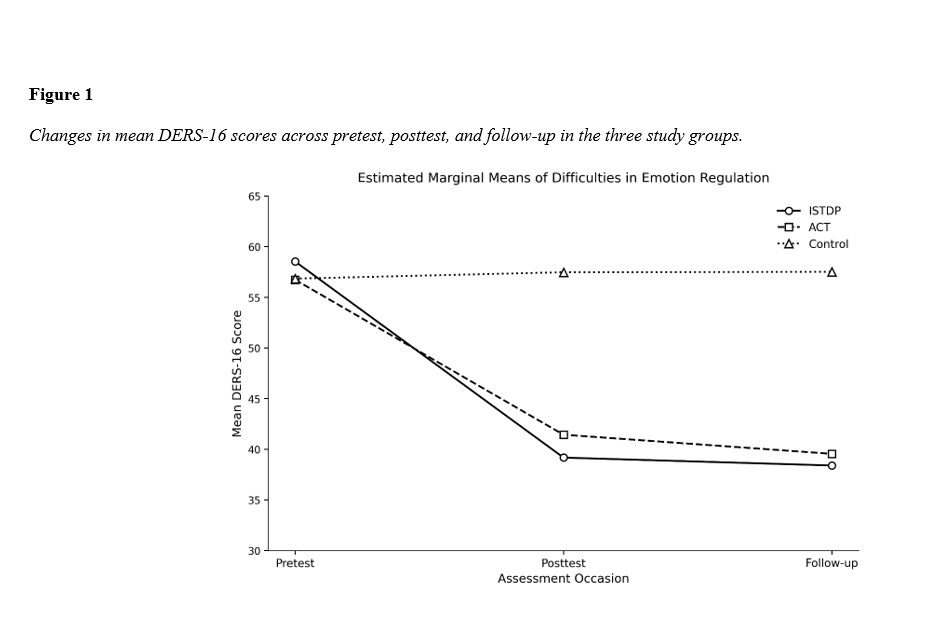
Difficulties in emotion regulation are considered a central psychological mechanism underlying self-injurious behavior in adolescents. The present study aimed to compare the effectiveness of Intensive Short-Term Dynamic Psychotherapy (ISTDP) and Acceptance and Commitment Therapy (ACT) in reducing difficulties in emotion regulation among adolescents with self-injurious behavior. This applied quasi-experimental study employed a pretest–posttest design with a two-month follow-up, including two intervention groups and one control group. The statistical population consisted of 310 upper-secondary public-school students with self-injurious behavior in Gonbad-e Kavus, Iran, during the 2024–2025 academic year. Participants were initially identified through cluster random sampling. Forty-five eligible adolescents were then selected and randomly assigned to the ISTDP, ACT, and control groups, with 15 participants in each group. The two intervention groups received eight weekly treatment sessions, whereas the control group received no structured psychological intervention during the study period. Difficulties in emotion regulation were assessed using the 16-item Difficulties in Emotion Regulation Scale (DERS-16). Data were analyzed using mixed repeated-measures analysis of variance and Bonferroni-adjusted pairwise comparisons. The results showed significant main effects of time and group as well as a significant group × time interaction on difficulties in emotion regulation (p < .001). Both ISTDP and ACT significantly reduced DERS-16 scores from pretest to posttest compared with the control group, and these improvements were maintained at the two-month follow-up. The difference between ISTDP and ACT was not statistically significant at either posttest or follow-up, although the ISTDP group showed slightly lower mean scores at both assessment points. Both ISTDP and ACT were effective in reducing difficulties in emotion regulation among adolescents with self-injurious behavior, and their therapeutic effects were maintained over the follow-up period. The findings suggest that different therapeutic pathways, including affective processing in ISTDP and psychological flexibility in ACT, may contribute to improved emotion regulation in adolescents who engage in self-injury.
Downloads
References
1. Farkas BF, Takacs ZK, Kollárovics N, Balázs J. The Prevalence Of Self-Injury In Adolescence: A Systematic Review And Meta-Analysis. European Child & Adolescent Psychiatry. 2024;33(10):3439-58. [PMID: 37486387] [PMCID: PMC11564408]
2. Nock MK. Why Do People Hurt Themselves? New Insights Into The Nature And Functions Of Self-Injury. Current Directions in Psychological Science. 2009;18(2):78-83. [PMID: 20161092]
3. Wolff JC, Thompson E, Thomas SA, Nesi J, Bettis AH, Ransford B, et al. Emotion Dysregulation And Non-Suicidal Self-Injury: A Systematic Review And Meta-Analysis. European Psychiatry. 2019;59:25-36. [PMID: 30986729] [PMCID: PMC6538442]
4. Bjureberg J, Ojala O, Hesser H, Häbel H, Sahlin H, Gratz KL, et al. Effect Of Internet-Delivered Emotion Regulation Individual Therapy For Adolescents With Nonsuicidal Self-Injury Disorder: A Randomized Clinical Trial. JAMA Network Open. 2023;6(7):e2322069. [PMID: 37440232] [PMCID: PMC10346121]
5. Espenes K, Tørmoen AJ, Rognstad K, Nilsen KH, Waaler PM, Wentzel-Larsen T, et al. Effect Of Psychosocial Interventions On Children And Youth Emotion Regulation: A Meta-Analysis. Administration and Policy in Mental Health and Mental Health Services Research. 2025;52(5):833-52. [PMID: 38717667] [PMCID: PMC12449357]
6. Abbass A, Town J, Driessen E. Intensive Short-Term Dynamic Psychotherapy: A Systematic Review And Meta-Analysis Of Outcome Research. Harvard Review of Psychiatry. 2012;20(2):97-108. [PMID: 22512743]
7. Thoma NC, Abbass A. Intensive Short-Term Dynamic Psychotherapy (Istdp) Offers Unique Procedures For Acceptance Of Emotion And May Contribute To The Process-Based Therapy Movement. Journal of Contextual Behavioral Science. 2022;25:106-14.
8. Midgley N, Mortimer R, Cirasola A, Batra P, Kennedy E. The Evidence-Base For Psychodynamic Psychotherapy With Children And Adolescents: A Narrative Synthesis. Frontiers in Psychology. 2021;12:662671. [PMID: 33986713] [PMCID: PMC8110733]
9. Lilliengren P, Mechler J, Lindqvist K, Maroti D, Johansson R. The Efficacy Of Experiential Dynamic Therapies: A 10-Year Systematic Review And Meta-Analysis Update. Clinical Psychology & Psychotherapy. 2025;32(3):e70086. [PMID: 40411162] [PMCID: PMC12102587]
10. Heshmati R, Wienicke FJ, Driessen E. The Effects Of Intensive Short-Term Dynamic Psychotherapy On Depressive Symptoms, Negative Affect, And Emotional Repression In Single Treatment-Resistant Depression: A Randomized Controlled Trial. Psychotherapy. 2023;60(4):497-511. [PMID: 37843533] [PMCID: PMC12547156]
11. Shafiei F, Dehghani M, Fathali Lavasani F, Manouchehri M, Mokhtare M. Intensive Short-Term Dynamic Psychotherapy For Irritable Bowel Syndrome: A Randomized Controlled Trial Examining Improvements In Emotion Regulation, Defense Mechanisms, Quality Of Life, And IBS Symptoms. Frontiers in Psychology. 2024;15:1293150. [PMID: 38605838] [PMCID: PMC11008577]
12. Ahmadvand Shahverdi Z, Dehghani M, Ashouri A, Manouchehri M, Mohebi N. Effectiveness Of Intensive Short-Term Dynamic Psychotherapy For Tension-Type Headache (Tth): A Randomized Controlled Trial Of Effects On Emotion Regulation, Anger, Anxiety, And Tth Symptom Severity. Acta Psychologica. 2024;244:104176. [PMID: 38330733]
13. Rahmani F, Kakaie N, Khazaie H. Effectiveness Of Intensive Short-Term Dynamic Psychotherapy For Suicidal Ideation And Anger In Suicidal Behavior. American Journal of Psychotherapy. 2025;78(3):186-9. [PMID: 40181666]
14. Hayes SC, Luoma JB, Bond FW, Masuda A, Lillis J. Acceptance And Commitment Therapy: Model, Processes And Outcomes. Behaviour Research and Therapy. 2006;44(1):1-25. [PMID: 16300724] [PMCID: PMC13225531]
15. Macri JA, Rogge RD. Examining Domains Of Psychological Flexibility And Inflexibility As Treatment Mechanisms In Acceptance And Commitment Therapy: A Comprehensive Systematic And Meta-Analytic Review. Clinical Psychology Review. 2024;110:102432. [PMID: 38615492]
16. López-Pinar C, Lara-Merín L, Macías J. Process Of Change And Efficacy Of Acceptance And Commitment Therapy (ACT) For Anxiety And Depression Symptoms In Adolescents: A Meta-Analysis Of Randomized Controlled Trials. Journal of Affective Disorders. 2025;368:633-44. [PMID: 39303882]
17. Yuan J, Zheng M, Liu D, Wang L. Effect Of Acceptance And Commitment Therapy On Emotion Regulation In Adolescent Patients With Nonsuicidal Self-Injury. Alpha Psychiatry. 2024;25(1):47-53. [PMID: 38799501] [PMCID: PMC11114234]
18. Giannakopoulos G, Prassou A. Acceptance-Based And ACT-Informed Interventions For Non-Suicidal Self-Injury In Adolescents: A Systematic Review And Exploratory Meta-Analysis. Children. 2026;13(7):972. [PMID: 42509997] [PMCID: PMC13406886]
Downloads
Publication Timeline
- Submitted
- Revised
- Accepted