Fear of Re-Injury Post-ACL Reconstruction: Cognitive-Behavioral Interventions
Keywords:
ACL reconstruction, fear of re-injury, cognitive-behavioral therapy, graded exposure, return to sportAbstract
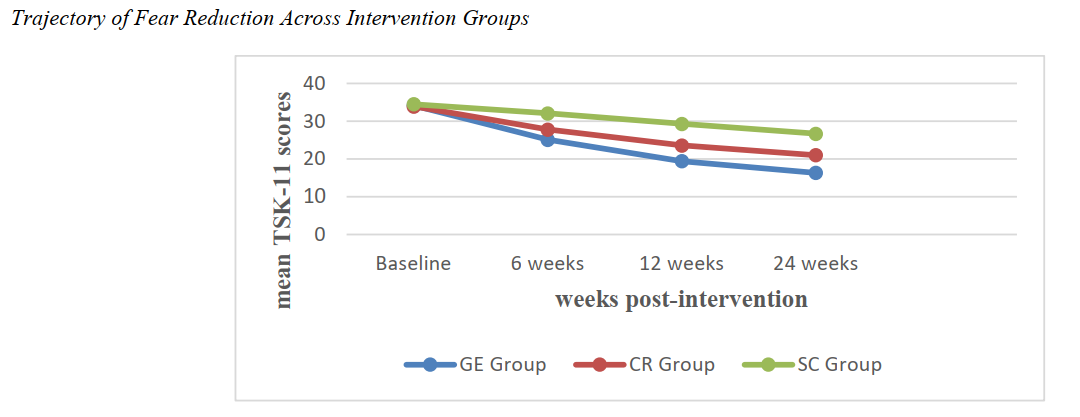
This study evaluated the efficacy of cognitive-behavioral interventions, particularly graded exposure therapy, in addressing fear of re-injury among athletes following anterior cruciate ligament (ACL) reconstruction, comparing outcomes with traditional cognitive restructuring and standard rehabilitation approaches. A randomized controlled trial was conducted with 120 athletes (ages 16-25) at 3-6 months post-ACL reconstruction, randomly assigned to graded exposure (GE), cognitive restructuring (CR), or standard care (SC) groups. The GE protocol incorporated systematic desensitization through sport-specific movements, while CR focused on modifying maladaptive beliefs about re-injury. Primary outcomes included changes in Tampa Scale for Kinesiophobia (TSK-11) scores, biomechanical assessments during drop-jump tasks, and return-to-sport rates, measured at baseline, 6, 12, and 24 weeks. The GE group demonstrated superior outcomes, with a 35.3% reduction in fear scores (TSK-11) compared to 33.1% in CR and 22.7% in SC (p < 0.001). Biomechanical improvements, including knee flexion angle and limb symmetry, were significantly greater in GE (p < 0.001). Qualitative findings highlighted enhanced movement confidence and reduced somatic fear in GE participants. Return-to-sport rates were highest in GE (68.9%) versus CR (62.5%) and SC (45.0%) (p = 0.007). Graded exposure therapy emerges as the most effective intervention for reducing fear of re-injury post-ACLR, combining psychological and neuromuscular benefits. These findings support integrating exposure-based protocols into standard rehabilitation programs during early-to-mid recovery phases to optimize both physical and psychological readiness for return to sport.
Downloads
References
1. D'Ambrosi R, Meena A, Arora ES, Attri M, Schäfer L, Migliorini F. Reconstruction of the anterior cruciate ligament: a historical view. Annals of Translational Medicine. 2023;11(10):364. [PMID: 37675316] [PMCID: PMC10477645] [DOI]
2. Cevallos N, Soriano KKJ, Lansdown DA, Ma CB, Feeley BT, Zhang AL. Contemporary Practice Patterns for the Treatment of Anterior Cruciate Ligament Tears in the United States. Orthopaedic Journal of Sports Medicine. 2021;9(9):23259671211040891. [PMID: 34604433] [PMCID: PMC8485167] [DOI]
3. Buckthorpe M. Optimising the Late-Stage Rehabilitation and Return-to-Sport Training and Testing Process After ACL Reconstruction. Sports Medicine. 2019;49(7):1043-58. [PMID: 31004279] [DOI]
4. Buckthorpe M, Gokeler A, Herrington L, Hughes M, Grassi A, Wadey R, et al. Optimising the Early-Stage Rehabilitation Process Post-ACL Reconstruction. Sports Medicine. 2024;54(1):49-72. [PMID: 37787846] [DOI]
5. Nyland J, Pyle B, Richards J, Yoshida K, Brey J, Carter S. A clinical practice review of therapeutic movement-based anterior cruciate ligament reconstruction return to sports bridge program: the biological, biomechanical and behavioral rationale. Annals of Joint. 2023;8:23. [PMID: 38529232] [PMCID: PMC10929313] [DOI]
6. Amiri M, Hofmeister M, Aminzadeh R, Nejat H, Dehghani E, Khazaei M, et al. Psychological Readiness after Injury and Its Impact on Fear of Return and Re-injury in Young Football Players. International Journal of Sport Studies for Health. 2025;8(3):1-12. [DOI]
7. Filbay S, Kvist J. Fear of Reinjury Following Surgical and Nonsurgical Management of Anterior Cruciate Ligament Injury: An Exploratory Analysis of the NACOX Multicenter Longitudinal Cohort Study. Physical Therapy. 2022;102(2):pzab273. [PMID: 34939109] [PMCID: PMC8860188] [DOI]
8. Almansour A, Madkhali M, Alzhrani M, Alanazi A, Aldaihan MM, Alamri YH, et al. Does fear of re-injury affect the self-perceived level of lower limb functionality among soccer players with ACL reconstruction?: A cross-sectional study. Medicine. 2023;102(44):e35645. [PMID: 37933019] [PMCID: PMC10627615] [DOI]
9. Hamdan M, Haddad BI, Amireh S, Abdel Rahman AMA, Almajali H, Mesmar H, et al. Reasons Why Patients Do Not Return to Sport Post ACL Reconstruction: A Cross-Sectional Study. Journal of Multidisciplinary Healthcare. 2025;18:329-38. [PMID: 39872868] [DOI]
10. Meredith SJ, Rauer T, Chmielewski TL, Fink C, Diermeier T, Rothrauff BB, et al. Return to Sport After Anterior Cruciate Ligament Injury: Panther Symposium ACL Injury Return to Sport Consensus Group. Orthopaedic Journal of Sports Medicine. 2020;8(6):2325967120930829. [PMID: 32647735] [PMCID: PMC7328222] [DOI]
11. Ptasinski AM, Dunleavy M, Adebayo T, Gallo RA. Returning Athletes to Sports Following Anterior Cruciate Ligament Tears. Current Reviews in Musculoskeletal Medicine. 2022;15(6):616-28. [PMID: 35881327] [PMCID: PMC9789290] [DOI]
12. Aizawa J, Hirohata K, Ohji S, Ohmi T, Koga H, Yagishita K. Factors Associated With Psychological Readiness to Return to Sports With Cutting, Pivoting, and Jump-Landings After Primary ACL Reconstruction. Orthopaedic Journal of Sports Medicine. 2020;8(11):2325967120964484. [PMID: 33244476] [PMCID: PMC7678401] [DOI]
13. Russell HC, Arendt EA, Wiese-Bjornstal DM. Psychological Responses During Latter Rehabilitation and Return to Sport After Anterior Cruciate Ligament Reconstruction Surgery. Journal of Athletic Training. 2024;59(6):627-32. [PMID: 38446462] [PMCID: PMC11220769] [DOI]
14. Neto T, Sayer T, Theisen D, Mierau A. Functional Brain Plasticity Associated with ACL Injury: A Scoping Review of Current Evidence. Neural Plasticity. 2019;2019:3480512. [PMID: 31949428] [PMCID: PMC6948303] [DOI]
15. Perrey S. A New Way to Treat Central Nervous System Dysfunction Caused by Musculoskeletal Injuries Using Transcranial Direct Current Stimulation: A Narrative Review. Brain Sciences. 2025;15(2):101. [PMID: 40002434] [PMCID: PMC11853165] [DOI]
16. Calabrò RS, Calderone A, Fiorente N. Neurosciences and Sports Rehabilitation in ACLR: A Narrative Review on Winning Alliance Strategies and Connecting the Dots. Journal of Functional Morphology and Kinesiology. 2025;10(2):119. [PMID: 40566416] [PMCID: PMC12015780] [DOI]
17. Kacprzak B. Molecular Biology of ACL Graft Healing: Early Mechanical Loading Perspective. Orthopedic Reviews. 2025;17:140716. [PMCID: PMC11769852] [DOI]
18. Ardern CL, Hooper N, O'Halloran P, Webster KE, Kvist J. A Psychological Support Intervention to Help Injured Athletes "Get Back in the Game": Design and Development Study. JMIR Formative Research. 2022;6(8):e28851. [PMID: 35943769] [PMCID: PMC9399889] [DOI]
19. Sell TC, Zerega R, King V, Reiter CR, Wrona H, Bullock GS, et al. Anterior Cruciate Ligament Return to Sport after Injury Scale (ACL-RSI) Scores over Time After Anterior Cruciate Ligament Reconstruction: A Systematic Review with Meta-analysis. Sports Medicine - Open. 2024;10(1):49. [PMID: 38689130] [PMCID: PMC11061071] [DOI]
20. Everhart JS, Harris K, Chafitz A, Kirven JC, Abouljoud M, Schiele S, et al. Psychological Assessment Tools Utilized in Sports Injury Treatment Outcomes Research: A Review. Journal of Sports Science & Medicine. 2020;19(2):408-19.
21. McPherson AL, Feller JA, Hewett TE, Webster KE. Psychological Readiness to Return to Sport Is Associated With Second Anterior Cruciate Ligament Injuries. The American Journal of Sports Medicine. 2019;47(4):857-62. [DOI]
22. Paterno MV, Huang B, Thomas S, Hewett TE, Schmitt LC. Clinical Factors That Predict a Second ACL Injury After ACL Reconstruction and Return to Sport: Preliminary Development of a Clinical Decision Algorithm. Orthopaedic Journal of Sports Medicine. 2017;5(12):2325967117745279. [PMID: 29318172] [PMCID: PMC5753959] [DOI]
23. Cronström A, Häger CK, Thorborg K, Ageberg E. Factors Associated With Sports Function and Psychological Readiness to Return to Sports at 12 Months After Anterior Cruciate Ligament Reconstruction: A Cross-sectional Study. The American Journal of Sports Medicine. 2023;51(12):3112-20. [PMID: 37681565] [PMCID: PMC10543957] [DOI]
24. Di Stasi S, Myer GD, Hewett TE. Neuromuscular training to target deficits associated with second anterior cruciate ligament injury. The Journal of Orthopaedic and Sports Physical Therapy. 2013;43(11):777-A11. [PMID: 24175599] [PMCID: PMC4163697] [DOI]
25. Abdoshahi M. Effects of an Intervention Based on Cognitive-Behavioral Therapy on Emotional Well-being of Athletic Adolescents with Injuries. Physical Activity in Children. 2024;1(2):61-8. [DOI]
26. Babiy Z, Frey BN, Bieling PJ, et al. Mindfulness-Based Interventions and Neuroplasticity: A Review of Network Connectivity in Healthy and Clinical Samples. Mindfulness. 2025;16:783-96. [DOI]
27. Shatrova D, Cáncer PF, Caperos JM. The role of interoception in reducing trauma-associated distress: a feasibility study. European Journal of Psychotraumatology. 2024;15(1). [PMID: 38289065] [PMCID: PMC10829842] [DOI]
28. Wohl TR, Criss CR, Grooms DR. Visual Perturbation to Enhance Return to Sport Rehabilitation after Anterior Cruciate Ligament Injury: A Clinical Commentary. International Journal of Sports Physical Therapy. 2021;16(2):552-64. [PMID: 33842051 ] [PMCID: PMC8016421] [DOI]
29. Ricupito R, Grassi A, Mourad F, Di Filippo L, Gobbo M, Maselli F. Anterior Cruciate Ligament Return to Play: “A Framework for Decision Making”. Journal of Clinical Medicine. 2025;14(7):2146. [PMID: 40217597] [PMCID: PMC11989641] [DOI]
30. Roman DP, Ulman S, Butler L, Walker C, Douthit T, Kuenze CM, et al. Age and Sex Differences in Anterior Cruciate Ligament-Return to Sport after Injury Subscale Scores of Emotions, Risk Appraisal, and Confidence After ACL Reconstruction. Orthopaedic Journal of Sports Medicine. 2025;13(7):23259671251356273. [DOI]
31. Gerfroit A, Marty-Diloy T, Laboudie P, Graveleau N, Bouguennec N. Correlation between Anterior Cruciate Ligament–Return to Sport after Injury Score at 6 Months after Anterior Cruciate Ligament Reconstruction and Mid-Term Functional Test Results: An Observational Study at 5-Year Follow-Up. Journal of Clinical Medicine. 2024;13(15):4498. [PMID: 39124766] [DOI]
32. Webster CS, Coomber T, Liu S, Allen K, Jowsey T. Interprofessional Learning in Multidisciplinary Healthcare Teams Is Associated With Reduced Patient Mortality: A Quantitative Systematic Review and Meta-analysis. Journal of Patient Safety. 2024;20(1):57-65. [PMID: 37921751] [DOI]
33. Damen MAW, Detaille SI, Robroek SJW, Engels JA, de Lange AH. Factors associated with blue-collar workers' participation in Worksite Health Promotion Programs: a scoping literature review. Health Promotion International. 2023;38(3):daad052. [PMID: 37379570] [PMCID: PMC10306361] [DOI]
34. Li Y, Peng J, Cao J, Ou Y, Wu J, Ma W, et al. Effectiveness of virtual reality technology in rehabilitation after anterior cruciate ligament reconstruction: A systematic review and meta-analysis. PLOS ONE. 2025;20(3):e0314766. [PMID: 40029868] [PMCID: PMC11875343] [DOI]
35. Martín Pérez SE, Pérez Canosa C, Pérez Aguiar I, Medina Rodríguez AM, Martín Pérez IM. Effectiveness of Virtual Reality Exposure Therapy for Postoperative Rehabilitation Following Cruciate Ligament Reconstruction: A Systematic Review and Meta-Analysis. Osteology. 2025;5(1):8. [DOI]
36. Cortés-Pérez I, Desdentado-Guillem JM, Camacho-Delgado MS, Del Rocío Ibancos-Losada M, Obrero-Gaitán E, Lomas-Vega R. Virtual reality-based therapy after anterior cruciate ligament injury effectively reduces pain and improves knee function, movement patterns, and dynamic balance: A systematic review and meta-analysis. Knee Surgery, Sports Traumatology, Arthroscopy. 2025;33(5):1736-53. [PMID: 39302094] [PMCID: PMC12022836] [DOI]
37. Cariati I, Bonanni R, Cifelli P, D'Arcangelo G, Padua E, Annino G, et al. Virtual reality and sports performance: a systematic review of randomized controlled trials exploring balance. Frontiers in Sports and Active Living. 2025;7:1497161. [PMID: 40365548] [PMCID: PMC12069346] [DOI]
38. Di Paolo S, Nijmeijer EM, Bragonzoni L, Gokeler A, Benjaminse A. Definition of High-Risk Motion Patterns for Female ACL Injury Based on Football-Specific Field Data: A Wearable Sensors Plus Data Mining Approach. Sensors. 2023;23(4):2176. [PMID: 36850776] [PMCID: PMC9961558] [DOI]
39. Roethke LC, Braaten JA, Rodriguez AN, LaPrade RF. Revision Anterior Cruciate Ligament Reconstruction (ACLR): Causes and How to Minimize Primary ACLR Failure. The Archives of Bone and Joint Surgery. 2023;11(2):80-93. [DOI]
40. Kaur M, Chmielewski TL, Saliba S, Hart J. How Does Physical and Psychological Recovery Vary Among Competitive and Recreational Athletes After Anterior Cruciate Ligament Reconstruction? Sports Health. 2025;17(2):272-80. [PMID: 38736252] [PMCID: PMC11569635] [DOI]
41. Berg D, Bonifacino E, Bundrick JD, Grubenhoff JA, Haskell MH, Jacob A, et al., editors. 15th Annual International Conference. Planning2022. 3_https://doi.org/DOI}
42. Maes C, Vanherle R, Fardouly J, Vandenbosch L. #BoPo, #Ideal, or #Mixed? Exploring Adolescents’ Daily Exposure to Appearance Content on Social Media and Its Relations with Body Image Components. Communication Research. 2025. [DOI]
43. Murray L, Vuoskoski P, Wellman J, Hebron C. It was the end of the world – The lifeworld of elite male rugby union players living with injury: An interpretative phenomenological analysis. Physiotherapy Theory and Practice. 2020;38(9):1219-32. [PMID: 33017226] [DOI]
44. van Ierssel J, Pennock KF, Sampson M, Zemek R, Caron JG. Which psychosocial factors are associated with return to sport following concussion? A systematic review. Journal of Sport and Health Science. 2022;11(4):438-49. [PMID: 35017101] [PMCID: PMC9338335] [DOI]
45. Suzuki M, Ishida T, Matsumoto H, Kaneko S, Inoue C, Aoki Y, et al. Association of Psychological Readiness to Return to Sports With Subjective Level of Return at 12 Months After ACL Reconstruction. Orthopaedic Journal of Sports Medicine. 2023;11(9):23259671231195030. [PMID: 37693806] [PMCID: PMC10492488] [DOI]
46. Lochbaum M, Cooper S, Limp S. The Athletic Identity Measurement Scale: A Systematic Review with Meta-Analysis from 1993 to 2021. European Journal of Investigation in Health, Psychology and Education. 2022;12(9):1391-414. [PMID: 36135235] [PMCID: PMC9497853] [DOI]
47. Edison BR, Christino MA, Rizzone KH. Athletic Identity in Youth Athletes: A Systematic Review of the Literature. International Journal of Environmental Research and Public Health. 2021;18(14):7331. [PMID: 34299786] [PMCID: PMC8305814] [DOI]
48. Brewer BW, Chatterton HA. Athletic Identity and Sport Injury Processes and Outcomes in Young Athletes: A Supplemental Narrative Review. Journal of Functional Morphology and Kinesiology. 2024;9(4):191. [PMID: 39449485] [PMCID: PMC11503344] [DOI]
49. Ghavami A, Moradi H, Ghavami A. The relationship between athletic identity and passion with psychological responses to sport injury in elite karate athletes. Functional Research in Sport Psychology. 2024;1(3):28-39. [PMCID: PMC11312896] [DOI]
50. Mateu P, Inglés E, Torregrossa M, Marques RFR, Stambulova N, Vilanova A. Living Life Through Sport: The Transition of Elite Spanish Student-Athletes to a University Degree in Physical Activity and Sports Sciences. Frontiers in Psychology. 2020;11:1367. [PMID: 32655454] [PMCID: PMC7325594] [DOI]
51. Monteiro R, Monteiro D, Torregrossa M, Travassos B. Modeling athletic career of football players: Implications for career management and retirement. International Journal of Sports Science & Coaching. 2023;18(5):1478-86. [DOI]
52. Stambulova NB, Ryba TV, Henriksen K. Career development and transitions of athletes: The International Society of Sport Psychology Position Stand revisited. International Journal of Sport and Exercise Psychology. 2021;19(4):524-50. [DOI]
53. Wylleman P. A developmental and holistic perspective on transiting out of elite sport. In: Anshel MH, Petrie TA, Steinfeldt JA, editors. APA handbook of sport and exercise psychology: Sport psychology: American Psychological Association; 2019. p. 201-16. 3_https://doi.org/DOI}
54. Montero A, Baranoff J, Adams R, Drummond M. Athletic retirement: factors contributing to sleep and mental health problems. Frontiers in Psychology. 2024;15:1350925. [PMID: 38558779] [PMCID: PMC10978592] [DOI]
55. Brett BL, Cohen AD, McCrea MA, Wang Y. Longitudinal alterations in cerebral perfusion following a season of adolescent contact sport participation compared to non-contact athletes. NeuroImage: Clinical. 2023;40:103538. [PMID: 37956583] [PMCID: PMC10666028] [DOI]
56. Brown DJ, Arnold R, Standage M, Turner JE, Fletcher D. The prediction of thriving in elite sport: A prospective examination of the role of psychological need satisfaction, challenge appraisal, and salivary biomarkers. Journal of Science and Medicine in Sport. 2021;24(4):373-9. [PMID: 33077401] [DOI]
57. Håkansson A, Moesch K, Jönsson C, Kenttä G. Potentially Prolonged Psychological Distress from Postponed Olympic and Paralympic Games during COVID-19—Career Uncertainty in Elite Athletes. International Journal of Environmental Research and Public Health. 2021;18(1):2. [PMID: 33374935] [PMCID: PMC7792570] [DOI]
58. Gouttebarge V, Castaldelli-Maia JM, Gorczynski P, Hainline B, Hitchcock ME, Kerkhoffs GM, et al. Occurrence of mental health symptoms and disorders in current and former elite athletes: a systematic review and meta-analysis. British Journal of Sports Medicine. 2019;53(11):700-6. [PMID: 31097451] [PMCID: PMC6579497] [DOI]
59. Wang W, Schweickle MJ, Arnold ER, Vella SA. Psychological Interventions to Improve Elite Athlete Mental Wellbeing: A Systematic Review and Meta-analysis. Sports Medicine (Auckland, NZ). 2025;55(4):877-97. [PMID: 39815135] [PMCID: PMC12011916] [DOI]
60. Pilkington V, Walton CC, Gwyther K, Rice S, Butterworth M, Burattin N, et al. Mental health service provision in elite sport: An evaluation of the Australian Institute of Sport Mental Health Referral Network. Journal of Applied Sport Psychology. 2025;37(4):397-421. [DOI]
61. Bu D, Chung PK, Zhang CQ, Liu J, Wang X. Mental Health Literacy Intervention on Help-Seeking in Athletes: A Systematic Review. International Journal of Environmental Research and Public Health. 2020;17(19):7263. [PMID: 33020448] [PMCID: PMC7579198] [DOI]
62. Bu D, Zhang CQ, Liu JD, Han Z, Wang X, Huang Z. Mental health literacy, mental health experiences and help-seeking behaviours of Chinese elite athletes: a qualitative study. Frontiers in Public Health. 2024;12:1391597. [PMID: 38813417] [PMCID: PMC11133729] [DOI]
63. Wood RE, Pachana NA. The Role of Meaning in the Retirement Transition: Scoping Review. The Gerontologist. 2025;65(6):gnaf076. [PMID: 39969022] [PMCID: PMC12082295] [DOI]
64. Chun Y, Wendling E, Sagas M. Identity Work in Athletes: A Systematic Review of the Literature. Sports (Basel, Switzerland). 2023;11(10):203. [PMID: 37888530] [PMCID: PMC10611030] [DOI]
65. Stathi A, Greaves CJ, Thompson JL, Withall J, Ladlow P, Taylor G, et al. Effect of a physical activity and behaviour maintenance programme on functional mobility decline in older adults: the REACT (Retirement in Action) randomised controlled trial. The Lancet Public Health. 2022;7(4):e316-e26. [PMID: 35325627] [DOI]
66. Ladlow P, Western MJ, Greaves CJ, Thompson JL, Withall J, de Koning J, et al. The REtirement in ACTion exercise programme and its effects on elements of long term functionality in older adults. Frontiers in Public Health. 2023;11:1151035. [PMID: 37575112] [PMCID: PMC10420051] [DOI]
67. Putukian M, Yeates KO. Clinical Commentary: Depression and Anxiety in Adolescent and Young Adult Athletes. Journal of Athletic Training. 2023;58(9):681-6. [PMID: 37971042] [PMCID: PMC11215733] [DOI]
68. McGinley J, Stapleton E, Gale E, Worrall H, Podvin C, Ellis HB, et al. Differences in athletic identity, sport participation, and psychosocial factors following anterior cruciate ligament rehabilitation in youth athletes. Frontiers in Psychology. 2024;14:1303887. [PMID: 38259536] [PMCID: PMC10800524] [DOI]
69. Shin O, Park S, Kim B, Wu CF. Retirement Transition Sequences and Well-Being Among Older Workers Focusing on Gender Differences. Journal of Gerontological Social Work. 2024;68(4):415-45. [PMID: 39431631] [DOI]
70. Aldridge LJ, Islam MR. Cultural differences in athlete attributions for success and failure: the sports pages revisited. International Journal of Psychology. 2012;47(1):67-75. [PMID: 33244476] [DOI]
71. Li Y, Schinke RJ, Giffin CE, Steadman EA, Yang X, Qi Z, et al. An Athlete-Centered Career Assistance Intervention Program for the Chinese Sport System: Reflections Into Polyphonics. Journal of Sport Psychology in Action. 2024;16(1):72-85. [DOI]
72. Castaldelli-Maia JM, Gallinaro JGME, Falcão RS, Gouttebarge V, Hitchcock ME, Hainline B, et al. Mental health symptoms and disorders in elite athletes: a systematic review on cultural influencers and barriers to athletes seeking treatment. British Journal of Sports Medicine. 2019;53(11):707-21. [PMID: 31092400] [DOI]
73. Voorheis P, Silver M, Consonni J. Adaptation to life after sport for retired athletes: A scoping review of existing reviews and programs. PLoS ONE. 2023;18(9):e0291683. [PMID: 37733723] [PMCID: PMC10513329] [DOI]
74. Wendling E, Sagas M. Is There a Reformation Into Identity Achievement for Life After Elite Sport? A Journey of Identity Growth Paradox During Liminal Rites and Identity Moratorium. Frontiers in Psychology. 2021;12:644839. [PMID: 33935901] [PMCID: PMC8085321] [DOI]
75. Ronkainen NJ, Schmid MJ, Hlasová H. Closing a chapter? A protocol for a longitudinal mixed methods study on retirement from elite sport. BMC Psychology. 2023;11:376. [PMID: 37936233] [PMCID: PMC10631078] [DOI]
76. Stevens M, Cruwys T, Olive L, Rice S, Schmid MJ, De Crom L, et al. Understanding and Improving Athlete
Patterns of reasons for retirement in Olympic athletes from Switzerland: a person-oriented study. International Journal of Sport and Exercise Psychology. 2025:1-20. [DOI]
77. Kim S, Alahmad ME, Oh T, Love A. Athletic justice: Scale development and validation. Heliyon. 2024;10(2):e24359. [PMID: 38293548] [DOI]
78. Sabatini S, Rupprecht F, Kaspar R, Klusmann V, Kornadt A, Nikitin J, et al. Successful Aging and Subjective Aging: Toward a Framework to Research a Neglected Connection. The Gerontologist. 2024;65(1):gnae051. [PMID: 38767091] [PMCID: PMC11879306] [DOI]
79. Pilkington V, Rice S, Olive L, Walton C, Purcell R. Athlete Mental Health and Wellbeing During the Transition into Elite Sport: Strategies to Prepare the System. Sports Medicine - Open. 2024;10(1):24. [PMID: 38460048] [PMCID: PMC10924853] [DOI]
80. Purcell R, Pilkington V, Carberry S, Reid D, Gwyther K, Hall K, et al. An Evidence-Informed Framework to Promote Mental Wellbeing in Elite Sport. Frontiers in Psychology. 2022;13:780359. [PMID: 35250720] [PMCID: PMC8890033] [DOI]
81. Oulevey M, Lavallee D, Ojio Y, Kohtake N. The design of a career transition psychological support program for retired Olympic athletes in Japan. Asian Journal of Sport and Exercise Psychology. 2024;4(1):7-10. [DOI]

Downloads
Additional Files
Published
Submitted
Revised
Accepted
License
Copyright (c) 2025 Dr Sameer Badri Al-Mhanna (Corresponding Author); Dr Moazzam Tanveer (Author)

This work is licensed under a Creative Commons Attribution-NonCommercial 4.0 International License.
How to Cite