The Relationship Between Health Awareness, Demographic Characteristics, and Mass Media Use with the Attitude of Headquarters Staff of Ilam University of Medical Sciences Toward Organic Chicken Consumption
DOI:
https://doi.org/10.61838/Keywords:
Health awareness, mass media, demographic characteristics, attitude, organic chicken, m University of Medical SciencesAbstract
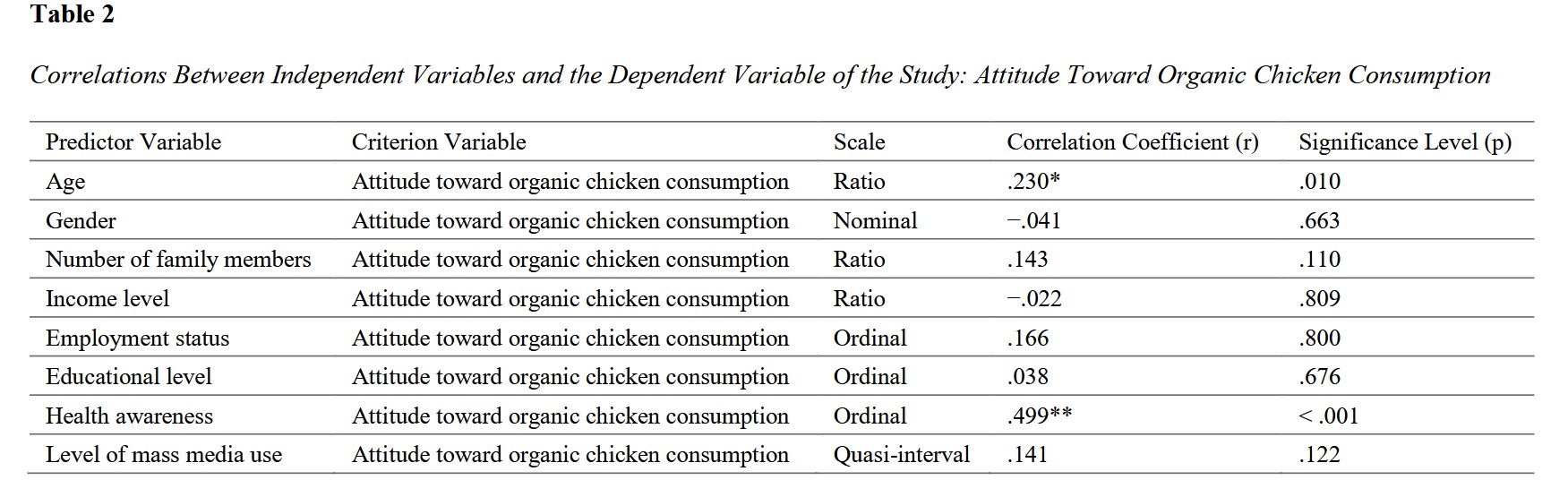
The present study aimed to determine the relationship between health awareness, demographic characteristics, and mass media use with the attitude of headquarters staff of Ilam University of Medical Sciences toward organic chicken consumption, as well as to predict attitude based on these variables. This was a descriptive-analytical study. The statistical population consisted of the headquarters staff of Ilam University of Medical Sciences (250 individuals), of whom 148 were selected as the sample size through simple random sampling using the Krejcie and Morgan table. The main research instrument was a questionnaire, whose content validity was confirmed through expert review, and its reliability was calculated using Cronbach’s alpha coefficient (0.75). Given the non-normal distribution of the data based on the Kolmogorov–Smirnov test, Spearman’s correlation coefficient and simple linear regression were used to analyze the data with SPSS version 26. The results showed that, among the eight independent variables, only two variables had a significant relationship with attitude toward organic chicken consumption. Health awareness showed the strongest relationship with attitude, with a correlation coefficient of 0.449 (p = 0.000), while age showed a positive and significant relationship with attitude, with a correlation coefficient of 0.230 (p = 0.010). Other variables, including gender, number of family members, income level, employment status, educational level, and level of mass media use, had no significant relationship with attitude (p > 0.05). The results of simple linear regression showed that age alone explained 5.1% of the variance in attitude, while health awareness explained 28.5% of its variance. In addition, the descriptive findings indicated that cyberspace and the Internet, with a mean score of 3.56, were the most frequently used media channels, whereas radio programs, with a mean score of 1.82, were the least frequently used media channels. Based on the findings, health awareness is the strongest factor associated with a positive attitude toward organic chicken consumption among the staff of Ilam University of Medical Sciences. Therefore, designing systematic educational programs, including workshops, webinars, and the production of scientific content; using the capacity of cyberspace and the Internet to disseminate health-oriented content; and employing older staff members with positive attitudes as “organic ambassadors” may be effective in improving attitudes and promoting organic chicken consumption.
Downloads
References
1. Yadav SPS, Ghimire NP, Yadav B, Paudel P. Key Requirements, Status, Possibilities, Consumer Perceptions, And Barriers Of Organic Poultry Farming: A Review. Fundamental and Applied Agriculture. 2022;7(2):150-67.
2. Dewi G, Smith C, Martin W, Venkitanarayanan K, Kollanoor Johny A. Focus Groups Exploring American Consumer Perspectives On Contemporary Poultry Production Reveal Critical Insights To Educate Sustainable Practices For Producers. Frontiers in Sustainable Food Systems. 2024;8:1416167.
3. Nassar FS. Poultry Production Under Threat: Framework To Counter Misinformation And Protect Food Security. Poultry Science. 2025:106050. [PMID: 41205433] [PMCID: PMC12747183]
4. Idda L, Madau FA, Pulina P, editors. The Motivational Profile Of Organic Food Consumers: A Survey Of Specialized Stores Customers In Italy. International Congress; 2008.
5. Zhou L, Chen T, editors. Consumer Perception Of Organic Food In Urumqi. 105th EAAE Seminar: International Marketing and International Trade of Quality Food Products; 2007; Bologna.
6. Annunziata A, Scarpato D. Factors Affecting Consumer Attitudes Towards Food Products With Sustainable Attributes. Agricultural Economics/Zemedelska Ekonomika. 2014;60(8).
7. Yeo SF, Tan CL, Tseng ML, Tam S, San WK. Factors Influencing Organic Food Purchase Decision: Fuzzy Dematel Approach. British Food Journal. 2022;124(12):4567-91.
8. Bolat BA, Kaygisiz F, Bulut D. How Consumers' Consciousness And Perception Levels Affect Purchase Intention Of Organic Chicken Meat In Turkey. Turkish Journal of Veterinary & Animal Sciences. 2020;44(6):1306-15.
9. Kavoosi Kalashami M, Heydari M, Kazerani H. Investigating Consumers' Willingness To Pay For Organic Green Chicken In Iran: Case Study Of Rasht City. International Journal of Agricultural Management and Development. 2012;2(3):235-41.
10. Amian S, Amiri Z, Kavoosi Kalashami M, Ghayebi S. Assessing Willingness To Pay And Attitudes Of Urmia Citizens Toward Green Chicken Consumption. Rural and Agricultural Economic Growth and Development. 2016;2(3):27-36.
11. Aghasafari H, Karbasi A. Components Affecting Consumers' Preference For Chicken Meat With Sustainability Labels: Case Study Of Mashhad City. Agricultural Economics Research. 2021;13(2):197-216.
12. Ismawati I, Harmini H, Suprehatin S. Pengaruh Kesadaran Kesehatan Dan Kepedulian Lingkungan Terhadap Niat Pembelian Telur Ayam Organik. Jurnal Agribisnis Indonesia. 2025;13(2):350-66.
13. Wang J, Xue Y, Liu T. Consumer Motivation For Organic Food Consumption: Health Consciousness OR Herd Mentality. Frontiers in Public Health. 2023;10:1042535. [PMID: 36711361] [PMCID: PMC9876609]
14. Chaturvedi A, Rashid MC, Rahman M, editors. Demographic Analysis Of Consumer Attitude Towards Organic Food. 2nd International Conference on Digital Transformation for Business Sustainability; 2023; Delhi-NCR, India.
15. Mohammadi H, Torabi S, Dogani A. Application Of Ordered Logit Model In Investigating The Factors Affecting People'S Income: A Case Study In Tehran City. International Journal of Academic Research in Economics and Management Sciences. 2015;4(1).
16. Mirsalimi H, Farhadian H, Kheiri S, Khosravani F. Investigating Consumers' Attitudes Toward Organic Agriculture: Case Study Of Alborz Province. Journal of Food Industry. 2016;13(52):147-60.
17. Ranjbar Shams H, Omidi Najafabadi M. Factors Affecting Attitudes Toward Consumption Of Organic Agricultural Products In Tehran. Agricultural Extension and Education Research. 2014;7(2):51-62.
18. Khodaverdizadeh M. Factors Affecting Consumers' Willingness To Pay For Organic Cucumber In Urmia. Agricultural Economics Research. 2017;9(35):97-122.
19. Alzaidi A, Baig M, Elhag E. An Investigation Into The Farmers' Attitudes Towards Organic Farming In Riyadh Region, Kingdom Of Saudi Arabia. Journal of Agricultural Science. 2013;19(3):426-31.
20. Haddadi S, Yazdani S, Saleh A. Investigating Factors Affecting Farmers' Adoption Of Organic Cucumber Cultivation In Alborz Province. Iranian Agricultural Economics and Development Research. 2017;48(3):369-78.
21. Khoshmaram M, Shiri N, Sharafi L. Factors Affecting Agricultural Extension Experts' Attitudes Toward Organic Agriculture. Rural Development Strategies. 2014;1(4):75-90.
22. Stobbelaar DJ, Casimir G, Borghuis J, Marks I, Meije L, Zebeda S. Adolescents' Attitudes Towards Organic Food: A Survey Of 15- To 16-Year-Old School Children. International Journal of Consumer Studies. 2007;31(4):349-56.
23. Yazdanpanah M, Komendantova N, Shirazi ZN, Linnerooth-Bayer J. Green OR In Between? Examining Youth Perceptions Of Renewable Energy In Iran. Energy Research & Social Science. 2015;8:78-85.
24. Carlsson F, Martinsson P. Do Hypothetical And Actual Marginal Willingness To Pay Differ In Choice Experiments? Application To The Valuation Of The Environment. Journal of Environmental Economics and Management. 2001;2:179-92.
Downloads
Additional Files
Publication Timeline
- Submitted
- Revised
- Accepted