Comparing the Effectiveness of Cognitive Behavioral Therapy and Emotion-Focused Therapy on Mindfulness and Psychological Flexibility in Generalized Anxiety Disorder
DOI:
https://doi.org/10.61838/Keywords:
generalized anxiety disorder, cognitive behavioral therapy, emotion-focused therapy, mindfulness, psychological flexibilityAbstract
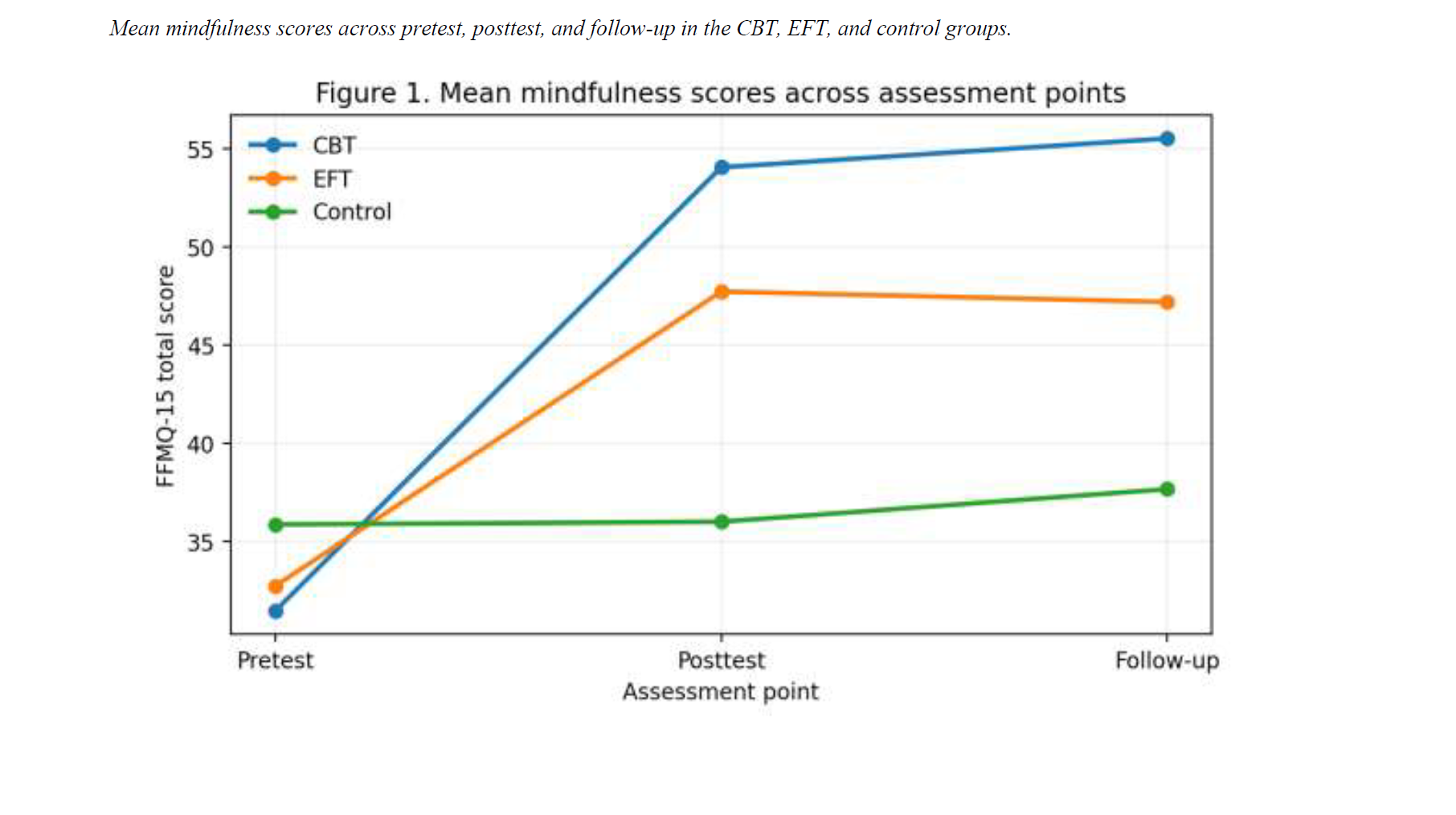
This study compared the effectiveness of cognitive behavioral therapy (CBT) and emotion-focused therapy (EFT) for improving mindfulness and psychological flexibility in women with generalized anxiety disorder (GAD). A quasi-experimental pretest-posttest design with a control group and follow-up assessment was used. Forty-five women with GAD who attended counseling and psychological service centers in Tehran in 2025 were selected through purposive sampling and then randomly assigned to three groups (n = 15 per group): CBT, EFT, and control. Interventions were delivered online in 12 weekly 90-minute sessions. Measures included the Generalized Anxiety Disorder Scale (GAD-7), the Five Facet Mindfulness Questionnaire (FFMQ-15), and the Acceptance and Action Questionnaire-II (AAQ-II). Data were analyzed using repeated-measures analysis of variance in SPSS version 26. Both active treatments produced significant improvements compared with the control group, but CBT showed the strongest effects. For mindfulness, the CBT group increased from M = 31.46 (SD = 5.12) at pretest to M = 54.06 (SD = 5.00) at posttest and M = 55.53 (SD = 8.41) at follow-up, whereas the EFT group increased from M = 32.73 (SD = 4.51) to M = 47.73 (SD = 4.72) and M = 47.20 (SD = 4.75). For AAQ-II scores, where lower scores indicate greater psychological flexibility, the CBT group improved from M = 33.80 (SD = 3.23) to M = 17.60 (SD = 4.08) and M = 18.26 (SD = 4.31), while the EFT group improved from M = 36.06 (SD = 3.43) to M = 23.40 (SD = 3.45) and M = 22.93 (SD = 4.69). The repeated-measures ANOVA showed significant time, group, and time × group effects for both mindfulness and psychological flexibility (all p < .001). Both CBT and EFT were effective in women with GAD, but CBT yielded greater gains in mindfulness and psychological flexibility and maintained these gains at follow-up.
Downloads
References
Fagan HA, Baldwin DS. Pharmacological treatment of generalized anxiety disorder: Current practice and future directions. Expert Review of Neurotherapeutics. 2023;23(6):535-48. [PMID: 37183813] [DOI]
2. Spitzer RL, Kroenke K, Williams JBW, Löwe B. A brief measure for assessing generalized anxiety disorder: The GAD-7. Archives of Internal Medicine. 2006;166(10):1092-7. [PMID: 16717171] [DOI]
3. Mirzai F, Nasiri Z, Naeim M, Imannezhad S, Javedani M. Advancing mental health in the Middle East: A paradigm shift. Asian Journal of Psychiatry. 2024;101:104220. [PMID: 39241655] [DOI]
4. Fereydouni S, Forstmeier S. An Islamic form of logotherapy in the treatment of depression, anxiety and stress symptoms in university students in Iran. Journal of Religion and Health. 2022;61(1):139-57. [PMID: 35018526] [PMCID: PMC8837512] [DOI]
5. Baer RA, Smith GT, Hopkins J, Krietemeyer J, Toney L. Using self-report assessment methods to explore facets of mindfulness. Assessment. 2006;13(1):27-45. [PMID: PMC8277060] [DOI]
6. Martínez-Pérez I, García-Rodríguez A, Morales-Rodríguez FM, Pérez-Mármol JM. Mindfulness abilities are associated with anxiety levels, emotional intelligence, and perceived self-efficacy. Sustainability. 2023;15(6):4729. [DOI]
7. Williams M, Honan C, Skromanis S, Sanderson B, Matthews AJ. Psychological outcomes and mechanisms of mindfulness-based training for generalised anxiety disorder: A systematic review and meta-analysis. Current Psychology. 2024;43:5318-40. [PMID: 37359641] [PMCID: PMC10173921] [DOI]
8. Bond FW, Hayes SC, Baer RA, Carpenter KM, Guenole N, Orcutt HK, et al. Preliminary psychometric properties of the Acceptance and Action Questionnaire-II: A revised measure of psychological inflexibility and experiential avoidance. Behavior Therapy. 2011;42(4):676-88. [PMID: 22035996] [PMCID: PMC8527996] [DOI]
9. Gloster AT, Block VJ, Klotsche J, Villanueva J, Rinner MTB, Benoy C, et al. Psy-Flex: A contextually sensitive measure of psychological flexibility. Journal of Contextual Behavioral Science. 2021;22:13-23. [DOI]
10. Akbari M, Seydavi M, Hosseini ZS, Krafft J, Levin ME. Experiential avoidance in depression, anxiety, obsessive-compulsive related, and posttraumatic stress disorders: A comprehensive systematic review and meta-analysis. Journal of Contextual Behavioral Science. 2022;24:81-104. [DOI]
11. Landi G, Pakenham KI, Crocetti E, Tossani E, Grandi S. The trajectories of anxiety and depression during the COVID-19 pandemic and the protective role of psychological flexibility: A four-wave longitudinal study. Journal of Affective Disorders. 2022;307:69-78. [PMID: 35378147] [PMCID: PMC8972980] [DOI]
12. Papola D, Miguel C, Mazzaglia M, Ostuzzi G, Gastaldon C, Barbui C, et al. Psychotherapies for generalized anxiety disorder in adults: A systematic review and network meta-analysis of randomized clinical trials. JAMA Psychiatry. 2024;81(3):250-9. [PMID: 37851421] [PMCID: PMC10585589] [DOI]
13. Simon NM, Hofmann SG, Rosenfield D, Hoeppner SS, Hoge EA, Bui E, et al. Efficacy of yoga vs cognitive behavioral therapy vs stress education for the treatment of generalized anxiety disorder: A randomized clinical trial. JAMA Psychiatry. 2021;78(1):13-20. [PMID: 32805013] [PMCID: PMC7788465] [DOI]
14. Trenoska Basile V, Newton-John T, Wootton BM. Remote cognitive-behavioral therapy for generalized anxiety disorder: A preliminary meta-analysis. Journal of Clinical Psychology. 2022;78(12):2381-95. [PMID: 35403706] [PMCID: PMC9790363] [DOI]
15. Greenberg LS. Changing emotion with emotion: A practitioner's guide: American Psychological Association; 2021. [DOI]
16. Timulak L, McElvaney J, Keogh D, Martin E, Clare P, Chepukova E, et al. Emotion-focused therapy for generalized anxiety disorder: An exploratory study. Psychotherapy. 2017;54(4):361-6. [PMID: 29251955] [DOI]
17. Keogh D, Timulak L. "It's wrong to relax, you have to be on the go, go, go, all the time": Emotional transformation in a case of emotion-focused therapy for generalized anxiety disorder. Counselling and Psychotherapy Research. 2023;23(4):1015-27. [DOI]
18. Cox KS, Towsen T, Egan SJ, Shafran R. An empirical investigation of the associations between metacognition, mindfulness, experiential avoidance, depression, and anxiety. Journal of Affective Disorders. 2023;340:651-9. [PMID: 37553018] [DOI]
19. Kroska EB, Roche AI, Adamowicz JL, Stegall MS. Psychological flexibility in the context of COVID-19 adversity: Associations with distress. Journal of Contextual Behavioral Science. 2020;18:28-33. [PMID: 32837889] [PMCID: PMC7406424] [DOI]
20. Gu J, Strauss C, Crane C, Barnhofer T, Karl A, Cavanagh K, et al. Examining the factor structure of the 39-item and 15-item versions of the Five Facet Mindfulness Questionnaire before and after mindfulness-based cognitive therapy for people with recurrent depression. Psychological Assessment. 2016;28(7):791-802. [PMID: 27078186] [PMCID: PMC4928699] [DOI]
21. Moskow Diamond D, Rosenfield D, Kaiser N, Baker AW, Hoge EA, Khalsa SBS, et al. Changes in mindfulness facets across yoga, CBT and stress education in individuals with generalized anxiety disorder. Journal of Mood and Anxiety Disorders. 2024;6:100058. [PMID: 39086907] [DOI]
Downloads
Additional Files
Publication Timeline
- Submitted
- Revised
- Accepted