Prediction of Self-Harming Thoughts Based on Early Maladaptive Schemas and Mindfulness
DOI:
https://doi.org/10.61838/kman.hn.5405Keywords:
self-harming thoughts, early maladaptive schemas, mindfulnessAbstract
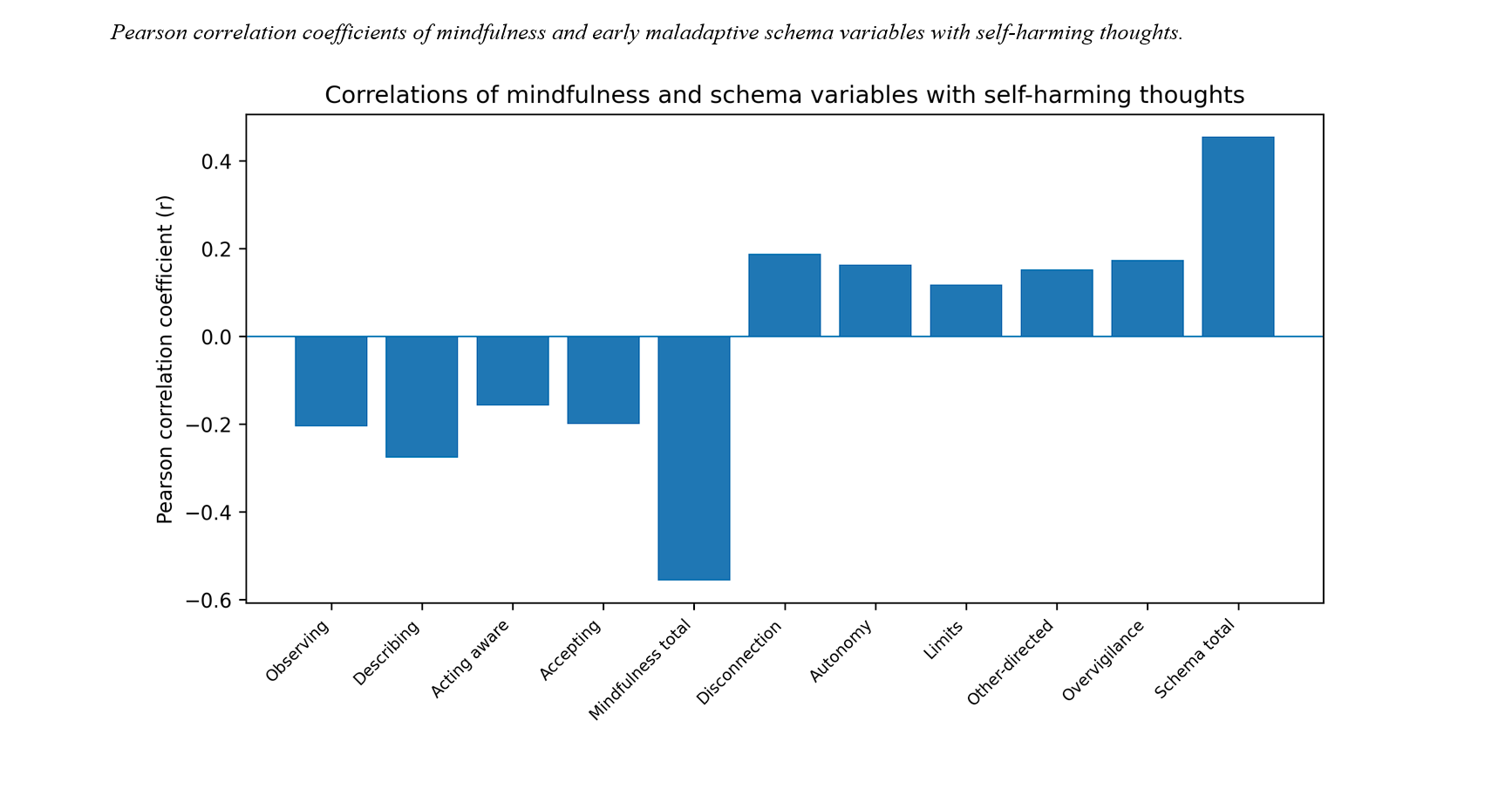
Self-harming thoughts are among the most important psychological warning signs associated with emotional dysregulation, maladaptive coping, and vulnerability to self-injurious behaviors. The present study aimed to examine the predictive role of mindfulness and early maladaptive schemas in self-harming thoughts among adults referring to psychological clinics in Tehran. This applied study used a descriptive-correlational cross-sectional design. The statistical population consisted of individuals over 18 years of age who referred to private or public psychological clinics in Tehran during the third quarter of 2025 due to anxiety, depression, or other psychological difficulties. Using simple random sampling and based on the Krejcie and Morgan table, 300 participants were selected. Data were collected using the Kentucky Inventory of Mindfulness Skills, Young Schema Questionnaire–Short Form, and Beck Scale for Suicide Ideation. Data were analyzed using Pearson correlation coefficients and simultaneous multiple regression analysis in SPSS version 22. The results showed that total mindfulness was negatively and significantly associated with self-harming thoughts (r = −0.556, p = 0.001), whereas the total maladaptive schema score was positively and significantly associated with self-harming thoughts (r = 0.455, p = 0.002). In the regression analyses, the mindfulness model and schema model significantly predicted self-harming thoughts. Among mindfulness components, only describing without labeling remained a significant predictor (β = 0.244, p = 0.004). Among schema domains, only impaired autonomy and performance significantly predicted self-harming thoughts (β = 0.307, p = 0.002). In the simultaneous model, mindfulness and early maladaptive schemas together explained approximately 40% of the variance in self-harming thoughts (R² = 0.402). These findings suggest that self-harming thoughts are shaped by the combined effects of reduced mindfulness skills and dysfunctional cognitive-emotional schemas. Interventions that strengthen nonjudgmental description of internal experiences and modify autonomy-related maladaptive schemas may help reduce self-harming thoughts.
Downloads
References
1. Cipriano A, Cella S, Cotrufo P. Nonsuicidal self-injury: A systematic review. Frontiers in Psychology. 2017;8:1946. [PMID: 29167651] [PMCID: PMC5682335]
2. Nock MK. Self-injury. Annual Review of Clinical Psychology. 2010;6:339-63. [PMID: 20192787]
3. Pilkington PD, Younan R, Bishop A. Early maladaptive schemas, suicidal ideation, and self-harm: A meta-analytic review. Journal of Affective Disorders Reports. 2021;3:100051.
4. Saarijärvi P, Salmivalli C, Helmi S, Karukivi M. Early maladaptive schemas are associated with self-injury thoughts and behavior in adolescents. BMC Psychiatry. 2023;23:632. [PMID: 37644535] [PMCID: PMC10466884]
5. Beck AT, Kovacs M, Weissman A. Assessment of suicidal intention: The Scale for Suicide Ideation. Journal of Consulting and Clinical Psychology. 1979;47(2):343-52. [PMID: 469082]
6. Zhang B, Fu W, Guo Y, Chen Y, Jiang C, Li X, et al. Effectiveness of Mindfulness-Based Cognitive Therapy Against Suicidal Ideation in Patients with Depression: A Systematic Review and Meta-Analysis. Journal of Affective Disorders. 2022;319:655-62. [PMID: 36170923]
7. Zhang D, Lee EKP, Mak ECW, Ho CY, Wong SYS. Mindfulness-based interventions: An overall review. British Medical Bulletin. 2021;138(1):41-57. [PMID: 33884400] [PMCID: PMC8083197]
8. de Aguiar KR, Bilhalva JB, Cabelleira MD, Guimarães GO, Madureira TM, Agako A, et al. The impact of mindfulness on suicidal behavior: A systematic review. Trends in Psychiatry and Psychotherapy. 2022;44:e20210316.
9. Bishop A, Younan R, Low J, Pilkington PD. Early maladaptive schemas and depression in adulthood: A systematic review and meta-analysis. Clinical Psychology & Psychotherapy. 2022;29(1):111-30. [PMID: 34131990]
10. Kover L, Szollosi GJ, Frecska E, Bugan A, Berecz R, Egerhazi A. The association between early maladaptive schemas and romantic relationship satisfaction. Frontiers in Psychology. 2024;15:1460723. [PMID: 39749279] [PMCID: PMC11694223]
11. Pilkington PD, Karantzas GC, Faustino B, Pizarro-Campagna E. Early maladaptive schemas, emotion regulation difficulties and alexithymia: A systematic review and meta-analysis. Clinical Psychology & Psychotherapy. 2024;31(1):e2914. [PMID: 37735142]
12. Simpson S, Simionato G, Smout M, van Vreeswijk MF, Hayes C, Sougleris C, et al. Burnout amongst clinical and counselling psychologists: The role of early maladaptive schemas and coping modes as vulnerability factors. Clinical Psychology & Psychotherapy. 2019;26(1):35-46. [PMID: 30203882]
13. Toniolo-Barrios M, Pitt L. Mindfulness and the challenges of working from home in times of crisis. Business horizons. 2021;64(2):189-97. [PMID: 33041346] [PMCID: PMC7535863]
14. Behan C. The benefits of meditation and mindfulness practices during times of crisis such as COVID-19. Irish Journal of Psychological Medicine. 2020;37(4):256-8. [PMID: 32406348] [PMCID: PMC7287297]
15. Klonsky ED. The functions of deliberate self-injury: A review of the evidence. Clinical Psychology Review. 2007;27(2):226-39. [PMID: 17014942]
16. Fernández-González L, Orue I, Adrián L, Calvete E. Child-to-parent aggression and dating violence: Longitudinal associations and the predictive role of early maladaptive schemas. Journal of Family Violence. 2022;37(1):181-9.
17. Shi Y, Song Y, Wang L, Liu J, Chen IJ. Early maladaptive schemas and the risk of nonsuicidal self-injury in college students: A retrospective study. Medicine. 2023;102(47):e35584. [PMID: 38013353] [PMCID: PMC10681388]
18. Krejcie RV, Morgan DW. Determining sample size for research activities. Educational and Psychological Measurement. 1970;30(3):607-10.
19. Baer RA, Smith GT, Allen KB. Assessment of mindfulness by self-report: The Kentucky Inventory of Mindfulness Skills. Assessment. 2004;11(3):191-206. [PMID: 15358875]
20. Baer RA. Mindfulness training as a clinical intervention: A conceptual and empirical review. Clinical Psychology: Science and Practice. 2003;10(2):125-43.
21. Young JE. Young Schema Questionnaire–Short Form 3 (YSQ-S3). Cognitive Therapy Center; 2005.
22. Oei TPS, Baranoff J. Young Schema Questionnaire: Review of psychometric and measurement issues. Australian Journal of Psychology. 2007;59(2):78-86.
23. Pauwels E, Dierckx E, Schoevaerts K, Claes L. Validation of the Young Schema Questionnaire–Short Form in a Flemish community sample. Psychologica Belgica. 2018;58(1):34-50. [PMID: 30479806] [PMCID: PMC6194525]
24. Welburn K, Coristine M, Dagg P, Pontefract A, Jordan S. The Schema Questionnaire–Short Form: Factor analysis and relationship between schemas and symptoms. Cognitive Therapy and Research. 2002;26:519-30.
25. Beck AT, Steer RA. Manual for the Beck Scale for Suicide Ideation: Psychological Corporation; 1991.
26. Steer RA, Kumar G, Beck AT. Self-reported suicidal ideation in adolescent psychiatric inpatients. Journal of Consulting and Clinical Psychology. 1993;61(6):1096-9. [PMID: 8113489]
Downloads
Additional Files
Publication Timeline
- Submitted
- Revised
- Accepted