
Effectiveness of Behavioral Therapy Based on Systematic Desensitization in Reducing Anxiety and Animal-Phobia Symptoms in Adolescents
DOI:
https://doi.org/10.61838/kman.hn.5517Keywords:
systematic desensitization, behavioral therapy, anxiety, animal phobia, specific phobia, adolescentsAbstract
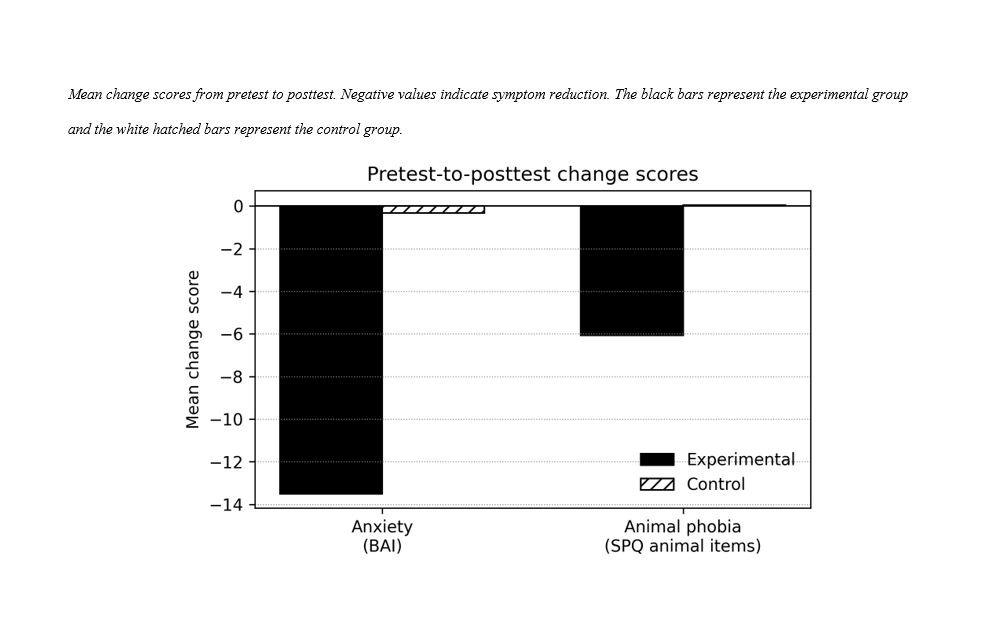
Animal phobia is a common subtype of specific phobia and is often accompanied by marked anxiety, avoidance behavior, and functional impairment. Systematic desensitization is a behavioral intervention that combines relaxation training with gradual exposure to feared stimuli. This study examined the effectiveness of behavioral therapy based on systematic desensitization in reducing anxiety and animal-phobia symptoms among adolescents with animal phobia. A quasi-experimental pretest-posttest design with a wait-list control group was used. Twenty-seven adolescents aged 15-18 years were recruited from counseling centers in Mashhad, Iran, after a clinical screening interview guided by DSM-5 criteria for specific phobia and an elevated score on the animal-phobia item set of the Specific Phobia Questionnaire. Participants were randomly allocated to an experimental group (n = 13) or a wait-list control group (n = 14). The experimental group received eight weekly 60-minute sessions of systematic desensitization, whereas the control group received no active intervention during the study period. Outcomes were assessed using the Beck Anxiety Inventory and 10 animal-related items from the Specific Phobia Questionnaire. Data were analyzed using descriptive statistics and univariate analysis of covariance, controlling for pretest scores. After controlling for pretest scores, the experimental group showed significantly lower posttest anxiety than the control group, F(1, 24) = 64.37, p < .001, partial eta squared = .728. A significant intervention effect was also observed for animal-phobia symptoms, F(1, 24) = 28.98, p < .001, partial eta squared = .547. These findings suggest that systematic desensitization may be a useful structured intervention for reducing anxiety and animal-phobia symptoms in adolescents. However, the small sample size, reliance on self-report outcomes, lack of behavioral approach testing, and absence of follow-up assessment require cautious interpretation. Future studies with larger samples, active control conditions, clinician-rated outcomes, and follow-up assessments are recommended.
Downloads
References
1. American Psychiatric A. Diagnostic and statistical manual of mental disorders. 5th ed: American Psychiatric Publishing; 2013. {3_https://doi.org/10.1176/appi.books.9780890425596}
2. Norberg MM, Visvalingam S, Stevenson RJ, Saluja S. A review of the phenomenology, aetiology and treatment of animal phobia and insights for biophobia. People and Nature. 2024;6(3):932-44. {3_https://doi.org/10.1002/pan3.10514}
3. Mineka S, Oehlberg K. The relevance of recent developments in classical conditioning to understanding the etiology and maintenance of anxiety disorders. Acta Psychologica. 2008;127(3):567-80. {2_18226795} {3_https://doi.org/10.1016/j.actpsy.2007.11.007}
4. Beck AT, Haigh EAP. Advances in cognitive theory and therapy: The generic cognitive model. Annual Review of Clinical Psychology. 2014;10:1-24. {2_24387236} {3_https://doi.org/10.1146/annurev-clinpsy-032813-153734}
5. Wolitzky-Taylor KB, Horowitz JD, Powers MB, Telch MJ. Psychological approaches in the treatment of specific phobias: A meta-analysis. Clinical Psychology Review. 2008;28(6):1021-37. {2_18410984} {3_https://doi.org/10.1016/j.cpr.2008.02.007}
6. de Jong R, Hofs A, Lommen MJJ, van Hout WJPJ, de Jong PJ, Nauta MH. Treating specific phobia in youth: A randomized controlled microtrial comparing gradual exposure in large steps to exposure in small steps. Journal of Anxiety Disorders. 2023;96:102712. {2_37043895} {3_https://doi.org/10.1016/j.janxdis.2023.102712}
7. Wolpe J. Psychotherapy by reciprocal inhibition: Stanford University Press; 1958.
8. Beck AT, Epstein N, Brown G, Steer RA. An inventory for measuring clinical anxiety: Psychometric properties. Journal of Consulting and Clinical Psychology. 1988;56(6):893-7. {2_3204199} {3_https://doi.org/10.1037/0022-006X.56.6.893}
9. Ovanessian MM, Fairbrother N, Vorstenbosch V, McCabe RE, Rowa K, Antony MM. Psychometric properties and clinical utility of the Specific Phobia Questionnaire in an anxiety disorders sample. Journal of Psychopathology and Behavioral Assessment. 2019;41(1):36-52. {3_https://doi.org/10.1007/s10862-018-9687-1}
10. Hoffmann WA, Odendaal JSJ. The effect of behavioral therapy on dog phobia response patterns. Anthrozoos. 2001;14(1):29-37. {3_https://doi.org/10.2752/089279301786999571}
11. Ost LG, Svensson L, Hellstrom K, Lindwall R. One-session treatment of specific phobias in youths: A randomized clinical trial. Journal of Consulting and Clinical Psychology. 2001;69(5):814-24. {2_11680558} {3_https://doi.org/10.1037/0022-006X.69.5.814}
12. Bandura A. Self-efficacy: The exercise of control: W. H. Freeman; 1997.
Downloads
Additional Files
Publication Timeline
- Submitted
- Revised
- Accepted