Environment, Ecology, and Urban Plant Diversity: A Dose-Response Analysis of Residential Green Space on Self-Reported Mental Health Using BRFSS and Land Cover Data
Keywords:
green space, mental health, BRFSS, vegetation composition, ecological inferenceAbstract
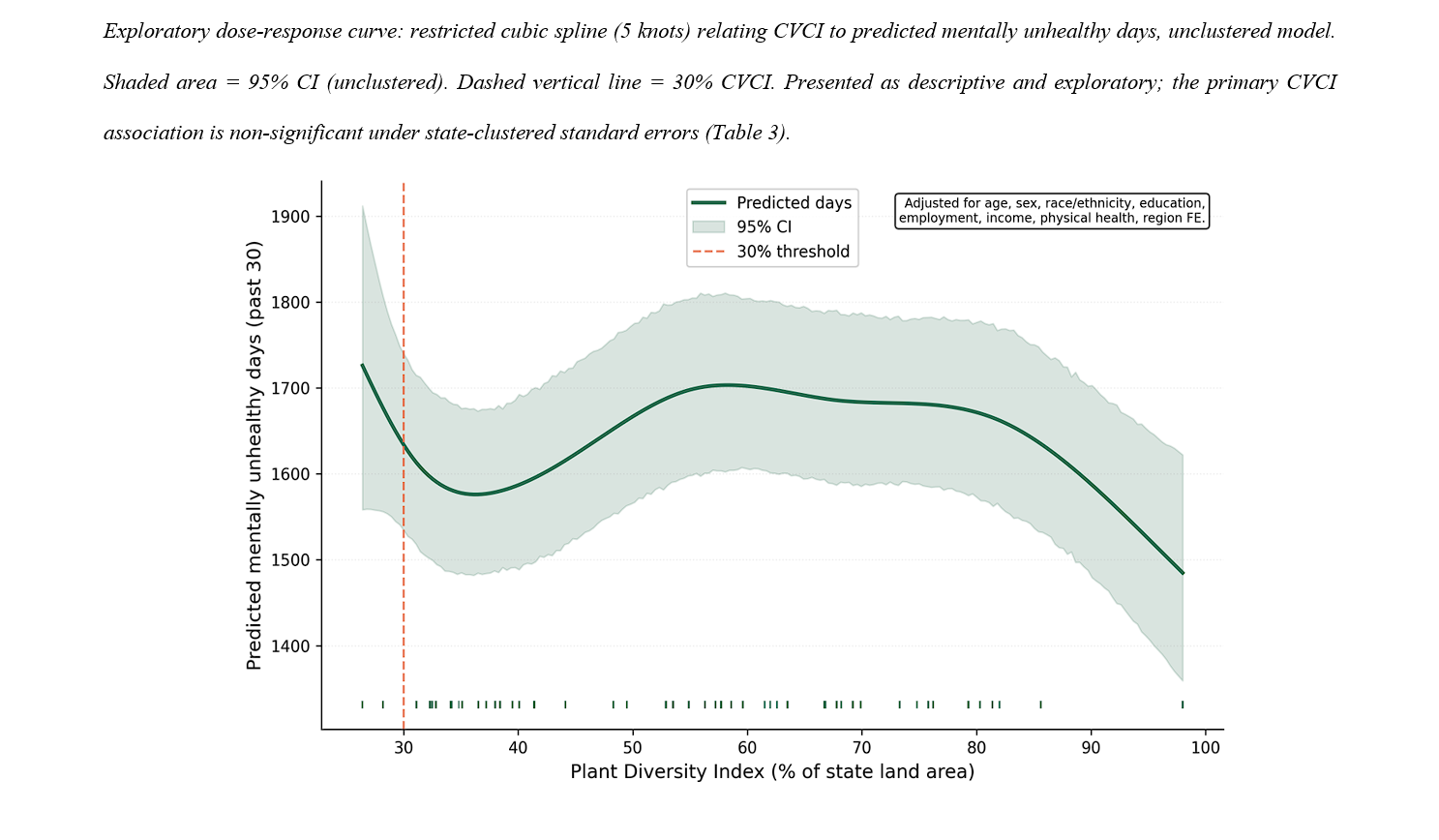
Residential green space is an established determinant of population mental health, yet most studies employ binary or categorical exposure measures, obscuring whether the relationship is linear or exhibits threshold effects. To estimate the dose-response relationship between residential plant diversity and self-reported mentally unhealthy days in a nationally representative US adult sample. We linked 297,195 adults from the 2019 BRFSS to state-level Plant Diversity Index (PDI) values derived from NLCD 2019, comprising tree canopy, shrub/scrub, and herbaceous vegetation. Negative binomial regression with restricted cubic splines (5 knots) estimated non-linear dose-response curves, adjusted for age, sex, race/ethnicity, education, employment, income, physical health, and census region. VIF assessed multicollinearity. Component-wise analysis tested each vegetation class independently. Results: Mean mentally unhealthy days was 3.39 (SD = 7.41). The composite PDI was significantly associated with mentally unhealthy days (IRR = 1.111, 95% CI: 1.031–1.198, p = 0.006). Component analysis revealed opposing effects: shrub/scrub was associated with more unhealthy days (IRR = 2.263, p < 0.001) while herbaceous cover was protective (IRR = 0.578, p = 0.036). The dose-response curve was non-linear with a threshold near 30% PDI and contextual reversal at high rural vegetation density. The PDI association was significant in urban residents (IRR = 1.125, p = 0.004) and confirmed by hurdle modelling (OR = 1.077, p = 0.023). Residential plant diversity is associated with mental health burden. Ecological composition — not merely quantity — determines the mental health relevance of plant cover. Findings support targeted canopy investment in low-income urban areas.
Downloads
References
1. Gascon M, Triguero-Mas M, Martinez D. Mental Health Benefits of Long-Term Exposure to Residential Green and Blue Spaces: A Systematic Review. International Journal of Environmental Research and Public Health. 2015;12(4):4354-79. doi: 10.3390/ijerph120404354.
2. Yang B, Zhao T, Hu L. Greenspace and human health: An umbrella review. The Innovation. 2021;2(4):100164. doi: 10.1016/j.xinn.2021.100164.
3. Ulrich RS. Aesthetic and affective response to natural environment: Plenum Press; 1983. 85-125 p.
4. Kaplan R, Kaplan S. The Experience of Nature: A Psychological Perspective: Cambridge University Press; 1989.
5. Beute F, Marselle M, Olszewska-Guizzo A. How do different types and characteristics of green space impact mental health? A scoping review. People and Nature. 2023;5(6):1839-62. doi: 10.1002/pan3.10529.
6. Nguyen P, Astell-Burt T, Rahimi-Ardabili H, Feng X. Green Space Quality and Health: A Systematic Review. International Journal of Environmental Research and Public Health. 2021;18(21):11028. doi: 10.3390/ijerph182111028.
7. Astell-Burt T, Feng X. Association of Urban Green Space With Mental Health and General Health Among Adults in Australia. JAMA Network Open. 2019;2(7):e198209. doi: 10.1001/jamanetworkopen.2019.8209.
8. Wang J, Tang L, Li D. Long-term exposure to residential greenness and decreased risk of depression and anxiety. Nature Mental Health. 2024;2:525-34. doi: 10.1038/s44220-024-00226-2.
9. Crouse D, Pinault L, Christidis T. Residential greenness and indicators of stress and mental well-being in a Canadian national-level survey. Environmental Research. 2020;191:110267. doi: 10.1016/j.envres.2020.110267.
10. Helbich M, Poppe R, Oberski D. Can't see the wood for the trees? Urban trees and psychosocial well-being. Landscape and Urban Planning. 2021;214:104181. doi: 10.1016/j.landurbplan.2021.104181.
11. Jiang B, Li J, Gong P. A generalized relationship between dose of greenness and mental health response. Nature Cities. 2025;2:739-48. doi: 10.1038/s44284-025-00189-2.
12. Reid C, Rieves E, Carlson K. Perceptions of green space were associated with better mental health during COVID-19. PLoS ONE. 2022;17(3):e0263779. doi: 10.1371/journal.pone.0263779.
13. Vegaraju A, Amiri S. Urban green and blue spaces and mental health among older adults. Health & Place. 2023;85:103148. doi: 10.1016/j.healthplace.2023.103148.
14. Maas CJM, Hox JJ. Sufficient sample sizes for multilevel modeling. Methodology. 2005;1(3):86-92. doi: 10.1027/1614-2241.1.3.86.
15. Jiang B, Li D, Larsen L, Sullivan WC. A Dose-Response Curve: Urban Tree Cover Density and Stress Recovery. Environment and Behavior. 2016;48(4):607-29. doi: 10.1177/0013916514552321.
16. Callaghan A, McCombe G, Harrold Á. The impact of green spaces on mental health in urban settings: a scoping review. Journal of Mental Health. 2020;30(2):179-93. doi: 10.1080/09638237.2020.1755026.
17. Tsai W, Nash M, Rosenbaum D. Association of Redlining and Natural Environment with Depressive Symptoms. Environmental Health Perspectives. 2023;131(4):047003. doi: 10.1289/EHP11237.
18. Xian Z, Nakaya T, Liu K. The effects of neighbourhood green spaces on mental health of disadvantaged groups: a systematic review. Humanities and Social Sciences Communications. 2024;11:1-19. doi: 10.1057/s41599-024-02711-4.
19. Zhang R, Zhang C, Rhodes RE. The pathways linking objectively-measured greenspace exposure and mental health. Environmental Research. 2021;198:111233. doi: 10.1016/j.envres.2021.111233.
Downloads
Publication Timeline
- Submitted
- Revised
- Accepted