
Embodied Cognition in Sport Expertise: A Thematic Exploration of Sensorimotor Awareness in Professional Athletes
DOI:
https://doi.org/10.61838/Keywords:
embodied cognition , sensorimotor awareness, sport expertise, professional athletes , perception–action coupling , interoception, proprioceptionAbstract
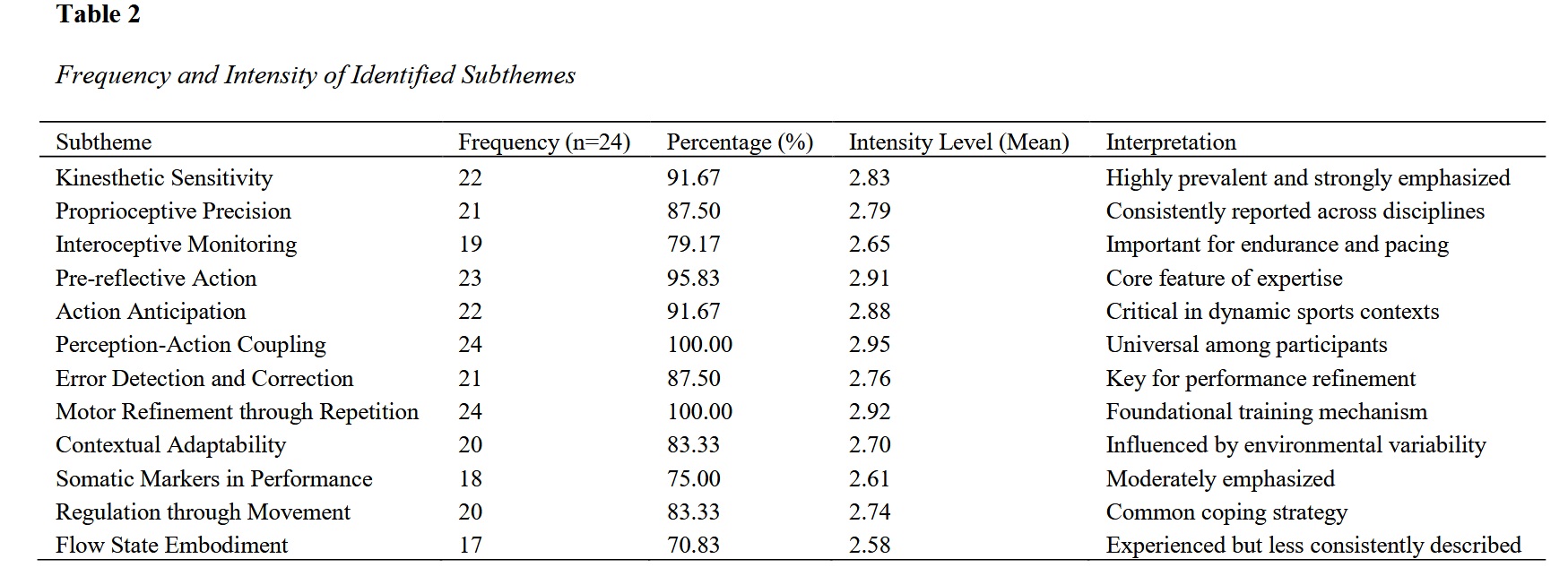
The objective of this study was to explore and interpret the lived experiences of professional athletes to identify the core thematic dimensions of sensorimotor awareness within the framework of embodied cognition. This study employed a qualitative research design using thematic analysis grounded in an interpretivist paradigm. Participants consisted of twenty-four professional athletes from Canada, representing both individual and team sports with a minimum of five years of elite-level experience. Data were collected through semi-structured in-depth interviews, complemented by reflective journals and researcher field notes to enhance contextual richness and triangulation. Interviews focused on athletes’ perceptions of bodily awareness, decision-making processes, and integration of sensory feedback during performance. All interviews were audio-recorded, transcribed verbatim, and analyzed following a six-phase thematic analysis procedure, including familiarization, coding, theme generation, review, and refinement. Rigor was ensured through member checking, peer debriefing, and maintenance of an audit trail. The analysis revealed four overarching themes: heightened bodily awareness, embodied decision-making, sensorimotor calibration, and embodied emotional regulation. The findings indicated that perception–action coupling and motor refinement through repetition were universally experienced and constituted the core of expertise. Athletes demonstrated strong reliance on pre-reflective, intuitive processes for rapid decision-making, particularly in dynamic environments. Interoceptive and proprioceptive awareness emerged as critical mechanisms supporting performance optimization and emotional regulation. Variations across sport types suggested that closed-skill sports emphasized precision and bodily control, whereas open-skill sports prioritized adaptability and anticipatory action. Overall, sensorimotor awareness functioned as an integrative system linking cognitive, physical, and affective domains. The findings support the central role of embodied cognition in sport expertise, demonstrating that high-level performance is grounded in the integration of sensory perception, motor execution, and emotional regulation. Sensorimotor awareness operates as a dynamic and multidimensional construct that enables athletes to adapt efficiently to complex and changing environments.
Downloads
References
1. Jaworska A. Embodied Cognition and Imagination in Sport. A Review of the Handbook of Embodied Cognition and Sport Psychology. Avant the Journal of the Philosophical-Interdisciplinary Vanguard. 2023.
2. Villarroel CA, Navia JA, Ruiz-Pérez L-M, Ayuso JAZ. How Enaction and Ecological Approaches Can Contribute to Sports and Skill Learning. Frontiers in Psychology. 2020;11. [PMID: 33192764] [PMCID: PMC7644965]
3. Wang Y, Sun Y, Yu J, Cheng X, Niu Z. Brain Network of Athletes in Motor Imagery and Action Anticipation: An ALE Meta-Analysis and MACM Analysis. Frontiers in Sports and Active Living. 2025;7. [PMID: 40927390] [PMCID: PMC12415032]
4. Yan Z, Zhao M, Qi Y, Chen A, Mou H, Jia X, et al. A Systematic Review and Coordinate-Based Meta-Analysis of Resting-State fMRI in Athletes From Open and Closed Skills Sports. Scientific Reports. 2025;15(1). [PMID: 40596321] [PMCID: PMC12214797]
5. Zeng R, Shen H, He YA, Ge L, Zhao D, Zhu S-j, et al. Exploring Individual Differences in Interoception Among Athletes Based on a Three‐Dimensional Construct of Interoception. Psychophysiology. 2025;62(1). [PMID: 39865370]
6. Kleber B, Sitges C, Brattico E, Vuust P, Zamorano AM. Association Between Interoceptive Accuracy and Pain Perception: Insights From Trained Musicians and Athletes. European Journal of Pain. 2025;29(5). [PMID: 40170322] [PMCID: PMC11962177]
7. Amara S, Al-Hadabi B, El-Ashkar H, Gmada N, Habacha H, Mkaouer B. Effect of Dynamic Balance on Human Mental Rotation Task in Female Badminton vs. Volleyball Players. Frontiers in Psychology. 2024;14. [PMID: 38274688] [PMCID: PMC10808328]
8. Feng T, Zhang F, Liu J, Liang M, Li Y. Axial Rotation Affects the Cognitive Characteristics of Spatial Ability. Frontiers in Psychology. 2024;15. [PMID: 39534476] [PMCID: PMC11555111]
9. Gürgan A, Karamancıoğlu B, Hoşbaş BD, Demirci D. The Relationship Between Musculoskeletal Disorders, Anxiety and Body Awareness in Elite Athletes. Turkish Journal of Sport and Exercise. 2023;25(3):537-45.
10. Carretti G, Spano F, Sgambati E, Manetti M, Marini M. Adapted Training to Boost Upper Body Sensorimotor Control and Daily Living Functionality in Visually Impaired Baseball Players. Medicina. 2024;60(7):1136. [PMID: 39064565] [PMCID: PMC11279096]
11. Carretti G, Dabraio A, Manetti M, Marini M. Biofeedback-Based Proprioceptive Training to Improve Functional Prerequisites of Dragon Boating in Breast Cancer Survivors. European Journal of Investigation in Health Psychology and Education. 2024;14(5):1351-68. [PMID: 38785587] [PMCID: PMC11120340]
12. Fabre M, Blouin J, Mouchnino L. Enhancing the Internal Representation of the Body Through Sensorimotor Training in Sports and Dance Improves Balance Control. Research & Investigations in Sports Medicine. 2020;6(1).
13. Lee AC, Sankaravel M, Abadi FH, Zainudin FF. Development of Balance Training Program to Improve Balance Control Among Malaysian Sports Schools Athletes. Pedagogy of Physical Culture and Sports. 2022;26(3):174-81.
14. Hinz M, Lehmann N, Musculus L. Elite Players Invest Additional Time for Making Better Embodied Choices. Frontiers in Psychology. 2022;13. [PMID: 35734458] [PMCID: PMC9207261]
15. Toner J, Moran A. Exploring the Orthogonal Relationship Between Controlled and Automated Processes in Skilled Action. Review of Philosophy and Psychology. 2020;12(3):577-93.
16. Gottwald VM, Davies M, Owen R. Every Story Has Two Sides: Evaluating Information Processing and Ecological Dynamics Perspectives of Focus of Attention in Skill Acquisition. Frontiers in Sports and Active Living. 2023;5. [PMID: 37293436] [PMCID: PMC10244639]
17. Kakavas G, Malliaropoulos N, Skarpas G, Forelli F. The Impact of Concussions on Neuromuscular Control and Anterior Cruciate Ligament Injury Risk in Female Soccer Players: Mechanisms and Prevention—A Narrative Review. Journal of Clinical Medicine. 2025;14(9):3199. [PMID: 40364230] [PMCID: PMC12072377]
18. Indharty RS, Siahaan AMP, Rosarina, Susanto M, Tandean S, Risfandi M. Prevention of Sports-Related Concussion in Soccer: A Comprehensive Review of the Literature. Annals of Medicine and Surgery. 2023;85(3):365-73. [PMID: 37008175] [PMCID: PMC10060082]
19. Terrien É, Huet B, Saury J. Exploring the Interplay Between Humans and Sports Equipment in the Quest for Performance. Adaptive Behavior. 2023;31(4):385-8.
20. Samuel RD, Tenenbaum G, Galily Y. The 2020 Coronavirus Pandemic as a Change-Event in Sport Performers’ Careers: Conceptual and Applied Practice Considerations. Frontiers in Psychology. 2020;11. [PMID: 33071895] [PMCID: PMC7540073]
21. Yang H. Analysis of the Association of Professional Sports With Athletes’ Cranial Nerve Dysfunction and Mental Health Problems. E3s Web of Conferences. 2021;271:03021.
22. Iona T, Raimo S, Coco DL, Tortella P, Masala D, Ammendolia A, et al. Specialization and Injury Risk in Different Youth Sports: A Bio-Emotional Social Approach. Frontiers in Psychology. 2022;13. [PMID: 35369204] [PMCID: PMC8966678]
23. Baba Y, Sato D, Otsuru N, Ikarashi K, Fujimoto T, Yamashiro K. Does Long-Term Training in a Water Immersion Environment Change Interoception? International Journal of Environmental Research and Public Health. 2021;18(19):10259. [PMID: 34639558] [PMCID: PMC8508048]
24. Ravn S. Integrating Qualitative Research Methodologies and Phenomenology—using Dancers’ and Athletes’ Experiences for Phenomenological Analysis. Phenomenology and the Cognitive Sciences. 2021;22(1):107-27.
25. Friedrich J, Grove P, Iskra M, Ittlinger S, Koop L, Raab M, et al. Less-Is-More and Embodiment – How the Body Simplifies Cognition. 2024.
26. Ladda AM, Wallwork SB, Lotze M. Multimodal Sensory-Spatial Integration and Retrieval of Trained Motor Patterns for Body Coordination in Musicians and Dancers. Frontiers in Psychology. 2020;11. [PMID: 33312150] [PMCID: PMC7704436]
27. Biassoni F. Efficacy of Imaginative Vocal Training for Enhancing Vocal Awareness in Non-Professional Singers. Plos One. 2025;20(12):e0338789. [PMID: 41385525] [PMCID: PMC12700440]
28. Zamorano AM. Embodied Singing: Dual Role of Interoception in Vocal Expertise and Musical Competence. Annals of the New York Academy of Sciences. 2025;1554(1):187-202. [PMID: 41165760] [PMCID: PMC12728333]
29. MohdAli A, Nasir MN, Subri S. Visual Awareness and Its Impact on Sports Performance of Basketball Players in the Maldives. Journal of Health Science and Medical Research. 2024:20241107.
30. Zhao K. An Exploration of the Role of Social Roles and Rewards in the Monitoring of Athletes' Action Outcome. Academic Journal of Humanities & Social Sciences. 2023;6(5).
Downloads
Additional Files
Publication Timeline
- Submitted
- Revised
- Accepted