Effects of Eight Weeks of Integrated Neuromuscular Training on Static and Dynamic Balance, Flexibility, and Landing Errors in Male Football Players Aged 18–20 Years
DOI:
https://doi.org/10.61838/Keywords:
integrated neuromuscular training; dynamic balance; static balance; flexibility; Landing Error Scoring System; football players; postural controlAbstract
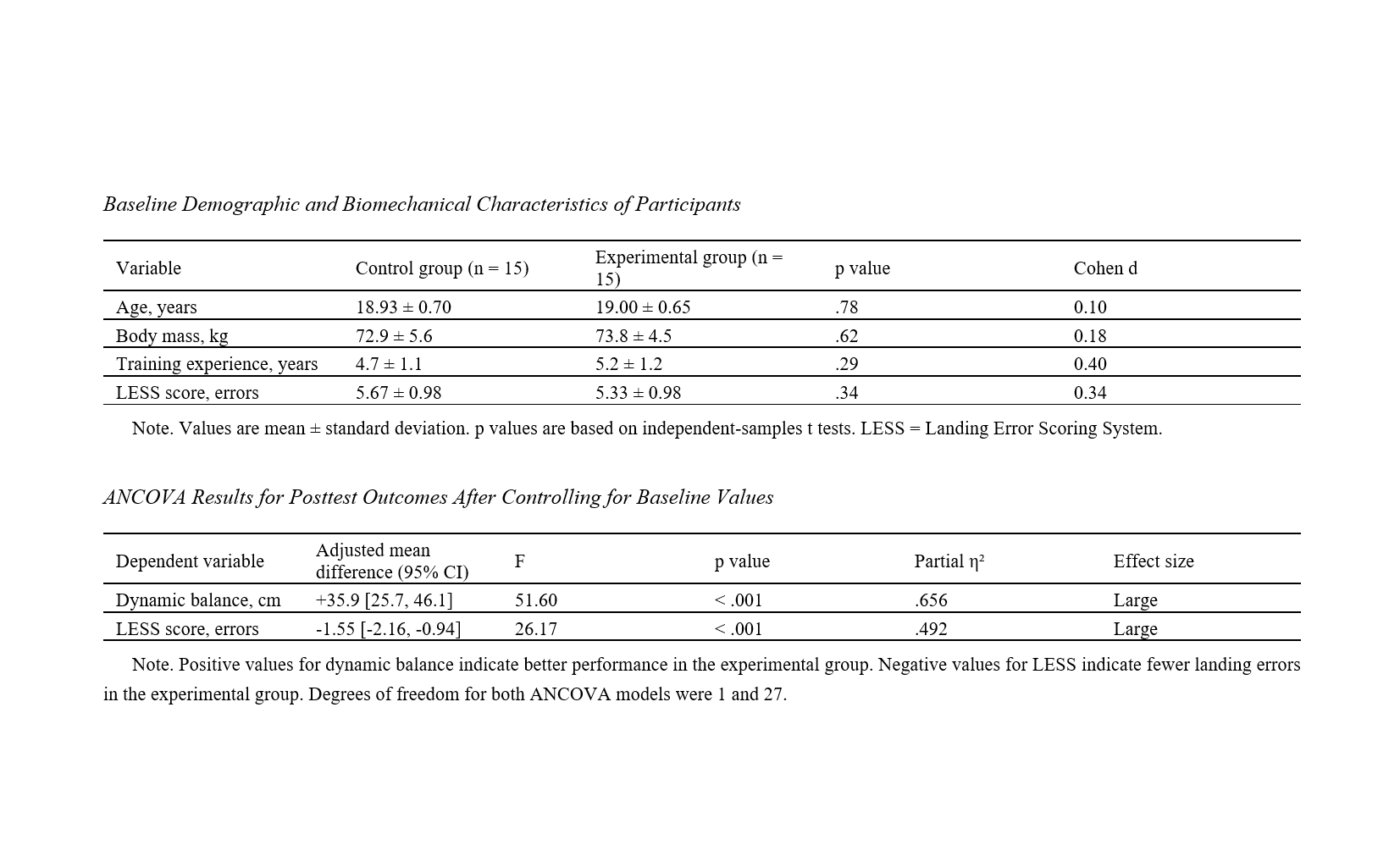
Football requires neuromuscular control, postural stability, flexibility, and safe jump-landing mechanics. Deficits in these components may impair performance and contribute to hazardous lower-limb movement patterns. This randomized controlled study examined the effects of eight weeks of integrated neuromuscular training on static and dynamic balance, flexibility, and landing errors in male football players aged 18–20 years. Methods: Thirty male football players were randomly allocated to an integrated neuromuscular training group or an active control group (n = 15 per group). The experimental group completed a progressive multicomponent program three times weekly for eight weeks, including balance, strength, plyometric, core-stability, landing-technique, and reactive-agility exercises. The control group continued usual football training. Dynamic balance, static balance, flexibility, and landing quality were assessed before and after the intervention. Analysis of covariance was used with baseline values entered as covariates. Results: After the intervention, the experimental group showed significantly greater improvements in static balance, dynamic balance, flexibility, and landing quality than the control group (p < .001). Large effects were observed for dynamic balance (partial η² = .656) and landing errors (partial η² = .492). The experimental group showed an adjusted 35.9-cm improvement in dynamic balance and a 1.55-error reduction in Landing Error Scoring System scores, corresponding to an approximate 27.6% reduction in landing errors. Exploratory mediation analysis suggested that improved dynamic balance statistically explained part of the reduction in landing errors. Conclusion: Eight weeks of integrated neuromuscular training improved postural control, flexibility, and landing mechanics in young male football players. The program may be used as a structured warm-up strategy in football settings, although larger trials with injury follow-up are required.
Downloads
References
1. Köklü Ö. Wearable Sensor Assessment Of Neuromuscular Latency: Revealing The Strength-Timing Trade-Off In Female Soccer. 2026.
2. Liang W, Hou Y, Liu C, Ma S, Zong Y, Yan X. Physiological And Physical Characteristics Of Bmx Freestyle Athletes: A Preliminary Review. Frontiers in Physiology. 2025;16. [PMID: 40917805] [PMCID: PMC12408523]
3. Ageberg E. Consequences Of A Ligament Injury On Neuromuscular Function And Relevance To Rehabilitation: Using The Anterior Cruciate Ligament-Injured Knee As A Model. Journal of Electromyography and Kinesiology. 2002;12(3):205-12. [PMID: 12086815]
4. Hewett TE, Myer GD, Ford KR, Heidt RS, Colosimo AJ, Mclean SG, et al. Biomechanical Measures Of Neuromuscular Control And Valgus Loading Of The Knee Predict Anterior Cruciate Ligament Injury Risk In Female Athletes. The American Journal of Sports Medicine. 2005;33(4):492-501. [PMID: 15722287]
5. Roos EM. Joint Injury Causes Knee Osteoarthritis In Young Adults. Current Opinion in Rheumatology. 2005;17(2):195-200. [PMID: 15711235]
6. Filipa A, Byrnes R, Paterno MV, Myer GD, Hewett TE. Neuromuscular Training Improves Performance On The Star Excursion Balance Test In Young Female Athletes. Journal of Orthopaedic & Sports Physical Therapy. 2010;40(9):551-8. [PMID: 20710094] [PMCID: PMC3439814]
7. Zech A, Klahn P, Hoeft J, Zu Eulenburg C, Steib S. Time Course And Dimensions Of Postural Control Changes Following Neuromuscular Training In Youth Field Hockey Athletes. European Journal of Applied Physiology. 2014;114(2):395-403. [PMID: 24318788]
8. Gidu DV, Badau D, Stoica M, Aron A, Focan G, Monea D, et al. The Effects Of Proprioceptive Training On Balance, Strength, Agility And Dribbling In Adolescent Male Soccer Players. International Journal of Environmental Research and Public Health. 2022;19(4):2028. [PMID: 35206215] [PMCID: PMC8871985]
9. Akbulut T, Agopyan A. Effects Of An Eight-Week Proprioceptive Neuromuscular Facilitation Stretching Program On Kicking Speed And Range Of Motion In Young Male Soccer Players. Journal of strength and conditioning research. 2015;29(12):3412-23. [PMID: 26020709]
10. Distefano LJ, Marshall SW, Padua DA, Peck KY, Beutler AI, De La Motte SJ, et al. The Effects Of An Injury Prevention Program On Landing Biomechanics Over Time. The American Journal of Sports Medicine. 2016;44(3):767-76. [PMID: 26792707] [PMCID: PMC9718103]
11. Pfile KR, Gribble PA, Buskirk GE, Meserth SM, Pietrosimone BG. Sustained Improvements In Dynamic Balance And Landing Mechanics After A 6-Week Neuromuscular Training Program In College Women'S Basketball Players. Journal of Sport Rehabilitation. 2016;25(3):233-40. [PMID: 26355913]
12. Myer GD, Faigenbaum AD, Chu DA, Falkel J, Ford KR, Best TM, et al. Integrative Training For Children And Adolescents: Techniques And Practices For Reducing Sports-Related Injuries And Enhancing Athletic Performance. The Physician and Sportsmedicine. 2011;39(1):74-84. [PMID: 21378489]
13. Fort-Vanmeerhaeghe A, Romero-Rodriguez D, Lloyd RS, Kushner A, Myer GD. Integrative Neuromuscular Training In Youth Athletes. Part Ii: Strategies To Prevent Injuries And Improve Performance. Strength and Conditioning Journal. 2016;38(4):9-27.
14. Emery CA, Roy TO, Whittaker JL, Nettel-Aguirre A, Van Mechelen W. Neuromuscular Training Injury Prevention Strategies In Youth Sport: A Systematic Review And Meta-Analysis. British Journal of Sports Medicine. 2015;49(13):865-70. [PMID: 26084526]
15. Noyes FR, Barber-Westin SD. Anterior Cruciate Ligament Injury Prevention Training In Female Athletes: A Systematic Review Of Injury Reduction And Results Of Athletic Performance Tests. Sports Health. 2012;4(1):36-46. [PMID: 23016067] [PMCID: PMC3435901]
16. Alentorn-Geli E, Myer GD, Silvers HJ, Samitier G, Romero D, Lázaro-Haro C, et al. Prevention Of Non-Contact Anterior Cruciate Ligament Injuries In Soccer Players. Part 2: A Review Of Prevention Programs Aimed To Modify Risk Factors And To Reduce Injury Rates. Knee Surgery, Sports Traumatology, Arthroscopy. 2009;17(8):859-79. [PMID: 19506834]
17. Sugimoto D, Myer GD, Bush HM, Hewett TE. Effects Of Compliance On Trunk And Hip Integrative Neuromuscular Training On Hip Abductor Strength In Female Athletes. Journal of strength and conditioning research. 2014;28(5):1187-94. [PMID: 24751656] [PMCID: PMC4170915]
18. De Sire A, Demeco A, Marotta N, Moggio L, Palumbo A, Iona T, et al. Anterior Cruciate Ligament Injury Prevention Exercises: Could A Neuromuscular Warm-Up Improve Muscle Pre-Activation Before A Soccer Game? A Proof-Of-Principle Study On Professional Football Players. Applied Sciences. 2021;11(11):4958.
19. Seyedi M, Zarei M, Daneshjoo A, Rajabi R, Shirzad E, Mozafaripour E, et al. Effects Of FIFA 11+ Warm-Up Program On Kinematics And Proprioception In Adolescent Soccer Players: A Parallel-Group Randomized Control Trial. Scientific Reports. 2023;13:5527. [PMID: 37016130] [PMCID: PMC10073194]
20. Panchal R, Rizvi MR, Sharma A, Ahmad F, Hasan S, Shaik AR, et al. Comparing The Effectiveness Of The FIFA 11+ Warm-Up And Conventional Warm-Up In Enhancing Cyclist Performance And Mitigating Injury Risk. Scientific Reports. 2025;15(1). [PMID: 40108222] [PMCID: PMC11923219]
21. Wan K, Dai Z-H, Ho RS, Tam BT. Comparing The Effects Of Integrative Neuromuscular Training And Traditional Physical Fitness Training On Physical Performance Outcomes In Young Athletes: A Systematic Review And Meta-Analysis. Sports Medicine - Open. 2025;11(1). [PMID: 39921710] [PMCID: PMC11807040]
22. Wang H, Zhang H, Li X, Zhu J. The Impact Of Transcranial Direct Current Stimulation On The Neuro-Muscular Control Strategies Of Penalty Kicks In Soccer Players. Frontiers in Sports and Active Living. 2025;7. [PMID: 40959533] [PMCID: PMC12433942]
23. Yılmaz O, Kaplan T, Baťalík L. Randomised Controlled Study On The Effects Of Pilates Exercises In Soccer: Comparing Mat And Reformer Methods On Physical And Technical Performance. Plos One. 2025;20(5):e0324129. [PMID: 40397911] [PMCID: PMC12094727]
24. Chmielewski TL, Myer GD, Kauffman D, Tillman SM. Plyometric Exercise In The Rehabilitation Of Athletes: Physiological Responses And Clinical Application. Journal of Orthopaedic & Sports Physical Therapy. 2006;36(5):308-19. [PMID: 16715831]
Downloads
Additional Files
Publication Timeline
- Submitted
- Revised
- Accepted