
Comparison of Electromyographic Activity Patterns of Gluteus Maximus, Biceps Femoris, and Tensor Fasciae Latae During Treadmill Walking in Individuals with Piriformis Syndrome
DOI:
https://doi.org/10.61838/Keywords:
Piriformis syndrome, surface electromyography, muscle activation, gaitAbstract
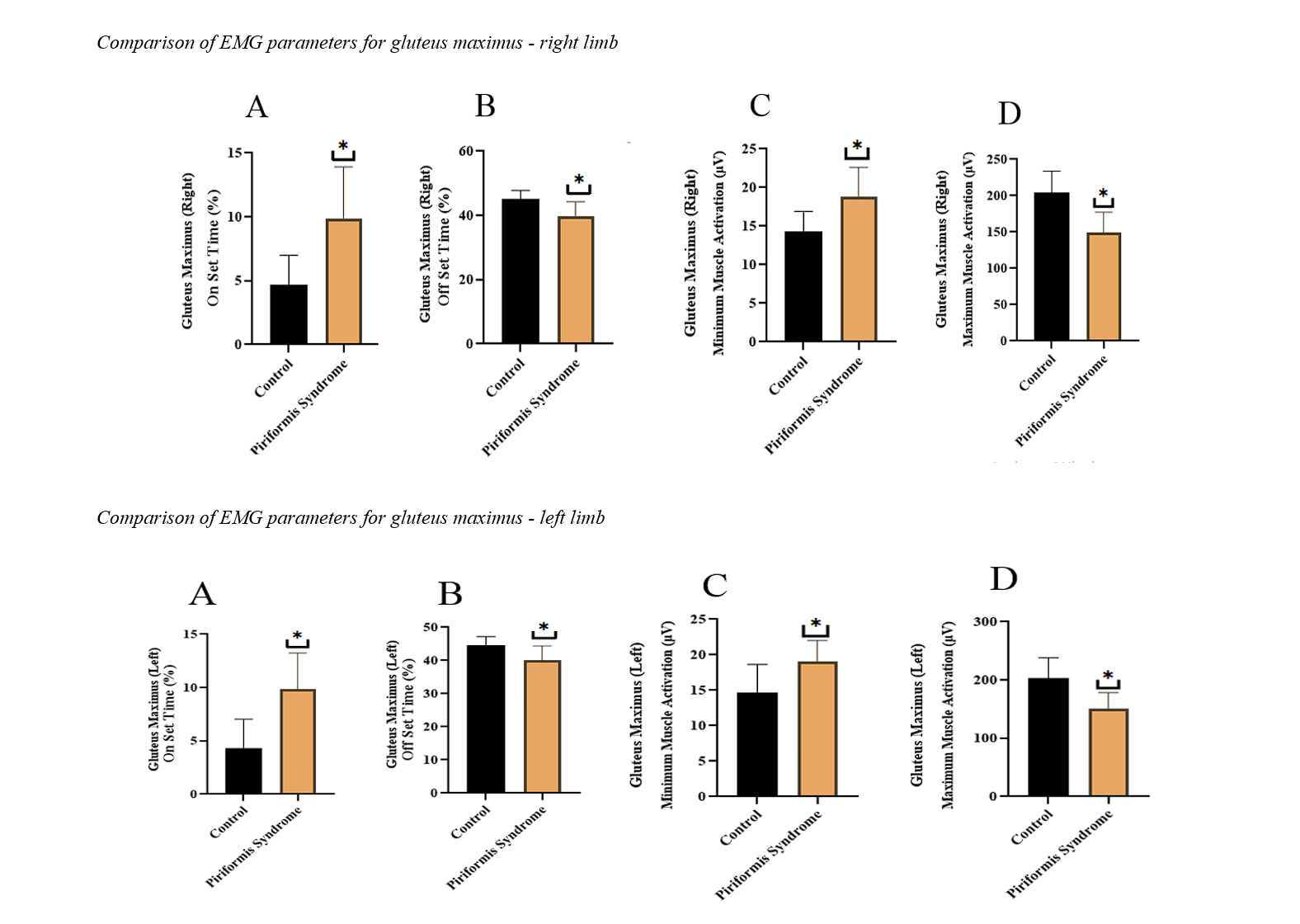
Piriformis syndrome is a common neuromuscular disorder characterized by gluteal pain and sciatic nerve irritation, which may alter gait patterns and lower-limb muscle activation. Understanding these alterations can help identify compensatory mechanisms and guide effective rehabilitation strategies. This study aimed to compare the electromyographic activity patterns of the gluteus maximus, biceps femoris, and tensor fasciae latae during treadmill walking in individuals with piriformis syndrome versus healthy controls. In this case-control study, 14 male participants (7 with piriformis syndrome and 7 healthy controls), aged 20–40 years with normal BMI, were recruited. Surface electromyography was recorded from the gluteus maximus, biceps femoris, and tensor fasciae latae of both lower limbs using the ME6000 system during treadmill walking at each participant's preferred speed. Signal processing included band-pass filtering (20–450 Hz), notch filtering at 50 Hz, full-wave rectification, and RMS envelope extraction. Activation onset, activation offset, minimum amplitude, and maximum amplitude were determined from three consecutive gait cycles. Independent t-tests were used for statistical analysis with a significance level of p < 0.05. The piriformis syndrome group showed delayed onset and earlier offset across all three muscles. The gluteus maximus demonstrated significantly higher minimum amplitude and lower maximum amplitude in both limbs (p < 0.05). The biceps femoris showed significant temporal alterations in both limbs, with reduced maximum amplitude only in the left limb (p = 0.018). The tensor fasciae latae demonstrated significant temporal alterations in both limbs, with increased minimum amplitude only in the right limb (p = 0.019). The findings suggest that individuals with piriformis syndrome demonstrate altered muscle activation timing and amplitude during gait. However, due to the cross-sectional case-control design, causal relationships and underlying neuromuscular mechanisms cannot be definitively established. Rehabilitation should incorporate neuromuscular control exercises to restore proper activation timing and coordination.
Downloads
References
1. Probst D, Stout A, Hunt D. Piriformis syndrome: a narrative review of the anatomy, diagnosis, and treatment. PM&R. 2019;11:S54-S63.
2. Jawish RM, Assoum HA, Khamis CF. Anatomical, clinical and electrical observations in piriformis syndrome. Journal of Orthopaedic Surgery and Research. 2010;5(1):3.
3. Michel F, Decavel P, Toussirot E, Tatu L, Aleton E, Monnier G. The piriformis muscle syndrome: an exploration of anatomical context, pathophysiological hypotheses and diagnostic criteria. Annals of Physical and Rehabilitation Medicine. 2013;56(4):300-11.
4. Cassidy L, Walters A, Bubb K, Shoja MM, Shane Tubbs R, Loukas M. Piriformis syndrome: implications of anatomical variations, diagnostic techniques, and treatment options. Surgical and Radiologic Anatomy. 2012;34(6):479-86.
5. Lewis S, Jurak J, Lee C, Lewis R, Gest T. Anatomical variations of the sciatic nerve, in relation to the piriformis muscle. Translational Research in Anatomy. 2016;5:15-9.
6. Alrabai HM, Alrashidi Y, AlEtebi RAA, Mufti TMA, Alali MYA, Alnazhan ASA. Piriformis Syndrome Is Often Overlooked as a Cause of Gluteal Pain and Sciatica: Diagnostic Challenges and the Role of Imaging—A Narrative Review. HSS Journal®. 2026;22(2):192-6.
7. Jankovic D, Peng P, van Zundert A. Brief review: piriformis syndrome: etiology, diagnosis, and management. Canadian Journal of Anesthesia/Journal canadien d'anesthésie. 2013;60(10):1003-12.
8. Morimoto Y, Oshikawa T, Imai A, Okubo Y, Kaneoka K. Piriformis electromyography activity during prone and side-lying hip joint movement. Journal of Physical Therapy Science. 2018;30(1):154-8.
9. Neal C, Gelatt T, Toma M. Prevalence and Clinical Patterns of Piriformis Syndrome Among Actively Competing and Retired Elite Hockey Players. Sports. 2026;14(3):95.
10. Barzak B, Hankus K, Mielczarek A, Wozniak S. The piriformis muscle syndrome–anatomy, diagnosis and the role of physiotherapy. A Review. Medical Journal of Cell Biology. 2023;11(2):39-43.
11. Chang C, Jeno SH, Varacallo MA. Anatomy, bony pelvis and lower limb: piriformis muscle: StatPearls Publishing; 2023.
12. Carro LP, Hernando MF, Cerezal L, Navarro IS, Fernandez AA, Castillo AO. Deep gluteal space problems: piriformis syndrome, ischiofemoral impingement and sciatic nerve release. Muscles, Ligaments and Tendons Journal. 2016;6(3):384.
13. Othman IK, Raj NB, Siew Kuan C, Sidek S, Wong LS, Djearamane S. Association of piriformis thickness, hip muscle strength, and low back pain patients with and without piriformis syndrome in Malaysia. Life. 2023;13(5):1208.
14. Hodges PW, McLean L, Hodder J. Insight into the function of the obturator internus muscle in humans: observations with development and validation of an electromyography recording technique. Journal of Electromyography and Kinesiology. 2014;24(4):489-96.
15. Lencioni T, Carpinella I, Rabuffetti M, Marzegan A, Ferrarin M. Human kinematic, kinetic and EMG data during different walking and stair ascending and descending tasks. Scientific Data. 2019;6(1):309.
16. Diamond LE, van den Hoorn W, Bennell KL, Wrigley TV, Hinman RS, O'Donnell J. Deep hip muscle activation during squatting in femoroacetabular impingement syndrome. Clinical Biomechanics. 2019;69:141-7.
17. Selkowitz DM, Beneck GJ, Powers CM. Comparison of electromyographic activity of the superior and inferior portions of the gluteus maximus muscle during common therapeutic exercises. Journal of Orthopaedic & Sports Physical Therapy. 2016;46(9):794-9.
18. Elzanie A, Borger J. Anatomy, bony pelvis and lower limb, gluteus maximus muscle: StatPearls Publishing; 2023.
19. Flack NAMS, Nicholson HD, Woodley SJ. A review of the anatomy of the hip abductor muscles, gluteus medius, gluteus minimus, and tensor fascia lata. Clinical Anatomy. 2012;25(6):697-708.
20. Rodgers CD, Raja A. Anatomy, bony pelvis and lower limb, hamstring muscle2019.
21. Timmins R, Woodley S, Shield A, Opar D. Anatomy of the Hamstrings. Prevention and Rehabilitation of Hamstring Injuries: Springer; 2020. p. 1-30.
22. Agur AM, Dalley AF. Moore's essential clinical anatomy: Lippincott Williams & Wilkins; 2018.
23. Neumann DA. Kinesiology of the musculoskeletal system: foundations for rehabilitation: Mosby Elsevier; 2010.
24. Aali S, Rezazadeh F, Sheykhalizadeh H, Qasemi M, Akman O, Badicu G. Frequency spectrum analysis of ground reaction forces during running in individuals with piriformis syndrome following an eight-week neuromuscular training program. Journal of Men's Health. 2026;22(2).
25. Jaiswal V, Sedhunivas R, Nikhilesh A. A Literature Review of Effectiveness of Dynamic Stretching versus MET on Pain and Flexibility in Piriformis Syndrome. Scientific Hub of Applied Research in Emerging Medical science & technology. 2026;5(2):399-407.
26. van Dieën JH, Selen LP, Cholewicki J. Trunk muscle activation in low-back pain patients, an analysis of the literature. Journal of Electromyography and Kinesiology. 2003;13(4):333-51.
27. Bishop BN, Greenstein J, Etnoyer‐Slaski JL, Sterling H, Topp R. Electromyographic analysis of gluteus maximus, gluteus medius, and tensor fascia latae during therapeutic exercises with and without elastic resistance. International Journal of Sports Physical Therapy. 2018;13(4):668.
28. Khushaba RN, Kodagoda S, Takruri M, Dissanayake G. Toward improved control of prosthetic fingers using surface electromyogram (EMG) signals. Expert Systems with Applications. 2012;39(12):10731-8.
29. Garland SJ, Gray VL, Knorr S. Muscle activation patterns and postural control following stroke. Motor Control. 2009;13(4):387-411.
30. Diamond LE, Van den Hoorn W, Bennell KL, Wrigley TV, Hinman RS, O'Donnell J. Coordination of deep hip muscle activity is altered in symptomatic femoroacetabular impingement. Journal of Orthopaedic Research. 2017;35(7):1494-504.
31. Andriacchi T, Andersson G, Örtengren R, Mikosz R. A study of factors influencing muscle activity about the knee joint. Journal of Orthopaedic Research. 1983;1(3):266-75.
32. Stokes IA, Gardner-Morse MG, Henry SM. Abdominal muscle activation increases lumbar spinal stability: analysis of contributions of different muscle groups. Clinical Biomechanics. 2011;26(8):797-803.
33. Mannion AF, Taimela S, Müntener M, Dvorak J. Active therapy for chronic low back pain: part 1. Effects on back muscle activation, fatigability, and strength. Spine. 2001;26(8):897-908.
34. Van der Made A, Wieldraaijer T, Kerkhoffs G, Kleipool R, Engebretsen L, Van Dijk C. The hamstring muscle complex. Knee Surgery, Sports Traumatology, Arthroscopy. 2015;23(7):2115-22.
35. Leung FT, Mendis MD, Stanton WR, Hides JA. The relationship between the piriformis muscle, low back pain, lower limb injuries and motor control training among elite football players. Journal of Science and Medicine in Sport. 2015;18(4):407-11.
36. Fatahi M, Minoonejad H, Alizadeh MH. The relationship between proximal and distal lower limb muscle activities with time to stabilization. Journal of Research in Rehabilitation Sciences. 2013;9(2):232-42.
37. Shayesteh M, Farahpour N, Jafarnezhadgero A. Comparisons of The Effects of Squat and Leg Press Exercises on The EMG Activity of Quadriceps Femoris Muscles During Step Descending Activity. Journal of Applied Exercise Physiology. 2019;15(29):143-54.
Downloads
Additional Files
Publication Timeline
- Submitted
- Revised
- Accepted