The Effectiveness of Trauma-Focused Mentalization-Based Group Therapy on Psychological Distress and Cognitive Errors in Women with War Experience
DOI:
https://doi.org/10.61838/Keywords:
trauma-focused mentalization-based therapy; group therapy; psychological distress; cognitive errors; women; war experience.Abstract
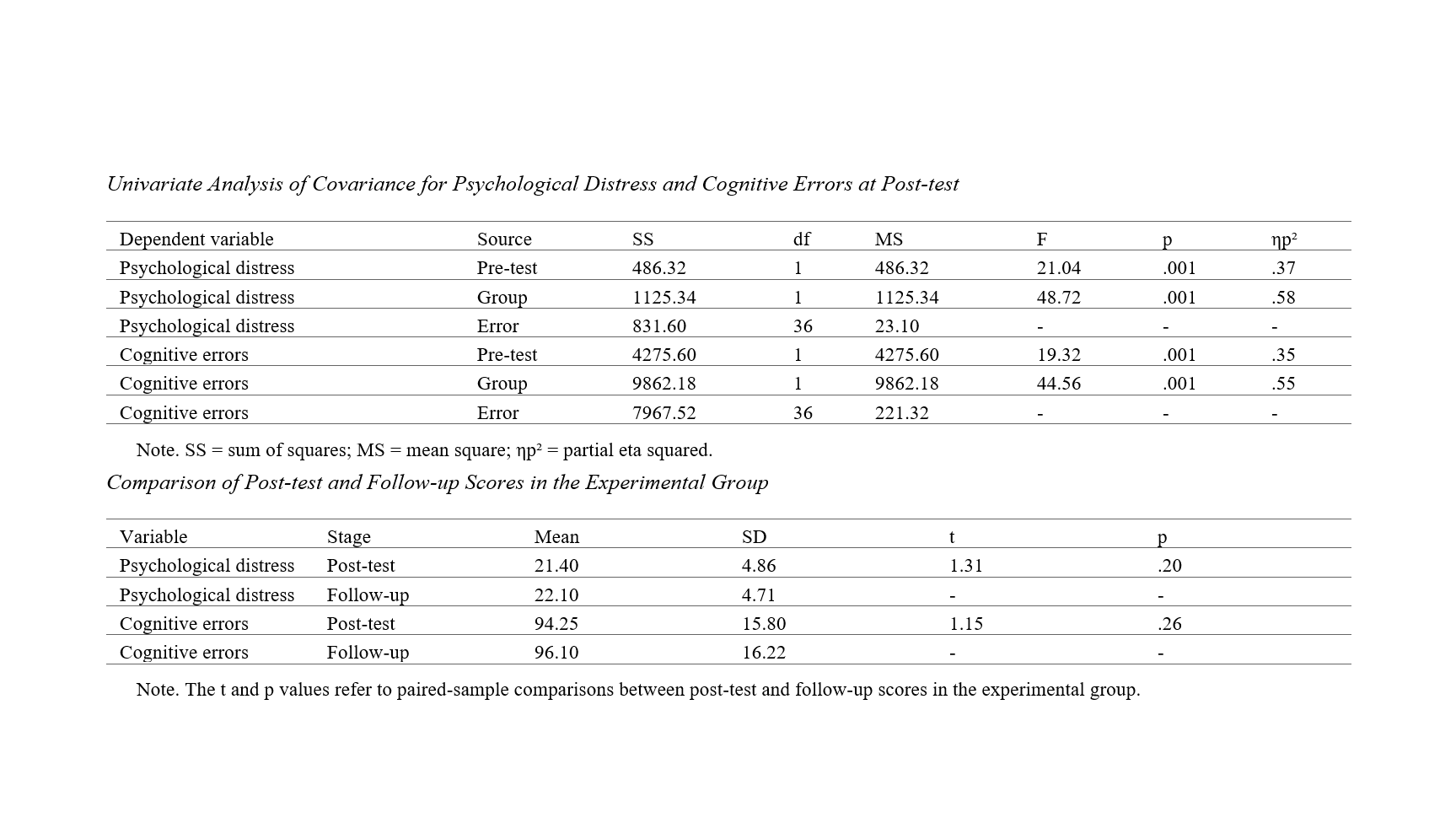
War-related experiences can create persistent psychological consequences for women, including elevated psychological distress and maladaptive cognitive processing. The present study examined the effectiveness of trauma-focused mentalization-based group therapy in reducing psychological distress and cognitive errors among women with war experience. This applied quasi-experimental study used a pre-test-post-test design with a control group and a follow-up phase. The sample consisted of 40 eligible women with war experience in Tabriz who were selected through purposive sampling and randomly assigned to an experimental group and a control group, with 20 participants in each group. The experimental group received trauma-focused mentalization-based group therapy in ten weekly 90-minute sessions, whereas the control group received no intervention. Psychological distress was measured using the Kessler Psychological Distress Scale, and cognitive errors were measured using the Cognitive Errors Questionnaire. Data were analyzed using multivariate analysis of covariance, univariate analysis of covariance, and paired-sample t-tests. Psychological distress in the experimental group decreased from 32.85 +/- 5.21 at pre-test to 21.40 +/- 4.86 at post-test and remained stable at follow-up (22.10 +/- 4.71). Cognitive errors decreased from 131.60 +/- 18.35 at pre-test to 94.25 +/- 15.80 at post-test and remained stable at follow-up (96.10 +/- 16.22). The multivariate effect of group was significant, Wilks Lambda = 0.43, F(2, 35) = 23.49, p = .001, partial eta squared = .57. Univariate analyses also showed significant group effects for psychological distress, F(1, 36) = 48.72, p = .001, partial eta squared = .58, and cognitive errors, F(1, 36) = 44.56, p = .001, partial eta squared = .55. Post-test-follow-up differences in the experimental group were not significant for psychological distress, t = 1.31, p = .20, or cognitive errors, t = 1.15, p = .26. Trauma-focused mentalization-based group therapy was effective in reducing psychological distress and cognitive errors among women with war experience, and the treatment effects were maintained at follow-up.
Downloads
References
Andrews, G., & Slade, T. (2001). Interpreting scores on the Kessler Psychological Distress Scale (K10). Australian and New Zealand Journal of Public Health, 25(6), 494-497. https://doi.org/10.1111/j.1467-842X.2001.tb00310.x
Bateman, A., & Fonagy, P. (2008). 8-Year follow-up of patients treated for borderline personality disorder: Mentalization-based treatment versus treatment as usual. American Journal of Psychiatry, 165(5), 631-638. https://doi.org/10.1176/appi.ajp.2007.07040636
Bateman, A., & Fonagy, P. (2009). Randomized controlled trial of outpatient mentalization-based treatment versus structured clinical management for borderline personality disorder. American Journal of Psychiatry, 166(12), 1355-1364. https://doi.org/10.1176/appi.ajp.2009.09040539
Brewin, C. R., Andrews, B., & Valentine, J. D. (2000). Meta-analysis of risk factors for posttraumatic stress disorder in trauma-exposed adults. Journal of Consulting and Clinical Psychology, 68(5), 748-766. https://doi.org/10.1037/0022-006X.68.5.748
Bryant, R. A., Schafer, A., Dawson, K. S., Anjuri, D., Mulili, C., Ndogoni, L., Koyiet, P., Sijbrandij, M., Ulate, J., Harper Shehadeh, M., Hadzi-Pavlovic, D., & van Ommeren, M. (2017). Effect of a brief behavioral intervention on psychological distress among women with a history of gender-based violence in urban Kenya: A randomized clinical trial. PLOS Medicine, 14(8), e1002371. https://doi.org/10.1371/journal.pmed.1002371
Charlson, F., van Ommeren, M., Flaxman, A., Cornett, J., Whiteford, H., & Saxena, S. (2019). New WHO prevalence estimates of mental disorders in conflict settings: A systematic review and meta-analysis. The Lancet, 394(10194), 240-248. https://doi.org/10.1016/S0140-6736(19)30934-1
Choi-Kain, L. W., & Gunderson, J. G. (2008). Mentalization: Ontogeny, assessment, and application in the treatment of borderline personality disorder. American Journal of Psychiatry, 165(9), 1127-1135. https://doi.org/10.1176/appi.ajp.2008.07081360
Covin, R., Dozois, D. J. A., Ogniewicz, A., & Seeds, P. M. (2011). Measuring cognitive errors: Initial development of the Cognitive Distortions Scale (CDS). International Journal of Cognitive Therapy, 4(3), 297-322. https://doi.org/10.1521/ijct.2011.4.3.297
Ehlers, A., & Clark, D. M. (2000). A cognitive model of posttraumatic stress disorder. Behaviour Research and Therapy, 38(4), 319-345. https://doi.org/10.1016/S0005-7967(99)00123-0
Hoppen, T. H., & Morina, N. (2019). The prevalence of PTSD and major depression in the global population of adult war survivors: A meta-analytically informed estimate in absolute numbers. European Journal of Psychotraumatology, 10(1), 1578637. https://doi.org/10.1080/20008198.2019.1578637
Kessler, R. C., Andrews, G., Colpe, L. J., Hiripi, E., Mroczek, D. K., Normand, S. L. T., Walters, E. E., & Zaslavsky, A. M. (2002). Short screening scales to monitor population prevalences and trends in non-specific psychological distress. Psychological Medicine, 32(6), 959-976. https://doi.org/10.1017/S0033291702006074
Lefebvre, M. F. (1981). Cognitive distortion and cognitive errors in depressed psychiatric and low back pain patients. Journal of Consulting and Clinical Psychology, 49(4), 517-525. https://doi.org/10.1037/0022-006X.49.4.517
Luyten, P., Campbell, C., Allison, E., & Fonagy, P. (2020). The mentalizing approach to psychopathology: State of the art and future directions. Annual Review of Clinical Psychology, 16, 297-325. https://doi.org/10.1146/annurev-clinpsy-071919-015355
Neuner, F., Schauer, M., Klaschik, C., Karunakara, U., & Elbert, T. (2004). A comparison of narrative exposure therapy, supportive counseling, and psychoeducation for treating posttraumatic stress disorder in African refugees. Journal of Consulting and Clinical Psychology, 72(4), 579-587. https://doi.org/10.1037/0022-006X.72.4.579
Rahman, A., Hamdani, S. U., Awan, N. R., Bryant, R. A., Dawson, K. S., Khan, M. F., Azeemi, M. M., Akhtar, P., Nazir, H., Chiumento, A., Sijbrandij, M., Wang, D., Farooq, S., & van Ommeren, M. (2016). Effect of a multicomponent behavioral intervention in adults impaired by psychological distress in a conflict-affected area of Pakistan: A randomized clinical trial. JAMA, 316(24), 2609-2617. https://doi.org/10.1001/jama.2016.17165
Rnic, K., Dozois, D. J. A., & Martin, R. A. (2016). Cognitive distortions, humor styles, and depression. Europe’s Journal of Psychology, 12(3), 348-362. https://doi.org/10.5964/ejop.v12i3.1118
Tol, W. A., Barbui, C., Galappatti, A., Silove, D., Betancourt, T. S., Souza, R., Golaz, A., & van Ommeren, M. (2011). Mental health and psychosocial support in humanitarian settings: Linking practice and research. The Lancet, 378(9802), 1581-1591. https://doi.org/10.1016/S0140-6736(11)61094-5
Turrini, G., Purgato, M., Ballette, F., Nosè, M., Ostuzzi, G., & Barbui, C. (2017). Common mental disorders in asylum seekers and refugees: Umbrella review of prevalence and intervention studies. International Journal of Mental Health Systems, 11, 51. https://doi.org/10.1186/s13033-017-0156-0
Downloads
Additional Files
Publication Timeline
- Submitted
- Revised
- Accepted