A Comparison of the Effectiveness of Cognitive-Behavioral Therapy and Acceptance and Commitment Therapy on Emotional Forgiveness and Positive Feelings in Discordant Couples Referred to Psychological Counseling Centers in East Tehran
Keywords:
cognitive-behavioral therapy, acceptance and commitment therapy, forgiveness, positive feelings toward spouse, distressed couples, couple counselingAbstract
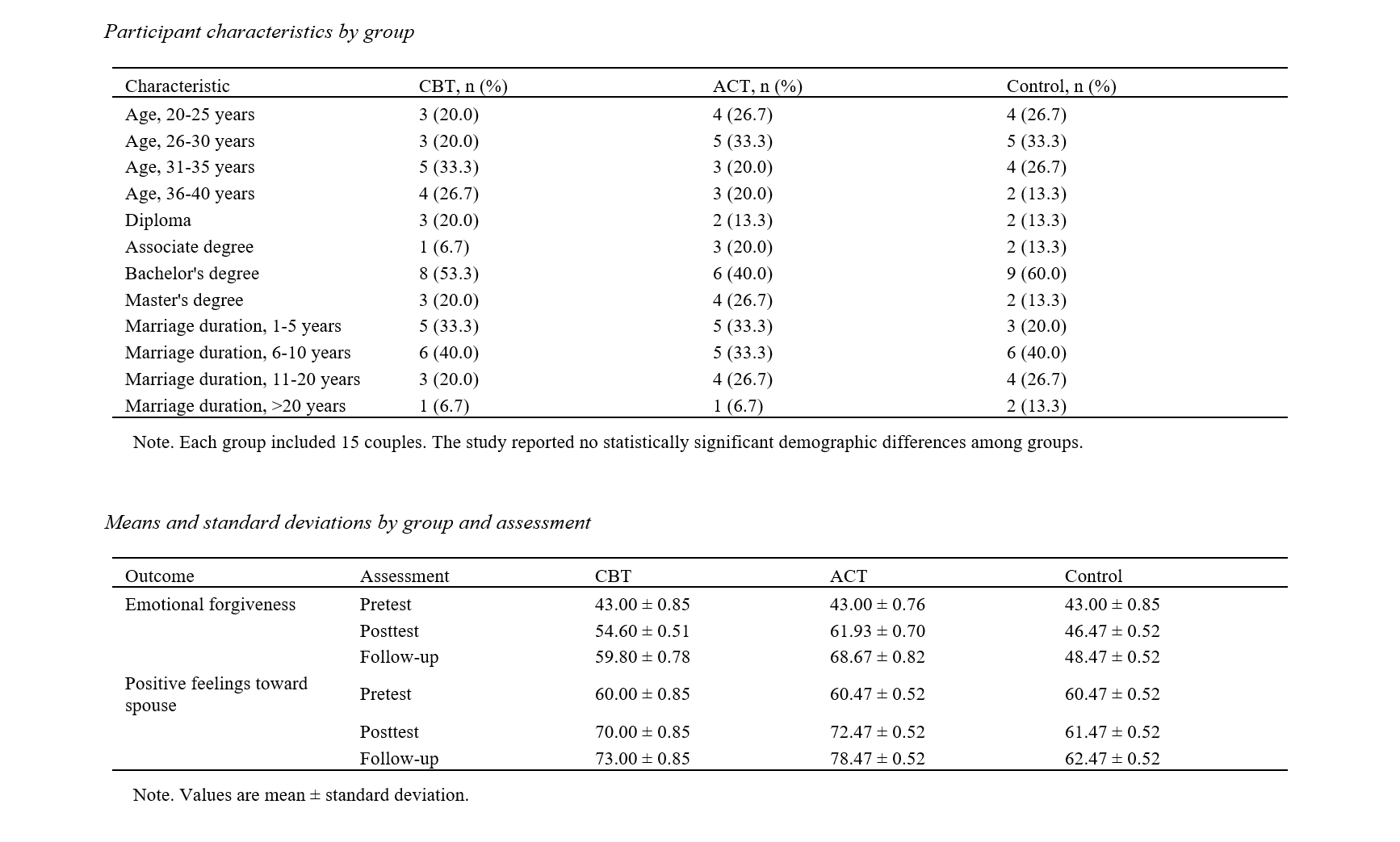
Persistent marital conflict may reduce forgiveness and positive affect toward the spouse. Cognitive-behavioral therapy (CBT) and acceptance and commitment therapy (ACT) target different processes that may improve distressed relationships. This study compared the effects of CBT and ACT on emotional forgiveness and positive feelings toward the spouse among distressed couples attending psychological counseling centers in East Tehran. A quasi-experimental pretest-posttest-follow-up design with two intervention groups and one no-treatment control group was used. From 80 eligible couples, 45 couples were selected using a random-number table and randomly allocated to CBT, ACT, or control groups (15 couples per group). The intervention groups received eight 90-minute sessions. Outcomes were assessed using the 15-item Rye Forgiveness Scale and the 17-item Positive Feelings Questionnaire. Repeated-measures analysis of variance was used to examine time, group, and time-by-group effects. Significant time, group, and time-by-group effects were reported for forgiveness and positive feelings toward the spouse (all p < .001). Both intervention groups improved relative to baseline, whereas the control group changed only modestly. The descriptive means were higher in the ACT group than in the CBT group at posttest and follow-up; however, direct adjusted CBT-versus-ACT contrasts were not reported. Both CBT and ACT were associated with improved emotional forgiveness and positive feelings toward the spouse. The available results do not establish the superiority of either intervention. Larger dyadic trials with complete treatment contrasts, fidelity assessment, and clearly specified follow-up intervals are required.
Downloads
References
Basirat, S. S., Yaghoubnejad, M. S., & Basirt, M. (2026). The effectiveness of emotionally focused couple therapy on marital commitment, marital intimacy, and marital forgiveness among couples affected by extramarital relationships: A quasi-experimental study. Health Nexus, 4(2), 1-8. https://doi.org/10.61838/kman.hn.5328
Baucom, D. H., & Fischer, M. S. (2019). Cognitive behavioral couple therapy. In J. L. Lebow, A. L. Chambers, & D. C. Breunlin (Eds.), Encyclopedia of couple and family therapy (pp. 489-497). Springer. https://doi.org/10.1007/978-3-319-49425-8_106
Christensen, A., Atkins, D. C., Baucom, B., & Yi, J. (2010). Marital status and satisfaction five years following a randomized clinical trial comparing traditional versus integrative behavioral couple therapy. Journal of Consulting and Clinical Psychology, 78(2), 225-235. https://doi.org/10.1037/a0018132
Fischer, M. S., Baucom, D. H., & Cohen, M. J. (2016). Cognitive-behavioral couple therapies: Review of the evidence for the treatment of relationship distress, psychopathology, and chronic health conditions. Family Process, 55(3), 423-442. https://doi.org/10.1111/famp.12227
Haji Abbasi, A., Karbalai Herofteh, F., & Sanagouye Moharer, G. (2026). Comparison of the effectiveness of acceptance and commitment-based couple therapy and cognitive-behavioral couple therapy on cognitive distortions, emotion regulation, and emotional intimacy in couples experiencing marital disenchantment. Applied Family Therapy Journal, 7(2), 1-16. https://doi.org/10.61838/kman.aftj.5039
Hayes, S. C., & King, G. A. (2024). Acceptance and commitment therapy: What the history of ACT and the first 1,000 randomized controlled trials reveal. Journal of Contextual Behavioral Science, 33, 100809. https://doi.org/10.1016/j.jcbs.2024.100809
Kenny, D. A., Kashy, D. A., & Cook, W. L. (2006). Dyadic data analysis. Guilford Press.
Lebow, J., & Snyder, D. K. (2022). Couple therapy in the 2020s: Current status and emerging developments. Family Process, 61(4), 1359-1385. https://doi.org/10.1111/famp.12824
Beck, J. S. (2020). Cognitive behavior therapy: Basics and beyond (3rd ed.). Guilford Press.
Durães, R. S. S., Khafif, T. C., Lotufo-Neto, F., & Serafim, A. P. (2020). Effectiveness of cognitive behavioral couple therapy on reducing depression and anxiety symptoms and increasing dyadic adjustment and marital social skills: An exploratory study. The Family Journal, 28(2), 148-158. https://doi.org/10.1177/1066480720902410
Fincham, F. D., & Beach, S. R. H. (2010). Marriage in the new millennium: A decade in review. Journal of Marriage and Family, 72(3), 630-649. https://doi.org/10.1111/j.1741-3737.2010.00722.x
Gordon, K. C., Baucom, D. H., & Snyder, D. K. (2004). An integrative intervention for promoting recovery from extramarital affairs. Journal of Marital and Family Therapy, 30(2), 213-231. https://doi.org/10.1111/j.1752-0606.2004.tb01235.x
Hayes, S. C., Luoma, J. B., Bond, F. W., Masuda, A., & Lillis, J. (2006). Acceptance and commitment therapy: Model, processes and outcomes. Behaviour Research and Therapy, 44(1), 1-25. https://doi.org/10.1016/j.brat.2005.06.006
Hayes, S. C., Strosahl, K. D., & Wilson, K. G. (2016). Acceptance and commitment therapy: The process and practice of mindful change (2nd ed.). Guilford Press.
O'Leary, K. D., Fincham, F., & Turkewitz, H. (1983). Assessment of positive feelings toward spouse. Journal of Consulting and Clinical Psychology, 51(6), 949-951. https://doi.org/10.1037/0022-006X.51.6.949
Rye, M. S., Loiacono, D. M., Folck, C. D., Olszewski, B. T., Heim, T. A., & Madia, B. P. (2001). Evaluation of the psychometric properties of two forgiveness scales. Current Psychology, 20(3), 260-277. https://doi.org/10.1007/s12144-001-1011-6
Wu, Q., Chi, P., Lin, X., Du, H., Zhou, N., & Cao, H. (2022). Gratitude and satisfaction in romantic relationships: Roles of decisional forgiveness and emotional forgiveness. Current Psychology, 41, 2668-2676. https://doi.org/10.1007/s12144-020-00780-7
Downloads
Publication Timeline
- Submitted
- Revised
- Accepted