The Role of Psychological Flexibility in the Relationship Between Positive Childhood Experiences and Suicidal Ideation
Keywords:
positive childhood experiences, psychological flexibility, suicidal ideation, indirect association, adultsAbstract
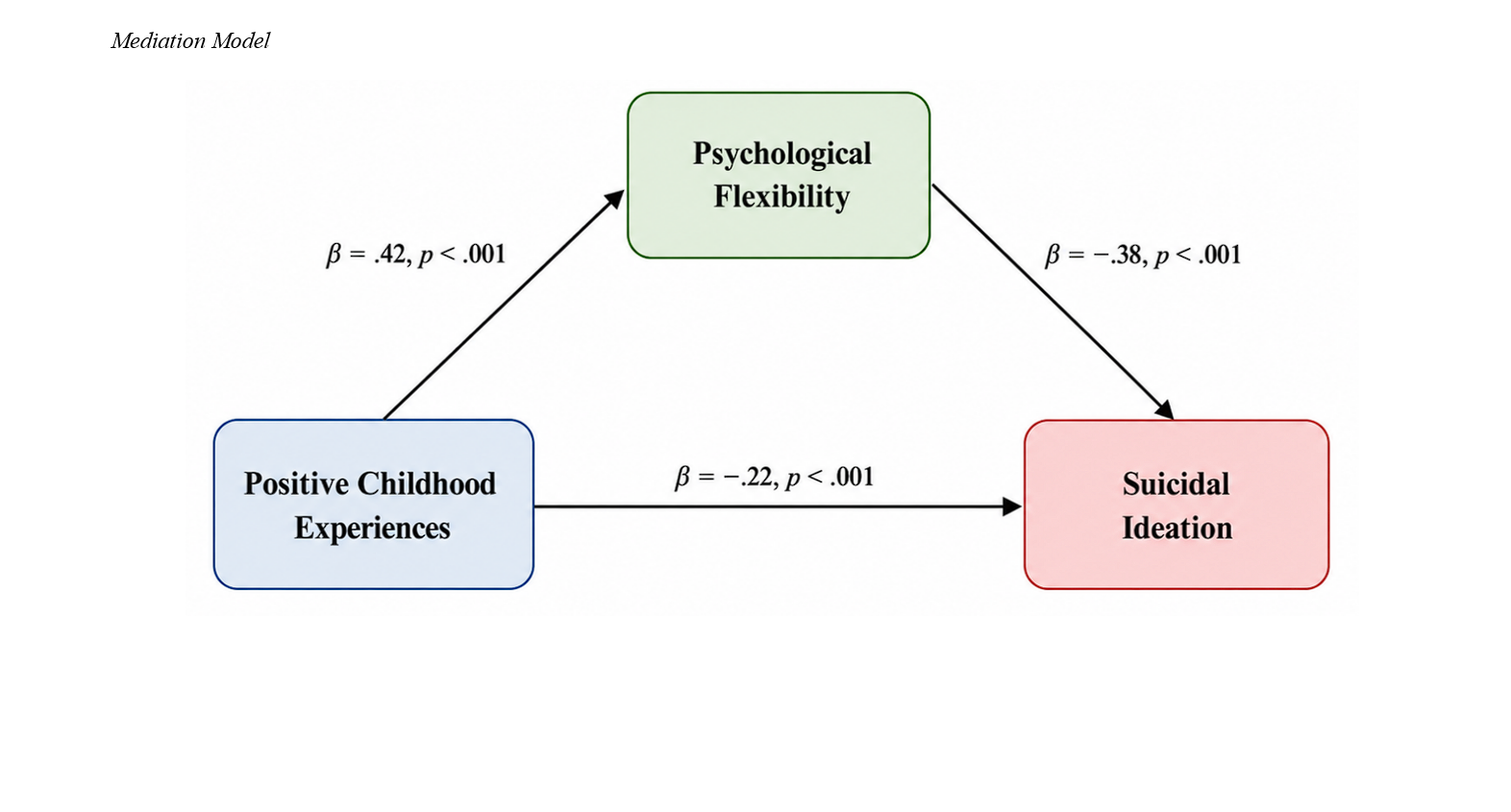
This study examined the role of psychological flexibility in the relationship between positive childhood experiences and suicidal ideation among Iranian adults. The study used a descriptive-correlational design and included 286 participants aged 20 to 40 years who were recruited through online convenience sampling. Data were collected using the Beck Scale for Suicide Ideation, developed by Beck et al. (1979), the Benevolent Childhood Experiences Scale, developed by Narayan et al. (2018), and the Psychological Flexibility Questionnaire, developed by Ben-Itzhak et al. (2014). Data were analyzed using Pearson correlation and structural equation modeling. Positive childhood experiences were positively associated with psychological flexibility (r = .42, p < .001) and negatively associated with suicidal ideation (r = −.38, p < .001). Psychological flexibility was also negatively associated with suicidal ideation (r = −.47, p < .001). The proposed mediation model showed an adequate fit to the data (χ²/df = 2.13, GFI = .93, CFI = .96, IFI = .96, NFI = .94, RMSEA = .063). Positive childhood experiences had a significant positive effect on psychological flexibility (β = .42, p < .001), whereas psychological flexibility had a significant negative effect on suicidal ideation (β = −.38, p < .001). The indirect effect of positive childhood experiences on suicidal ideation through psychological flexibility was also significant (β = −.16, 95% CI [−.23, −.10]), supporting a partial mediating role of psychological flexibility. These findings suggest that positive childhood experiences may be associated with lower suicidal ideation both directly and indirectly through greater psychological flexibility. Psychological flexibility may therefore represent an important protective mechanism in understanding and preventing suicidal ideation.
Downloads
References
Akbulut, Ö. F. (2025). Positive childhood experiences, suicide cognitions, subjective happiness, and mental well-being in young adults: A half-longitudinal serial mediation study. Psychiatric Quarterly. Advance online publication. https://doi.org/10.1007/s11126-025-10162-6
Amraei, A., Mirzai, F., Pooyanfard, R., Fayazmanesh, H., Babakhani, D., & Jaberghaderi, N. (2025). The relationship between suicidal ideation and psychological distress in medical students: A descriptive-analytical study. Journal of Injury and Violence Research, 17(2), 195–203.
Angelakis, I., & Gooding, P. (2021). Experiential avoidance in non-suicidal self-injury and suicide experiences: A systematic review and meta-analysis. Suicide and Life-Threatening Behavior, 51(5), 978–992. https://doi.org/10.1111/sltb.12784
Beck, A. T., Kovacs, M., & Weissman, A. (1979). Assessment of suicidal intention: The Scale for Suicide Ideation. Journal of Consulting and Clinical Psychology, 47(2), 343-352. https://doi.org/10.1037/0022-006X.47.2.343
Beck, A. T., Steer, R. A., & Ranieri, W. F. (1988). Scale for Suicide Ideation: Psychometric properties of a self-report version. Journal of Clinical Psychology, 44(4), 499-505. https://doi.org/10.1002/1097-4679(198807)44:4<499::AID-JCLP2270440404>3.0.CO;2-6
Ben-Itzhak, S., Bluvstein, I., & Maor, M. (2014). The Psychological Flexibility Questionnaire (PFQ): Development, reliability and validity. WebMedCentral Psychology, 5(4), WMC004606. https://doi.org/10.9754/journal.wmc.2014.004606
Bethell, C., Jones, J., Gombojav, N., Linkenbach, J., & Sege, R. (2019). Positive childhood experiences and adult mental and relational health in a statewide sample: Associations across adverse childhood experiences levels. JAMA Pediatrics, 173(11), e193007. https://doi.org/10.1001/jamapediatrics.2019.3007
Bryan, C. J., Ray-Sannerud, B., & Heron, E. A. (2015). Psychological flexibility as a dimension of resilience for posttraumatic stress, depression, and risk for suicidal ideation among Air Force personnel. Journal of Contextual Behavioral Science, 4(4), 263–268. https://doi.org/10.1016/j.jcbs.2015.10.002
Bunting, L., McCartan, C., Davidson, G., Grant, A., Mulholland, C., Schubotz, D., Hamill, R., McBride, O., Murphy, J., Nolan, E., & Shevlin, M. (2023). The influence of adverse and positive childhood experiences on young people’s mental health and experiences of self-harm and suicidal ideation. Child Abuse & Neglect, 140, 106159. https://doi.org/10.1016/j.chiabu.2023.106159
Davies, R., Price Tate, R., & Taverner, N. V. (2024). What next for “counseling” in genetic counseling training: A reflection on how CBT and ACT approaches can contribute to the genetic counseling toolkit. Journal of Genetic Counseling, 33(1), 129–134. https://doi.org/10.1002/jgc4.1873
del Carpio, L., Paul, S., Paterson, A., & Rasmussen, S. (2021). A systematic review of controlled studies of suicidal and self-harming behaviours in adolescents following bereavement by suicide. PLOS ONE, 16(7), Article e0254203. https://doi.org/10.1371/journal.pone.0254203
Eghdami, Z., & Fouladchang, M. (2022). Predicting suicidal thoughts based on parental psychological control: The mediating role of mindfulness. Journal of Psychology, 26(1), 1-11. http://iranapsy.ir/en/Article/22281
Han, D., Dieujuste, N., Doom, J. R., & Narayan, A. J. (2023). A systematic review of positive childhood experiences and adult outcomes: Promotive and protective processes for resilience in the context of childhood adversity. Child Abuse & Neglect, 144, Article 106346. https://doi.org/10.1016/j.chiabu.2023.106346
Hou, H., Zhang, C., Tang, J., Wang, J., Xu, J., Zhou, Q., Yan, W., Gao, X., & Wang, W. (2022). Childhood experiences and psychological distress: Can benevolent childhood experiences counteract the negative effects of adverse childhood experiences? Frontiers in Psychology, 13, Article 800871. https://doi.org/10.3389/fpsyg.2022.800871
Kandsperger, S., Jarvers, I., Ecker, A., Schleicher, D., Madurkay, J., Otto, A., & Brunner, R. (2021). Emotional reactivity and family-related factors associated with self-injurious behavior in adolescents presenting to a child and adolescent psychiatric emergency service. Frontiers in Psychiatry, 12, Article 634346. https://doi.org/10.3389/fpsyt.2021.634346
Kashdan, T. B., & Rottenberg, J. (2010). Psychological flexibility as a fundamental aspect of health. Clinical Psychology Review, 30(7), 865–878. https://doi.org/10.1016/j.cpr.2010.03.001
Kroska, E. B., Roche, A. I., Adamowicz, J. L., & Stegall, M. S. (2020). Psychological flexibility in the context of COVID-19 adversity: Associations with distress. Journal of Contextual Behavioral Science, 18, 28–33. https://doi.org/10.1016/j.jcbs.2020.07.011
Maral, S., Bilmez, H., & Satici, S. A. (2024). Positive childhood experiences and spiritual well-being: Psychological flexibility and meaning-based coping as mediators in Turkish sample. Journal of Religion and Health, 63(4), 2709–2726. https://doi.org/10.1007/s10943-024-02079-4
Mardani, A., Alimohammadi, A., & Mahmoudi Tabar, M. (2022). The structural relationship between emotional schemas and experiential avoidance with self-harm behaviors: The mediating role of smartphone addiction [In Persian]. Rooyesh-e-Ravanshenasi Journal, 11(7), 145–154.
Misitano, A., Michelini, G., & Oppo, A. (2024). Understanding suicidal ideation through psychological flexibility and inflexibility: A network analysis perspective. Journal of Contextual Behavioral Science, 34, 100853. https://doi.org/10.1016/j.jcbs.2024.100853
Narayan, A. J., Rivera, L. M., Bernstein, R. E., Harris, W. W., & Lieberman, A. F. (2018). Positive childhood experiences predict less psychopathology and stress in pregnant women with childhood adversity: A pilot study of the Benevolent Childhood Experiences (BCEs) scale. Child Abuse & Neglect, 78, 19–30. https://doi.org/10.1016/j.chiabu.2017.09.022
Safarzaei, M., Ameri, F., Mehrinejad, S. A., Khodabakhsh Pirkalani, R., & Peivastegar, M. (2020). Psychometric properties of the Psychological Flexibility Questionnaire among students [In Persian]. Research in Psychological Health, 14(2), 50-65. https://doi.org/10.52547/rph.14.2.50
Van Orden, K. A., Witte, T. K., Cukrowicz, K. C., Braithwaite, S. R., Selby, E. A., & Joiner, T. E. (2010). The interpersonal theory of suicide. Psychological Review, 117(2), 575–600. https://doi.org/10.1037/a0018697
Vangölü, M. S., Ünsal, F., & Çiçek, İ. (2026). Psychological flexibility as a mediating mechanism linking adverse and positive childhood experiences to suicidal thoughts in emerging adults. BMC Pediatrics. Advance online publication. https://doi.org/10.1186/s12887-026-07027-7
Yıldız, E., & Büyükfırat, E. (2025). Psychological flexibility in individuals with substance use disorder: The mediating effect of distress tolerance and stress. Journal of Psychiatric and Mental Health Nursing, 32(3), 610–622. https://doi.org/10.1111/jpm.13140
Zimmer-Gembeck, M. J., Webb, H. J., Pepping, C. A., Swan, K., Merlo, O., Skinner, E. A., Avdagic, E., & Dunbar, M. (2017). Review: Is parent–child attachment a correlate of children’s emotion regulation and coping? International Journal of Behavioral Development, 41(1), 74–93. https://doi.org/10.1177/0165025415618276
Downloads
Publication Timeline
- Submitted
- Revised
- Accepted