Comparing the Effectiveness of Emotion-Focused Therapy and Acceptance and Commitment Therapy on Recovery Motivation, Self-Control, and Relapse Prevention in Individuals with Substance Use Disorder
Keywords:
Emotion-Focused Therapy, Acceptance and Commitment Therapy, substance use disorder, recovery motivation, self-control, relapse preventionAbstract
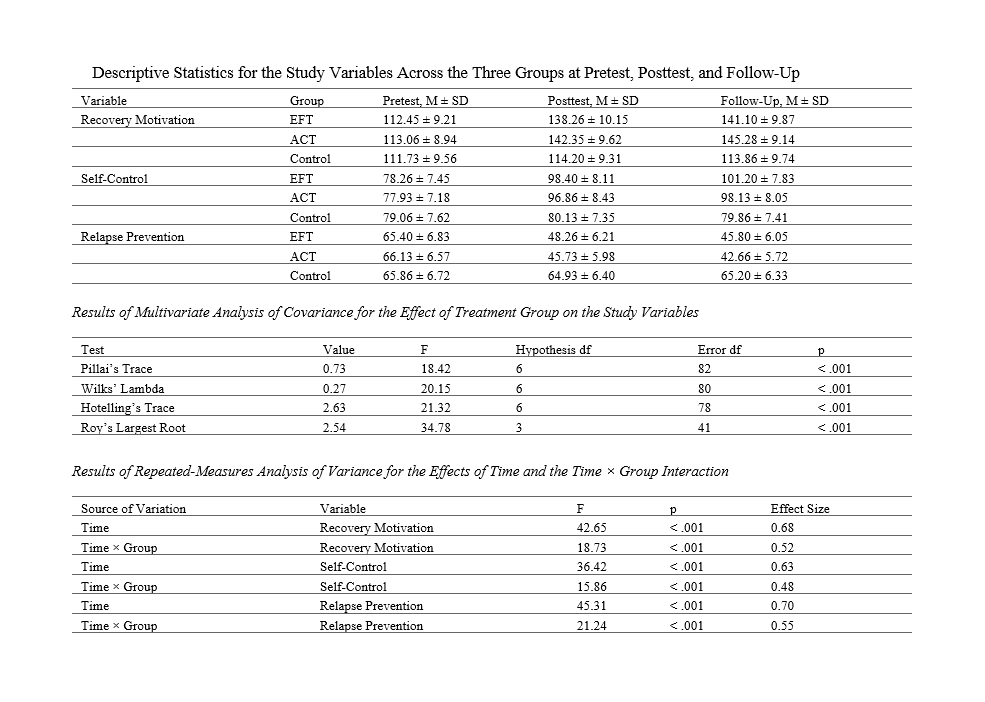
The present study aimed to compare the effectiveness of Emotion-Focused Therapy (EFT) and Acceptance and Commitment Therapy (ACT) on recovery motivation, self-control, and relapse prevention in individuals with substance use disorder. This study employed a quasi-experimental pretest–posttest design with a control group and a two-month follow-up period. The statistical population consisted of all individuals with substance use disorder who attended addiction treatment centers in Tehran in 2026. Among eligible individuals, 45 participants were selected using convenience sampling and randomly assigned to three groups of 15 participants each: an Emotion-Focused Therapy group, an Acceptance and Commitment Therapy group, and a control group. The Emotion-Focused Therapy group received 10 90-minute intervention sessions, and the Acceptance and Commitment Therapy group received 10 90-minute intervention sessions, whereas the control group received the routine services provided by the treatment center. Data were collected using the Recovery Motivation Questionnaire, the Self-Control Scale, and the Relapse Prevention Questionnaire and were analyzed using multivariate analysis of covariance (MANCOVA) and the Bonferroni post hoc test in SPSS version 28. The results indicated that, compared with the control group, both interventions significantly increased recovery motivation and self-control and reduced the likelihood of relapse. Moreover, a significant difference was observed between the two therapeutic approaches. Specifically, Acceptance and Commitment Therapy demonstrated greater effectiveness in enhancing recovery motivation and preventing relapse, whereas Emotion-Focused Therapy showed superior effectiveness in improving self-control and emotional processing. The findings indicated that both Emotion-Focused Therapy and Acceptance and Commitment Therapy are effective in enhancing recovery motivation, improving self-control, and preventing relapse among individuals with substance use disorder. Therefore, these two interventions can be used as effective therapeutic approaches in addiction treatment centers.
Downloads
References
1. Volkow ND, Blanco C. Substance Use Disorders: A Comprehensive Update Of Classification, Epidemiology, Neurobiology, Clinical Aspects, Treatment And Prevention. World Psychiatry. 2023;22(2):203-29. [PMID: 37159360] [PMCID: PMC12116982] [DOI]
2. Marlatt GA, Donovan DM. Relapse Prevention: Maintenance Strategies In The Treatment Of Addictive Behaviors. 2nd ed. New York: Guilford Press; 2005.
3. Tangney JP, Baumeister RF, Boone AL. High Self-Control Predicts Good Adjustment, Less Pathology, Better Grades, And Interpersonal Success. Journal of Personality. 2004;72(2):271-324. [PMID: 15016066] [PMCID: PMC10208523] [DOI]
4. Stellern J, Xiao KB, Grennell E, Sanches M, Gowin JL, Sloan ME. Emotion Regulation In Substance Use Disorders: A Systematic Review And Meta-Analysis. Addiction. 2023;118(1):30-47. [PMID: 35851975] [DOI]
5. Chrétien S, Giroux I, Smith I, Jacques C, Ferland F, Sévigny S. Emotional Regulation In Substance-Related And Addictive Disorders Treatment: A Systematic Review. Journal of Gambling Studies. 2025;41:353-448. [PMID: 39918691] [PMCID: PMC12116982] [DOI]
6. Greenberg LS. Emotion-Focused Therapy. Washington, DC: American Psychological Association; 2002. [DOI]
7. Elliott R, Watson JC, Goldman RN, Greenberg LS. Learning Emotion-Focused Therapy: The Process-Experiential Approach To Change. Washington, DC: American Psychological Association; 2004. [DOI]
8. Greenberg LS. Emotion-Focused Therapy: Coaching Clients To Work Through Their Feelings. 2nd ed. Washington, DC: American Psychological Association; 2015. [DOI]
9. Hayes SC, Luoma JB, Bond FW, Masuda A, Lillis J. Acceptance And Commitment Therapy: Model, Processes And Outcomes. Behaviour Research and Therapy. 2006;44(1):1-25. [PMID: 16300724] [PMCID: PMC13225531] [DOI]
10. Hayes SC, Strosahl KD, Wilson KG. Acceptance And Commitment Therapy: The Process And Practice Of Mindful Change. 2nd ed. New York: Guilford Press; 2012.
11. Gloster AT, Walder N, Levin ME, Twohig MP, Karekla M. The Empirical Status Of Acceptance And Commitment Therapy: A Review Of Meta-Analyses. Journal of Contextual Behavioral Science. 2023;28:181-92. [DOI]
12. Twohig MP, Levin ME. Acceptance And Commitment Therapy As A Treatment For Anxiety And Depression: A Review. Psychiatric Clinics of North America. 2017;40(4):751-70. [PMID: 29080598] [DOI]
13. Osaji J, Ojimba C, Ahmed S. The Use Of Acceptance And Commitment Therapy In Substance Use Disorders: A Review Of Literature. Journal of Clinical Medicine Research. 2020;12(10):629-33. [PMID: 33029268] [PMCID: PMC7524566] [DOI]
14. Díez-Bejarano L, Chaves C. Is Acceptance And Commitment Therapy Effective In Treating Addiction? A Systematic Review. Psychiatric Annals. 2022;52(6):248-60. [DOI]
15. Krotter A, Aonso-Diego G, González-Menéndez A, González-Roz A, Secades-Villa R, García-Pérez Á. Effectiveness Of Acceptance And Commitment Therapy For Addictive Behaviors: A Systematic Review And Meta-Analysis. Journal of Contextual Behavioral Science. 2024;32:100773. [DOI]
Downloads
Publication Timeline
- Submitted
- Revised
- Accepted