
Leveling the Components of Balanced Scorecard-Based Budgeting in Iran’s Healthcare Sector Using the ISM–MICMAC Approach
Keywords:
budgeting, Balanced Scorecard, healthcare sector, efficiency and effectiveness of the financial system.Abstract
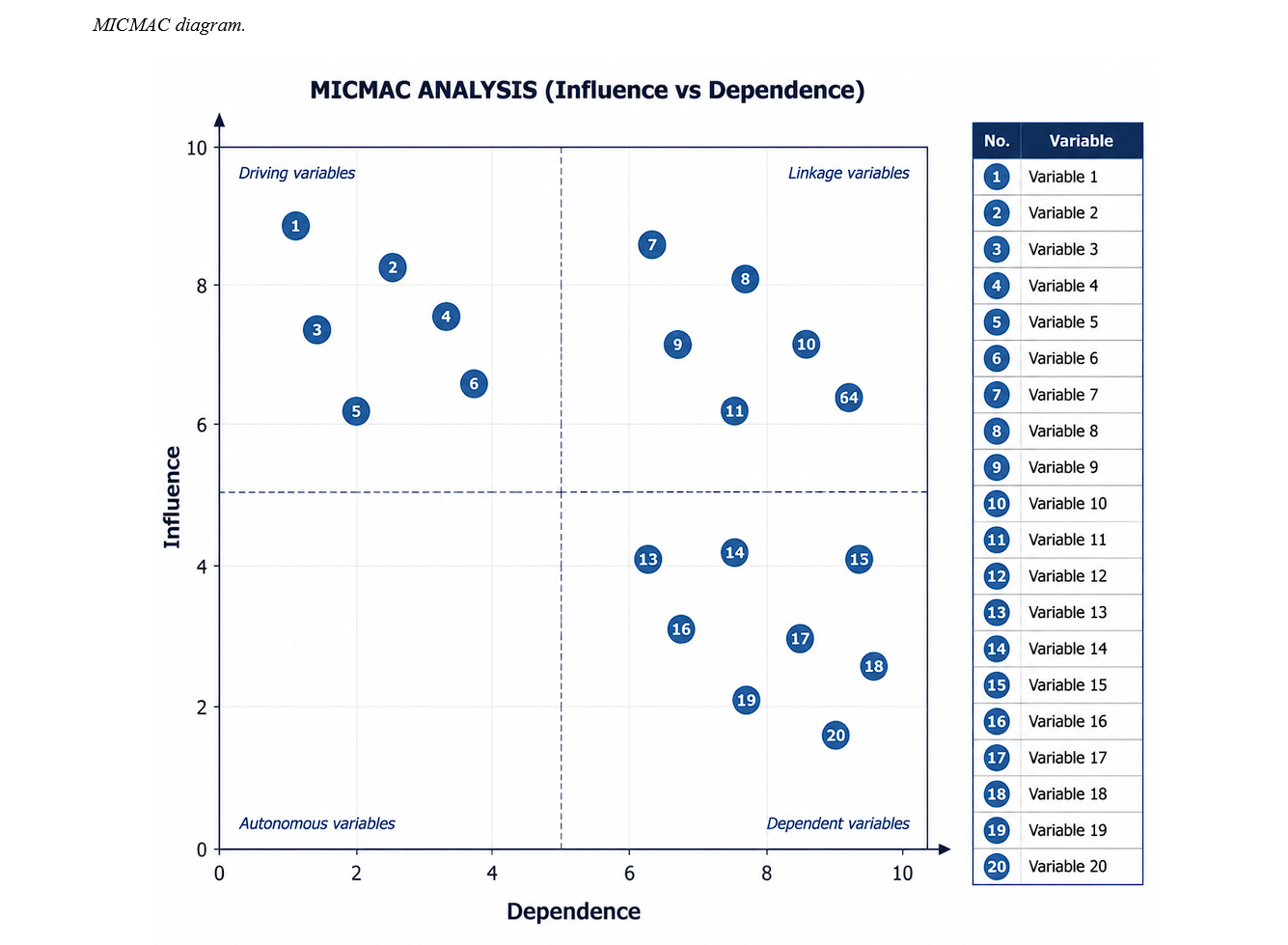
The primary objective of this study was to level the components of Balanced Scorecard-based budgeting in Iran’s healthcare sector using the ISM–MICMAC approach, so that by establishing links among strategic objectives, budgeting processes, and performance evaluation, the efficiency and effectiveness of the financial system of healthcare centers can be enhanced. In terms of purpose, the present study was applied-developmental, and methodologically, it employed an exploratory mixed-methods design (qualitative–quantitative). In the qualitative phase, semi-structured interviews were conducted with 15 experts in the fields of healthcare and finance, and thematic analysis was used to extract the fundamental dimensions and components of the model. In the quantitative phase, Interpretive Structural Modeling (ISM) revealed seven levels of relationships among the identified factors. At this stage, data were collected using an ISM questionnaire completed by 15 executive and academic experts. Within this structure, some factors were positioned at the foundational levels as principal drivers that create the conditions for influencing other factors, whereas others were located at higher levels and were more strongly affected by other variables. According to the findings, factors such as the development of human capacities, strengthening of information infrastructures, and establishment of organizational learning platforms were positioned at the foundational levels and played an important role in shaping and reinforcing the other dimensions of the model. In contrast, factors such as improving data-driven decision-making and enhancing the efficiency of organizational processes were located at higher levels of the model and primarily emerged as outcomes of strengthening the foundational factors. The findings indicate that the simultaneous strengthening of human capital, information technology infrastructure, and an organizational learning culture can facilitate the transition of the budgeting system from a purely financial approach toward a strategic and performance-oriented approach.
Downloads
References
1. Hidayat M. Strengthening Performance-Based Budgeting Through Standardization of Tridharma Indicators at UIN Alauddin Makassar. AMUYA: Indonesian Journal of Management Reviews. 2026;2(1):25-44. doi: 10.61860/amuya.v2i1.62.
2. Barros RS. Research on the Balanced Scorecard for Government Entities: A Literature Review. Journal of Public Budgeting, Accounting & Financial Management. 2025;37(3):415-40. doi: 10.1108/JPBAFM-10-2022-0162.
3. Gonzalez-Sanchez MB, Broccardo L, Pires AMM. The Use and Design of the BSC in the Health Care Sector: A Systematic Literature Review for Italy, Spain, and Portugal. International Journal of Health Planning and Management. 2018;33(1):6-30. doi: 10.1002/hpm.2415.
4. Bohm V, Lacaille D, Spencer N, Barber CEH. Scoping Review of Balanced Scorecards for Use in Healthcare Settings: Development and Implementation. BMJ Open Quality. 2021;10(3):e001293. doi: 10.1136/bmjoq-2020-001293.
5. Aljumaili HN, Chouaibi J. Measuring and Evaluating Multidimensional Performance Using the TOPSIS Model Based on the Integration of the Balanced Scorecard and Budgeting: A Case Study of a Sample of Companies Listed on the ISX. 2026.
6. Hadi, Jahan, Najafi, Shariat. Identification of Performance Factors of Healthcare Providers Using Fuzzy Delphi. Journal of Health System Research. 2025;20(4):401-8.
7. Behrouzi F, Ma'aram A. Identification and Ranking of Specific Balanced Scorecard Performance Measures for Hospitals: A Case Study of Private Hospitals in the Klang Valley Area, Malaysia. International Journal of Health Planning and Management. 2019;34(4):1364-76. doi: 10.1002/hpm.2799.
8. Adams C, Walpola R, Schembri AM, Harrison R. The Ultimate Question? Evaluating the Use of Net Promoter Score in Healthcare: A Systematic Review. Health Expectations. 2022;25(5):2328-39. doi: 10.1111/hex.13577.
9. Barzouzadeh Z, Nikbakht. Performance Evaluation Using the Balanced Scorecard (BSC) after Implementation of an Electronic Fund Request System: A Case Study of the General Treasury Administration. Empirical Studies in Financial Accounting. 2024;21(82):167-204.
10. Digehsara AA, Rezazadeh H, Soleimani M. Performance Evaluation of Project Management System Based on Combination of EFQM and QFD. Journal of Project Management. 2018;3(4):171-82. doi: 10.5267/j.jpm.2018.4.003.
11. Tortorella GL, Fogliatto FS, Espôsto KF, Mac Cawley Vergara A, Vassolo R, Tlapa Mendoza D, et al. Measuring the Effect of Healthcare 4.0 Implementation on Hospitals' Performance. Production Planning & Control. 2022;33(4):386-401. doi: 10.1080/09537287.2020.1824283.
12. Almeida Marques PC. Strategic Resilience in Healthcare: Towards a Digitalised and Regenerative Balanced Scorecard Framework. Journal of Health Organization and Management. 2026:1-24. doi: 10.1108/JHOM-09-2025-0595.
13. Budarina YV. The Impact of Balanced Scorecard on the Efficiency of Healthcare Institutions: International Experience and Practical Approaches. Health Care of the Russian Federation. 2025;69(5):435-41. doi: 10.47470/0044-197X-2025-69-5-435-441.
14. Bejja I, Najdi A. Implementing a Balanced Scorecard-Driven Performance Dashboard for Governance in a Public Oncology Centre in Morocco. Health SA Gesondheid. 2026;31:1-11. doi: 10.4102/HSAG.v31i0.3411.
15. Mirzaei A, Rahmani M, Omidvar Z, Rastgoo H. Performance Evaluation and Ranking of Iran Agricultural Insurance Agencies Using the Balanced Scorecard (BSC) and VIKOR Method. 2024.
16. Yaghoubi F, Afshari R, Ramezani. Performance Management and Determination of Asset Maintenance Indicators Based on the Balanced Scorecard Method. Supply Chain Management. 2024;83(26):49-64.
Downloads
Publication Timeline
- Submitted
- Revised
- Accepted