
The Effects of Neurofeedback and Mindfulness-Based Cognitive Therapy on Cognitive Flexibility and Working Memory Performance in Older Adults with Alzheimer’s Disease
Keywords:
Alzheimer’s disease, cognitive flexibility, working memory, older adults, neurofeedback, mindfulness-based cognitive therapyAbstract
ABSTRACT
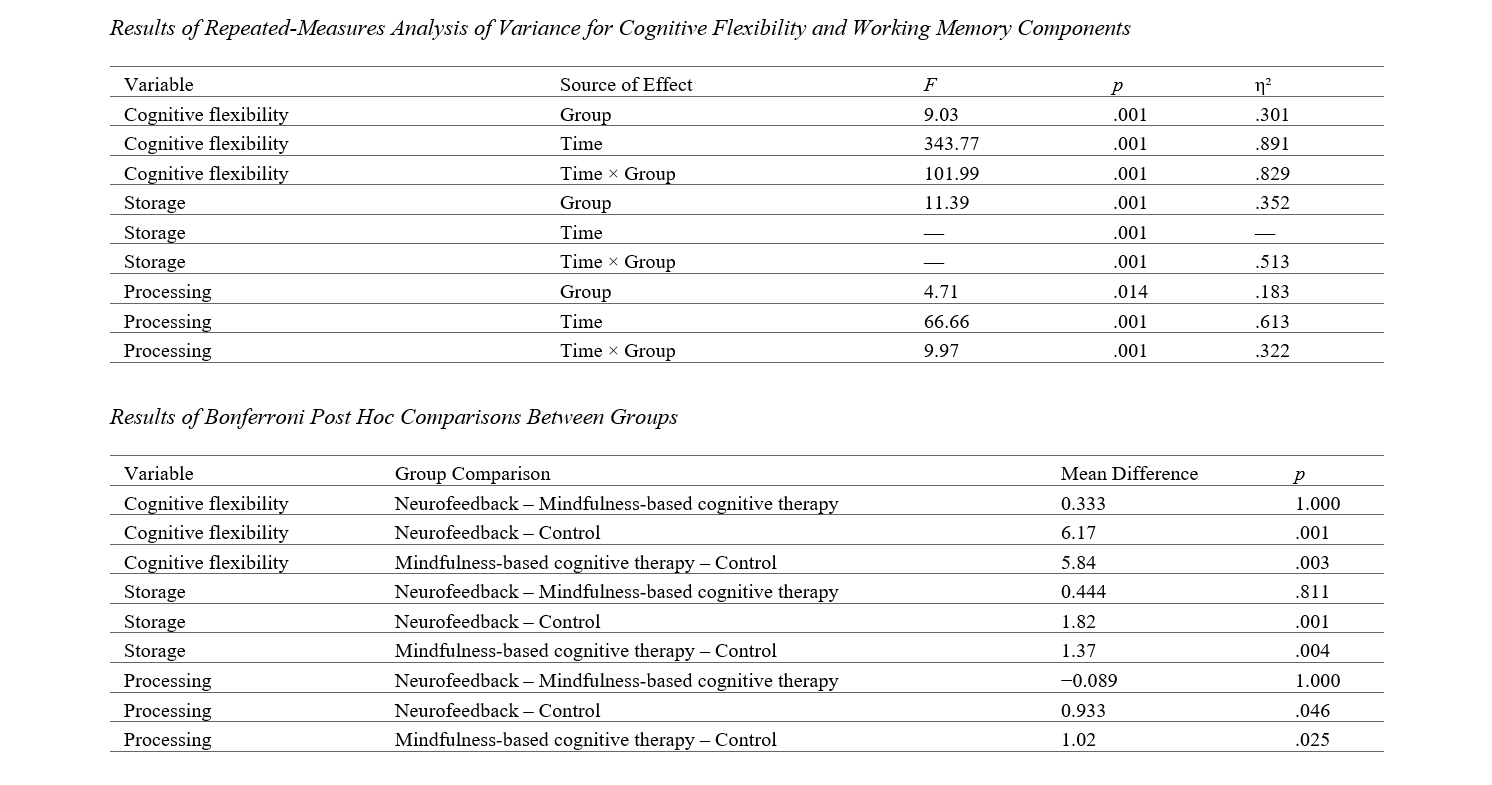
The present study aimed to determine the effectiveness of neurofeedback and mindfulness-based cognitive therapy (MBCT) in improving cognitive flexibility and working memory performance among older adults with Alzheimer’s disease. In terms of purpose, this was an applied study, and methodologically, it employed a quasi-experimental design with pretest, posttest, and three-month follow-up assessments and a control group. The statistical population consisted of older adults with Alzheimer’s disease residing at the Kahrizak Nursing Home and Rehabilitation Center for Older Adults and Persons with Disabilities in Tehran during 2021–2022. Among eligible individuals, 45 older adults were selected through convenience sampling and, after being matched for age, were randomly assigned to three groups: neurofeedback, mindfulness-based cognitive therapy, and control. Data were collected using the Working Memory Test developed by Daneman and Carpenter (1980) and the Cognitive Flexibility Inventory developed by Dennis and Vander Wal (2010). The neurofeedback intervention was administered in 10 sessions of 45 minutes each, while mindfulness-based cognitive therapy was delivered in 10 one-hour sessions based on the protocol developed by Crane (2017); the control group received no intervention during this period. Data were analyzed using repeated-measures analysis of variance. The results indicated that, compared with the control group, both neurofeedback and mindfulness-based cognitive therapy significantly increased cognitive flexibility in older adults with Alzheimer’s disease. In addition, both interventions improved the working memory components of storage and processing compared with the control group. The posttest and follow-up findings also demonstrated the effectiveness of the interventions on the variables under investigation. The findings suggest that neurofeedback and mindfulness-based cognitive therapy can be used as nonpharmacological, adjunctive interventions to improve cognitive flexibility and working memory performance in older adults with Alzheimer’s disease. Incorporating these interventions alongside conventional care and treatment may contribute to the maintenance and enhancement of cognitive functioning in these patients.
Downloads
References
1. Gandomkar M, Kalantari A, Kosari M. Cognitive Health In Old Age. Tehran: Andisheh Kamyab Iranian; 2025.
2. Doering S, Mccullough A, Gordon BA, Chen CD, Mckay N, Hobbs D, et al. Deconstructing Pathological Tau By Biological Process In Early Stages Of Alzheimer Disease: A Method For Quantifying Tau Spatial Spread In Neuroimaging. eBioMedicine. 2024;103:105080. [PMID: 38552342] [PMCID: PMC10995809] [DOI]
3. Rodrigues JFR, De Araújo Filho GM. Alzheimer'S Disease And Suicide Association (Asa) Theory. New Ideas in Psychology. 2026;80:101218. [DOI]
4. Mukunzi P, Byishimo BS, Etukudo EM, Iradukunda H, Benimana D, Usman IM, et al. Phytochemical Composition And Anti-Alzheimer Potential Of Medicinal Plants From Central And West Africa: Systematic Review. Toxicology Reports. 2026;16:102205. [PMID: 41625587] [PMCID: PMC12854038] [DOI]
5. Bernardo ABI, Presbitero A. Cognitive Flexibility And Cultural Intelligence. International Journal of Intercultural Relations. 2018;66(12):21. [DOI]
6. Akbari Gharalari N, Fallahi S, Nakhjiri E, Hosseini L, Pakkhou S, Havaei N, et al. How To Improve Cognitive Flexibility: Evidence From Noninvasive Neuromodulation Techniques. CNS Neuroscience & Therapeutics. 2025;31(9):e70613. [PMID: 40955796] [PMCID: PMC12439197] [DOI]
7. Bakhtiari J, Haghayegh SA. The Predictive Role Of Working Memory And Sustained Attention In Sleep Quality Of Children With Attention-Deficit/Hyperactivity Disorder. Shafa Khatam. 2019;8(2):10-7. [DOI]
8. Kober SE, Berger LM, Kübler A, Kleih SC. Neurofeedback And How To Use It. Academic Press; 2025. p. 91-103. [DOI]
9. Khaksarian M, Hassanvandi S, Piri R, Sohrabifard M. Comparison Of The Effectiveness Of Neurofeedback In Improving Executive Functions In Individuals With Attention-Deficit/Hyperactivity Disorder And Epilepsy. Scientific-Research Quarterly of Lorestan University of Medical Sciences. 2020;22:13-23.
10. Zhong X, Yuan X, Dai Y, Zhang X, Jiang C. Neurofeedback Training For Executive Function In ADHD Children: A Systematic Review And Meta-Analysis. Scientific Reports. 2025;15:28148. [PMID: 40750997] [PMCID: PMC12316938] [DOI]
11. Enriquez-Geppert S, Huster RJ, Scharfenort R, Herrmann CS. Enhancing Working Memory In Older Adults Through Frontal-Midline Theta Neurofeedback. Frontiers in Aging Neuroscience. 2023;15:1184520. [DOI]
12. Wang X, Li J, Zhang Y, Zhou L. Frontal Neurofeedback Training Improves Working Memory In Mild Cognitive Impairment. Neuropsychological Rehabilitation. 2024;34(5):1234-48. [DOI]
13. Lin YR, Hsu TW, Hsu CW, Chen PY, Tseng PT, Liang CS. Effectiveness Of Electroencephalography Neurofeedback For Improving Working Memory And Episodic Memory In The Elderly: A Meta-Analysis. Medicina. 2024;60(3):369. [PMID: 38541096] [PMCID: PMC10972127] [DOI]
14. Nan W, Rodrigues J, He B. Neurofeedback As A Cognitive Enhancement Tool For Working Memory In Elderly Individuals. Journal of Cognitive Enhancement. 2025;9(2):204-18. [DOI]
15. Verma S, Kurdekar A. Effectiveness Of Neuro-Feedback On Alzheimer’S Rehabilitation: A Bibliometric Analysis. Neurodegenerative Disease Management. 2024;14(6):257-66. [PMID: 39630012] [PMCID: PMC11703126] [DOI]
16. Valizadeh H, Parandin S. The Effectiveness Of Mindfulness-Based Cognitive Therapy On Irrational Beliefs And Happiness In Older Adults. Psychology of Aging. 2022;8(1):11-24.
17. Rahnavard M, Shirin-Sahraei S, Akbaripour F, Riahifar M, Samadi F, Hassanzadeh-Hajiabadi S. Comparison Of The Effectiveness Of Cognitive-Behavioral Therapy And Mindfulness-Based Therapy On Emotion Regulation And Psychological Flexibility In Patients With Major Depressive Disorder. Cognition, Behavior, Learning. 2025;2(1):1-11. [DOI]
18. Zeidan F, Johnson SK, Diamond BJ. Mindfulness-Based Cognitive Therapy Enhances Cognitive Flexibility In Older Adults. Aging & Mental Health. 2023;27(6):1245-56. [DOI]
19. Chiesa A, Calati R, Serretti A. Mindfulness Interventions And Cognitive Flexibility In The Elderly: A Randomized Controlled Trial. Journal of Gerontology: Psychological Sciences. 2024;79(4):712-21. [DOI]
20. Malinowski P, Moore A, Mead B. Effects Of Mindfulness-Based Cognitive Therapy On Executive Functions In Older Adults. Aging Neuropsychology and Cognition. 2024;31(1):89-103. [DOI]
21. González-Martín AM, Aibar-Almazán A, Rivas-Campo Y, Marín-Gutiérrez A, Castellote-Caballero Y. Effects Of Mindfulness-Based Cognitive Therapy On Older Adults With Sleep Disorders: A Systematic Review And Meta-Analysis. Frontiers in Public Health. 2023;11. [PMID: 38179560] [PMCID: PMC10765593] [DOI]
22. Wang YH, Wang YL, Leung DKY, Ng ZLY, Chan OLH, Wong SMY, et al. Effectiveness Of An Age-Modified Mindfulness-Based Cognitive Therapy (Mbct) In Improving Mental Health In Older People With Depressive Symptoms: A Non-Randomised Controlled Trial. BMC Complementary Medicine and Therapies. 2025;25(1):81. [PMID: 40011881] [PMCID: PMC11863447] [DOI]
23. Ding J, Ali ZM, Ibrahim AM, Atta MHR, Khasawneh MAS, Ibrahim FM. Effectiveness Of Mindfulness-Based Cognitive Therapy (Mbct) On Depression And Anxiety In Older Adults: A Systematic Review And Meta-Analysis. Journal of Behavior Therapy and Experimental Psychiatry. 2026;92:102105. [PMID: 42068736] [DOI]
Downloads
Publication Timeline
- Submitted
- Revised
- Accepted