Effect of Music and Lemon Aroma on Anaerobic Power and Balance of Athletes After Exhausting Activity
DOI:
https://doi.org/10.61838/kman.intjssh.6.2.8Keywords:
Static Balance, Dynamic Balance, Anaaerbic Performance, Lemon Flavor, MusicAbstract
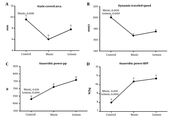
Background: The aim of this study was to investigate the effect of lemon aroma (LA) and music on anaerobic power and balance in athletes following sporting activity. Recognizing the potential influence of sensory stimuli on performance, we sought to contribute valuable insights into optimizing recovery strategies for athletes. Objectives: The primary objective was to assess the effects of LA and music on anaerobic power and balance, employing a comprehensive set of physical fitness factors. Methods: Twelve male amateur athletes were randomly included in our study. These individuals were given LA, music, and with no supplementation (control) for 72 hours, followed by a standardized recovery phase using a Monarch ergometer, and lactic acid levels were measured after the intervention to assess the physiological effect. Balance analysis covering both static and dynamic conditions was performed using a specialized balance machine. Isometric dynamometer measurements and detailed assessments of Sargent's jumping performance were performed to analyze physical fitness factors. Results: Significant differences were observed in balance parameters, with both static balance (SB) and dynamic balance (DB) registering higher values in the control time (P = 0.006; P < 0.001, respectively). Lemon aroma exposure resulted in the highest values for peak power (PP) and relative PP (RPP) (P < 0.001; P < 0.001, respectively). Conversely, in the control time exhibited the lowest values for relative anaerobic power (RAP) and vertical jump (VJ). Conclusions: The findings suggest a positive influence of stimulating aroma (lemon) and music elements on sportive performance. Lemon aroma was associated with enhanced anaerobic power, while the control group exhibited superior balance outcomes. These results underscore the potential benefits of incorporating sensory interventions into athletes' recovery protocols for optimized performance.Downloads
References
1. Nakata H, Yoshie M, Miura A, Kudo K. Characteristics of the athletes’
brain: evidence from neurophysiology and neuroimaging. Brain Res
Rev. 2010;62(2):197–211. [PubMed ID: 19944119]. https://doi.org/10.1016/
j.brainresrev.2009.11.006.
2. Soudry Y, Lemogne C, Malinvaud D, Consoli SM, Bonfils P. Olfactory
system and emotion: common substrates. Eur Ann Otorhinolaryngol
Head Neck Dis. 2011;128(1):18–23. [PubMed ID: 21227767]. https://doi.org/
10.1016/j.anorl.2010.09.007.
3. Emmery L, Hackney ME, Kesar T, McKay JL, Rosenberg MC. An
integrated review of music cognition and rhythmic stimuli in
sensorimotor neurocognition and neurorehabilitation. Ann N Y Acad
Sci. 2023;1530(1):74–86. [PubMed ID: 37917153]. https://doi.org/10.1111/
nyas.15079.
4. Niijima A, Nagai K. Effect of olfactory stimulation with flavor
of grapefruit oil and lemon oil on the activity of sympathetic
branch in the white adipose tissue of the epididymis. Exp Biol Med
(Maywood). 2003;228(10):1190–2. [PubMed ID: 14610259]. https://doi.
org/10.1177/153537020322801014.
5. McClurkin SL, Smith CD. The duration of self-selected music needed
to reduce preoperative anxiety. J Perianesth Nurs. 2016;31(3):196–208.
[PubMed ID: 27235956]. https://doi.org/10.1016/j.jopan.2014.05.017.
6. Ni CH, Tsai WH, Lee LM, Kao CC, Chen YC. Minimising preoperative
anxiety with music for day surgery patients - a randomised clinical
trial. J Clin Nurs. 2012;21(5-6):620–5. [PubMed ID: 21332853]. https://doi.
org/10.1111/j.1365-2702.2010.03466.x.
7. Palmer JB, Lane D, Mayo D, Schluchter M, Leeming R. Effects of
music therapy on anesthesia requirements and anxiety in women
undergoing ambulatory breast surgery for cancer diagnosis
and treatment: A randomized controlled trial. J Clin Oncol.
2015;33(28):3162–8. [PubMed ID: 26282640]. [PubMed Central ID:
PMC4979095]. https://doi.org/10.1200/JCO.2014.59.6049.
8. Atkinson G, Wilson D, Eubank M. Effects of music on work-rate
distribution during a cycling time trial. Int J Sports Med.
2004;25(8):611–5. [PubMed ID: 15532005]. https://doi.org/10.1055/s2004-815715.
9. Szmedra L, Bacharach DW. Effect of music on perceived exertion,
plasma lactate, norepinephrine and cardiovascular hemodynamics
during treadmill running. Int J Sports Med. 1998;19(1):32–7.
[PubMed ID: 9506797]. https://doi.org/10.1055/s-2007-971876.
10. Terry PC, Karageorghis CI, Saha AM, D’Auria S. Effects of synchronous
music on treadmill running among elite triathletes. J Sci Med Sport.
2012;15(1):52–7. [PubMed ID: 21803652]. https://doi.org/10.1016/j.jsams.
2011.06.003.
11. Zatorre RJ, Halpern AR, Perry DW, Meyer E, Evans AC. Hearing in the
mind’s ear: A PET investigation of musical imagery and perception. J
Cogn Neurosci. 1996;8(1):29–46. [PubMed ID: 23972234].https://doi.org/
10.1162/jocn.1996.8.1.29.
12. Terry PC, Karageorghis CI, Curran ML, Martin OV, Parsons-Smith
RL. Effects of music in exercise and sport: A meta-analytic review.
Psychol Bull. 2020;146(2):91–117. [PubMed ID: 31804098]. https://doi.
org/10.1037/bul0000216.
13. Copeland BL, Franks BD. Effects of types and intensities of
background music on treadmill endurance. J Sports Med Phys
Fitness. 1991;31(1):100–3. [PubMed ID: 1861474].
14. Jia T, Ogawa Y, Miura M, Ito O, Kohzuki M. Music attenuated a decrease
in parasympathetic nervous system activity after exercise. PLoS One.
2016;11(2). e0148648. [PubMed ID: 26840532]. [PubMed Central ID:
PMC4739605]. https://doi.org/10.1371/journal.pone.0148648.
15. Karageorghis C, Kuan G, Schiphof-Godart L. Music in sport: From
conceptual underpinnings to applications. Essentials of exercise and
sport psychology: An open access textbook. Society for Transparency,
Openness, and Replication in Kinesiology; 2021. p. 530–64. https://doi.
org/10.51224/b1023.
16. Hongratanaworakit T. Physiological effects in aromatherapy.
Songklanakarin J Sci Technol. 2004;26.
17. Tisserand RB. The art of aromatherapy. Rochester: Healing Arts Press;
1977.
18. Sivaphongthongchai A, Nakkliang K, Thetsana P, Seepika N,
Thammarakit T, Nopthaisong TVD. A review on seven selected
essential oils used as aromatherapy to maintain sports performance.
J Exerc Physiol. 2023;26(5).
19. Faul F, Erdfelder E, Lang AG, Buchner A. G*Power 3: a flexible statistical
power analysis program for the social, behavioral, and biomedical
sciences. Behav Res Methods. 2007;39(2):175–91. [PubMed ID: 17695343].
https://doi.org/10.3758/bf03193146.
20. Beneke R, Pollmann C, Bleif I, Leithauser RM, Hutler M. How
anaerobic is the wingate anaerobic test for humans? Eur J Appl
Physiol. 2002;87(4-5):388–92. [PubMed ID: 12172878]. https://doi.org/10.
1007/s00421-002-0622-4.
21. Ayan-Perez C, Cancela-Carral JM, Lago-Ballesteros J, Martinez-Lemos I.
Reliability of sargent jump test in 4- to 5-year-old children. Percept Mot
Skills. 2017;124(1):39–57. [PubMed ID: 27837043]. https://doi.org/10.1177/
0031512516676174.
22. Bui HT, Farinas MI, Fortin AM, Comtois AS, Leone M. Comparison and
analysis of three different methods to evaluate vertical jump height.
Clin Physiol Funct Imaging. 2015;35(3):203–9. [PubMed ID: 24690449].
https://doi.org/10.1111/cpf.12148.
23. Mansfield A, Aqui A, Fraser JE, Rajachandrakumar R, Lakhani B,
Patterson KK. Can augmented feedback facilitate learning a reactive
balance task among older adults? Exp Brain Res. 2017;235(1):293–304.
[PubMed ID: 27709269]. [PubMed Central ID: PMC5233445]. https://
doi.org/10.1007/s00221-016-4790-6.
24. Blood AJ, Zatorre RJ. Intensely pleasurable responses to music
correlate with activity in brain regions implicated in reward
and emotion. Proc Natl Acad Sci U S A. 2001;98(20):11818–23.
[PubMed ID: 11573015]. [PubMed Central ID: PMC58814]. https:
//doi.org/10.1073/pnas.191355898.
25. Karamızrak N. Ses ve muzi ¨ gin organları ˘
˙Iyiles¸tirici etkisi. Kosuyolu
Kalp Dergisi. 2014;17(1):54–7. https://doi.org/10.4274/khj.4775.
26. Hackney AC, Lane AR. Exercise and the regulation of
endocrine hormones. Prog Mol Biol Transl Sci. 2015;135:293–311.
[PubMed ID: 26477919]. https://doi.org/10.1016/bs.pmbts.2015.07.001.
27. Zhang S, Yang J, Tao X, Du L, Li X, Lv Y, et al. Listening to self-selected
music during warm-up improves anaerobic performance through
enhancement of the excitability of the cerebral cortex. Applied
Sciences. 2023;13(12). https://doi.org/10.3390/app13127180.
28. Mohd Saleh M, Abd Razak FA, Abd Rahman SA, Ab Razak R, Sanuddin
ND, Linoby A, et al. ‘Music to move’ – effects of listening to preferential
music on aerobic endurance performance and rate perceived of
exertion responses. Malaysian J Sport Sci Rec. 2023;19(2):341–50. https:
//doi.org/10.24191/mjssr.v19i2.24010.
29. Bentouati E, Romdhani M, Khemila S, Chtourou H, Souissi N. The
effects of listening to non-preferred or self-selected music during
short-term maximal exercise at varied times of day. Percept Mot
Skills. 2023;130(1):539–54. [PubMed ID: 36458504]. https://doi.org/10.
1177/00315125221142662.
30. Pusey CG, Haugen T, Høigaard R, Ivarsson A, Røshol AW, Laxdal A.
Put some music on: The effects of pre-task music tempo on arousal,
affective state, perceived exertion, and anaerobic performance. Music
& Science. 2023;6. https://doi.org/10.1177/20592043231174388.
31. Svoboda SM, Kostrna J. Effects of tempo of self-selected music on
isokinetic strength performance and psychological outcomes. Scand
J Med Sci Sports. 2023;34(1). [PubMed ID: 37702552]. https://doi.org/10.
1111/sms.14487.
32. Jebabli N, Khlifi M, Ouerghi N, Boujabli M, Bouassida A, Abderrahman
AB, et al. Single and combined effects of preferred music and
endpoint knowledge on jump performance in basketball players.
Sports (Basel). 2023;11(5). [PubMed ID: 37234061]. [PubMed Central ID:
PMC10220768]. https://doi.org/10.3390/sports11050105.
33. Farrar AJ, Farrar FC. Clinical aromatherapy. Nurs Clin North Am.
2020;55(4):489–504. [PubMed ID: 33131627]. [PubMed Central ID:
PMC7520654]. https://doi.org/10.1016/j.cnur.2020.06.015.
34. Field T, Diego M, Hernandez-Reif M, Cisneros W, Feijo L, Vera Y,
et al. Lavender fragrance cleansing gel effects on relaxation. Int J
Neurosci. 2005;115(2):207–22. [PubMed ID: 15764002]. https://doi.org/
10.1080/00207450590519175.
35. van der Watt G, Janca A. Aromatherapy in nursing and mental health
care. Contemp Nurse. 2008;30(1):69–75. [PubMed ID: 19072192]. https://
doi.org/10.5172/conu.673.30.1.69.
36. Rambod M, Rakhshan M, Tohidinik S, Nikoo MH. The effect of lemon
inhalation aromatherapy on blood pressure, electrocardiogram
changes, and anxiety in acute myocardial infarction patients: A
clinical, multi-centered, assessor-blinded trial design. Complement
Ther Clin Pract. 2020;39:101155. [PubMed ID: 32379635]. https://doi.org/
10.1016/j.ctcp.2020.101155.
37. Kustriyanti D, Putri AA. Ginger and lemon aromatherapy to relieve
nausea and vomiting in pregnancy. Jurnal Keperawatan Soedirman.
2019;14(1). https://doi.org/10.20884/1.jks.2019.14.1.868.
38. Kwon S, Ahn J, Jeon H. Can aromatherapy make people feel better
throughout exercise? Int J Environ Res Public Health. 2020;17(12).
[PubMed ID: 32599887]. [PubMed Central ID: PMC7344894]. https://
doi.org/10.3390/ijerph17124559.
39. Patil SL, Sreekumaran E, Krishna AP. Evaluation of the efficacy of
cardamom aromatherapy on aerobic fitness & autonomic functions
among students. J Health Allied Sci NU. 2020;1(01/03):23–9. https://doi.
org/10.1055/s-0040-1703515.
Downloads
Publication Timeline
Issue
Section
License

This work is licensed under a Creative Commons Attribution-NonCommercial 4.0 International License.