The Effect of tDCS-Mindfulness Program on Self-Control and Emotion Regulation in Badminton Players
DOI:
https://doi.org/10.61838/kman.intjssh.7.1.2Keywords:
Emotion Regulation, Mindfulness, Self-Control, tDCSAbstract
Background: Mindfulness and tDCS have been shown to have psychological and physiological effects. However, the effects of using both simultaneously have not yet been fully determined.
Objectives: This study aimed to investigate the effect of a tDCS-mindfulness program on selective attention in skilled badminton players.
Methods: Thirty-six healthy skilled male badminton players were selected based on the study criteria and divided into three groups: A-tDCS-mindfulness, sham-tDCS-mindfulness, and control (N=12). The research variables were measured using pre- and post-tests. The Shapiro-Wilk test indicated that the data were normal; therefore, the t-test and one-way ANOVA were used to test the research hypotheses.
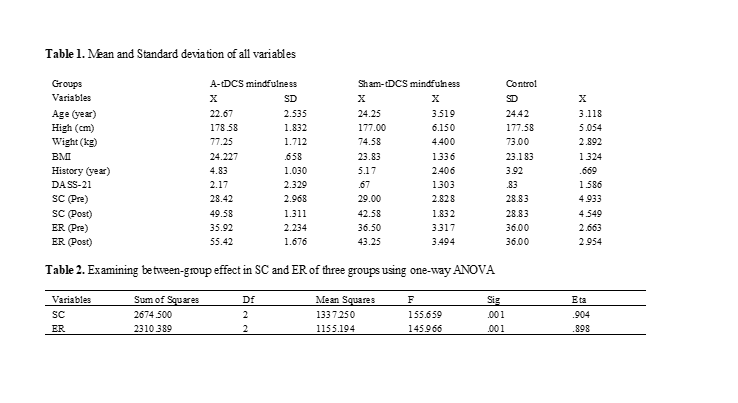
Results: The results showed that A significant difference was observed between the pre- and post-test scores for self-control and emotion regulation in both the A-tDCS and sham-tDCS mindfulness groups. In the between-groups comparison effect, it was also found that there was a significant difference in self-control and emotion regulation, and post-hoc analysis showed that the A-tDCS-mindfulness, sham-tDCS-mindfulness, and control groups had the best SC and ER, respectively.
Conclusions: This study supports the effectiveness of tDCS-mindfulness on self-control and emotion regulation in badminton players. The results also indicate that the simultaneous use of tDCS and mindfulness was more effective than mindfulness alone.
Downloads
References
1. Liang W, Wang DD, Shang BR, Zhang C-Q, Duan YP,
Si GY. Further examination of the psychometric properties of the
Brief Self-Control Scale: evidence from Chinese athletes and
students. International Journal of Sport and Exercise Psychology.
2022;20(1):16-35. [DOI]
2. Wagstaff CR, Weston NJ. Examining emotion regulation
in an isolated performance team in Antarctica. Sport, Exercise, and
Performance Psychology. 2014;3(4):273. [DOI]
3. Allom V, Panetta G, Mullan B, Hagger MS. Self-report
and behavioural approaches to the measurement of self-control:
Are we assessing the same construct? Personality and Individual
Differences. 2016;90:137-42. [DOI]
4. Landman A, Nieuwenhuys A, Oudejans RR. Decisionrelated action orientation predicts police officers' shooting
performance under pressure. Anxiety, stress, & coping.
2016;29(5):570-9. [PMID: 26215425] [DOI]
5. Bauer IM, Baumeister RF. Self-regulatory strength.
Handbook of self-regulation: Research, theory, and applications.
2011;2:64-82.
6. Gratz KL, Roemer L. Multidimensional assessment of
emotion regulation and dysregulation: Development, factor
structure, and initial validation of the difficulties in emotion
regulation scale. Journal of psychopathology and behavioral
assessment. 2004;26:41-54. [DOI]
7. Thompson RA. Emotion regulation: A theme in search of
definition. Monographs of the society for research in child
development. 1994:25-52. [PMID: 7984164] [DOI]
8. Lane AM, Beedie CJ, Jones MV, Uphill M, Devonport
TJ. The BASES expert statement on emotion regulation in sport.
Journal of sports sciences. 2012;30(11):1189-95. [PMID:
22709410] [DOI]
9. Fletcher D, Hanton S, Wagstaff CR. Performers'
responses to stressors encountered in sport organisations. Journal
of sports sciences. 2012;30(4):349-58. [PMID: 22236205] [DOI]
10. Hanin YL. Coping with anxiety in sport. Coping in sport:
Theory, methods, and related constructs. 2010;159:175.
11. Jekauc D, Kittler C, Schlagheck M. Effectiveness of a
mindfulness-based intervention for athletes. Psychology.
2016;8(1):1-13. [DOI]
12. Birrer D, Röthlin P, Morgan G. Mindfulness to enhance
athletic performance: Theoretical considerations and possible
impact mechanisms. Mindfulness. 2012;3(3):235-46. [DOI]
13. Bulğay C, Tingaz EO, Bayraktar I, Çetin E. Athletic
performance and mindfulness in track and field athletes. Current
Psychology. 2022;41(7):4482-9. [DOI]
14. Scott-Hamilton J, Schutte NS. The role of adherence in
the effects of a mindfulness intervention for competitive athletes:
Changes in mindfulness, flow, pessimism, and anxiety. Journal of
Clinical Sport Psychology. 2016;10(2):99-117. [DOI]
15. Moen F, Federici RA, Abrahamsen F. Examining
possible Relationships between mindfulness, stress, school-and
sport performances and athlete burnout. International Journal of
Coaching Science. 2015;9(1).
16. Aherne C, Moran AP, Lonsdale C. The effect of
mindfulness training on athletes’ flow: An initial investigation. The
Sport Psychologist. 2011;25(2):177-89. [DOI]
17. Zhu Y, Sun F, Li C, Chow DH, Wang K. Acute effect of
brief mindfulness-based intervention coupled with fluid intake on
athletes’ cognitive function. Journal of Sports Science & Medicine.
2020;19(4):753.
18. Kabat-Zinn J. Mindfulness meditation for everyday life.
New York: Hyperion; 1994.
19. Kabat-Zinn J. Mindfulness. Mindfulness. 2015; 6 (6):
1481–3. [DOI]
20. Zeidan F, Grant J, Brown C, McHaffie J, Coghill R.
Mindfulness meditation-related pain relief: evidence for unique
brain mechanisms in the regulation of pain. Neuroscience letters.
2012;520(2):165-73. [PMID: 22487846] [PMCID: PMC3580050]
[DOI]
21. Veldema J, Engelhardt A, Jansen P. Does anodal tDCS
improve basketball performance? A randomized controlled trial.
European Journal of Sport Science. 2022;22(2):126-35. [PMID:
33297843] [DOI]
22. Hamner J, Villamar MF, Fregni F, Taylor JA.
Transcranial direct current stimulation (tDCS) and the
cardiovascular responses to acute pain in humans. Clinical
Neurophysiology. 2015;126(5):1039-46. [PMID: 25288502] [DOI]
23. Cavaleiro C, Martins J, Goncalves J, Castelo-Branco M.
Memory and cognition-related neuroplasticity enhancement by
transcranial direct current stimulation in rodents: a systematic
review. Neural plasticity. 2020;2020. [PMID: 32211039] [PMCID:
PMC7061127] [DOI]
24. Paulus W. Transcranial electrical stimulation (tES –
tDCS; tRNS, tACS) methods. Neuropsychological rehabilitation.
2011;21(5):602-17. [PMID: 21819181] [DOI]
25. Flöel A. tDCS-enhanced motor and cognitive function in
neurological diseases. Neuroimage. 2014;85:934-47. [PMID:
23727025] [DOI]
26. Jacoby N, Lavidor M. Null tDCS effects in a sustained
attention task: the modulating role of learning. Frontiers in
psychology. 2018;9:476. [PMID: 29681876] [PMCID:
PMC5897507] [DOI]
27. Machado S, Jansen P, Almeida V, Veldema J. Is tDCS an
adjunct ergogenic resource for improving muscular strength and
endurance performance? A systematic review. Frontiers in
psychology. 2019;10:1127. [PMID: 31156520] [PMCID:
PMC6532530] [DOI]
28. Li Y, Wang J, Ye H, Luo J. Modulating the activity of
vmPFC regulates informational social conformity: A tDCS study.
Frontiers in psychology. 2020;11:566977. [PMID: 33041931]
[PMCID: PMC7527649] [DOI]
29. Yavari Kateb M, Moghadas Tabrizi Y, Shahrbanian S,
Gharayagh Zandi H, Behjame F. Effects of Transcranial direct
current stimulation on Imagery ability in students. Journal of
Applied Psychological Research. 2018;9(1):149-65.
30. Kateb MY, Arabameri E, Rostami R, zandi HG, tabrizi
YM. The Effects of a tDCS-Mindfulness Program on Some
Cognitive and Psychological Factors in skilled Badminton Players.
Tehran, Iran: University of Tehran; 2023.
31. Badran BW, Austelle CW, Smith NR, Glusman CE,
Froeliger B, Garland EL, et al. A double-blind study exploring the
use of transcranial direct current stimulation (tDCS) to potentially
enhance mindfulness meditation (E-Meditation). Brain
Stimulation: Basic, Translational, and Clinical Research in
Neuromodulation. 2017;10(1):152-4. [PMID: 27839723] [DOI]
32. Besharat MA. Cognitive emotion regulation
questionnaire: instruction and scoring. 2016.
33. Garnefski N, Kraaij V. Cognitive emotion regulation
questionnaire–development of a short 18-item version (CERQshort). Personality and individual differences. 2006;41(6):1045-53.
[DOI]
34. Oldfield RC. The assessment and analysis of handedness:
the Edinburgh inventory. Neuropsychologia. 1971;9(1):97-113.
[PMID: 5146491] [DOI]
35. Fotohi Ardakani R, Mostofi H. The effectiveness of
short-term behavioral activation therapy on reducing depression in
students with clinical symptoms of depression. Journal of
Psychology New Ideas. 2021;10(14):1-9.
36. Nitsche MA, Paulus W. Sustained excitability elevations
induced by transcranial DC motor cortex stimulation in humans.
Neurology. 2001;57(10):1899-901. [PMID: 11723286] [DOI]
37. Lang N, Nitsche M, Paulus W, Rothwell JC, Lemon RN.
Effects of transcranial direct current stimulation over the human
motor cortex on corticospinal and transcallosal excitability.
Experimental brain research. 2004;156:439-43. [PMID: 14745467]
[DOI]
38. Classen J, Liepert J, Wise SP, Hallett M, Cohen LG.
Rapid plasticity of human cortical movement representation
induced by practice. Journal of neurophysiology. 1998;79(2):1117-
23. [PMID: 9463469] [DOI]
39. Meron D, Hedger N, Garner M, Baldwin DS.
Transcranial direct current stimulation (tDCS) in the treatment of
depression: systematic review and meta-analysis of efficacy and
tolerability. Neuroscience & Biobehavioral Reviews. 2015;57:46-
62. [PMID: 26232699] [DOI]
40. Mackenzie CS, Poulin PA, Seidman-Carlson R. A brief
mindfulness-based stress reduction intervention for nurses and
nurse aides. Applied nursing research. 2006;19(2):105-9. [PMID:
16728295] [DOI]
Downloads
Publication Timeline
Issue
Section
License
Copyright (c) 2024 Meysam Yavari Kateb, Elahe Arab Ameri, Reza Rostami , Hassan Gharayagh Zandi, Yosef Moghadas Tabrizi (Author)

This work is licensed under a Creative Commons Attribution-NonCommercial 4.0 International License.