Identification and Analysis of Factors Influencing the Development of Sports in the Islamic Republic of Iran's Army Using Foresight Methodology (Focusing on Health and Lifestyle)
DOI:
https://doi.org/10.61838/kman.intjssh.8.1.1Keywords:
Sports Development, Foresight, Islamic Republic of Iran's ArmyAbstract
Objective: Sport has gained attention from health policymakers as a significant factor in promoting health. Therefore, sport is of crucial importance and requires the identification of relevant drivers and scenarios. The aim of this study is to identify and analyze the factors influencing the development of sports in the Islamic Republic of Iran's Army using the foresight methodology.
Material and Methods: This research is applied-developmental in nature and descriptive-analytical based on data collection and analysis methods.
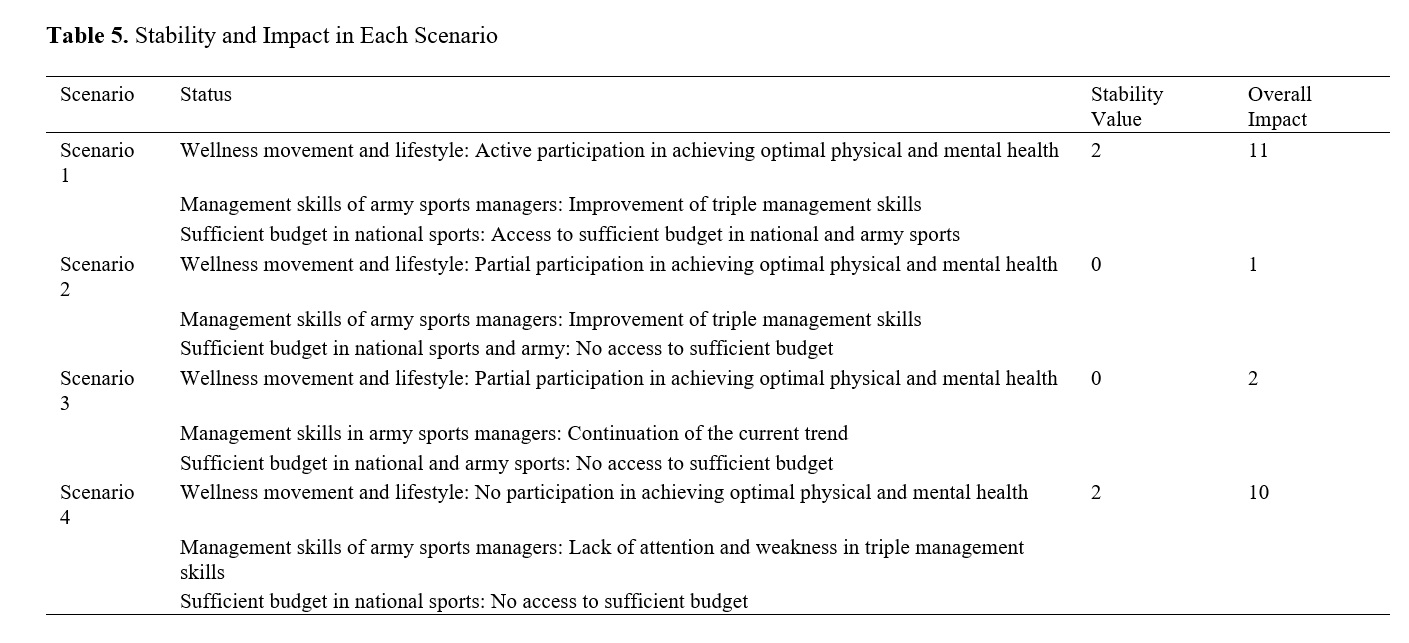
Results: According to the findings, 30 drivers were identified in six general categories: social, technological, environmental, economic, political, and value-based. Subsequently, considering three dimensions—critical uncertainty, the wellness movement and lifestyle, the management skills of army sports managers, and sufficient sports budget—four alternative future scenarios were created: Bright World (Green Land Scenario), the Land of Sports and Health Seekers, the Static Land, and the Desert Land.
Conclusion: According to the research results, in the policy-making for the development of sports and health in the Islamic Republic of Iran's Army, the drivers, particularly the strategic drivers of the wellness movement and lifestyle, the management skills of army sports managers, and a sufficient budget, should be taken into consideration for greater success in this field.
Downloads
References
1. Agostinelli PJ, Linder BA, Frick KA, Sefton JM. Anthropometrics Impact Army Combat Fitness Test Performance in Reserve Officer Training Corps Cadets. Military Medicine. 2022;189(3-4):661-7. [PMID: 35794778] [DOI]
2. Haskell WL. Physical activity, sport, and health: toward the next century. Research Quarterly for Exercise and Sport. 1996;67(sup3):S-37-S-47. [PMID: 8902907] [DOI]
3. Yagmaee F, Taheri M, Irandoust K, Mirmoezzi M. Lifestyle behaviors predict COVID-19 severity: a cross-sectional study. International Journal of Sport Studies for Health. 2023;6(2). [DOI]
4. Smith BJ, Tang KC, Nutbeam D. WHO health promotion glossary: new terms. Health promotion international. 2006;21(4):340-5. [PMID: 16963461] [DOI]
5. Bennett GG, Wolin KY, Puleo EM, Mâsse LC, Atienza AA. Awareness of national physical activity recommendations for health promotion among US adults. Medicine and science in sports and exercise. 2009;41(10):1849. [PMID: 19727030] [PMCID: PMC4286240] [DOI]
6. Walker SN, Sechrist KR, Pender NJ. Health promotion model-instruments to measure health promoting lifestyle: Health-promoting lifestyle profile [HPLP II](Adult version). 1995.
7. Karami E, Arabzadeh E, Shirvani H. The effect of four-weeks of CrossFit workouts on cardiovascular indicators and physical readiness in military forces. Comparative Exercise Physiology. 2024;20(2):183-91. [DOI]
Downloads
Additional Files
Publication Timeline
Issue
Section
License
Copyright (c) 2024 Mohammad Sadegh Karimzadeh, Mahdi Naderinasab, Morteza Taheri, Sied Abbas Biniyas (Author)

This work is licensed under a Creative Commons Attribution-NonCommercial 4.0 International License.