Investigating the Impact of Special Education Policies on the Psychological Well-Being of Exceptional Students
DOI:
https://doi.org/10.61838/kman.prien.3.2.1Keywords:
Special education policies, psychological well-being, exceptional students, inclusive education, policy implementation, emotional support, teacher training, parental advocacyAbstract
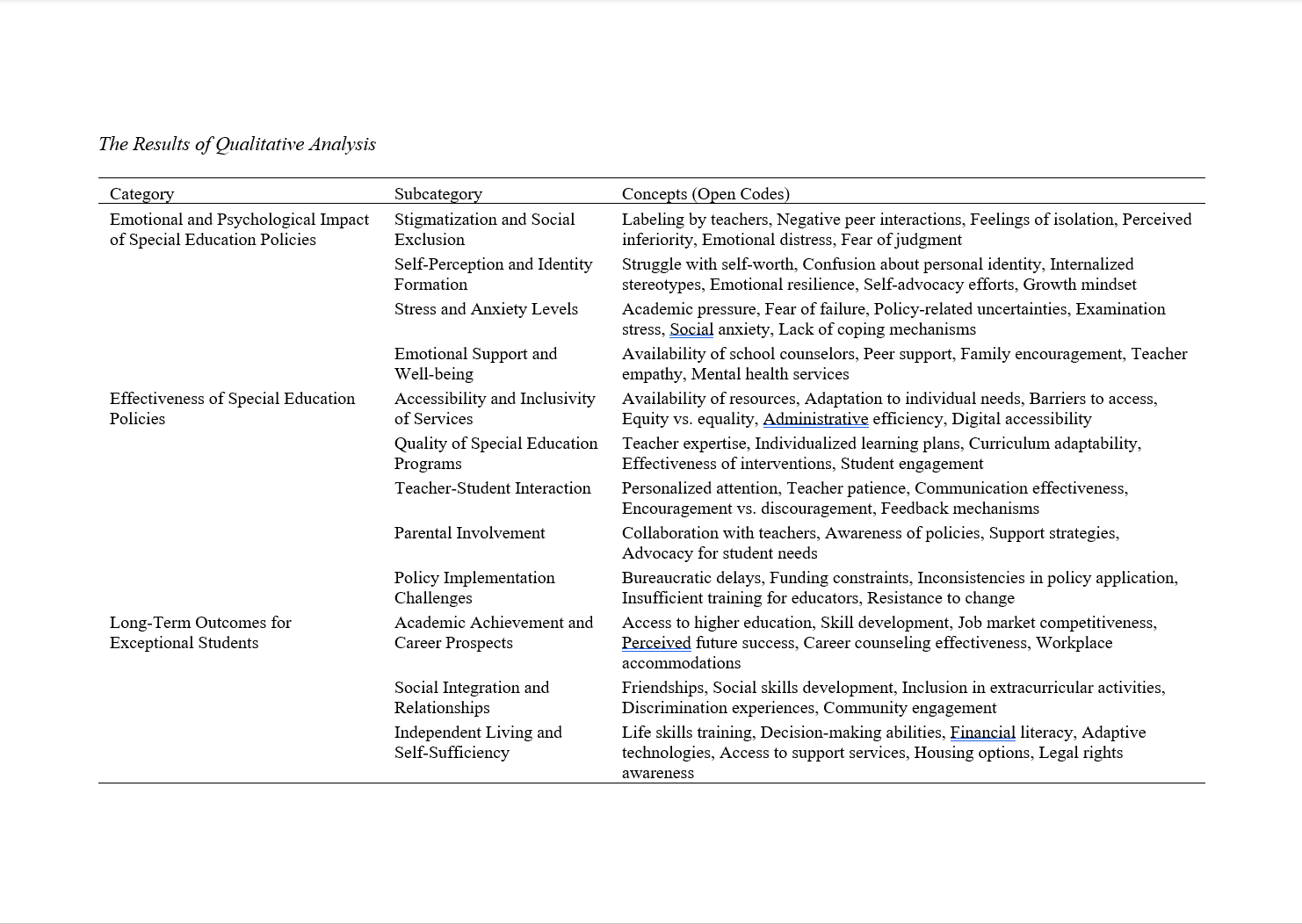
This study aimed to explore the impact of special education policies on the psychological well-being of exceptional students. This qualitative research employed a phenomenological approach, utilizing semi-structured interviews with 33 exceptional students recruited through online platforms. The study relied on theoretical saturation to determine the final sample size. Data were analyzed using thematic analysis with the support of NVivo software, following an inductive coding process to identify key themes related to emotional and psychological well-being, policy implementation, and future prospects of exceptional students. The results revealed three primary themes: emotional and psychological impacts, the effectiveness of special education policies, and long-term student outcomes. Participants reported experiences of stigmatization, social exclusion, and policy-related stress, which significantly affected their emotional well-being. While some students benefited from individualized education plans and supportive teacher interactions, others faced inconsistencies in policy implementation, leading to increased anxiety and uncertainty. The study also highlighted the crucial role of parental advocacy and teacher preparedness in ensuring the effectiveness of special education policies. Long-term concerns included access to higher education, career readiness, and independent living skills, with many participants expressing uncertainty about future accommodations and opportunities. The study underscores the critical influence of special education policies on the psychological well-being of exceptional students, emphasizing the need for stable, well-implemented policies, improved teacher training, and stronger parental engagement. Addressing inconsistencies in policy application and enhancing emotional support mechanisms within educational settings are essential steps toward fostering the well-being and long-term success of exceptional students.
Downloads
References
Aktürk, E. S., Yavuz, F. N., Unsal, H., & Şeker, E. D. (2023). Impact of Angle Malocclusions on Oral Health Related Quality of Life in Adolescents. Australasian Orthodontic Journal, 39(2), 194-199.https://doi.org/10.2478/aoj-2023-0038
Caingcoy, M., Empinado, J. C. T., Lambo, K. X. A., & Caingcoy,M. E. (2024). Status of the Children's Socio-Emotional WellBeing Before and During the Pandemic: A Scoping Review. International Journal of Business Law and Education, 5(2),1521-1528.https://doi.org/10.56442/ijble.v5i2.406
Chen, X. (2023). A Review on the Influence of Parental MetaEmotional Philosophy on Preschool Children's Emotion Regulation. Journal of Education Humanities and Social Sciences, 22, 632-639. https://doi.org/10.54097/ehss.v22i.13244
Dahiya, J., & Devi, R. (2024). Organizational Policies and Emotional Well-Being of Employees. 137-170.https://doi.org/10.4018/979-8-3693-6839-8.ch008
Du, Y. (2023). The Problem of Emotional Well-Being of Preschool Children in the Context of Child-Parent Relationships: Experience of Empirical Analysis. Scientific Research and Development Socio-Humanitarian Research and Technology,12(3), 113-118.https://doi.org/10.12737/2306-1731-2023-12-3-113-118
Glazzard, J. (2025). The Impact of Technology on Children's WellBeing. 29-45. https://doi.org/10.4324/9781041056881-4
Hébert, T. P.(2022). Supporting the Emotional Well-Being of Twice-Exceptional Students Using Literature.75-83.https://doi.org/10.1007/978-3-031-10378-0_6
Kılıç, C., Doğan, R. Y., & Metin, E. N. (2024). Exploring the Relationship Between Turkish Mothers’ Parenting and Psychological Well-Being in Early Childhood: The Role of Child Emotion Regulation and Dysregulation. Behavioral Sciences, 14(6), 426.https://doi.org/10.3390/bs14060426
Koenarso, D. A. P. (2024). Pengaruh Baby Blues Pada Interaksi Ibu Dan Kesejahteraan Emosional Anak. Muadalah, 12(2), 115-128.https://doi.org/10.18592/muadalah.v12i2.13974
Martin, G., Reilly, K., Everitt, H., & Gilliland, J. (2021). Review: The Impact of Climate Change Awareness on Children's Mental Well‐being and Negative Emotions – A Scoping Review. Child and Adolescent Mental Health, 27(1), 59-72.https://doi.org/10.1111/camh.12525
Okoye, F., & Mensah, P. A. (2021). Child Poverty and Food Scheme in Rural South African Schools: The Prospects and Limits Towards Improving the Emotional Well-Being of the Elementary School Students. International Journal of Scientific Research and Management, 9(08), 1852-1859.https://doi.org/10.18535/ijsrm/v9i08.el02
Papadopoulos, D. (2021). Parenting the Exceptional Social Emotional Needs of Gifted and Talented Children: What Do We Know? Children, 8(11), 953.https://doi.org/10.3390/children8110953
Parsons, S., Sullivan, A., Fitzsimons, E., & Ploubidis, G. B. (2021).The Role of Parental and Child Physical and Mental Health on Behavioural and Emotional Adjustment in Mid-Childhood: A Comparison of Two Generations of British Children Born 30 Years Apart. Longitudinal and Life Course Studies, 12(4),517-550.https://doi.org/10.1332/175795921x16115949616122
Rafiyya, A., Kraiwanit, T., Limna, P., Sonsuphap, R., Kasrisom,A., & Snongtaweeporn, T. (2024). Early Childhood SocialEmotional Development: An Impact on a Developing Country. International Journal of Evaluation and Research in Education (Ijere), 13(5), 3081.https://doi.org/10.11591/ijere.v13i5.29462
Redeş, A., & Roman, A. F. (2022). The Wellbeing Perception of Teachers and the Impact on Learning Process of Preschoolers.https://doi.org/10.15405/epes.22032.74
Sulaiman, S., Bakar, N. A., Wan Nor Azilawanie Tun, I., Pauzi, H.M., & Tuan Muhammad Zukri Tuan, S. (2023). Poverty and Well-Being: The Subjective Well-Being Status of Poor Children in Kuala Lumpur, Malaysia. Planning Malaysia, 21.https://doi.org/10.21837/pm.v21i30.1400
Terekhina, O. V., & Silaeva, D. V. (2023). Features of Social Development and Emotional Well-Being Among Preschool Children Conceived With Assisted Reproductive Technologies. Perspectives of Science and Education, 64(4),411-426.https://doi.org/10.32744/pse.2023.4.25
Trang, D. T., Anh, H. K., Thị, T. N., & Huy, T. Q. (2023). Impact of Emotional Intelligence on the Cognitive Subjective WellBeing of Vietnamese College Students. European Journal of Education and Pedagogy, 4(4), 40-46.https://doi.org/10.24018/ejedu.2023.4.4.708
Watson, P., & Osborne, A. (2025). Being a Military Child in Denmark: Young People’s Experiences of Living With a Parent With PTSD. PLOS Ment Health, 2(1), e0000144.https://doi.org/10.1371/journal.pmen.0000144
Wu, S. (2023). Critically Discuss the Importance of Play for Young Children’s Learning and Development. International Journal of New Developments in Education, 5(2).https://doi.org/10.25236/ijnde.2023.050205
Yob, F. S. C., Ghani, A. A. M., Pek, L. S., Ismail, M. R., Mee, R.W. M., Tazli, U. N. A., & Shahdan, T. S. T. (2022). V.U.C.A. And Sustainable Well-Being: Impact on B40 Children’s Socio-Emotional Development.https://doi.org/10.15405/epms.2022.10.17
Zatayumni, S. I., & Siregar, M. F. Z. (2024). Kesejahteraan Psikologis Anak Rantau: Pentingnya Peran Orang Tua Dalam Mendukung Melalui Teknologi Jarak Jauh. Ability Journal of Education and Social Analysis, 30-42.https://doi.org/10.51178/jesa.v5i2.2031
Downloads
Additional Files
Publication Timeline
Issue
Section
License

This work is licensed under a Creative Commons Attribution-NonCommercial 4.0 International License.