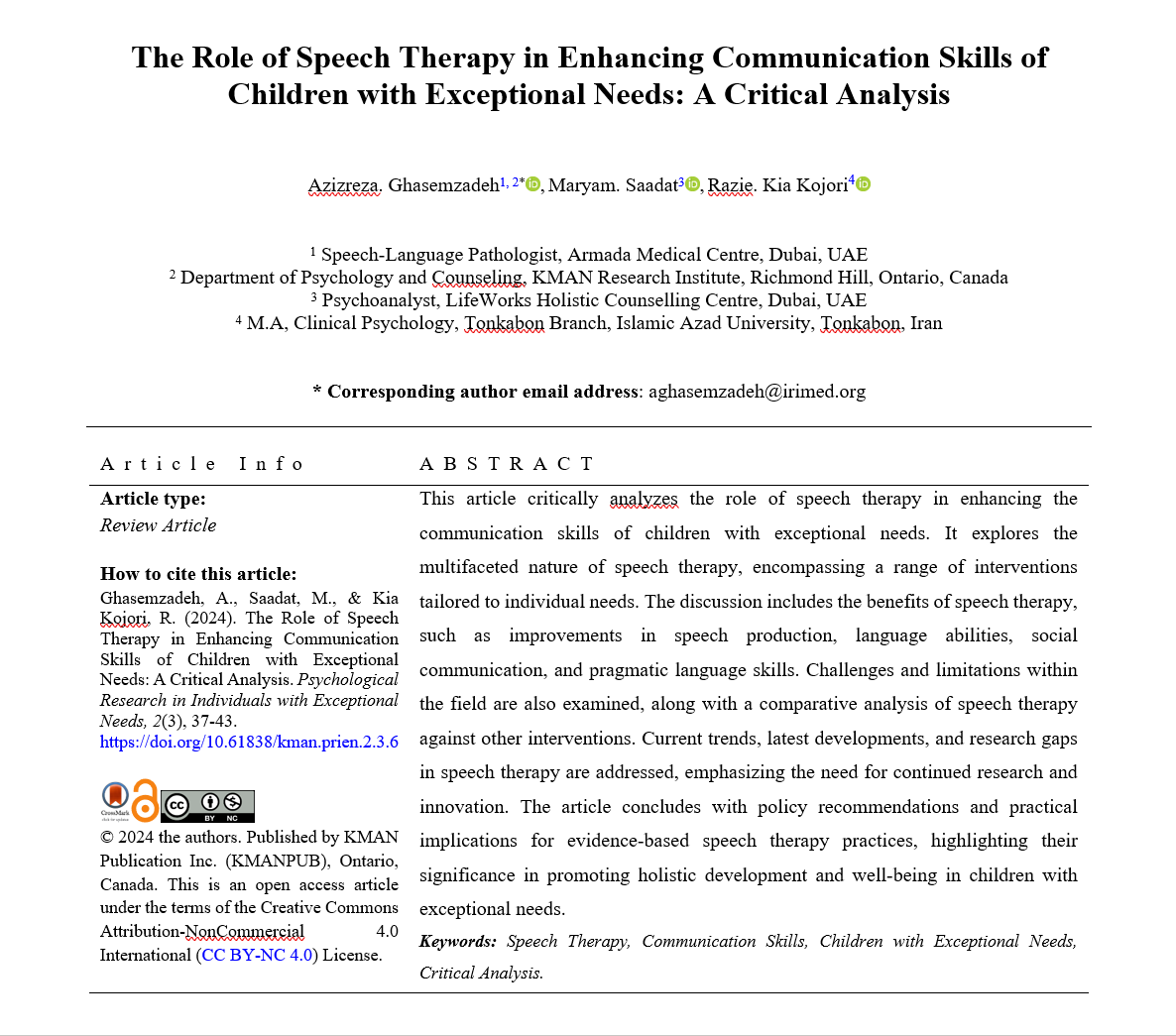
The Role of Speech Therapy in Enhancing Communication Skills of Children with Exceptional Needs: A Critical Analysis
DOI:
https://doi.org/10.61838/kman.prien.2.3.6Keywords:
Speech Therapy, Communication Skills, Children with Exceptional Needs, Critical AnalysisAbstract
This article critically analyzes the role of speech therapy in enhancing the communication skills of children with exceptional needs. It explores the multifaceted nature of speech therapy, encompassing a range of interventions tailored to individual needs. The discussion includes the benefits of speech therapy, such as improvements in speech production, language abilities, social communication, and pragmatic language skills. Challenges and limitations within the field are also examined, along with a comparative analysis of speech therapy against other interventions. Current trends, latest developments, and research gaps in speech therapy are addressed, emphasizing the need for continued research and innovation. The article concludes with policy recommendations and practical implications for evidence-based speech therapy practices, highlighting their significance in promoting holistic development and well-being in children with exceptional needs.
Keywords: Speech Therapy, Communication Skills, Children with Exceptional Needs, Critical Analysis.
Downloads
References
Adams, C., & Lloyd, J. (2007). The Effects of Speech and Language Therapy Intervention on Children With Pragmatic Language Impairments in Mainstream School. British Journal of Special Education. https://doi.org/10.1111/j.1467-8578.2007.00483.x
Alaluusua, S., Hölttä, E., Saarikko, A., Geneid, A., Leikola, J., & Heliövaara, A. (2022). Speech Symptoms of Velopharyngeal Insufficiency and the Incidence of Secondary Speech Surgery in 10-Year-Old Children With Unilateral Cleft Lip and Palate: Comparison of 2 Randomized Surgical Methods for Primary Palatal Surgery. Journal of Craniofacial Surgery.https://doi.org/10.1097/scs.0000000000008926
Allen, J., Cleland, J., & Smith, M. (2022). An Initial Framework for Use of Ultrasound by Speech and Language Therapists in the UK: Scope of Practice, Education and Governance. Ultrasound.https://doi.org/10.1177/1742271x221122562
Anghel, E. E., & Agheana, V. (2022). Improving Language Disorders in Children With Down Syndrome by Applying a Multimodal Intervention Program Structured in Accordance With the Theory of Multiple Intelligences. Review of Psychopedagogy.https://doi.org/10.56663/rop.v11i1.39
Aslanyan, A. A. (2023). The Implementation of Speech Therapy Services and Speech Disorders Assessment in Regional Psycho Pedagogical Support Centers. Armenian Journal of Special Education.https://doi.org/10.24234/se.v6i1.302
Bennett, T. D., Niedzwecki, C., Korgenski, E. K., & Bratton, S. L. (2013). Initiation of Physical, Occupational, and Speech Therapy In Children With Traumatic Brain Injury. Archives of Physical Medicine and Rehabilitation.https://doi.org/10.1016/j.apmr.2013.02.021
Bessell, A., Sell, D., Whiting, P., Roulstone, S., Albery, L., (2013). Speech and Language Therapy Interventions for Children With Cleft Palate: A Systematic Review. The Cleft Palate-Craniofacial Journal. https://doi.org/10.1597/11-202
Bruder, M. B., & Dunst, C. J. (2005). Personnel Preparation in Recommended Early Intervention Practices. Topics in Early Childhood Special Education.https://doi.org/10.1177/02711214050250010301
Cavaco, S., Guimarães, I., Ascensão, M., Abad, A., Anjos, I., Oliveira, F. R. d., Martins, S., Marques, N. C., Eskenazi, M., Magalhães, J., & Grilo, M. (2020). The BioVisualSpeech Corpus of Words With Sibilants for Speech Therapy Games Development.Information.https://doi.org/10.3390/info11100470
Detter-Biesl, D., & Schwartz, B. (2022). The ETKA Study - Impact of Early Therapy Termination on Treated Phonemes in Conversational Speech Tasks in Children Aged 5 to 6 Years With Phonologically Delayed Development: Protocol for a Multicenter Randomized Controlled Trial.https://doi.org/10.1101/2022.04.14.22273887
Douglas, S., & Gerde, H. K. (2019). A Strategy to Support the Communication of Students With Autism Spectrum Disorder. Intervention in School and Clinic.https://doi.org/10.1177/1053451219833021
Fama, M. E., Baron, C., Hatfield, B., & Turkeltaub, P. E. (2016). Group Therapy as a Social Context for Aphasia Recovery: A Pilot, Observational Study in an Acute Rehabilitation Hospital. Topics in Stroke Rehabilitation.https://doi.org/10.1080/10749357.2016.1155277
Gijsel, M., Bosman, A. M. T., & Verhoeven, L. (2006). Kindergarten Risk Factors, Cognitive Factors, and Teacher Judgments as Predictors of Early Reading in Dutch. Journal of Learning Disabilities.https://doi.org/10.1177/00222194060390060701
Glogowska, M., Roulstone, S., Enderby, P., & Peters, T. J. (2000). Randomised Controlled Trial of Community Based Speech and Language Therapy in Preschool Children. bmj.https://doi.org/10.1136/bmj.321.7266.923
Groß, W., Linden, U., & Ostermann, T. (2010). Effects of Music Therapy in the Treatment of Children With Delayed Speech Development - Results of a Pilot Study. BMC Complementary and Alternative Medicine.https://doi.org/10.1186/1472-6882-10-39
Hill, A., Davidson, B., & Theodoros, D. (2012). Reflections on Clinical Learning in Novice Speech–language Therapy Students. International Journal of Language & Communication Disorders. https://doi.org/10.1111/j.1460-6984.2012.00154.x
Jagoe, C., & Roseingrave, R. (2011). “If This Is What I’m ‘Meant to Be’…”: The Journeys of Students Participating in a Conversation Partner Scheme for People With Aphasia.Journal of Academic Ethics.https://doi.org/10.1007/s10805-011-9140-5
John, M. S., Reyk, O. v., Koolen, D. A., Vries, B. B. d., Amor, D. J., & Morgan, A. (2022). Expanding the Speech and Language Phenotype in Koolen-De Vries Syndrome: Late Onset and Periodic Stuttering a Novel Feature. European Journal of Human Genetics.https://doi.org/10.1038/s41431-022-01230-7
Lindsay, G. (2011). The Collection and Analysis of Data on Children With Speech, Language and Communication Needs:The Challenge to Education and Health Services. Child Language Teaching and Therapy.https://doi.org/10.1177/0265659010396608
Lindsay, G., Dockrell, J., Desforges, M., Law, J., & Peacey, N. (2010). Meeting the Needs of Children and Young People With Speech, Language and Communication Difficulties. International Journal of Language & Communication Disorders.https://doi.org/10.3109/13682820903165693
Mackenzie, C., Muir, M., & Allen, C. (2010). Non‐speech Oro‐motor Exercise Use in Acquired Dysarthria Management:Regimes and Rationales. International Journal of Language & Communication Disorders.https://doi.org/10.3109/13682820903470577
Markham, C., Laar, D. V., & Dean, T. (2011). Development of a Quality of Life Measure for Children and Young People With Speech, Language, and Communication Needs. EvidenceBased Communication Assessment and Intervention.https://doi.org/10.1080/17489539.2012.688342
Martins, S., & Cavaco, S. (2022). Customizable Serious Speech Therapy Games With Dynamic Difficulty Adjustment for Children With Sigmatism.https://doi.org/10.3233/shti220215
Miyamoto, R. T., Houston, D. M., & Bergeson, T. R. (2005). Cochlear Implantation in Deaf Infants. The Laryngoscope.https://doi.org/10.1097/01.mlg.0000172039.26650.9b
Monish, V., & Sreedevi, N. (2022). Speech and Swallowing Difficulties and Rehabilitation in Osmotic Demyelination Syndrome: A Single Case Report. Ip Journal of Otorhinolaryngology and Allied Science.https://doi.org/10.18231/j.ijoas.2021.031
Mytsyk, A., & Pryshliak, M. (2020). Telepractice in the System of Providing Correctional and Developmental Services to Children With Speech Disorders: Interaction at a Distance. Journal of History Culture and Art Research.https://doi.org/10.7596/taksad.v9i3.2674
Niratama, F., Wagino, W., Widajati, W., & Andajani, S. J. (2023). Development of Application for Early Intervention Speech Therapy in Children With Intellectual Disability. Journal of Icsar.https://doi.org/10.17977/um005v7i12023p30
Niyazova, A. Y., Mussagozhina, A. K., Kabdenova, A. B., Lukpanova, A. E., & Kozhakanova, M. T. (2018). Modeling Learning Situations of Verbal Communication in Professionallyoriented Teaching English for Students in the Sphere of Transport Logistics. Xlinguae.https://doi.org/10.18355/xl.2018.11.02.15
O'Neill, M., Henderson, M., Duffy, O., & Kernohan, G. (2019). The Emerging Contribution of Speech and Language Therapists in Awake Craniotomy: A National Survey of Their Roles, Practices and Perceptions. International Journal of Language & Communication Disorders.https://doi.org/10.1111/1460-6984.12510
Pennington, L., Smallman, C., & Farrier, F. (2006). Intensive Dysarthria Therapy for Older Children With Cerebral Palsy: Findings From Six Cases. Child Language Teaching and Therapy.https://doi.org/10.1191/0265659006ct307xx
Qiu, L., & Abdullah, S. (2021). Voice Assistants for Speech Therapy.https://doi.org/10.1145/3460418.3479336
Semansky, R. M., Xie, M., Lawer, L., & Mandell, D. S. (2013). How States Use Medicaid to Fund Community-Based Services to Children With Autism Spectrum Disorders. Psychiatric Services.https://doi.org/10.1176/appi.ps.201200390
Sobaniec, P., Szukiel, B., Batruch, E., Kruk, U., & Lotowska, J. M. (2017). Impact of Multidisciplinary Therapy on the Functioning of Children With Autism. Results of the "Supporting the Development of Children With Autism" Project Using the ATEC Form. Child Neurology.https://doi.org/10.20966/chn.2017.53.408
Stackhouse, J., Wells, B., Pascoe, M., & Rees, R. (2002). From Phonological Therapy to Phonological Awareness. Seminars in Speech and Language. https://doi.org/10.1055/s-2002-23509
Sumastri, H., & Pastari, M. (2022). The Effectiveness of the Combination of Play Therapy and Speech Therapy on the Behavioral Development of Children With Autism Spectrum Disorder (ASD). Eduvest - Journal of Universal Studies.https://doi.org/10.36418/eduvest.v2i9.573
Terband, H., Coppens-Hofman, M. C., Reffeltrath, M., & Maassen, B. (2017). Effectiveness of Speech Therapy in Adults With Intellectual Disabilities. Journal of Applied Research in Intellectual Disabilities.https://doi.org/10.1111/jar.12384
Theodoros, D. (2008). Telerehabilitation for Service Delivery in Speech-Language Pathology. Journal of Telemedicine and Telecare.https://doi.org/10.1258/jtt.2007.007044
Thomas‐Stonell, N., Washington, K. N., Oddson, B., Robertson, B., & Rosenbaum, P. (2013). Measuring Communicative Participation Using the FOCUS©: Focus on the Outcomes of CUnderSix. Child Care Health and Development.https://doi.org/10.1111/cch.12049
Wallace, T., & Bradshaw, A. (2011). Technologies and Strategies for People With Communication Problems Following Brain Injury or Stroke. NeuroRehabilitation.https://doi.org/10.3233/nre-2011-0649
Downloads
Additional Files
Publication Timeline
Issue
Section
License

This work is licensed under a Creative Commons Attribution-NonCommercial 4.0 International License.