Aerobic Interval Training and Probiotic Supplementation Modulate Intrinsic Apoptosis-Related Gene Expression in the Myocardium of Rats with Myocardial Infarction
DOI:
https://doi.org/10.61838/Keywords:
myocardial infarction; aerobic interval training; probiotic; intrinsic apoptosis; Bax/Bcl2 ratio; Wistar ratAbstract
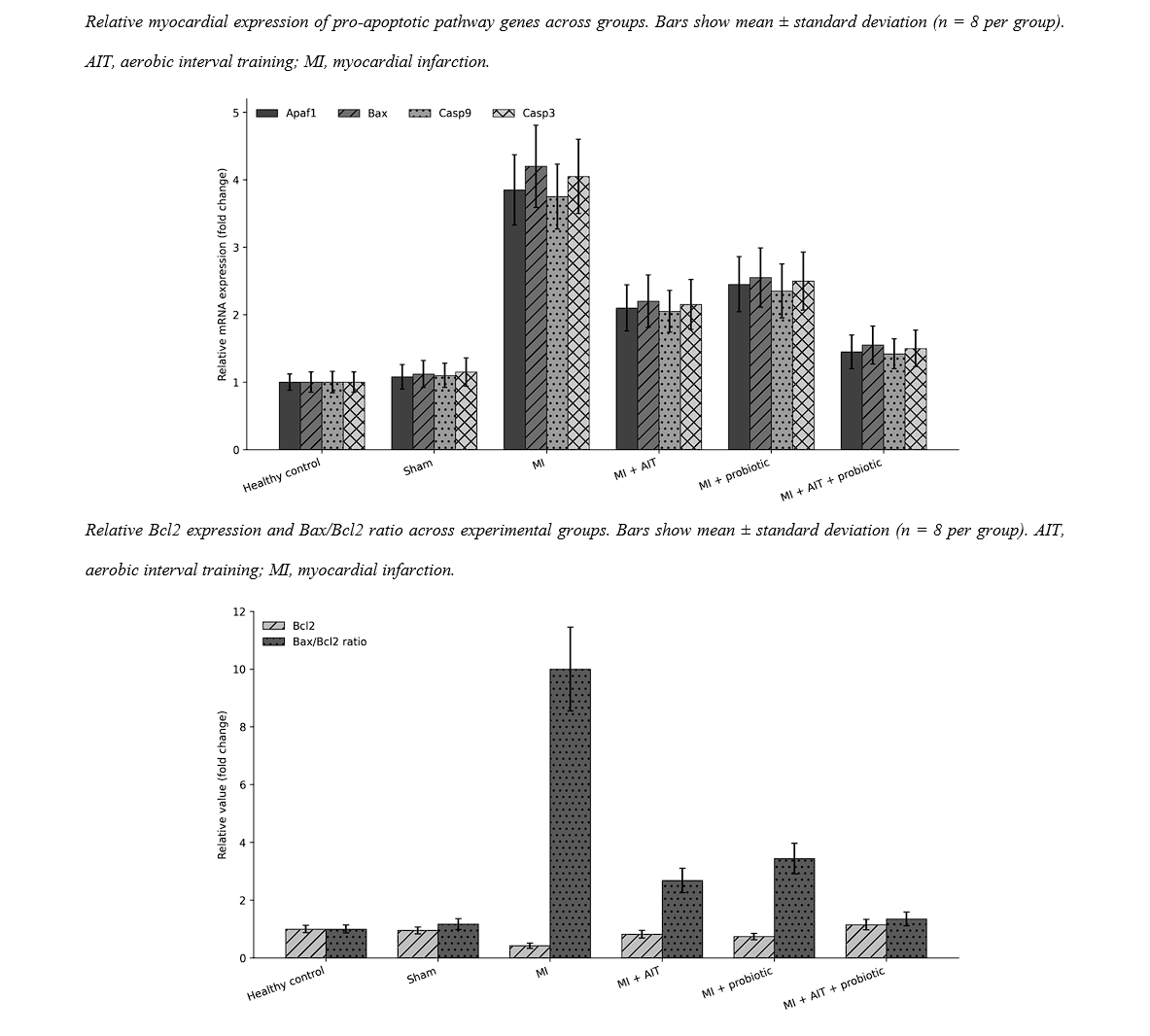
Myocardial infarction (MI) promotes mitochondrial dysfunction, oxidative stress, and cardiomyocyte loss, partly through activation of the intrinsic apoptotic pathway. Exercise training and probiotics may each influence these processes, but evidence concerning their combined effects is limited. This controlled animal study examined the effects of aerobic interval training (AIT), Lactobacillus acidophilus supplementation, and their combination on myocardial expression of Apaf1, Bax, Bcl2, Casp9, and Casp3 and on the Bax/Bcl2 expression ratio. Forty-eight male Wistar rats (250 ± 30 g) were allocated to six groups (n = 8 each): healthy control, sham surgery, MI, MI + AIT, MI + probiotic, and MI + AIT + probiotic. MI was induced by permanent ligation of the left anterior descending coronary artery. The interventions continued for 10 weeks; AIT was performed five sessions per week, and the probiotic was administered daily at 10^9 colony-forming units/mL. Left ventricular tissue was collected 48 h after the final intervention. Relative mRNA expression was quantified by real-time polymerase chain reaction and analyzed using one-way analysis of variance followed by Tukey testing. Significant group effects were detected for all outcomes (P < 0.001; η² = 0.79–0.89). Compared with healthy controls, MI increased Apaf1, Bax, Casp9, and Casp3 expression, reduced Bcl2 expression, and markedly increased the Bax/Bcl2 ratio. Both interventions attenuated these changes. The combined intervention produced the values closest to control levels, reducing Apaf1, Bax, Casp9, Casp3, and the Bax/Bcl2 ratio by approximately 62%, 63%, 62%, 63%, and 87%, respectively, relative to untreated MI, while increasing Bcl2 expression. These findings indicate that AIT and probiotic supplementation, particularly when combined, are associated with a less pro-apoptotic myocardial gene-expression profile after experimental MI. Because only mRNA outcomes were assessed, protein-level, functional, and clinical confirmation is required.
Downloads
References
Asgharpour-Arshad, M., Siahkouhian, M., Bolboli, L., Jafari, A., & Sheikhzadeh-Hesari, F. (2017). Effects of three months of aerobic interval training on the expression of selected mitochondrial apoptosis-pathway genes in rat skeletal muscle. Applied Exercise Physiology Research, 13(25), 211–221. [In Persian]
Baldi, A., Abbate, A., Bussani, R., Patti, G., Melfi, R., Angelini, A., & Di Sciascio, G. (2002). Apoptosis and post-infarction left ventricular remodeling. Journal of Molecular and Cellular Cardiology, 34(2), 165–174.
Bonab, S. F., Tahmasebi, S., Ghafouri-Fard, S., & Eslami, S. (2025). Preventive impact of probiotic supplements on heart injury and inflammatory indices in a rat model of myocardial infarction: Histopathological and gene expression evaluation. APMIS, 133(1), e13479.
Chen, X., Zou, X., Zhou, Y., Peng, C., & Huang, R. (2025). The role of gut microbiota in myocardial ischemia–reperfusion injury. Frontiers in Cardiovascular Medicine, 12, 1625299.
Elmore, S. (2007). Apoptosis: A review of programmed cell death. Toxicologic Pathology, 35(4), 495–516. https://doi.org/10.1080/01926230701320337
Ghahremani, M., Azarbayjani, M. A., Peeri, M., & Raoofi, A. (2017). Effect of aerobic interval-training intensity on Bcl2 and Bax gene expression in rats with myocardial infarction. Armaghane Danesh, 22(6), 781–791. [In Persian]
Jiang, H. K., Wang, Y. H., Sun, L., He, X., Zhao, M., Feng, Z. H., & Zang, W. J. (2014). Aerobic interval training attenuates mitochondrial dysfunction in rats post-myocardial infarction: Roles of mitochondrial network dynamics. International Journal of Molecular Sciences, 15(4), 5304–5322. https://doi.org/10.3390/ijms15045304
Kordi, N., Azizi, M., Samadi, M., & Tahmasbi, V. (2023). Effect of aerobic training on selected pro- and anti-apoptotic myocardial genes in rats after methamphetamine withdrawal. Sport and Biokinetic Sciences, 15(30), 1–10. [In Persian]
Kunapuli, S., Rosanio, S., & Schwarz, E. R. (2006). How do cardiomyocytes die? Apoptosis and autophagic cell death in cardiac myocytes. Journal of Cardiac Failure, 12(5), 381–391.
Liang, Y., Zhao, L., Zhang, X., Liu, S., Lu, P., Wang, J., & Gao, J. (2025). Lactobacillus ameliorates myocardial ischemia–reperfusion injury by attenuating apoptosis, inflammation, oxidative stress, and ferroptosis. BMC Medicine, 23(1), 377. https://doi.org/10.1186/s12916-025-04203-x
Lossi, L. (2022). The concept of intrinsic versus extrinsic apoptosis. Biochemical Journal, 479(3), 357–384.
Lu, K., Wang, L., Wang, C., Yang, Y., Hu, D., & Ding, R. (2015). Effects of high-intensity interval versus continuous moderate-intensity aerobic exercise on apoptosis, oxidative stress, and metabolism of the infarcted myocardium in a rat model. Molecular Medicine Reports, 12(2), 2374–2382.
Maherinia, H., Peeri, M., Azarbayjani, M. A., & Delfan, M. (2022). Aerobic exercise training combined with probiotic supplementation improves antioxidant defense of cardiomyocytes by regulating Nrf2 and caspase-3 gene expression in type 2 diabetic rats. Comparative Exercise Physiology, 18(3), 255–264.
National Research Council. (2011). Guide for the Care and Use of Laboratory Animals (8th ed.). National Academies Press. https://doi.org/10.17226/12910
Percie du Sert, N., Hurst, V., Ahluwalia, A., Alam, S., Avey, M. T., Baker, M., Browne, W. J., Clark, A., Cuthill, I. C., Dirnagl, U., Emerson, M., Garner, P., Holgate, S. T., Howells, D. W., Karp, N. A., Lazic, S. E., Lidster, K., MacCallum, C. J., Macleod, M., Pearl, E. J., Petersen, O. H., Rawle, F., Reynolds, P., Rooney, K., Sena, E. S., Silberberg, S. D., Steckler, T., & Würbel, H. (2020). The ARRIVE guidelines 2.0: Updated guidelines for reporting animal research. PLOS Biology, 18(7), e3000410. https://doi.org/10.1371/journal.pbio.3000410
Sahoo, G., Samal, D., Khandayataray, P., & Murthy, M. K. (2023). A review on caspases: Key regulators of biological activities and apoptosis. Molecular Neurobiology, 60(10), 5805–5837.
Soori, R., Zare-Shahneh, M., Choobineh, S., & Ramezankhani, A. (2018). Effect of high-intensity interval training on pro- and anti-apoptotic gene expression in cardiac tissue of aged male C57BL/6 mice. Journal of Exercise Physiology and Physical Activity, 11(2), 13–24. [In Persian]
Downloads
Publication Timeline
- Submitted
- Revised
- Accepted